Paper I — Q2
(a) Describe the diversity in the disciplinary thoughts with special reference to structuralism, functionalism and behaviourism…
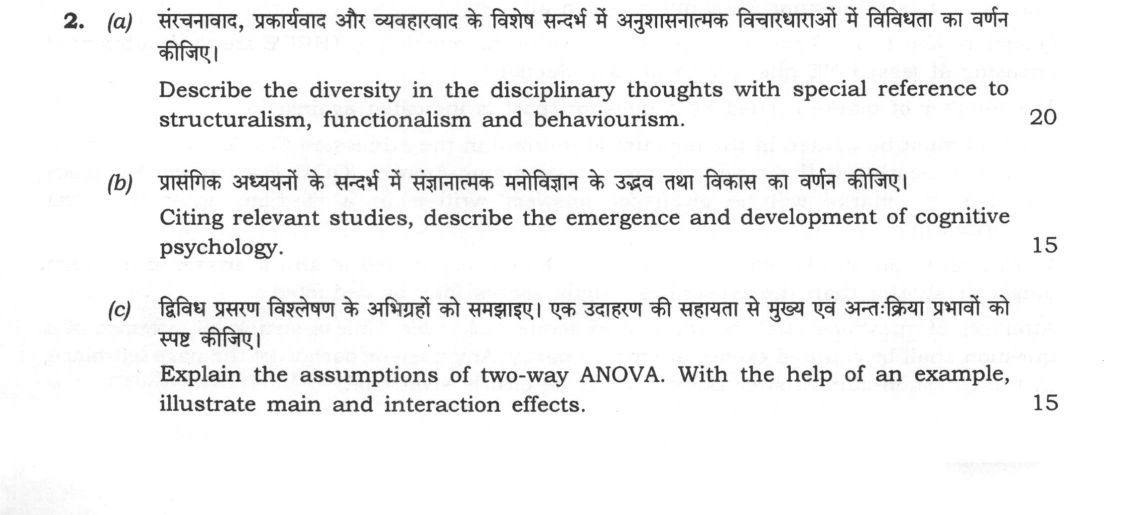
Describe the diversity in the disciplinary thoughts with special reference to structuralism, functionalism and behaviourism. 20 marks
Citing relevant studies, describe the emergence and development of cognitive psychology. 15 marks
Explain the assumptions of two-way ANOVA. With the help of an example, illustrate main and interaction effects. 15 marks
हिंदी में प्रश्न पढ़ें
संरचनावाद, प्रकार्यवाद और व्यवहारवाद के विशेष संदर्भ में अनुशासनात्मक विचारधाराओं में विविधता का वर्णन कीजिए। (20 अंक)
प्रासंगिक अध्ययनों के संदर्भ में संज्ञानात्मक मनोविज्ञान के उद्भव तथा विकास का वर्णन कीजिए। (15 अंक)
द्विविध प्रसरण विश्लेषण के अभिग्रहों को समझाइए। एक उदाहरण की सहायता से मुख्य एवं अंतःक्रिया प्रभावों को स्पष्ट कीजिए। (15 अंक)
Model answer
Written by UPSC Answer Check against this question's marking rubric, to the expected length. UPSC does not publish answers for Mains — this is one way to score well, not an official key.
Diversity in Disciplinary Thoughts
The evolution of psychological science reflects distinct epistemological paradigms regarding the subject matter and methods of inquiry. Structuralism, established by Wilhelm Wundt and formalized by Edward Titchener, adopted an elementalist framework. It sought to deconstruct conscious experience into basic components—sensations, images, and affective states—using trained, systematic introspection under controlled laboratory conditions.
Functionalism, developed by William James and John Dewey, arose as an evolutionary critique of structuralism's static atomism. James posited consciousness as a continuous, dynamic stream whose primary value lies in its adaptive utility for survival. Dewey extended this functional stance to the reflex arc concept, arguing that psychological activity must be viewed as an integrated, goal-directed coordination rather than discrete, artificial stimulus-response components.
Behaviourism, inaugurated by J. B. Watson’s 1913 manifesto and advanced by B. F. Skinner’s radical behaviourism, represented an ontological rupture by rejecting mentalism and introspection entirely. Watson redefined psychology as the purely objective, empirical science of observable behavior, aiming for the prediction and control of stimulus-response (S-R) relationships. Skinner elaborated this framework through operant conditioning, functional analyses, and reinforcement schedules. These three schools embody fundamentally contrasting epistemological stances: structuralism sought elemental conscious analysis, functionalism examined adaptive utility, and behaviourism enforced objective behavioural control.
Emergence and Development of Cognitive Psychology
Cognitive psychology developed during the mid-20th century as behaviourism proved inadequate to explain complex human phenomena such as language, problem-solving, and attention. The cognitive revolution was catalyzed by Noam Chomsky’s (1959) critique of Skinner’s Verbal Behavior, which proved that internal syntactic mechanisms are necessary to account for linguistic generativity. Simultaneously, Claude Shannon’s information theory and the rise of digital computing provided the information-processing metaphor, framing the mind as an active computational system manipulating symbolic representations.
Landmark empirical studies established the field's foundation. George Miller (1956) demonstrated capacity constraints on immediate memory through his formulation of the "magical number seven, plus or minus two" and the process of chunking. Donald Broadbent (1958) introduced the filter model of selective attention using dichotic listening tasks. Ulric Neisser codified the discipline with his 1967 text Cognitive Psychology. Subsequent structural formulations included Atkinson and Shiffrin’s (1968) multi-store memory model and Daniel Kahneman and Amos Tversky’s empirical work on heuristics and cognitive biases in decision-making. In India, cognitive frameworks were integrated into clinical and empirical research through neurocognitive profiling at the National Institute of Mental Health and Neurosciences (NIMHANS), Bengaluru, alongside R. C. Mishra’s research on the influence of eco-cultural contexts on cognitive development and spatial processing.
Two-Way ANOVA: Assumptions and Illustration
A two-way Analysis of Variance (ANOVA) evaluates the simultaneous effects of two categorical independent variables (factors) and their interaction on a single continuous dependent variable. The mathematical model relies on four core assumptions: the dependent variable is measured on an interval or ratio scale; observations are independent across and within groups; the dependent variable is normally distributed within each treatment population; and the variances across all treatment combinations are equal (homoscedasticity).
Consider a 2×2 factorial design examining Teaching Method (Factor A: Traditional vs. Interactive) and Student Gender (Factor B: Male vs. Female) on Examination Score (DV, scale 0–100):
Under the Traditional Method, Male Mean = 60 and Female Mean = 60 (Row Mean = 60). Under the Interactive Method, Male Mean = 70 and Female Mean = 90 (Row Mean = 80). The resulting Column Means are Male = 65 and Female = 75, with an overall Grand Mean of 70.
A main effect represents the direct impact of one factor collapsed across all levels of the other. Factor A shows a main effect of Method, as the Interactive method outperforms the Traditional method (80 vs. 60). Factor B shows a main effect of Gender, as female students achieve higher overall scores than male students (75 vs. 65). An interaction effect occurs when the effect of one factor depends on the specific level of the second factor. In this scenario, the Interactive method produces a modest +10 point gain for males (70 vs. 60) but a substantial +30 point gain for females (90 vs. 60). This non-parallel pattern indicates an ordinal interaction, demonstrating that pedagogical efficacy is contingent upon gender.
Modern cognitive psychology resolved the historic tensions among structuralism, functionalism, and behaviourism by combining the study of internal representations with rigorous, objective experimental methodologies.
What "Describe" is asking you to do
Give a full, ordered account of the thing named — its parts, stages or mechanism — in the sequence in which it actually exists or occurs. Most describe questions come from the science optionals, where the marks sit in correct technical detail and, where the stem says so, a labelled diagram.
Structure that answers it
One-line identification of the subject → the parts or stages in their real order, each with its defining detail → labelled diagram where the subject is structural → closing line on function or significance
Where marks are lost
Loose general prose where the examiner is ticking named parts, correct terminology and their sequence; and in the General Studies papers, turning to evaluation before the description is finished.
How this answer will be evaluated
Approach
(a) describe: define > structure or process in order > labelled diagram > significance | (b) describe: define > structure or process in order > labelled diagram > significance | (c) explain: definition/context > points in order > small example > short close Full marks: Comprehensive, accurate, and well-structured answers with specific examples and citations.
Key points expected
- Define structuralism, functionalism, and behaviourism
- Contrast their core tenets (e.g., introspection vs. function vs. observable behavior)
- Identify key figures (Wundt, James, Watson)
- Explain the shift from one school to the next
- Identify the 'cognitive revolution' as the starting point
- Cite specific studies (e.g., Miller's 'Magical Number Seven')
- Mention key figures (Neisser, Chomsky, Broadbent)
- Explain the shift from behaviourism to internal mental processes
Evaluation rubric
Each sub-part is marked on its own, against the marks and word limit printed on the paper.
- (a) Define and contrast structuralism, functionalism, and behaviourism to show disciplinary diversity. 20 marks
describe— define → structure or process in order → labelled diagram → significance
Must cover
- Define structuralism, functionalism, and behaviourism
- Contrast their core tenets (e.g., introspection vs. function vs. observable behavior)
- Identify key figures (Wundt, James, Watson)
- Explain the shift from one school to the next
Loses marks
- Confusing structuralism with functionalism
- Ignoring the 'diversity' aspect (treating them as identical)
- Lack of specific names or dates
Earns more
- Mention specific methods (e.g., Titchener's introspection, Watson's conditioning)
- Discuss the role of the environment in functionalism
- Reference the 'stimulus-response' paradigm in behaviourism
- Briefly mention the limitations of each school
Extra mark
- Reference specific experiments (e.g., Little Albert)
- Mention specific journals or institutions associated with each
- (b) Trace the emergence of cognitive psychology by citing relevant studies and developmental milestones. 15 marks
describe— define → structure or process in order → labelled diagram → significance
Must cover
- Identify the 'cognitive revolution' as the starting point
- Cite specific studies (e.g., Miller's 'Magical Number Seven')
- Mention key figures (Neisser, Chomsky, Broadbent)
- Explain the shift from behaviourism to internal mental processes
Loses marks
- Failing to cite specific studies as requested
- Treating cognitive psychology as a static field rather than a development
- Ignoring the 'emergence' aspect
Earns more
- Reference the 'black box' metaphor
- Mention the influence of computer science (information processing)
- Discuss the role of linguistics (Chomsky's critique of Skinner)
- Mention the publication of Neisser's 'Cognitive Psychology' (1967)
Extra mark
- Reference specific dates of key publications
- Mention specific cognitive models (e.g., Atkinson-Shiffrin)
- (c) Explain the assumptions of two-way ANOVA and illustrate main and interaction effects with an example. 15 marks
explain— definition/context → points in order → small example → short close
Must cover
- List the assumptions of two-way ANOVA (normality, homogeneity of variance, independence)
- Define main effects in the context of two independent variables
- Define interaction effects
- Provide a clear example illustrating both main and interaction effects
Loses marks
- Confusing one-way and two-way ANOVA
- Failing to provide an example as requested
- Incorrectly defining interaction effects
Earns more
- Use a specific, relatable example (e.g., drug dosage and time of day)
- Explain the logic of partitioning variance
- Mention the F-ratio
- Briefly explain the difference between fixed and random factors
Extra mark
- Include a simple diagram of interaction effects
- Mention specific software used for ANOVA
Practice this exact question
Write your answer and it is marked point by point against the model answer above — what you covered, what you missed, what you got wrong.
Evaluate my answer →More from Psychology 2024 Paper I
- Q1 Answer the following questions in about 150 words each: (a) What makes psychology a scien…
- Q2 (a) Describe the diversity in the disciplinary thoughts with special reference to structu…
- Q3 (a) Discuss the signal detection theory (SDT) with reference to perceptual vigilance task…
- Q4 (a) Differentiate between classical and operant conditioning. Discuss their applications…
- Q5 Answer the following questions in about 150 words each: (a) Citing research evidence, exp…