Paper I — Q4
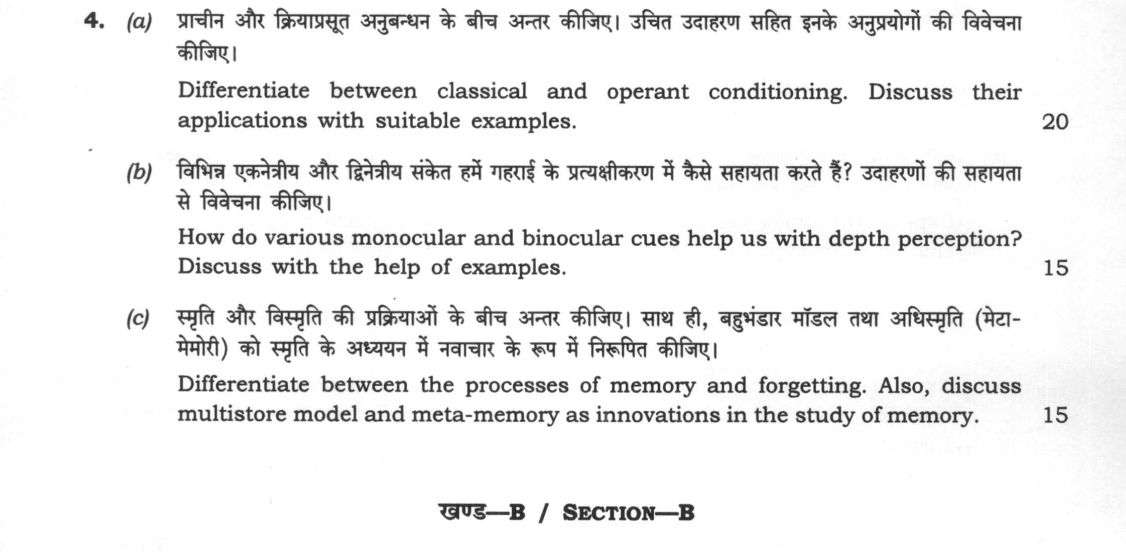
(a) Differentiate between classical and operant conditioning. Discuss their applications with suitable examples. (20 marks) (b)…
Differentiate between classical and operant conditioning. Discuss their applications with suitable examples. 20 marks
How do various monocular and binocular cues help us with depth perception? Discuss with the help of examples. 15 marks
Differentiate between the processes of memory and forgetting. Also, discuss multistore model and meta-memory as innovations in the study of memory. 15 marks
हिंदी में प्रश्न पढ़ें
प्राचीन और क्रियाप्रसूत अनुबंधन के बीच अंतर कीजिए। उचित उदाहरण सहित इनके अनुप्रयोगों की विवेचना कीजिए। (20 अंक)
विभिन्न एकनेत्रीय और द्विनेत्रीय संकेत हमें गहराई के प्रत्यक्षीकरण में कैसे सहायता करते हैं? उदाहरणों की सहायता से विवेचना कीजिए। (15 अंक)
स्मृति और विस्मृति की प्रक्रियाओं के बीच अंतर कीजिए। साथ ही, बहुभंडार मॉडल तथा अधिस्मृति (मेटा-मेमोरी) को स्मृति के अध्ययन में नवाचार के रूप में निरूपित कीजिए। (15 अंक)
Model answer
Written by UPSC Answer Check against this question's marking rubric, to the expected length. UPSC does not publish answers for Mains — this is one way to score well, not an official key.
Learning, perception and memory are basic cognitive processes that support adaptive behaviour.
Classical and operant conditioning. Classical conditioning, described by Pavlov, is learning by association between two stimuli: a neutral stimulus becomes a conditioned stimulus (CS) after pairing with an unconditioned stimulus (US), eliciting a conditioned response (CR). Its mechanism is S-S*, the response is involuntary, and it is elicited by a CS that has preceded the US. Pavlov’s dog salivating to a bell illustrates this. Operant conditioning, described by Skinner, is learning by consequences: a voluntary emitted response is strengthened or weakened by reinforcement or punishment. Its mechanism is R-S*, the response is voluntary, and it follows an antecedent stimulus and is followed by a consequence. Skinner’s box, where a rat presses a lever for food, illustrates this. Thus, classical conditioning changes stimulus-stimulus associations for elicited behaviour, while operant conditioning changes response-stimulus associations for emitted behaviour. Applications differ. Systematic desensitisation for anxiety disorders and aversion therapy for alcohol or substance dependence use classical principles by pairing feared or unwanted cues with relaxation or nausea. In India, systematic desensitisation has been used for classroom phobia and school avoidance, and NIMHANS, Bengaluru, provides behaviour therapy for anxiety and substance abuse in clinical settings. Operant principles are used in behaviour modification for autism, token economies in psychiatric rehabilitation, and biofeedback training, which uses contingent feedback to regulate physiological responses. Indian psychiatric rehabilitation programmes have used token economies to shape attendance, hygiene and social skills.
Depth perception. Depth perception relies on monocular and binocular cues. Monocular cues work with one eye: linear perspective, where parallel lines appear to converge; texture gradient, where surface detail becomes finer with distance; relative size, where smaller retinal images are judged farther; interposition, where one object blocks another; aerial perspective, where distant objects appear hazier and bluer; and motion parallax, where nearer objects shift more across the retina during head or body movement. Binocular cues require both eyes: retinal disparity, the difference between the two retinal images, and convergence, the inward turning of the eyes for near objects. These cues support driving, sports, threading a needle, and artisanal craft such as pottery or woodwork, where accurate depth judgments are essential. Neurologically, retinal disparity is processed in visual cortical areas, and stereopsis matures during infancy and early childhood. Cross-cultural work, including Segall et al.’s carpentered-world hypothesis, suggests that exposure to rectilinear built environments may increase reliance on pictorial cues; Indian tribal and urban comparisons have examined variation in cue use, linked to environmental exposure rather than innate ability.
Memory and forgetting. Memory is a constructive process involving encoding, storage and retrieval, while forgetting is the failure or degradation of one or more of these stages. Forgetting may arise from decay, interference, motivated forgetting, or retrieval failure due to poor cues or context. The multistore model of Atkinson and Shiffrin describes sensory memory, short-term memory and long-term memory, linked by control processes such as attention and rehearsal. It identifies duration and capacity limits, such as short-term memory holding about 7 ± 2 items, but it is limited because it treats stores as fixed boxes and underplays active construction, working memory and retrieval cues. Metamemory, studied by Flavell, is knowledge about one’s own memory: knowledge of person, strategies and phenomena, including feeling-of-knowing judgments. It helps learners plan, monitor and control study, and metamemory training can improve recall in students and older adults. Indian relevance includes NCERT’s educational psychology materials and classroom memory-training studies, the yoga-psychological concept of smriti as recollection, and contemporary research from NIMHANS on cognitive ageing. Together, these processes show that learning, perception and memory are coordinated systems that support adaptive behaviour.
What "Differentiate" is asking you to do
Fix the criteria on which the two differ and apply each criterion to both, so the pair can no longer be mixed up. Differentiate stems usually carry a further task attached — describe the mechanism, set out the principles, discuss the applications — and that task carries its own marks.
Structure that answers it
Criterion 1 applied to both → criterion 2 → criterion 3 → summary line or table → the attached second demand answered in full
Where marks are lost
Two standalone definitions placed side by side, leaving the reader to extract the difference. The second common loss is running out of space before the attached task, which is often worth as much as the differentiation.
How this answer will be evaluated
Approach
Framework: Classical vs Operant Conditioning; Monocular/Binocular Cues; Memory Models. (a) compare: paired headings or table > key differences > significance > conclusion | (b) explain: definition/context > points in order > small example > short close | (c) compare: paired headings or table > key differences > significance > conclusion Full marks: Comprehensive differentiation, clear examples, and critical evaluation of models.
Key points expected
- Define classical conditioning (Pavlov) and operant conditioning (Skinner).
- Tabulate key differences: stimulus-response vs response-consequence.
- Provide suitable examples for each type of conditioning.
- Discuss practical applications in education or therapy.
- Define depth perception and its importance.
- List and explain monocular cues (e.g., perspective, occlusion).
- List and explain binocular cues (e.g., retinal disparity, convergence).
- Provide examples illustrating how these cues work.
Evaluation rubric
Each sub-part is marked on its own, against the marks and word limit printed on the paper.
- (a) Differentiate classical and operant conditioning and discuss their applications with examples. 20 marks
compare— paired headings or table → key differences → significance → conclusion
Must cover
- Define classical conditioning (Pavlov) and operant conditioning (Skinner).
- Tabulate key differences: stimulus-response vs response-consequence.
- Provide suitable examples for each type of conditioning.
- Discuss practical applications in education or therapy.
Loses marks
- Confusing the roles of stimulus and response.
- Providing only definitions without applications.
Earns more
- Mention specific experiments (e.g., Little Albert, Skinner Box).
- Reference specific therapeutic applications (e.g., Systematic Desensitization).
Extra mark
- Diagram of the conditioning process (US, UR, CS, CR).
- (b) Explain how monocular and binocular cues aid depth perception with examples. 15 marks
explain— definition/context → points in order → small example → short close
Must cover
- Define depth perception and its importance.
- List and explain monocular cues (e.g., perspective, occlusion).
- List and explain binocular cues (e.g., retinal disparity, convergence).
- Provide examples illustrating how these cues work.
Loses marks
- Failing to distinguish between monocular and binocular cues.
- Listing cues without explaining their mechanism.
Earns more
- Mention specific visual illusions related to depth cues.
- Reference specific researchers (e.g., Gibson, Wallach).
Extra mark
- Diagram illustrating retinal disparity or linear perspective.
- (c) Differentiate memory and forgetting; discuss multistore model and meta-memory. 15 marks
compare— paired headings or table → key differences → significance → conclusion
Must cover
- Differentiate between memory (storage) and forgetting (loss).
- Explain the Multistore Model (Atkinson-Shiffrin).
- Define and discuss meta-memory (knowledge about memory).
- Evaluate these as innovations in memory study.
Loses marks
- Confusing meta-memory with metacognition generally.
- Failing to link the models to the study of memory.
Earns more
- Mention specific theories of forgetting (e.g., decay, interference).
- Reference specific studies on meta-memory.
Extra mark
- Diagram of the Multistore Model (Sensory, STM, LTM).
Practice this exact question
Write your answer and it is marked point by point against the model answer above — what you covered, what you missed, what you got wrong.
Evaluate my answer →More from Psychology 2024 Paper I
- Q1 Answer the following questions in about 150 words each: (a) What makes psychology a scien…
- Q2 (a) Describe the diversity in the disciplinary thoughts with special reference to structu…
- Q3 (a) Discuss the signal detection theory (SDT) with reference to perceptual vigilance task…
- Q4 (a) Differentiate between classical and operant conditioning. Discuss their applications…
- Q5 Answer the following questions in about 150 words each: (a) Citing research evidence, exp…
- Q6 (a) How do heuristic and algorithm differ as problem-solving strategies? Illustrate the r…
- Q7 (a) Distinguish between psychoanalytic and humanistic approaches to personality. Discuss…