Paper I — Q6
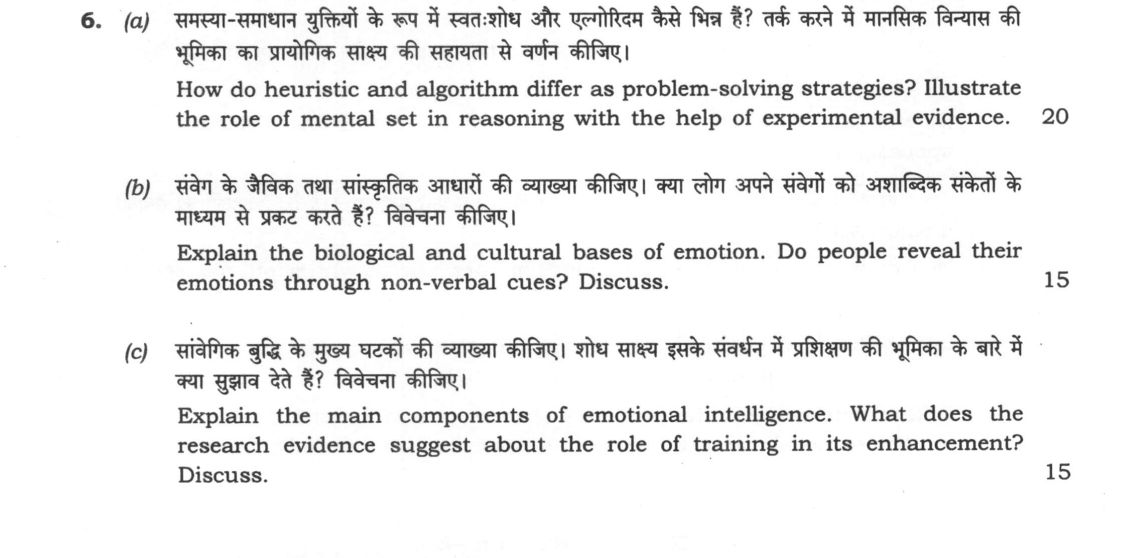
(a) How do heuristic and algorithm differ as problem-solving strategies? Illustrate the role of mental set in reasoning with the…
How do heuristic and algorithm differ as problem-solving strategies? Illustrate the role of mental set in reasoning with the help of experimental evidence. 20 marks
Explain the biological and cultural bases of emotion. Do people reveal their emotions through non-verbal cues? Discuss. 15 marks
Explain the main components of emotional intelligence. What does the research evidence suggest about the role of training in its enhancement? Discuss. 15 marks
हिंदी में प्रश्न पढ़ें
समस्या-समाधान युक्तियों के रूप में स्वतःशोध और एल्गोरिदम कैसे भिन्न हैं? तर्क करने में मानसिक विन्यास की भूमिका का प्रायोगिक साक्ष्य की सहायता से वर्णन कीजिए। (20 अंक)
संवेग के जैविक तथा सांस्कृतिक आधारों की व्याख्या कीजिए। क्या लोग अपने संवेगों को अशाब्दिक संकेतों के माध्यम से प्रकट करते हैं? विवेचना कीजिए। (15 अंक)
सांवेगिक बुद्धि के मुख्य घटकों की व्याख्या कीजिए। शोध साक्ष्य इसके संवर्धन में प्रशिक्षण की भूमिका के बारे में क्या सुझाव देते हैं? विवेचना कीजिए। (15 अंक)
Model answer
Written by UPSC Answer Check against this question's marking rubric, to the expected length. UPSC does not publish answers for Mains — this is one way to score well, not an official key.
Problem-solving, emotion and emotional intelligence are interlinked cognitive-affective processes: problem-solving depends on how information is represented and retrieved; emotion colours appraisal and action; emotional intelligence helps regulate these processes.
(a) An algorithm is a systematic, step-by-step procedure that, if followed correctly, guarantees a solution when one exists. A heuristic is a fast, experience-based shortcut that is efficient but not guaranteed. The distinction is:
Algorithm | Heuristic Exhaustive, rule-bound | Approximate, cue-based Guarantees solution if applicable | Probabilistic, may err Slow, high cognitive load | Quick, low load Example: exhaustive search | means-ends analysis
Newell and Simon’s problem-space theory frames reasoning as moving through states from initial to goal, where operators and representations determine success. Mental set is a tendency to repeat a previously successful strategy, which can help but can also cause the Einstellung effect. Luchins’ water-jar experiment showed that after solving several problems with the same formula, participants failed to see a simpler solution for a later problem; prior success created fixation. Duncker’s candle problem showed that tools (box, tacks, candle) were initially seen only by their usual function, illustrating functional fixedness; when the box was redefined as a platform, solutions increased. Maier’s two-string problem similarly showed that people often miss the solution of swinging one string with a pliers because they do not recombine familiar objects in a novel way. These experiments show that prior experience constrains problem-solving by narrowing the problem space.
(b) Emotion has biological bases. James-Lange theory says emotion follows bodily change; Cannon-Bard argues visceral and emotional responses occur in parallel; Schachter-Singer adds cognitive labelling of arousal. The limbic system, especially amygdala and hypothalamus, and the Papez circuit help generate, regulate and express emotion. Polygraphs can measure arousal but cannot reliably identify a specific emotion. Culture shapes emotion through display rules, cultural scripts and learned norms. Ekman identified basic facial expressions of universal emotions with cross-cultural recognition, while Matsumoto’s research showed recognition accuracy varies with cultural context and familiarity. Non-verbal cues include facial expressions, body language, paralanguage and proxemics. People do reveal emotions through these cues, but decoding is culturally mediated. In India, collectivist display rules often encourage restraint of anger, pride or grief in public, while stronger expressions may be permitted in family or close-group settings.
(c) Emotional intelligence can be explained through Goleman’s five components: self-awareness, self-regulation, motivation, empathy and social skills. The Mayer-Salovey four-branch model treats EI as an ability: perceiving, using, understanding and managing emotions. Ability EI is measured by performance tasks, while trait EI is a self-reported disposition. Research evidence suggests training can enhance EI, especially in workplace and educational settings. Meta-analyses of workplace EI training report moderate improvements in emotional competence and related outcomes. Nelis et al. (2009), in a primary training study, found that emotion-focused training improved adolescents’ emotional competence and social outcomes. Matthews et al. (2002), in a critical review, cautioned that ability EI may be relatively stable and that not all self-report gains reflect real skill. Indian SEL initiatives are expanding, but they are not by themselves proof of effectiveness; rigorous evaluation is needed. Thus training is useful but not a panacea; it works best when it targets specific skills, provides practice and feedback, and is embedded in supportive institutional norms.
Conclusion: Cognition and emotion are not separate; adaptive functioning depends on accurate problem-solving, culturally informed emotional expression, and trained emotional regulation.
What "Explain" is asking you to do
Make the working of something clear — what sets it off, what follows from what, and what it produces. Explain is the Commission's mechanism word: it dominates the technical papers and the “explain why” stems, where the marks sit in the causal chain and not in the label.
Structure that answers it
State what it is → the initiating condition → the chain of cause, step by step → an instance where it plays out → what the chain produces
Where marks are lost
Describing what something looks like instead of why it works that way. Naming the stages without linking them reads as description too.
How this answer will be evaluated
Approach
(a) compare: paired headings or table > key differences > significance > conclusion | (b) explain: definition/context > points in order > small example > short close | (c) explain: definition/context > points in order > small example > short close Full marks: Comprehensive, well-structured, with specific examples and evidence.
Key points expected
- Define heuristic and algorithm as problem-solving strategies
- Tabulate key differences (guarantee, speed, accuracy)
- Define mental set (functional fixedness)
- Cite specific experimental evidence (e.g., Luchins water jar)
- Explain biological bases (e.g., James-Lange, Cannon-Bard)
- Explain cultural bases (e.g., Ekman's universality vs display rules)
- Discuss non-verbal cues (facial, body language)
- Provide examples of non-verbal expression
Evaluation rubric
Each sub-part is marked on its own, against the marks and word limit printed on the paper.
- (a) Distinguish heuristic vs algorithm and illustrate mental set with evidence. 20 marks
compare— paired headings or table → key differences → significance → conclusion
Must cover
- Define heuristic and algorithm as problem-solving strategies
- Tabulate key differences (guarantee, speed, accuracy)
- Define mental set (functional fixedness)
- Cite specific experimental evidence (e.g., Luchins water jar)
Loses marks
- Confusing heuristic with general 'intuition'
- Defining mental set without experimental context
- Listing differences without explaining their impact
Earns more
- Mention specific heuristic types (means-ends, hill-climbing)
- Discuss cognitive rigidity in reasoning
- Reference Luchins (1942) or Duncker (1945)
Extra mark
- Diagram the water jar problem setup
- Mention specific algorithm examples (e.g., Euclidean)
- (b) Explain biological/cultural bases of emotion and non-verbal cues. 15 marks
explain— definition/context → points in order → small example → short close
Must cover
- Explain biological bases (e.g., James-Lange, Cannon-Bard)
- Explain cultural bases (e.g., Ekman's universality vs display rules)
- Discuss non-verbal cues (facial, body language)
- Provide examples of non-verbal expression
Loses marks
- Ignoring the cultural aspect of emotion
- Failing to link non-verbal cues to emotion
- Vague description of biological bases
Earns more
- Mention specific theories (Schachter-Singer, Panksepp)
- Discuss cross-cultural studies on facial expressions
- Reference Ekman's FACS (Facial Action Coding System)
Extra mark
- Diagram the neural pathways of emotion
- Mention specific cultural display rules examples
- (c) Explain EI components and role of training in enhancement. 15 marks
explain— definition/context → points in order → small example → short close
Must cover
- Define emotional intelligence (EI)
- List main components (e.g., Goleman's model)
- Discuss research evidence on EI training
- Evaluate the effectiveness of training
Loses marks
- Confusing EI with general intelligence
- Failing to discuss the role of training
- Vague description of EI components
Earns more
- Mention specific EI models (Goleman, Salovey-Mayer)
- Cite specific training programs or studies
- Discuss the malleability of EI
Extra mark
- Diagram the components of EI
- Mention specific psychometric tools (e.g., MSCEIT)
Practice this exact question
Write your answer and it is marked point by point against the model answer above — what you covered, what you missed, what you got wrong.
Evaluate my answer →More from Psychology 2024 Paper I
- Q3 (a) Discuss the signal detection theory (SDT) with reference to perceptual vigilance task…
- Q4 (a) Differentiate between classical and operant conditioning. Discuss their applications…
- Q5 Answer the following questions in about 150 words each: (a) Citing research evidence, exp…
- Q6 (a) How do heuristic and algorithm differ as problem-solving strategies? Illustrate the r…
- Q7 (a) Distinguish between psychoanalytic and humanistic approaches to personality. Discuss…
- Q8 (a) How do Skinner and Chomsky differ in their approach to language development? Also, di…