Paper I — Q5
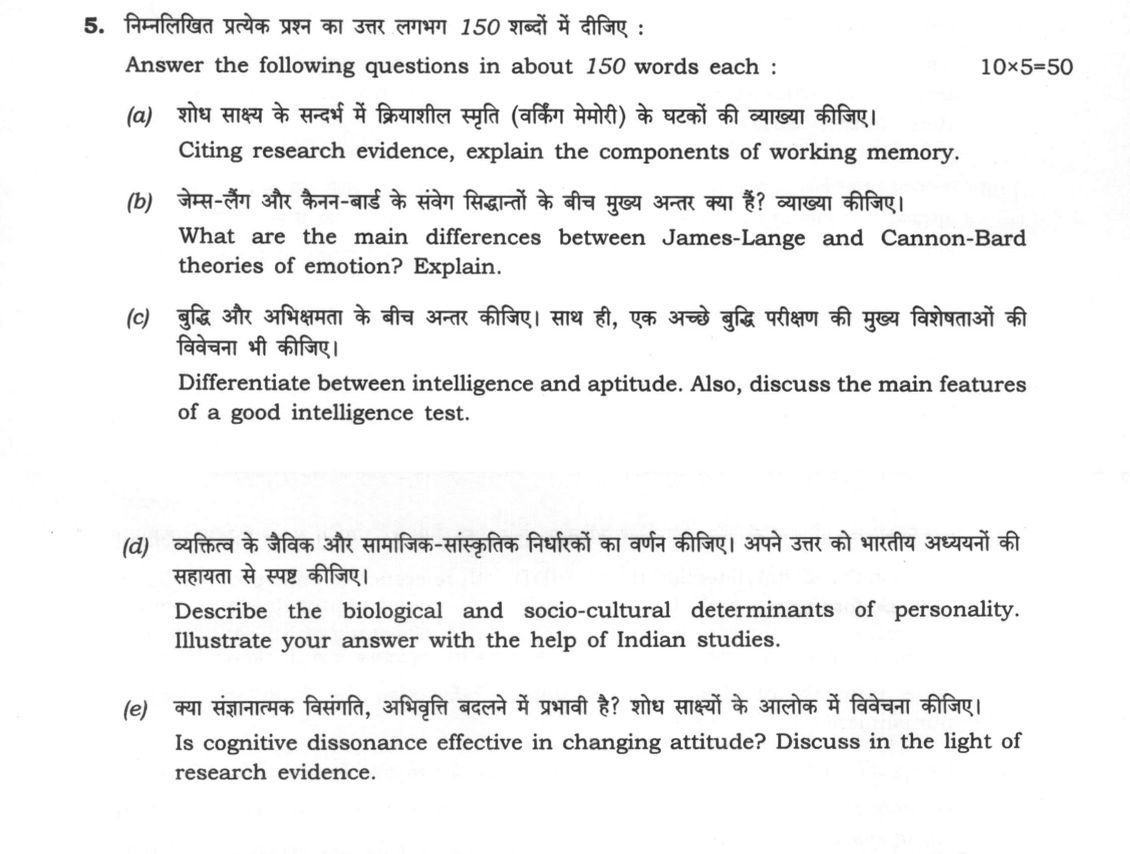
Answer the following questions in about 150 words each: (a) Citing research evidence, explain the components of working memory…
Answer the following questions in about 150 words each: Citing research evidence, explain the components of working memory. 10 marks
What are the main differences between James-Lange and Cannon-Bard theories of emotion? Explain. 10 marks
Differentiate between intelligence and aptitude. Also, discuss the main features of a good intelligence test. 10 marks
Describe the biological and socio-cultural determinants of personality. Illustrate your answer with the help of Indian studies. 10 marks
Is cognitive dissonance effective in changing attitude? Discuss in the light of research evidence. 10 marks
हिंदी में प्रश्न पढ़ें
निम्नलिखित प्रत्येक प्रश्न का उत्तर लगभग 150 शब्दों में दीजिए : शोध साक्ष्य के संदर्भ में क्रियाशील स्मृति (वर्किंग मेमोरी) के घटकों की व्याख्या कीजिए। (10 अंक)
जेम्स-लैंग और कैनन-बार्ड के संवेग सिद्धांतों के बीच मुख्य अंतर क्या हैं? व्याख्या कीजिए। (10 अंक)
बुद्धि और अभिक्षमता के बीच अंतर कीजिए। साथ ही, एक अच्छे बुद्धि परीक्षण की मुख्य विशेषताओं की विवेचना भी कीजिए। (10 अंक)
व्यक्तित्व के जैविक और सामाजिक-सांस्कृतिक निर्धारकों का वर्णन कीजिए। अपने उत्तर को भारतीय अध्ययनों की सहायता से स्पष्ट कीजिए। (10 अंक)
क्या संज्ञानात्मक विसंगति, अभिवृत्ति बदलने में प्रभावी है? शोध साक्ष्यों के आलोक में विवेचना कीजिए। (10 अंक)
Model answer
Written by UPSC Answer Check against this question's marking rubric, to the 150-word length. UPSC does not publish answers for Mains — this is one way to score well, not an official key.
(a) Working memory. Working memory is an active system for temporarily storing and manipulating information. Baddeley and Hitch (1974) proposed the central executive, phonological loop and visuospatial sketchpad; Baddeley (2000) added the episodic buffer. The central executive is an attentional controller that allocates resources, suppresses irrelevant information and coordinates subsystems. The phonological loop stores verbal and auditory material through a phonological store and articulatory refreshment; the visuospatial sketchpad holds visual and spatial images. Their dual-task evidence showed that a concurrent digit-span load impaired reasoning, especially verbal reasoning, indicating differential interference between verbal and visuospatial systems rather than a single store. Neuroimaging supports this division: prefrontal regions are linked to executive control, left temporal-parietal areas to phonological processing, and right parietal-occipital areas to visuospatial processing. The episodic buffer binds verbal, visual and episodic information into coherent episodes, drawing on long-term memory. It allows integration of information across modalities and time.
(b) James-Lange and Cannon-Bard. James-Lange theory holds that emotion is the perception of bodily changes: a stimulus first produces physiological arousal—trembling, sweating, increased heart rate—and the brain interprets this peripheral feedback as emotion; we feel afraid because we tremble. The causal chain is stimulus → bodily response → feeling. Cannon-Bard theory rejects this sequence. It argues that the thalamus receives sensory input and simultaneously sends signals to the cortex, where the subjective feeling occurs, and to the autonomic nervous system, where physiological expression occurs. Thus emotion and bodily response are parallel, not dependent on feedback. Cannon’s critique was that visceral changes are too slow to explain rapid emotion, are too similar across different emotions, and are not necessary: people with spinal cord injuries or sympathetic trunk damage can still report emotions. Hence, James-Lange makes peripheral feedback the cause of emotion, while Cannon-Bard makes thalamic relay the common trigger of simultaneous feeling and expression.
(c) Intelligence and aptitude. Intelligence is the general capacity to learn, reason, solve problems and adapt to novel situations; it is usually measured by tests of verbal, numerical and spatial ability. Aptitude, by contrast, is the specific potential to acquire a particular skill or perform in a defined domain, such as musical, mechanical, clerical or artistic aptitude. Intelligence is broad and general; aptitude is narrow and task-specific. A person may have high general intelligence but low musical aptitude, or high mechanical aptitude despite average intelligence. A good intelligence test must be standardized in administration, scoring and time limits, so that all test-takers face equivalent conditions. It must be reliable, giving consistent scores over time and across items. It must be valid, measuring what it claims to measure through content, criterion and construct evidence. It needs representative and current norms, objective scoring, fairness across groups, and practicality. These features ensure that scores reflect ability rather than artefacts of administration.
(d) Determinants of personality. Personality is shaped by biological and socio-cultural determinants. Biological factors include heredity, temperament, brain structure and neurotransmitters. Eysenck’s PEN model links extraversion, neuroticism and psychoticism to cortical arousal, autonomic reactivity and dopamine/serotonin systems. Indian twin studies, such as Srivastava and Srivastava (1975), found monozygotic twins more similar than dizygotic twins on personality traits, supporting a genetic contribution. Socio-cultural factors include family, parenting, caste, religion, education, occupation and urbanization. In India, Kuppuswamy’s socioeconomic status scale (1961) has been used to operationalize family class in studies of personality; such studies link parental education, occupation and income to differences in social behaviour and confidence. Caste and religious community also transmit norms of conformity, assertiveness, gender roles and deference, while urbanization and schooling can promote individualism and achievement orientation. Thus personality in India is not merely inherited or culturally imposed; it is a product of biological predispositions interacting with caste, family and social institutions.
(e) Cognitive dissonance and attitude change. Cognitive dissonance is effective in changing attitude when a person performs a behaviour that conflicts with an existing belief and lacks sufficient external justification. Festinger and Carlsmith (1959) had participants perform a boring task and then lie to another participant. Those paid only $1 rated the task as more interesting than those paid $20, because the low reward created dissonance that was reduced by changing the attitude. Aronson and Mills (1959) showed that women who underwent a severe initiation rated the group more favourably, because inconsistency was resolved by valuing the group. Post-decision studies show that after choosing between alternatives, people rate the chosen option more favourably to justify the decision. However, effectiveness is limited: self-affirmation theory shows that affirming other self-values can reduce dissonance without attitude change; individual differences in self-esteem and locus of control matter. Thus dissonance is a powerful but conditional mechanism of attitude change.
What "Explain" is asking you to do
Make the working of something clear — what sets it off, what follows from what, and what it produces. Explain is the Commission's mechanism word: it dominates the technical papers and the “explain why” stems, where the marks sit in the causal chain and not in the label.
Structure that answers it
State what it is → the initiating condition → the chain of cause, step by step → an instance where it plays out → what the chain produces
Where marks are lost
Describing what something looks like instead of why it works that way. Naming the stages without linking them reads as description too.
How this answer will be evaluated
Approach
Framework: Baddeley's Multi-component Model of Working Memory. (a) explain: definition/context > points in order > small example > short close | (b) compare: paired headings or table > key differences > significance > conclusion | (c) compare: paired headings or table > key differences > significance > conclusion | (d) describe: define > structure or process in order > labelled diagram > significance | (e) discuss: intro > 3-4 dimensions > example > balanced close Full marks: Precise definitions, named theories/researchers, specific evidence, clear structure, and correct application of command words.
Key points expected
- Define working memory as an active processing system
- Identify Central Executive, Phonological Loop, Visuo-spatial Sketchpad
- Mention Episodic Buffer (Baddeley's 2000 update)
- Cite specific research evidence (e.g., dual-task studies)
- State James-Lange: Physiological arousal precedes emotion
- State Cannon-Bard: Arousal and emotion occur simultaneously
- Mention Cannon's critique of James-Lange (e.g., speed of response)
- Mention Bard's role in the thalamus
Evaluation rubric
Each sub-part is marked on its own, against the marks and word limit printed on the paper.
- (a) Define working memory and detail its components with research evidence. · 150 words
explain— definition/context → points in order → small example → short close
Must cover
- Define working memory as an active processing system
- Identify Central Executive, Phonological Loop, Visuo-spatial Sketchpad
- Mention Episodic Buffer (Baddeley's 2000 update)
- Cite specific research evidence (e.g., dual-task studies)
Loses marks
- Confusing working memory with short-term memory
- Listing components without explaining their function
- Theory without any research evidence
Earns more
- Mention Baddeley & Hitch (1974) model
- Briefly explain the function of each component
- Reference Shallice's supervisory system
Extra mark
- Include a labelled diagram of the model
- Mention specific dual-task experiments (e.g., span tasks)
- (b) Differentiate James-Lange and Cannon-Bard theories of emotion. · 150 words
compare— paired headings or table → key differences → significance → conclusion
Must cover
- State James-Lange: Physiological arousal precedes emotion
- State Cannon-Bard: Arousal and emotion occur simultaneously
- Mention Cannon's critique of James-Lange (e.g., speed of response)
- Mention Bard's role in the thalamus
Loses marks
- Confusing the sequence of events in the two theories
- Failing to mention the role of the thalamus in C-B
- Vague description without specific theoretical claims
Earns more
- Mention Schachter-Singer as a later development
- Reference specific physiological evidence (e.g., heart rate)
Extra mark
- Use a table to contrast the two theories
- Mention the 'fight or flight' response context
- (c) Distinguish intelligence from aptitude and list features of a good test. · 150 words
compare— paired headings or table → key differences → significance → conclusion
Must cover
- Define Intelligence (general ability to learn/adapt)
- Define Aptitude (potential for specific skill)
- List features: Reliability, Validity, Standardization
- Mention Objectivity and Norms
Loses marks
- Treating intelligence and aptitude as identical
- Listing test features without defining them
- Ignoring the 'good test' part of the question
Earns more
- Mention specific tests (e.g., WAIS, Raven's)
- Distinguish between fluid and crystallized intelligence
Extra mark
- Mention specific psychometric properties (e.g., Cronbach's alpha)
- Reference specific Indian intelligence tests
- (d) Explain biological and socio-cultural determinants of personality with Indian examples. · 150 words
describe— define → structure or process in order → labelled diagram → significance
Must cover
- List biological factors (Heredity, Hormones, Brain)
- List socio-cultural factors (Family, Culture, Education)
- Provide specific Indian studies/examples
- Mention the interaction of nature and nurture
Loses marks
- Ignoring the 'Indian studies' requirement
- Listing factors without explaining their influence
- Vague generalities without specific examples
Earns more
- Mention specific Indian researchers (e.g., Srinivasan)
- Reference specific cultural concepts (e.g., Samskara)
Extra mark
- Mention specific Indian personality traits (e.g., 'Sattva')
- Reference specific cross-cultural studies
- (e) Evaluate the effectiveness of cognitive dissonance in attitude change. · 150 words
discuss— intro → 3-4 dimensions → example → balanced close
Must cover
- Define Cognitive Dissonance (Festinger)
- Explain the mechanism of attitude change
- Cite research evidence (e.g., Festinger & Carlsmith)
- Discuss limitations or conditions for effectiveness
Loses marks
- Defining dissonance without explaining the change mechanism
- Ignoring the 'research evidence' requirement
- Presenting a one-sided view without discussion
Earns more
- Mention specific experiments (e.g., $1 vs $20 study)
- Reference specific applications (e.g., health behavior)
Extra mark
- Mention specific modern applications (e.g., climate change)
- Reference specific meta-analyses
Practice this exact question
Write your answer and it is marked point by point against the model answer above — what you covered, what you missed, what you got wrong.
Evaluate my answer →More from Psychology 2024 Paper I
- Q2 (a) Describe the diversity in the disciplinary thoughts with special reference to structu…
- Q3 (a) Discuss the signal detection theory (SDT) with reference to perceptual vigilance task…
- Q4 (a) Differentiate between classical and operant conditioning. Discuss their applications…
- Q5 Answer the following questions in about 150 words each: (a) Citing research evidence, exp…
- Q6 (a) How do heuristic and algorithm differ as problem-solving strategies? Illustrate the r…
- Q7 (a) Distinguish between psychoanalytic and humanistic approaches to personality. Discuss…
- Q8 (a) How do Skinner and Chomsky differ in their approach to language development? Also, di…