Paper I — Q7
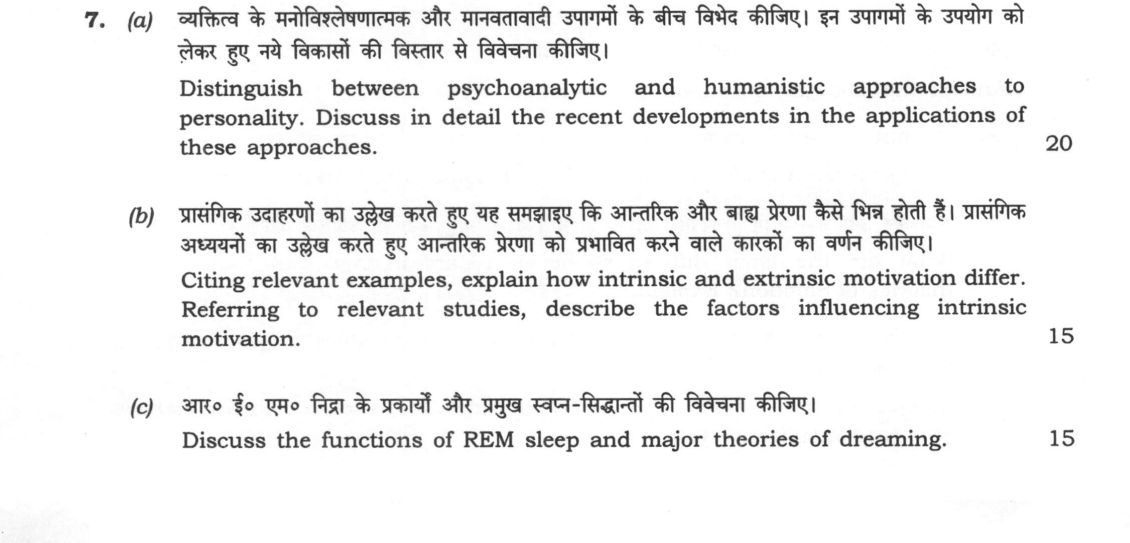
(a) Distinguish between psychoanalytic and humanistic approaches to personality. Discuss in detail the recent developments in the…
Distinguish between psychoanalytic and humanistic approaches to personality. Discuss in detail the recent developments in the applications of these approaches. 20 marks
Citing relevant examples, explain how intrinsic and extrinsic motivation differ. Referring to relevant studies, describe the factors influencing intrinsic motivation. 15 marks
Discuss the functions of REM sleep and major theories of dreaming. 15 marks
हिंदी में प्रश्न पढ़ें
व्यक्तित्व के मनोविश्लेषणात्मक और मानवतावादी उपागमों के बीच विभेद कीजिए। इन उपागमों के उपयोग को लेकर हुए नये विकासों की विस्तार से विवेचना कीजिए। (20 अंक)
प्रासंगिक उदाहरणों का उद्धेख करते हुए यह समझाइए कि आंतरिक और बाह्य प्रेरणा कैसे भिन्न होती हैं। प्रासंगिक अध्ययनों का उल्लेख करते हुए, आंतरिक प्रेरणा को प्रभावित करने वाले कारकों का वर्णन कीजिए। (15 अंक)
आर० ई० एम० निद्रा के प्रकार्यों और प्रमुख स्वप्न-सिद्धांतों की विवेचना कीजिए। (15 अंक)
Model answer
Written by UPSC Answer Check against this question's marking rubric, to the expected length. UPSC does not publish answers for Mains — this is one way to score well, not an official key.
Psychoanalytic versus Humanistic Approaches to Personality
Psychoanalytic and humanistic frameworks represent fundamentally contrasting paradigms in understanding personality. Sigmund Freud’s psychoanalysis is characterized by psychic determinism, positing that personality is governed by unconscious conflicts among the id, ego, and superego, and rooted in early childhood psychosexual stages. Humanistic psychology, championed by Carl Rogers and Abraham Maslow, possesses a core property that psychoanalysis explicitly rejects: human agency and inherent growth orientation. Humanism views individuals as fundamentally free, rational agents driven by an innate drive toward self-actualization, requiring unconditional positive regard. While psychoanalysis adopts an idiographic, deficit-oriented focus on pathology and past fixation, humanism adopts a phenomenological, future-oriented approach emphasizing human potential and subjective conscious experience.
Recent developments have revitalized both approaches. Psychoanalysis has evolved into neuropsychoanalysis through Mark Solms, using fMRI studies to map unconscious processes, ego defense mechanisms, and drive systems onto subcortical-cortical brain networks. Clinically, long-term psychoanalysis has adapted into Intensive Short-Term Dynamic Psychotherapy (ISTDP), offering evidence-based, rapid resolution of unconscious defense mechanisms. Concurrently, humanistic concepts underpin modern positive psychology, such as Martin Seligman’s PERMA framework of flourishing. In Indian education, humanistic principles inform NCERT’s Social and Emotional Learning (SEL) modules and growth mindset curricula, fostering empathetic, learner-centered classroom environments.
Intrinsic versus Extrinsic Motivation
Intrinsic motivation refers to engaging in a behavior purely for the inherent satisfaction, challenge, or curiosity it provides, such as a child solving puzzles to achieve a state of flow. Extrinsic motivation involves performing an activity to attain external outcomes, avoid punishment, or gain tangible rewards, such as an employee working for salary or a student memorizing content for grades within token economies.
Deci and Ryan’s Self-Determination Theory (SDT) explains this distinction through three innate psychological needs: autonomy, competence, and relatedness. Edward Deci’s classic studies (1971, 1975) and Lepper, Greene, and Nisbett’s overjustification effect demonstrated that introducing extrinsic rewards for intrinsically motivating tasks undermines spontaneous interest by shifting the perceived locus of causality from internal to external. Key factors sustaining intrinsic motivation include providing choice, providing informational rather than controlling immediate feedback, and maintaining an optimal challenge-skill balance. Indian field studies on autonomy-supportive pedagogy in Eklavya Model Residential Schools (tribal education) affirm that curricula offering contextual autonomy and collaborative peer-learning (relatedness) significantly elevate students' intrinsic academic drive compared to purely incentive-driven interventions.
Functions of REM Sleep and Theories of Dreaming
Rapid Eye Movement (REM) sleep performs crucial physiological and cognitive functions. As demonstrated by Robert Stickgold, REM sleep is essential for memory consolidation, particularly the neurochemical reprocessing and integration of emotional and procedural memories. The high proportion of REM sleep in infants supports neurodevelopment and synaptic plasticity, while it also serves adaptive thermoregulatory and neural restoration functions.
Major theories explain the genesis of dreaming during REM. Freud’s psychoanalytic model interpreted dreams as disguised wish-fulfillment, transforming latent unconscious desires into manifest content via dream work. Conversely, Hobson and McCarley’s activation-synthesis hypothesis posits that dreams are the cerebral cortex’s attempt to synthesize and make sense of random periodic bursts of neural firing originating in the brainstem (pons). Mark Solms’ neurocognitive model integrates both, demonstrating that dreaming is driven by forebrain dopaminergic reward pathways independently of brainstem activation. Additionally, Antti Revonsuo’s threat simulation theory proposes an evolutionary function: dreams provide biologically safe rehearsals for threatening real-world scenarios. Contemporary REM deprivation research reveals severe affective dysregulation, informing PTSD interventions like imagery rehearsal therapy and workplace health protocols for Indian industrial shift workers suffering from circadian disruptions.
A holistic way forward requires integrating these complementary domains—resolving subconscious conflicts, fostering intrinsic self-determination, and optimizing sleep hygiene—into community-based mental health initiatives like the National Tele Mental Health Programme (Tele-MANAS) to support comprehensive psychological well-being.
What "Distinguish" is asking you to do
Name the property that separates the items and say which side holds it. Distinguish is marked exactly as differentiate is, with no difference in expectation, but its stems more often line up three terms rather than two — gender equality, gender equity and empowerment — and every pair in the set has to be separated.
Structure that answers it
The category they all sit in → the property dividing the first pair → the second pair → the third → why the boundary matters in practice
Where marks are lost
Separating the two obviously different items and leaving the middle term unplaced. A description of each side from which the line must be inferred is marked as description, not as a distinction.
How this answer will be evaluated
Approach
Framework: UPSC Psychology Paper 1. (a) compare: paired headings or table > key differences > significance > conclusion | (b) explain: definition/context > points in order > small example > short close | (c) discuss: intro > 3-4 dimensions > example > balanced close Full marks: Precise distinctions, named studies, and detailed recent applications.
Key points expected
- Contrast Freud's unconscious drive vs Maslow's self-actualization
- Differentiate determinism vs free will/agency
- Detail recent applications of psychoanalysis (e.g., trauma, art)
- Detail recent applications of humanism (e.g., positive psych)
- Define intrinsic (internal) vs extrinsic (external) motivation
- Provide relevant examples for both types
- List factors influencing intrinsic motivation (e.g., interest, autonomy)
- Reference relevant studies (e.g., Deci & Ryan)
Evaluation rubric
Each sub-part is marked on its own, against the marks and word limit printed on the paper.
- (a) Compare psychoanalytic and humanistic approaches and detail recent applications. 20 marks
compare— paired headings or table → key differences → significance → conclusion
Must cover
- Contrast Freud's unconscious drive vs Maslow's self-actualization
- Differentiate determinism vs free will/agency
- Detail recent applications of psychoanalysis (e.g., trauma, art)
- Detail recent applications of humanism (e.g., positive psych)
Loses marks
- Treating both as identical 'talking cures'
- Ignoring the 'recent developments' aspect
- Defining without distinguishing
Earns more
- Mention Jung or Adler as neo-psychoanalytic developments
- Reference Rogers' Person-Centered Therapy
- Mention specific modern therapeutic modalities
- Use a comparison table for clarity
Extra mark
- Cite specific modern studies on humanistic efficacy
- Mention specific psychoanalytic case studies
- (b) Differentiate intrinsic/extrinsic motivation and list factors influencing intrinsic motivation. 15 marks
explain— definition/context → points in order → small example → short close
Must cover
- Define intrinsic (internal) vs extrinsic (external) motivation
- Provide relevant examples for both types
- List factors influencing intrinsic motivation (e.g., interest, autonomy)
- Reference relevant studies (e.g., Deci & Ryan)
Loses marks
- Confusing motivation with emotion
- Failing to cite any study or researcher
- Vague examples without context
Earns more
- Mention Self-Determination Theory (SDT)
- Discuss the 'overjustification effect'
- Mention specific experiments (e.g., puzzle studies)
Extra mark
- Mention specific psychometric tools for motivation
- Reference specific Indian studies on student motivation
- (c) Explain the functions of REM sleep and major theories of dreaming. 15 marks
discuss— intro → 3-4 dimensions → example → balanced close
Must cover
- List functions of REM sleep (e.g., memory consolidation)
- Discuss major theories of dreaming (e.g., Freud, Activation-Synthesis)
- Explain the mechanism of Activation-Synthesis (Hobson)
- Mention the role of REM in emotional regulation
Loses marks
- Confusing REM with NREM functions
- Ignoring the 'theories' aspect
- Listing functions without explaining them
Earns more
- Mention the 'threat simulation theory'
- Reference specific physiological markers of REM
- Compare Freud's wish fulfillment vs modern views
Extra mark
- Mention specific sleep disorders related to REM
- Cite specific neuroimaging studies on dreaming
Practice this exact question
Write your answer and it is marked point by point against the model answer above — what you covered, what you missed, what you got wrong.
Evaluate my answer →More from Psychology 2024 Paper I
- Q4 (a) Differentiate between classical and operant conditioning. Discuss their applications…
- Q5 Answer the following questions in about 150 words each: (a) Citing research evidence, exp…
- Q6 (a) How do heuristic and algorithm differ as problem-solving strategies? Illustrate the r…
- Q7 (a) Distinguish between psychoanalytic and humanistic approaches to personality. Discuss…
- Q8 (a) How do Skinner and Chomsky differ in their approach to language development? Also, di…