Paper I — Q3
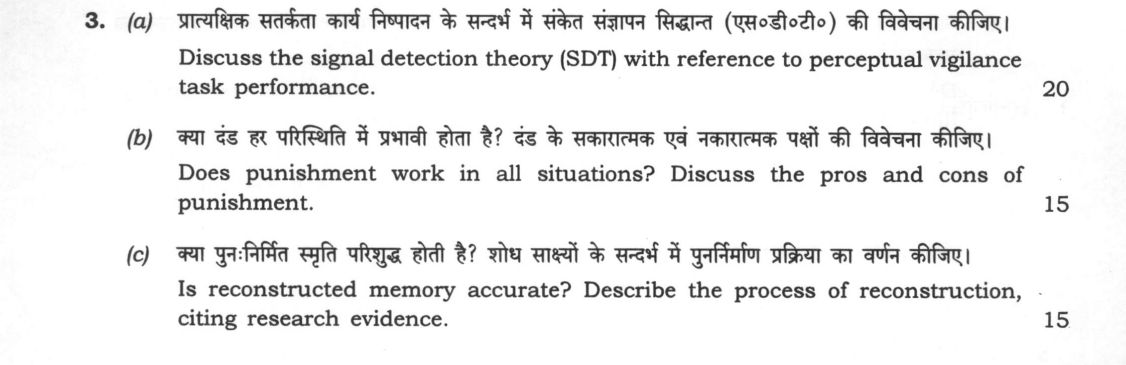
(a) Discuss the signal detection theory (SDT) with reference to perceptual vigilance task performance. (20 marks) (b) Does…
Discuss the signal detection theory (SDT) with reference to perceptual vigilance task performance. 20 marks
Does punishment work in all situations? Discuss the pros and cons of punishment. 15 marks
Is reconstructed memory accurate? Describe the process of reconstruction, citing research evidence. 15 marks
हिंदी में प्रश्न पढ़ें
प्रायोगिक सतर्कता कार्य निष्पादन के संदर्भ में संकेत संज्ञान सिद्धांत (एस.डी.टी.) की विवेचना कीजिए। (20 अंक)
क्या दंड हर परिस्थिति में प्रभावी होता है? दंड के सकारात्मक एवं नकारात्मक पक्षों की विवेचना कीजिए। (15 अंक)
क्या पुनर्निर्मित स्मृति परिशुद्ध होती है? शोध साक्ष्यों के संदर्भ में पुनर्निर्माण प्रक्रिया का वर्णन कीजिए। (15 अंक)
Model answer
Written by UPSC Answer Check against this question's marking rubric, to the expected length. UPSC does not publish answers for Mains — this is one way to score well, not an official key.
Perceptual vigilance and SDT Signal detection theory treats perception as a decision under uncertainty. It separates sensitivity, d′, the separation between signal and noise distributions, from response bias, β, the criterion for saying “target.” ROC curves plot hit rate against false-alarm rate across criteria, showing that the same d′ can yield different performance if the observer is liberal or conservative. In practice, ROC analysis can reveal whether a vigilance decrement is mainly a loss of discrimination or a change in decision rule. In perceptual vigilance, targets are rare and monitoring is prolonged. Performance may decline because d′ falls—due to fatigue, monotony, low target probability, high workload, poor arousal or motivation—or because β shifts conservatively, reducing hits and false alarms. Both changes matter: demanding tasks can show genuine sensitivity decrements, while low-risk monitoring often shows criterion change. Mackworth’s clock test, where a target clock with a missing number appears among many, demonstrated a time-on-task decrement. Wiener’s vigilance studies extended this by showing that sustained attention depends on allocation of resources and response policy. Applied contexts such as radar monitoring, air traffic control and security screening show that SDT helps distinguish perceptual failure from institutional bias.
Punishment: conditional utility Punishment does not work in all situations. It can suppress a behaviour when it is contingent on the response, immediate, sufficiently intense, consistent, and paired with reinforcement of alternatives. Punishment is most defensible when mild, proportionate and temporary, and least effective when used in anger or as the only strategy. Its advantages are speed, safety, and deterrence when the punisher is predictable. Its disadvantages are fear, aggression, escape, avoidance, damage to trust, and failure to teach better behaviour. It must be distinguished from negative reinforcement, which removes an aversive stimulus to increase a behaviour, whereas punishment adds one to decrease it. Skinner treated punishment as powerful but risky, emphasising side-effects; Azrin-Holz argued it can be effective under strict conditions but is not universally appropriate. In India, NCPCR school surveys, including 2019-20, have repeatedly found widespread corporal punishment, yet evidence links it to anxiety, aggression and disengagement rather than durable learning. Criminal-justice debates over deterrence, especially capital punishment, show that punishment may deter some offences but is weakened by low detection and conviction rates. In organisations, harsh discipline may reduce immediate violations but can increase resentment, turnover and concealment.
Reconstructed memory Bartlett’s War of the Ghosts showed that memory is reconstructive rather than reproductive. Instead of replaying a stored trace, people rebuild experiences using schemas described in his schema theory, expectations and current goals. Encoding is already selective and interpretive; retrieval is a generative act in which gaps are filled, details are omitted, and events are made coherent. Loftus’s misinformation paradigm demonstrated that post-event information can alter reports, especially when questions are leading. Eyewitness-testimony research shows that stress, delay, weapon focus, and social pressure reduce accuracy. Indian legal and trauma studies, including work on child witnesses and sexual-assault cases, similarly show that suggestibility, repeated questioning and emotional stress can distort recall. Thus reconstructed memory is not simply inaccurate; it is accurate to the extent that it serves present meaning, but it can be seriously misleading in forensic contexts.
Conclusion All three areas show that human performance is context-dependent. Perceptual vigilance is shaped by task demands and response policy; punishment depends on contingency, timing, intensity and alternatives; memory depends on schemas, suggestion and retrieval context. Cognitive biases and ecological pressures therefore compromise perceptual judgments, behavioural responses and memory reports. Ecological validity matters because laboratory tasks, school classrooms and courtrooms all involve rare events, incentives, and social context. A sound way forward is to use SDT to monitor both sensitivity and bias, to apply punishment only conditionally and ethically, and to treat memory as reconstructive, requiring corroboration in legal and organisational settings.
What "Discuss" is asking you to do
Lay the issue out from more than one side — how it arose, what is claimed for it, what is held against it, and where it now stands. UPSC attaches discuss to broad topics with several live dimensions, so coverage of the dimensions earns more than the strength of your opinion.
Structure that answers it
Set the issue up → the case as it is made → the case against → the dimension both sides leave out → where the balance now lies
Where marks are lost
Listing facts with no thread between them, or arguing one side throughout and calling it a discussion.
How this answer will be evaluated
Approach
Framework: Signal Detection Theory (SDT). (a) discuss: intro > 3-4 dimensions > example > balanced close | (b) discuss: intro > 3-4 dimensions > example > balanced close | (c) describe: define > structure or process in order > labelled diagram > significance Full marks: Comprehensive coverage of all parts with named studies, clear diagrams, and balanced analysis.
Key points expected
- Define signal, noise, and decision criterion
- Explain hit, miss, false alarm, and correct rejection
- Link d-prime (sensitivity) to vigilance performance
- Discuss the impact of response bias on vigilance
- Define punishment in the context of operant conditioning
- List at least two pros (e.g., rapid behavior change, deterrence)
- List at least two cons (e.g., aggression, avoidance, fear)
- Provide a balanced conclusion on its situational utility
Evaluation rubric
Each sub-part is marked on its own, against the marks and word limit printed on the paper.
- (a) Explain SDT components and their application to vigilance task performance. 20 marks
discuss— intro → 3-4 dimensions → example → balanced close
Must cover
- Define signal, noise, and decision criterion
- Explain hit, miss, false alarm, and correct rejection
- Link d-prime (sensitivity) to vigilance performance
- Discuss the impact of response bias on vigilance
Loses marks
- Confusing sensitivity (d') with response bias (beta)
- Failing to link theory to the specific context of vigilance
- Describing vigilance without referencing SDT terminology
Earns more
- Mention ROC curves in the context of vigilance
- Reference Mackworth's vigilance decrement study
- Explain the role of a priori probability
- Discuss the cost-benefit matrix in decision making
Extra mark
- Draw a labeled ROC curve diagram
- Cite specific numerical values from a classic SDT study
- (b) Evaluate the effectiveness of punishment, listing its advantages and disadvantages. 15 marks
discuss— intro → 3-4 dimensions → example → balanced close
Must cover
- Define punishment in the context of operant conditioning
- List at least two pros (e.g., rapid behavior change, deterrence)
- List at least two cons (e.g., aggression, avoidance, fear)
- Provide a balanced conclusion on its situational utility
Loses marks
- Presenting punishment as universally effective or ineffective
- Confusing punishment with negative reinforcement
- Failing to provide a balanced view (pros and cons)
Earns more
- Distinguish between positive and negative punishment
- Mention the 'overjustification effect' or learned helplessness
- Reference Skinner's work on operant conditioning
- Discuss the 'extinction burst' phenomenon
Extra mark
- Cite a specific study on the long-term effects of punishment
- Mention the 'aggression hypothesis' (Bandura)
- (c) Explain the process of memory reconstruction and its accuracy using research evidence. 15 marks
describe— define → structure or process in order → labelled diagram → significance
Must cover
- Define memory reconstruction (vs. reproduction)
- Describe the process of schema-based filling in gaps
- Cite Loftus's research on eyewitness testimony
- Discuss the 'misinformation effect' as evidence of inaccuracy
Loses marks
- Treating memory as a perfect recording device
- Failing to cite specific research evidence (e.g., Loftus)
- Confusing reconstruction with simple forgetting
Earns more
- Mention Bartlett's 'War of the Ghosts' study
- Explain the role of leading questions in reconstruction
- Discuss the 'source monitoring' error
- Reference the 'reminiscence bump' or 'tip of the tongue' phenomenon
Extra mark
- Cite a specific statistic from a Loftus study
- Mention the 'reconstructive memory' model by Bartlett
Practice this exact question
Write your answer and it is marked point by point against the model answer above — what you covered, what you missed, what you got wrong.
Evaluate my answer →More from Psychology 2024 Paper I
- Q1 Answer the following questions in about 150 words each: (a) What makes psychology a scien…
- Q2 (a) Describe the diversity in the disciplinary thoughts with special reference to structu…
- Q3 (a) Discuss the signal detection theory (SDT) with reference to perceptual vigilance task…
- Q4 (a) Differentiate between classical and operant conditioning. Discuss their applications…
- Q5 Answer the following questions in about 150 words each: (a) Citing research evidence, exp…
- Q6 (a) How do heuristic and algorithm differ as problem-solving strategies? Illustrate the r…