Paper II — Q1
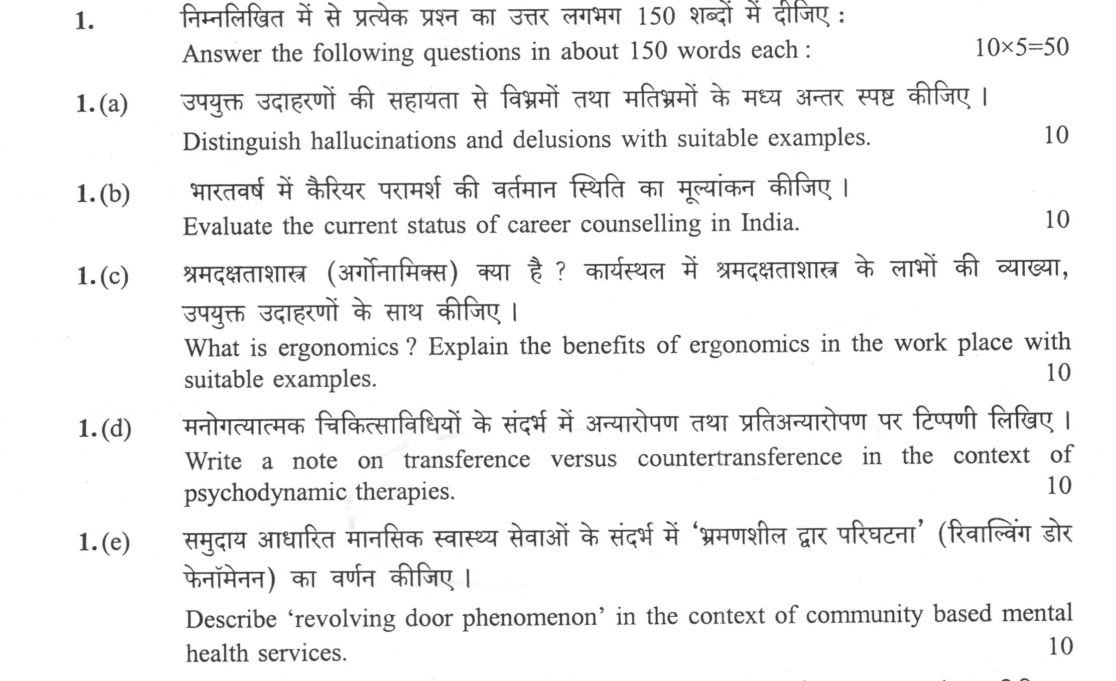
Answer the following questions in about 150 words each: (a) Distinguish hallucinations and delusions with suitable examples…
Answer the following questions in about 150 words each: Distinguish hallucinations and delusions with suitable examples. 10 marks
Evaluate the current status of career counselling in India. 10 marks
What is ergonomics ? Explain the benefits of ergonomics in the work place with suitable examples. 10 marks
Write a note on transference versus countertransference in the context of psychodynamic therapies. 10 marks
Describe 'revolving door phenomenon' in the context of community based mental health services. 10 marks
हिंदी में प्रश्न पढ़ें
निम्नलिखित में से प्रत्येक प्रश्न का उत्तर लगभग 150 शब्दों में दीजिए : उपयुक्त उदाहरणों की सहायता से विभ्रमों तथा मतिभ्रमों के मध्य अंतर स्पष्ट कीजिए । 10
भारतवर्ष में कैरियर परामर्श की वर्तमान स्थिति का मूल्यांकन कीजिए । 10
श्रमदक्षताशास्त्र (अगोनामिक्स) क्या है ? कार्यस्थल में श्रमदक्षताशास्त्र के लाभों की व्याख्या, उपयुक्त उदाहरणों के साथ कीजिए । 10
मनोगतात्मक चिकित्साविधियों के संदर्भ में अन्यारोपण तथा प्रतिअन्यारोपण पर टिप्पणी लिखिए । 10
समुदाय आधारित मानसिक स्वास्थ्य सेवाओं के संदर्भ में 'भ्रमणशील द्वार परिघटना' (रिवाल्विंग दोर फेनोमेनन) का वर्णन कीजिए । 10
Model answer
Written by UPSC Answer Check against this question's marking rubric, to the 150-word length. UPSC does not publish answers for Mains — this is one way to score well, not an official key.
(a) Distinguishing Hallucinations and Delusions
The fundamental distinction lies in the domain of psychological functioning: hallucinations belong to the perceptual domain, whereas delusions belong to the cognitive domain. A hallucination possesses the property of sensory perception occurring in the complete absence of any external stimulus. It is experienced as a real, vivid sensory event across modalities, such as auditory hallucinations in schizophrenia where a patient clearly hears voices commenting on their behavior without anyone speaking.
In contrast, a delusion lacks sensory creation and instead possesses the property of an unshakeable, fixed false belief held with complete conviction despite clear, incontrovertible contradictory evidence. Common examples include persecutory delusions, where an individual falsely believes the state intelligence agencies are surveilling them, or grandiose delusions of possessing divine powers. While hallucinations represent a breakdown in sensory processing, delusions represent a pathology of cognitive ideation and reality interpretation.
(b) Current Status of Career Counselling in India
Career counselling in India is currently undergoing a structural transition from unorganized, parental-pressure-driven guidance toward formalized, scientific assessment. The National Education Policy (NEP) 2020 has placed explicit emphasis on career guidance, vocational integration, and psychological support across secondary education. Institutions like the NCERT have developed standardized aptitude testing frameworks such as Tamanna and integrated psychosocial support portals like Manodarpan.
However, significant structural deficits persist. India faces an acute shortage of licensed career psychologists, with the counselor-to-student ratio falling drastically short of global benchmarks. There is a sharp urban-rural divide: while tier-1 private institutions utilize psychometric profiling and AI-driven platforms, rural government schools largely lack dedicated guidance infrastructure. Furthermore, career counselling operates in silos without adequate integration into community mental health frameworks. Overall, despite progressive policy intent, career counselling in India remains largely privatized and urban-centric, requiring decentralized institutionalization at the district school level.
(c) Ergonomics and Workplace Benefits
Ergonomics, or human factors engineering, is the scientific discipline dedicated to designing and arranging workplace environments, tools, and workflows to fit the physiological and psychological capabilities and limitations of the worker, fundamentally shifting the paradigm from fitting the person to the job to fitting the job to the person.
Ergonomic interventions yield substantial workplace benefits:
Musculoskeletal Health: Designing anthropometrically aligned furniture significantly reduces Musculoskeletal Disorders (MSDs) such as lumbar disc strain and repetitive strain injuries. In the Indian IT and BPO sectors, using height-adjustable sit-stand workstations, dynamic lumbar-support chairs, and ergonomic vertical mice reduces carpal tunnel syndrome and neck strain.
Fatigue Reduction and Cognitive Ergonomics: Optimizing display interfaces, lighting, and ambient noise diminishes visual fatigue and mental workload.
Productivity and Safety: In manufacturing, redesigning assembly-line tools with padded, vibration-dampening handles prevents hand-arm vibration syndrome, simultaneously reducing industrial accidents, sick leaves, and absenteeism.
(d) Transference versus Countertransference
In psychodynamic psychotherapy, transference and countertransference denote the reciprocal unconscious relational dynamics between client and therapist:
Transference occurs when the client unconsciously redirects and projects repressed feelings, wishes, defense mechanisms, and expectations formed in early childhood relationships (typically with parental figures) onto the therapist. For example, a client may exhibit deep-seated resentment or excessive dependence toward the therapist, treating the practitioner as an authoritarian, rejecting father figure.
Countertransference, conversely, is the therapist's emotional reaction and unconscious projection onto the client, triggered by the client's transference or the therapist's own unresolved conflicts. For instance, a therapist may experience an irrational urge to rescue or over-nurture a client due to personal unresolved parental anxieties.
While early classical psychoanalysis viewed countertransference strictly as a clinical impediment, modern dynamic therapy utilizes both: working through transference resolves core neuroses, while self-reflective monitoring of countertransference deepens clinical empathy and preserves therapeutic boundaries.
(e) 'Revolving Door Phenomenon' in Community Mental Health
The 'revolving door phenomenon' describes the repetitive, cyclical pattern wherein individuals with severe mental disorders (SMDs) are admitted to acute psychiatric facilities, stabilized, discharged into the community, and rapidly readmitted due to subsequent relapse.
This cycle is primarily driven by systemic gaps in community-based post-discharge care. Once discharged, patients often experience severe social stigma, familial abandonment, poor psychoeducation, and an abrupt cessation of pharmacotherapy due to lack of local supervision.
In the context of India's National Mental Health Programme (NMHP) and District Mental Health Programme (DMHP), the phenomenon highlights the critical deficit in deinstitutionalization infrastructure. Primary Health Centres (PHCs) frequently face psychotropic drug stockouts and lack psychiatric social workers, day-care centers, and sheltered workshops. Mitigating this cycle requires robust Assertive Community Treatment (ACT) models, integrating ASHA workers for community-level adherence monitoring, and establishing step-down residential and psychosocial rehabilitation facilities.
What "Distinguish" is asking you to do
Name the property that separates the items and say which side holds it. Distinguish is marked exactly as differentiate is, with no difference in expectation, but its stems more often line up three terms rather than two — gender equality, gender equity and empowerment — and every pair in the set has to be separated.
Structure that answers it
The category they all sit in → the property dividing the first pair → the second pair → the third → why the boundary matters in practice
Where marks are lost
Separating the two obviously different items and leaving the middle term unplaced. A description of each side from which the line must be inferred is marked as description, not as a distinction.
How this answer will be evaluated
Approach
Framework: Psychology Paper 2: Define > Theory/Model > Evidence > Application. (a) compare: paired headings or table > key differences > significance > conclusion | (b) evaluate: criteria > evidence > balanced judgment | (c) explain: definition/context > points in order > small example > short close | (d) compare: paired headings or table > key differences > significance > conclusion | (e) describe: define > structure or process in order > labelled diagram > significance Full marks: All parts: precise definitions, named theories/studies, Indian context, balanced evaluation, no errors
Key points expected
- Define hallucination as false sensory perception
- Define delusion as false fixed belief
- Provide specific example of hallucination
- Provide specific example of delusion
- State current status of career counselling in India
- Identify key challenges or gaps
- Provide evidence or examples of current practices
- Offer balanced judgment on effectiveness
Evaluation rubric
Each sub-part is marked on its own, against the marks and word limit printed on the paper.
- (a) Distinguish hallucinations and delusions with suitable examples. 10 marks · 150 words
compare— paired headings or table → key differences → significance → conclusion
Must cover
- Define hallucination as false sensory perception
- Define delusion as false fixed belief
- Provide specific example of hallucination
- Provide specific example of delusion
Loses marks
- Confusing hallucination with illusion
- Confusing delusion with overvalued idea
- Providing only definitions without examples
Earns more
- Mention types (e.g., auditory, paranoid)
- Note that delusions are cognitive, hallucinations perceptual
- Reference DSM-5 or ICD-10 criteria
- Mention co-occurrence in schizophrenia
Extra mark
- Name a specific psychometric tool for assessment
- Reference a named study on symptom differentiation
- (b) Evaluate the current status of career counselling in India. 10 marks · 150 words
evaluate— criteria → evidence → balanced judgment
Must cover
- State current status of career counselling in India
- Identify key challenges or gaps
- Provide evidence or examples of current practices
- Offer balanced judgment on effectiveness
Loses marks
- Providing only general advice without evaluation
- Ignoring Indian context
- No evidence or examples to support claims
Earns more
- Reference NEP 2020 or government initiatives
- Mention role of schools/colleges in counselling
- Note urban-rural disparity
- Reference specific career counselling models used
Extra mark
- Name a specific government scheme or policy
- Cite a named study on career counselling outcomes
- (c) What is ergonomics? Explain the benefits of ergonomics in the work place with suitable examples. 10 marks · 150 words
explain— definition/context → points in order → small example → short close
Must cover
- Define ergonomics
- Explain at least two benefits in workplace
- Provide suitable example for each benefit
- Link benefits to worker health/productivity
Loses marks
- Defining ergonomics incorrectly
- Listing benefits without examples
- Ignoring workplace context
Earns more
- Mention specific ergonomic interventions (e.g., chair design)
- Reference occupational health standards
- Note reduction in musculoskeletal disorders
- Mention cost-benefit of ergonomic changes
Extra mark
- Name a specific ergonomic standard or guideline
- Reference a named study on workplace ergonomics
- (d) Write a note on transference versus countertransference in the context of psychodynamic therapies. 10 marks · 150 words
compare— paired headings or table → key differences → significance → conclusion
Must cover
- Define transference in psychodynamic context
- Define countertransference in psychodynamic context
- Distinguish between the two concepts
- Explain their role in therapy
Loses marks
- Confusing transference with general client feelings
- Ignoring countertransference or defining it incorrectly
- No link to psychodynamic therapy context
Earns more
- Reference Freud or later psychodynamic theorists
- Mention positive and negative transference
- Note therapist's self-awareness in countertransference
- Provide clinical example of each
Extra mark
- Name a specific psychodynamic therapy model
- Reference a named study on transference/countertransference
- (e) Describe 'revolving door phenomenon' in the context of community based mental health services. 10 marks · 150 words
describe— define → structure or process in order → labelled diagram → significance
Must cover
- Define revolving door phenomenon
- Explain its occurrence in community mental health
- Describe the cycle of admission/discharge
- Link to service gaps or system failures
Loses marks
- Defining revolving door incorrectly
- Ignoring community-based context
- No explanation of the cycle or its causes
Earns more
- Mention specific mental health services involved
- Note impact on patient and system
- Reference community-based care models
- Suggest ways to reduce revolving door
Extra mark
- Name a specific community mental health program
- Reference a named study on revolving door phenomenon
Practice this exact question
Write your answer and it is marked point by point against the model answer above — what you covered, what you missed, what you got wrong.
Evaluate my answer →More from Psychology 2024 Paper II
- Q1 Answer the following questions in about 150 words each: (a) Distinguish hallucinations an…
- Q2 (a) Evaluate effectiveness of ABCD Model in the treatment of psychological disorders. 15…
- Q3 (a) Discuss rehabilitation of juvenile delinquents in Indian context. 15 (b) What is lear…
- Q4 (a) What are the components of Vroom's theory of motivation ? How can it be used to incre…