Paper II — Q7
(a) What is social integration ? Explain the psychological measures that can be taken to achieve the goal of social integration…
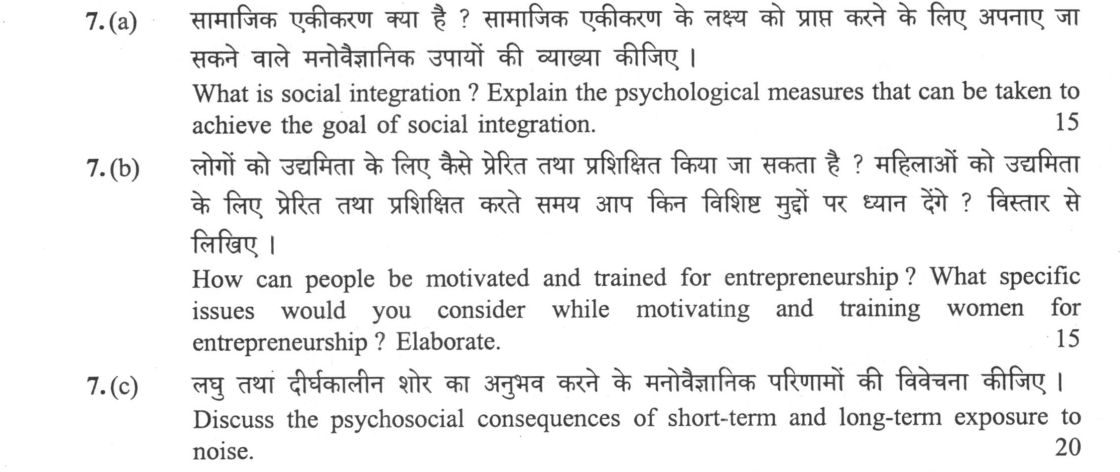
What is social integration ? Explain the psychological measures that can be taken to achieve the goal of social integration. 15 marks
How can people be motivated and trained for entrepreneurship ? What specific issues would you consider while motivating and training women for entrepreneurship ? Elaborate. 15 marks
Discuss the psychosocial consequences of short-term and long-term exposure to noise. 20 marks
हिंदी में प्रश्न पढ़ें
सामाजिक एकीकरण क्या है ? सामाजिक एकीकरण के लक्ष्य को प्राप्त करने के लिए अपनाए जा सकने वाले मनोवैज्ञानिक उपायों की व्याख्या कीजिए। 15
लोगों को उद्यमिता के लिए कैसे प्रेरित तथा प्रशिक्षित किया जा सकता है ? महिलाओं को उद्यमिता के लिए प्रेरित तथा प्रशिक्षित करते समय आप किन विशिष्ट मुद्दों पर ध्यान देंगे ? विस्तार से लिखिए। 15
लघु तथा दीर्घकालीन शोर का अनुभव करने के मनोवैज्ञानिक परिणामों की विवेचना कीजिए। 20
Model answer
Written by UPSC Answer Check against this question's marking rubric, to the expected length. UPSC does not publish answers for Mains — this is one way to score well, not an official key.
Social Integration: Concept and Psychological Measures
Social integration refers to a process where diverse social, ethnic, and cultural groups participate cohesively in societal life while preserving their distinct identities. It differs from assimilation, which forces minority groups to abandon their cultural heritage to blend into the dominant culture, and acculturation, which involves multidirectional cultural exchange without necessarily guaranteeing equitable systemic inclusion.
Tajfel’s Social Identity Theory explains that social fragmentation arises from cognitive categorization, leading to in-group favouritism and out-group derogation. To counter this, Brewer’s Optimal Distinctiveness Theory suggests balancing individuals' dual needs for distinctiveness and belongingness. Key psychological measures include: Contact Hypothesis Interventions: Applying Gordon Allport’s Contact Hypothesis by structuring intergroup contact with equal status, institutional support, cooperative interdependence, and common objectives. Superordinate Goals: Implementing Muzafer Sherif’s superordinate goals to encourage cross-group cooperation on tasks that require collective effort. Empathy and Perspective-Taking: Conducting sensitivity training and role-reversal exercises to dismantle stereotypes and enhance emotional empathy. Inclusive Education: Designing multicultural school curricula and cooperative learning models (e.g., Aronson's jigsaw classroom) to foster early decategorization and recategorization into a common in-group identity.
Motivating and Training for Entrepreneurship
Entrepreneurial motivation relies on core psychological constructs. David McClelland’s Need for Achievement (n-Ach) drives calculated risk-taking and goal orientation, developed through Entrepreneurship Development Programmes (EDPs). Julian Rotter’s internal Locus of Control fosters personal accountability, while Albert Bandura’s Self-Efficacy builds conviction through mastery experiences, vicarious role modeling, and verbal persuasion. Comprehensive training must combine technical skill acquisition, psychometric assessment, seed-stage incubation, and structured mentorship.
Special Considerations for Women Entrepreneurs: Women face specific socio-psychological barriers, including internalised gender-role conflict, disproportionate caregiving burdens (work-family conflict), restricted mobility, and social stigma. Additionally, systemic hurdles like limited access to formal collateral and absence of professional networks limit growth. Interventions must include: Targeted Mentorship and Networks: Establishing women-centric business incubators and peer-support networks to provide vicarious learning and emotional validation. Psycho-Social Training: Assertiveness training, negotiation workshops, and self-efficacy coaching to counter imposter phenomenon. Institutional and Policy Synergy: Leveraging state-backed micro-credit initiatives such as PM MUDRA Yojana, Stand-Up India, and Self-Help Group (SHG) microfinance under Deendayal Antyodaya Yojana-NRLM, paired with local entrepreneurship workshops.
Psychosocial Consequences of Noise Exposure
Noise acts as an ambient environmental stressor inducing physiological, cognitive, and behavioural disruptions.
Short-Term Exposure: Immediate impacts include startle reflexes, autonomic arousal (sympathetic activation, elevated cortisol), situational annoyance, and cognitive distraction. It leads to attentional narrowing and significant performance decrements in complex, vigilance-demanding tasks, as well as heightened interpersonal irritability.
Long-Term Exposure: Chronic exposure causes sensorineural hearing loss, persistent sleep disturbances, and chronic cardiovascular conditions such as hypertension and ischemic heart disease. In children, chronic noise impairs sustained attention, memory retrieval, and language acquisition. Cohen et al.’s landmark Los Angeles airport study and Evans' Munich airport longitudinal study demonstrated elevated neuroendocrine stress responses, higher blood pressure, and severe reading impairments in children attending schools under flight paths. In India, persistent exposure to unmanaged traffic noise and high-decibel festival loudspeakers contributes to community stress and cognitive fatigue, frequently exceeding WHO Environmental Noise Guidelines.
Moderating Variables: The psychological severity of noise depends on perceived control (Glass and Singer showed that believing one has a switch to terminate noise reduces post-noise deficits), predictability (unpredictable intermittent noise causes greater cognitive interference than continuous noise), and personality traits such as high noise sensitivity and neuroticism.
Way Forward
Addressing these challenges requires an integrated applied psychological framework: dismantling intergroup friction through cooperative community architectures, fostering inclusive entrepreneurial efficacy via targeted socio-cognitive training, and enforcing environmental acoustic standards through evidence-based urban design to ensure psychological well-being across social strata.
What "Discuss" is asking you to do
Lay the issue out from more than one side — how it arose, what is claimed for it, what is held against it, and where it now stands. UPSC attaches discuss to broad topics with several live dimensions, so coverage of the dimensions earns more than the strength of your opinion.
Structure that answers it
Set the issue up → the case as it is made → the case against → the dimension both sides leave out → where the balance now lies
Where marks are lost
Listing facts with no thread between them, or arguing one side throughout and calling it a discussion.
How this answer will be evaluated
Approach
Framework: Social Psychology & Applied Psychology. (a) explain: definition/context > points in order > small example > short close | (b) explain: definition/context > points in order > small example > short close | (c) discuss: intro > 3-4 dimensions > example > balanced close Full marks: Precise definitions, named theories/studies, clear distinction between short/long-term, specific psychological mechanisms, Indian context where relevant.
Key points expected
- Precise definition of social integration
- Psychological measures (e.g., contact hypothesis, intergroup contact)
- Application of measures to reduce prejudice
- Logical connection between measures and goal
- Methods for motivating people for entrepreneurship
- Training components for entrepreneurship
- Specific issues for women (e.g., social barriers, confidence)
- Elaboration on gender-specific training needs
Evaluation rubric
Each sub-part is marked on its own, against the marks and word limit printed on the paper.
- (a) Define social integration and detail psychological measures to achieve it. 15 marks
explain— definition/context → points in order → small example → short close
Must cover
- Precise definition of social integration
- Psychological measures (e.g., contact hypothesis, intergroup contact)
- Application of measures to reduce prejudice
- Logical connection between measures and goal
Loses marks
- Confusing social integration with socialization
- Listing only social measures without psychological basis
- Vague generalities without specific psychological mechanisms
Earns more
- Reference to Allport's Contact Hypothesis
- Mention of specific psychological techniques (e.g., jigsaw classroom)
- Distinction between social and psychological integration
- Reference to Indian context (e.g., caste dynamics)
Extra mark
- Citation of specific study (e.g., Sherif's Robbers Cave)
- Diagram of intergroup contact conditions
- (b) Explain motivation/training for entrepreneurship and specific issues for women. 15 marks
explain— definition/context → points in order → small example → short close
Must cover
- Methods for motivating people for entrepreneurship
- Training components for entrepreneurship
- Specific issues for women (e.g., social barriers, confidence)
- Elaboration on gender-specific training needs
Loses marks
- Ignoring the specific 'women' aspect of the question
- Confusing motivation with training
- General advice without psychological grounding
Earns more
- Reference to self-efficacy theory
- Mention of specific barriers (e.g., work-family conflict)
- Reference to specific training programs (e.g., incubators)
- Discussion of psychological capital
Extra mark
- Citation of specific study on women entrepreneurs
- Reference to specific government schemes (e.g., Stand-Up India)
- (c) Discuss psychosocial consequences of short-term and long-term noise exposure. 20 marks
discuss— intro → 3-4 dimensions → example → balanced close
Must cover
- Short-term psychosocial consequences (e.g., annoyance, stress)
- Long-term psychosocial consequences (e.g., chronic stress, social withdrawal)
- Distinction between short-term and long-term effects
- Balanced discussion of both dimensions
Loses marks
- Confusing psychosocial with purely physiological effects
- Failing to distinguish short-term from long-term
- Vague generalities without specific psychosocial outcomes
Earns more
- Reference to specific studies (e.g., airport noise studies)
- Mention of specific psychosocial outcomes (e.g., aggression, sleep disturbance)
- Discussion of individual differences in noise sensitivity
- Reference to WHO guidelines on noise
Extra mark
- Citation of specific longitudinal study
- Diagram of noise exposure timeline and effects
Practice this exact question
Write your answer and it is marked point by point against the model answer above — what you covered, what you missed, what you got wrong.
Evaluate my answer →More from Psychology 2024 Paper II
- Q4 (a) What are the components of Vroom's theory of motivation ? How can it be used to incre…
- Q5 Answer the following questions in about 150 words each: (a) Explain multilevel marketing…
- Q6 (a) What are the prevalent forms of gender discrimination in Indian society ? Discuss the…
- Q7 (a) What is social integration ? Explain the psychological measures that can be taken to…
- Q8 (a) Discuss the role of media in the present scenario of antisocial behaviour ? Consideri…