Paper II — Q2
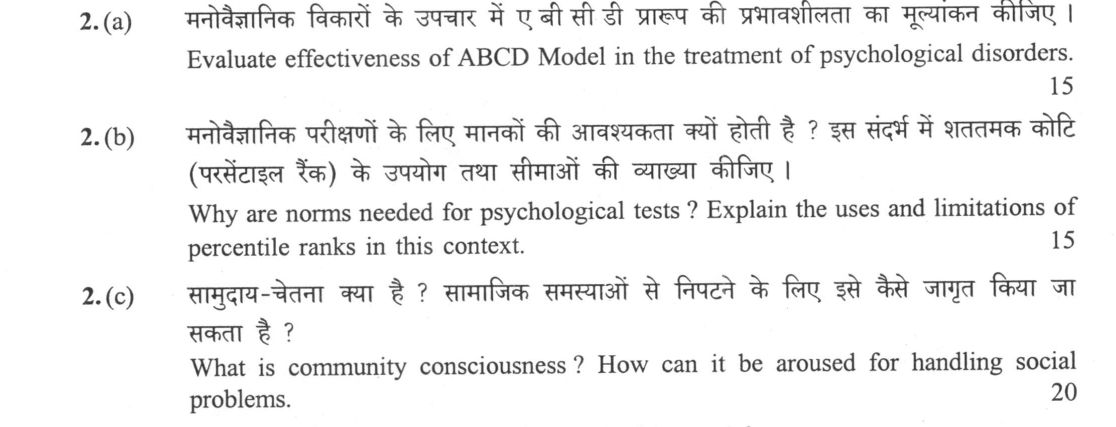
(a) Evaluate effectiveness of ABCD Model in the treatment of psychological disorders. 15 (b) Why are norms needed for…
Evaluate effectiveness of ABCD Model in the treatment of psychological disorders. 15 marks
Why are norms needed for psychological tests ? Explain the uses and limitations of percentile ranks in this context. 15 marks
What is community consciousness ? How can it be aroused for handling social problems. 20 marks
हिंदी में प्रश्न पढ़ें
मनोवैज्ञानिक विकारों के उपचार में ए बी सी डी प्रारूप की प्रभावशीलता का मूल्यांकन कीजिए । 15
मनोवैज्ञानिक परीक्षणों के लिए मानकों की आवश्यकता क्यों होती है ? इस संदर्भ में शतमक कोटि (परसेंटाइल रैंक) के उपयोग तथा सीमाओं की व्याख्या कीजिए । 15
सामुदाय-चेतना क्या है ? सामाजिक समस्याओं से निपटने के लिए इसे कैसे जागृत किया जा सकता है ? 20 marks
Model answer
Written by UPSC Answer Check against this question's marking rubric, to the expected length. UPSC does not publish answers for Mains — this is one way to score well, not an official key.
Evaluation of the ABCD Model
Albert Ellis’s ABCD framework within Rational Emotive Behaviour Therapy (REBT) conceptualises psychopathology not as a direct outcome of an Activating event (A), but as mediated by irrational Beliefs (B) characterised by dogmatic demands, awfulising, and low frustration tolerance. These beliefs generate dysfunctional emotional and behavioural Consequences (C). Therapeutic change requires active Disputing (D)—employing cognitive, logical, and empirical challenges to irrational beliefs—to yield an Effective new cognitive philosophy (E).
Empirical evaluations confirm the ABCD model's robust efficacy in treating unipolar depression, generalised anxiety, social phobias, and anger management. In comparison to Aaron Beck’s Cognitive Therapy, which relies on collaborative empiricism to test automatic thoughts through behavioural experiments, the ABCD model adopts a more direct, philosophically confrontational approach.
However, the model exhibits clear clinical and cultural boundaries. Its effectiveness diminishes in severe psychopathology such as schizophrenia, acute bipolar mania, and neurocognitive disorders, where abstract logical disputation is unfeasible due to formal thought disorders. In the Indian context, the model’s hyper-rational, individualistic ethos can clash with collectivist values and interdependent self-construals, where fatalistic or socio-centric beliefs often reflect culturally sanctioned coping mechanisms rather than purely maladaptive cognitions.
Norms in Psychological Testing and Percentile Ranks
Raw scores on psychological tests lack inherent interpretative meaning. Norms provide a standardised frame of reference derived from a representative sample, enabling clinicians to interpret individual performance, assess deviation, and establish diagnostic thresholds (e.g., in the NIMHANS Neuropsychological Battery).
Percentile ranks (PR) represent the percentage of individuals in the normative group scoring below a given raw score.
- Uses: PRs are non-parametric, intuitive, and readily understood by clients, educators, and multidisciplinary teams, facilitating direct rank-ordering and relative standing across different testing instruments.
- Limitations: PRs transform data into an ordinal scale with unequal intervals, exaggerating small raw score differences near the median of a normal distribution while compressing large score differences at the extreme tails (floor and ceiling effects). In India, reliance on Western norms or urban-centric Indian standardisations introduces systematic cultural and linguistic biases, leading to misdiagnoses when applied to rural or diverse linguistic populations.
Community Consciousness and Social Problems
Community consciousness denotes a shared collective identity, mutual emotional connection, and psychological sense of community (Seymour Sarason), coupled with collective efficacy (Albert Bandura)—the shared belief in a group's collective power to resolve systemic problems. It shifts the locus of intervention from the isolated individual to structural and socio-cultural ecologies.
Arousing community consciousness to tackle social issues such as gender-based violence, substance abuse, and open defecation requires bottom-up mobilisation rather than top-down administrative directives:
- Participatory Action Research (PAR) and CBPR: Community-Based Participatory Research fosters critical conscientization (Paulo Freire) by treating community members as co-researchers who identify indigenous problems and co-produce locally feasible solutions.
- Indigenous Communication and Folk Media: Utilising culturally resonant media, such as Nukkad Natak (street theatre), Kala Jathas, and local folklore, de-stigmatises sensitive topics, raises collective awareness, and sparks public dialogue.
- Mobilising Grassroots Collectives: Empowering self-help groups (such as Kerala’s Kudumbashree model), Village Health Sanitation and Nutrition Committees (VHSNCs), and Panchayati Raj institutions transforms passive recipients into active change agents.
Verdict
While individualistic models like the ABCD framework and standardised psychometric norms provide rigorous tools for micro-level clinical interventions, their standalone utility is constrained by cultural diversities and systemic inequities in India. A truly effective mental health framework under the National Mental Health Programme must integrate culturally tailored cognitive interventions with the bottom-up arousal of community consciousness and collective efficacy.
What "Evaluate" is asking you to do
Judge how well something has performed against the standard it set for itself — its stated aim, mandate or promise — and commit to a verdict. Name the yardstick before you judge; an unanchored judgement reads as opinion.
Structure that answers it
Name the yardstick — stated aim, mandate or benchmark → performance against it → shortfall against it → why the gap exists → verdict
Where marks are lost
Presenting both sides and then declining to decide, or delivering a verdict against a standard you never stated, which makes it look arbitrary.
How this answer will be evaluated
Approach
Framework: ABCD Model (Ellis). (a) evaluate: criteria > evidence > balanced judgment | (b) explain: definition/context > points in order > small example > short close | (c) suggest: the problem in one line > implementable measures > who acts > conclusion Full marks: Comprehensive, evidence-based, and critically analytical with specific examples.
Key points expected
- Define A, B, C, D components of the model
- Explain the mechanism of cognitive restructuring
- Provide evidence of effectiveness for specific disorders
- Critically assess limitations or scope of the model
- Define norms and their role in interpretation
- Explain the calculation and meaning of percentile ranks
- List specific uses of percentile ranks in testing
- Discuss limitations such as non-linear distribution
Evaluation rubric
Each sub-part is marked on its own, against the marks and word limit printed on the paper.
- (a) Assess the efficacy of the ABCD model in treating psychological disorders. 15 marks
evaluate— criteria → evidence → balanced judgment
Must cover
- Define A, B, C, D components of the model
- Explain the mechanism of cognitive restructuring
- Provide evidence of effectiveness for specific disorders
- Critically assess limitations or scope of the model
Loses marks
- Describing the model without evaluating its effectiveness
- Confusing ABCD with other cognitive models
Earns more
- Mention specific disorders like anxiety or depression
- Reference Ellis's Rational Emotive Behavior Therapy (REBT)
- Compare with other cognitive models
Extra mark
- Cite a specific study or meta-analysis on REBT
- Include a diagram of the ABCD process
- (b) Justify the need for norms and detail the utility and limits of percentile ranks. 15 marks
explain— definition/context → points in order → small example → short close
Must cover
- Define norms and their role in interpretation
- Explain the calculation and meaning of percentile ranks
- List specific uses of percentile ranks in testing
- Discuss limitations such as non-linear distribution
Loses marks
- Failing to distinguish between norms and standards
- Ignoring the limitations of percentile ranks
Earns more
- Mention standard deviation or z-scores as alternatives
- Give an example of a standardized test (e.g., WAIS)
- Discuss the difference between raw and standard scores
Extra mark
- Provide a specific example of a percentile rank calculation
- Reference a specific psychometric tool
- (c) Define community consciousness and propose methods to arouse it for social issues. 20 marks
suggest— the problem in one line → implementable measures → who acts → conclusion
Must cover
- Define community consciousness in a social context
- Identify key social problems requiring this consciousness
- Propose specific measures to arouse community consciousness
- Explain how these measures handle social problems
Loses marks
- Vague or general suggestions without specific measures
- Failing to link consciousness to problem-solving
Earns more
- Mention specific social problems like pollution or health
- Reference community-based organizations or NGOs
- Discuss the role of media and education
Extra mark
- Cite a specific successful community initiative
- Reference a specific government scheme or policy
Practice this exact question
Write your answer and it is marked point by point against the model answer above — what you covered, what you missed, what you got wrong.
Evaluate my answer →More from Psychology 2024 Paper II
- Q1 Answer the following questions in about 150 words each: (a) Distinguish hallucinations an…
- Q2 (a) Evaluate effectiveness of ABCD Model in the treatment of psychological disorders. 15…
- Q3 (a) Discuss rehabilitation of juvenile delinquents in Indian context. 15 (b) What is lear…
- Q4 (a) What are the components of Vroom's theory of motivation ? How can it be used to incre…
- Q5 Answer the following questions in about 150 words each: (a) Explain multilevel marketing…