Paper II — Q5
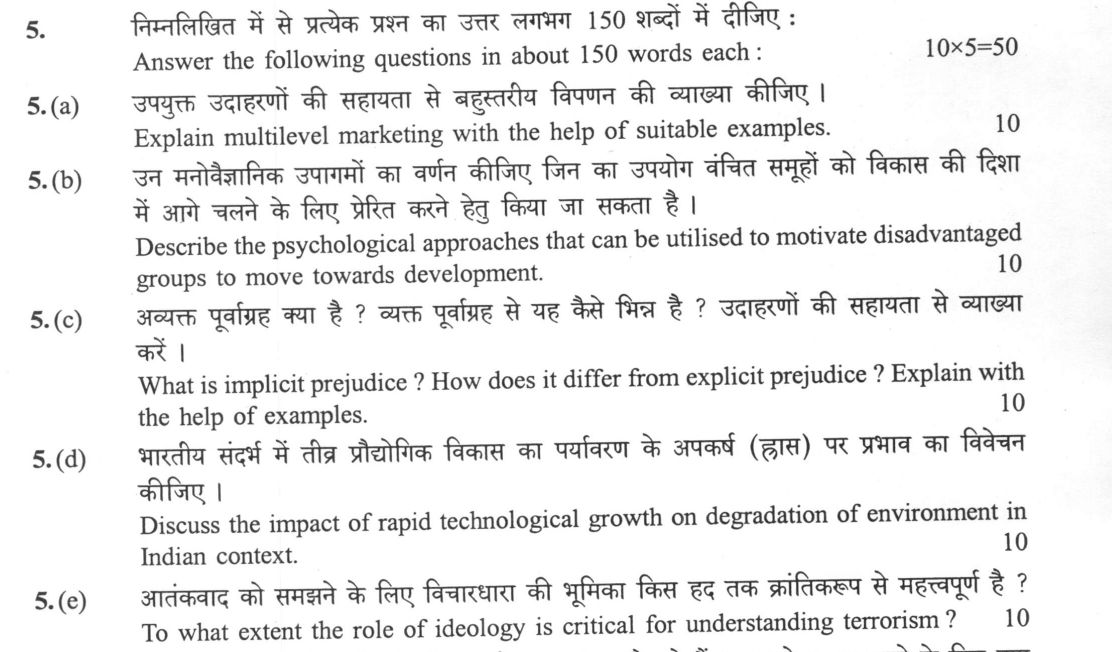
Answer the following questions in about 150 words each: (a) Explain multilevel marketing with the help of suitable examples…
Answer the following questions in about 150 words each: Explain multilevel marketing with the help of suitable examples. 10 marks
Describe the psychological approaches that can be utilised to motivate disadvantaged groups to move towards development. 10 marks
What is implicit prejudice ? How does it differ from explicit prejudice ? Explain with the help of examples. 10 marks
Discuss the impact of rapid technological growth on degradation of environment in Indian context. 10 marks
To what extent the role of ideology is critical for understanding terrorism ? 10 marks
हिंदी में प्रश्न पढ़ें
निम्नलिखित में से प्रत्येक प्रश्न का उत्तर लगभग 150 शब्दों में दीजिए : उपयुक्त उदाहरणों की सहायता से बहुस्तरीय विपणन की व्याख्या कीजिए । 10
उन मनोवैज्ञानिक उपागमों का वर्णन कीजिए जिन का उपयोग वंचित समूहों को विकास की दिशा में आगे चलने के लिए प्रेरित करने हेतु किया जा सकता है । 10
अव्यक्त पूर्वाग्रह क्या है ? व्यक्त पूर्वाग्रह से यह कैसे भिन्न है ? उदाहरणों की सहायता से व्याख्या करें । 10
भारतीय संदर्भ में तीव्र प्रौद्योगिक विकास का पर्यावरण के अपकर्ष (ह्रास) पर प्रभाव का विवेचन कीजिए । 10
आतंकवाद को समझने के लिए विचारधारा की भूमिका किस हद तक क्रांतिकरूप से महत्त्वपूर्ण है ? 10 marks
Model answer
Written by UPSC Answer Check against this question's marking rubric, to the 150-word length. UPSC does not publish answers for Mains — this is one way to score well, not an official key.
(a) Multilevel Marketing
Multilevel marketing (MLM) is a direct selling business model where independent distributors earn income through two streams: direct sales of products to consumers and commissions from the sales made by their recruited downline participants. It legally distinguishes itself from fraudulent pyramid schemes by offering legitimate, tangible goods rather than relying solely on recruitment fees. In India, companies like Amway India and Herbalife operate within regulatory frameworks, whereas entities like QNet have faced regulatory scrutiny regarding pyramid-like recruitment dynamics. Psychologically, MLMs sustain recruitment through social proof, where prospects conform after observing apparent peer wealth, and the norm of reciprocity, where initial gifts or personal mentoring create psychological indebtedness. Furthermore, MLM structures induce an illusion of control through an entrepreneurial narrative, leading recruits to attribute systemic downline saturation and financial failure to personal lack of effort rather than structural mathematical impossibility.
(b) Motivating Disadvantaged Groups towards Development
Mobilizing disadvantaged groups requires targeting psychological barriers such as learned helplessness through structured empowerment frameworks. Applying Albert Bandura’s self-efficacy theory, mastery experiences and vicarious modeling by successful peers build agency and dismantle internalized self-limiting beliefs. Integrating Amartya Sen’s capability approach with Julian Rappaport’s empowerment psychology shifts individuals from passive aid recipients to self-determined agents capable of exercising substantive freedoms. Participatory Action Research (PAR) reinforces this by fostering critical consciousness (conscientization), enabling marginalized communities to collaboratively analyze their structural disadvantages and devise solutions. In India, the National Rural Livelihoods Mission (NRLM) and Kerala’s Kudumbashree institutionalize these psychological principles through Self-Help Groups (SHGs). By combining micro-credit management with collective decision-making, these programs foster an internal locus of control and collective efficacy, which directly drive sustained socioeconomic participation and upward mobility.
(c) Implicit vs. Explicit Prejudice
Explicit prejudice consists of consciously accessible, deliberative negative attitudes and stereotypes held toward an outgroup, which an individual openly endorses. In contrast, implicit prejudice, conceptualized by Anthony Greenwald and Mahzarin Banaji, refers to automatically activated, unconscious associations that operate without intentional awareness. Explicit bias is assessed through direct self-reports, making it susceptible to social desirability bias, whereas implicit bias is measured via response latency through the Implicit Association Test (IAT). In the Indian context, a person may explicitly endorse egalitarian constitutional values rejecting caste discrimination, yet simultaneously exhibit implicit caste prejudice on an IAT through faster cognitive pairings of dominant-caste names with positive valence and marginalized-caste names with negative valence. Consequently, while explicit prejudice dictates deliberate discriminatory decisions, implicit prejudice subtly shapes micro-behaviors, nonverbal cues, hiring preferences, and spontaneous outgroup evaluations.
(d) Technological Growth and Environmental Degradation in India
Rapid technological growth accelerates environmental degradation through behavioral, consumerist, and cognitive pathways. Market-driven perceived obsolescence and planned obsolescence generate high turnover of electronic goods, fueling massive electronic waste. In India, informal processing hubs such as Mandoli and Seelampur in Delhi extract precious metals through crude chemical leaching, causing toxic heavy-metal contamination of soil and groundwater. Concurrently, rapid digitalization expands the digital carbon footprint due to high electricity demands of server farms and data infrastructure. Psychologically, excessive screen immersion reduces direct interaction with the natural environment, inducing what Richard Louv terms "nature-deficit disorder." This cognitive and affective disconnection from local ecosystems erodes biophilic affinities, diminishing environmental risk perception and undermining individual motivation to engage in pro-environmental, conservation-oriented behaviors.
(e) Role of Ideology in Understanding Terrorism
Ideology functions as a critical cognitive framework that provides moral justification, collective identity, and target specification for violent political extremism. In Silber and Bhatt’s radicalization pathway model, individuals transition from pre-radicalization to indoctrination, where ideological adoption facilitates moral disengagement and the outgroup dehumanization necessary to justify violence. Similarly, Arie Kruglanski’s Significance Quest Theory demonstrates that individuals experiencing alienation or grievance adopt radical ideologies because they offer a clear path to social significance, purpose, and self-worth. In India, this dynamic is evident in Left-Wing Extremism and cross-border terrorism in Kashmir, where ideological narratives channel local socioeconomic grievances into armed mobilization. However, ideology serves as a necessary but insufficient factor on its own; it requires an intersection with social network dynamics, perceived relative deprivation, and charismatic recruitment to translate radical cognition into active terrorist mobilization.
What "Explain" is asking you to do
Make the working of something clear — what sets it off, what follows from what, and what it produces. Explain is the Commission's mechanism word: it dominates the technical papers and the “explain why” stems, where the marks sit in the causal chain and not in the label.
Structure that answers it
State what it is → the initiating condition → the chain of cause, step by step → an instance where it plays out → what the chain produces
Where marks are lost
Describing what something looks like instead of why it works that way. Naming the stages without linking them reads as description too.
How this answer will be evaluated
Approach
Framework: Define > Theory or model > Evidence > Application. (a) explain: definition/context > points in order > small example > short close | (b) describe: define > structure or process in order > labelled diagram > significance | (c) explain: definition/context > points in order > small example > short close | (d) discuss: intro > 3-4 dimensions > example > balanced close | (e) comment: context > arguments both sides > judgment > close Full marks: Precise definitions, named theories/studies, clear examples, and balanced analysis.
Key points expected
- Define multilevel marketing (MLM) structure
- Explain the compensation plan mechanism
- Provide a suitable example (e.g., Amway, Herbalife)
- Distinguish MLM from pyramid schemes
- Identify specific psychological approaches (e.g., Self-efficacy)
- Link approach to motivation for development
- Apply to a specific disadvantaged group
- Explain the mechanism of change
Evaluation rubric
Each sub-part is marked on its own, against the marks and word limit printed on the paper.
- (a) Definition of MLM and its operational structure with examples. 10 marks · 150 words
explain— definition/context → points in order → small example → short close
Must cover
- Define multilevel marketing (MLM) structure
- Explain the compensation plan mechanism
- Provide a suitable example (e.g., Amway, Herbalife)
- Distinguish MLM from pyramid schemes
Loses marks
- Confusing MLM with direct selling
- Failing to provide a concrete example
- Vague description of the compensation structure
Earns more
- Mention specific MLM companies
- Discuss the 'downline' concept
- Reference consumer protection issues
Extra mark
- Cite a specific legal case on MLM
- Mention a specific regulatory body
- (b) Psychological strategies to motivate disadvantaged groups for development. 10 marks · 150 words
describe— define → structure or process in order → labelled diagram → significance
Must cover
- Identify specific psychological approaches (e.g., Self-efficacy)
- Link approach to motivation for development
- Apply to a specific disadvantaged group
- Explain the mechanism of change
Loses marks
- General advice without psychological basis
- Ignoring the 'disadvantaged' context
- Theory without application to development
Earns more
- Mention Bandura's Self-Efficacy Theory
- Reference Cognitive Behavioral Therapy (CBT)
- Discuss group dynamics or social learning
Extra mark
- Cite a specific field study in India
- Name a specific psychometric tool used
- (c) Definition of implicit prejudice and its distinction from explicit prejudice. 10 marks · 150 words
explain— definition/context → points in order → small example → short close
Must cover
- Define implicit prejudice (unconscious)
- Define explicit prejudice (conscious)
- Highlight the key difference (awareness/control)
- Provide examples for both types
Loses marks
- Failing to distinguish the two clearly
- Lack of concrete examples
- Confusing prejudice with discrimination
Earns more
- Mention the Implicit Association Test (IAT)
- Discuss the role of social desirability bias
- Reference Greenwald's work
Extra mark
- Cite a specific IAT study result
- Mention a specific psychometric tool
- (d) Impact of rapid technological growth on environmental degradation in India. 10 marks · 150 words
discuss— intro → 3-4 dimensions → example → balanced close
Must cover
- Identify specific technologies causing degradation
- Explain the mechanism of environmental impact
- Contextualize within the Indian scenario
- Provide specific examples (e.g., e-waste, mining)
Loses marks
- General statements without Indian context
- Ignoring the 'rapid growth' aspect
- Failing to link technology to specific degradation
Earns more
- Mention specific Indian industries (e.g., IT, manufacturing)
- Reference specific environmental issues (e.g., air/water pollution)
- Discuss the trade-off between growth and environment
Extra mark
- Cite a specific Indian environmental policy
- Mention a specific statistic on pollution
- (e) Critical assessment of ideology's role in understanding terrorism. 10 marks · 150 words
comment— context → arguments both sides → judgment → close
Must cover
- Define the role of ideology in terrorism
- Present arguments for its critical importance
- Present arguments for its limitations
- Offer a balanced judgment on its extent
Loses marks
- One-sided argument (only for or against)
- Failing to address the 'extent' of the role
- Vague generalizations without specific examples
Earns more
- Mention specific ideologies (e.g., religious, political)
- Reference specific terrorist groups
- Discuss the interplay with other factors (e.g., poverty)
Extra mark
- Cite a specific academic study on terrorism
- Mention a specific theoretical framework
Practice this exact question
Write your answer and it is marked point by point against the model answer above — what you covered, what you missed, what you got wrong.
Evaluate my answer →More from Psychology 2024 Paper II
- Q2 (a) Evaluate effectiveness of ABCD Model in the treatment of psychological disorders. 15…
- Q3 (a) Discuss rehabilitation of juvenile delinquents in Indian context. 15 (b) What is lear…
- Q4 (a) What are the components of Vroom's theory of motivation ? How can it be used to incre…
- Q5 Answer the following questions in about 150 words each: (a) Explain multilevel marketing…
- Q6 (a) What are the prevalent forms of gender discrimination in Indian society ? Discuss the…
- Q7 (a) What is social integration ? Explain the psychological measures that can be taken to…
- Q8 (a) Discuss the role of media in the present scenario of antisocial behaviour ? Consideri…