Paper II — Q8
(a) Discuss the role of media in the present scenario of antisocial behaviour ? Considering Indian context in view suggest some…
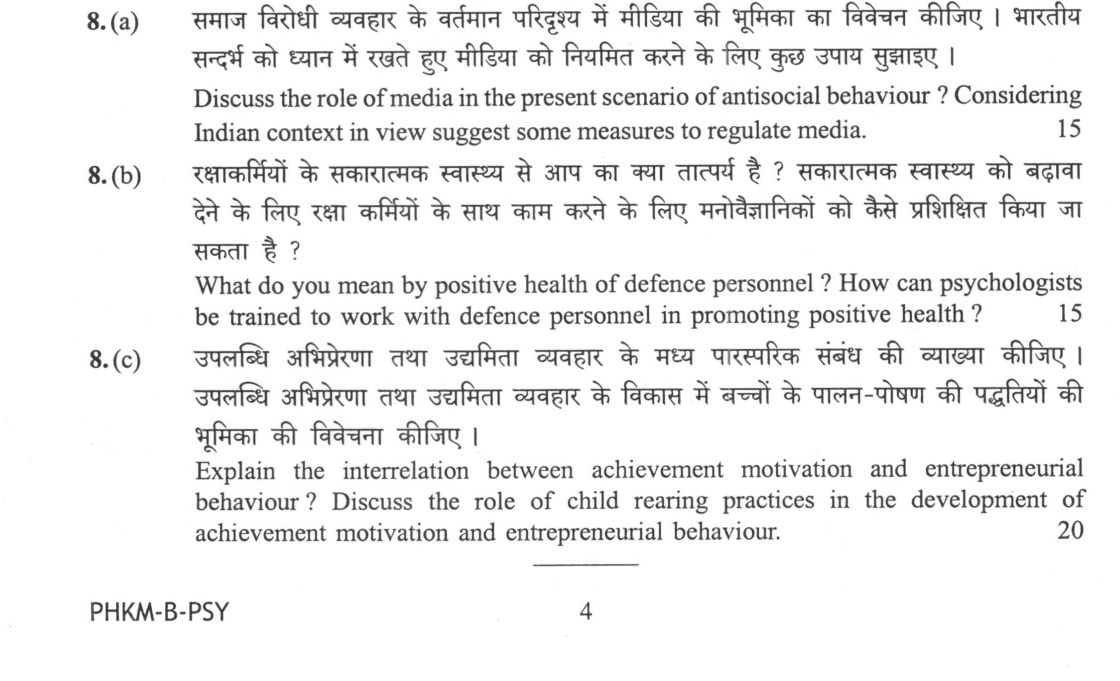
Discuss the role of media in the present scenario of antisocial behaviour ? Considering Indian context in view suggest some measures to regulate media. 15 marks
What do you mean by positive health of defence personnel ? How can psychologists be trained to work with defence personnel in promoting positive health ? 15 marks
Explain the interrelation between achievement motivation and entrepreneurial behaviour ? Discuss the role of child rearing practices in the development of achievement motivation and entrepreneurial behaviour. 20 marks
हिंदी में प्रश्न पढ़ें
समाज विरोधी व्यवहार के वर्तमान परिदृश्य में मीडिया की भूमिका का विवेचन कीजिए। भारतीय संदर्भ को ध्यान में रखते हुए मीडिया को नियमित करने के लिए कुछ उपाय सुझाइए। 15
रक्षाकर्मियों के सकारात्मक स्वास्थ्य से आप का क्या तात्पर्य है ? सकारात्मक स्वास्थ्य को बढ़ावा देने के लिए रक्षा कर्मियों के साथ काम करने के लिए मनोवैज्ञानिकों को कैसे प्रशिक्षित किया जा सकता है ? 15 marks
उपलब्धि अभिप्रेरणा तथा उद्यमिता व्यवहार के मध्य पारस्परिक संबंध की व्याख्या कीजिए। उपलब्धि अभिप्रेरणा तथा उद्यमिता व्यवहार के विकास में बच्चों के पालन-पोषण की पद्धतियों की भूमिका की विवेचना कीजिए। 20
Model answer
Written by UPSC Answer Check against this question's marking rubric, to the expected length. UPSC does not publish answers for Mains — this is one way to score well, not an official key.
Media and Antisocial Behaviour
The relationship between media consumption and antisocial behaviour operates through established psychological mechanisms. Albert Bandura’s Social Learning Theory demonstrates that aggressive and deviant behaviours are acquired through observational learning, modeling, and vicarious reinforcement, exacerbated by interactive digital video games and violent content. George Gerbner’s Cultivation Theory explains how prolonged exposure to hostile content cultivates a "mean world" syndrome, heightening perceived vulnerability and reactive aggression. Furthermore, continuous exposure leads to cognitive and physiological desensitization, diminishing empathy toward real-world victims and lowering inhibitions against cyberbullying, trolling, and hate speech.
In the Indian context, media regulation demands a delicate balance between fundamental speech freedoms and social order. Legislative measures like the Information Technology (Intermediary Guidelines and Digital Media Ethics Code) Rules, 2021 introduce a three-tier grievance redressal framework and content categorization. However, the debate between state-led control and self-regulation (via bodies like the News Broadcasting and Digital Standards Authority) highlights the risk of censorship versus regulatory laxity. Regulation must extend beyond punitive legalities to institutionalized digital media literacy in school curricula, empowering consumers to critically evaluate media narratives and mitigate antisocial outcomes.
Positive Health in Defence Personnel
Positive health in the military domain extends beyond the mere absence of psychopathology or operational fatigue. It constitutes a holistic state characterized by psychological resilience, robust emotional regulation, high unit cohesion (esprit de corps), hardiness, and the capacity for post-traumatic growth in high-stress, combat, or isolated deployments.
Training psychologists to work with defence personnel requires a specialized pedagogical framework:
- Military Cultural Competence: Psychologists must understand military ethos, rank hierarchies, operational environments, and subcultural stigmas surrounding mental health to build therapeutic alliance.
- Trauma-Informed and Evidence-Based Interventions: Training must emphasize stress-inoculation therapy, EMDR, and rapid management of operational stress injuries and moral injury.
- Peer-Support Integration: Psychologists should be equipped to institutionalize community-level mental hygiene frameworks, strengthening traditional military mechanisms like the "Buddy System" in coordination with bodies like the Defence Institute of Psychological Research (DIPR).
Achievement Motivation, Entrepreneurship, and Child-Rearing
David McClelland’s theory posits that the Need for Achievement (nAch) is the primary psychological driver of entrepreneurial behaviour. Individuals high in nAch exhibit a preference for calculated, moderate risks, seek personal responsibility for solving problems, and require concrete feedback on performance. McClelland’s seminal Kakinada Experiment in India proved that nAch can be induced through targeted psychological training, directly spurring local commercial enterprise. In modern India, high nAch combined with an internal locus of control drives the innovation, calculated risk-taking, and resilience seen in the expanding startup ecosystem, although in collectivist contexts, entrepreneurial achievement is often co-motivated by familial and community advancement.
The development of nAch and entrepreneurial orientation is deeply rooted in early socialization:
- Independence Training: As Marian Winterbottom identified, early parental encouragement of autonomy, self-reliance, and mastery tasks without excessive restrictions fosters high nAch.
- Parenting Styles: Diana Baumrind’s authoritative parenting—combining high warmth with clear, demanding standards—nurtures emotional security, exploratory drive, and frustration tolerance. In contrast, authoritarian or overprotective parenting stifles self-efficacy and fear of failure.
- Mastery-Oriented Feedback: Praise directed at effort and strategy rather than innate ability (Carol Dweck’s growth mindset) instills an internal attribution style, teaching children to view setbacks as feedback rather than failure, a cornerstone of entrepreneurial resilience.
Way Forward
Applied psychology provides pivotal frameworks for addressing complex socio-national challenges. Integrating empirical behavioral insights into national media policy, armed forces welfare doctrines, and early developmental education will foster a resilient, mentally sound, and enterprise-driven society.
What "Discuss" is asking you to do
Lay the issue out from more than one side — how it arose, what is claimed for it, what is held against it, and where it now stands. UPSC attaches discuss to broad topics with several live dimensions, so coverage of the dimensions earns more than the strength of your opinion.
Structure that answers it
Set the issue up → the case as it is made → the case against → the dimension both sides leave out → where the balance now lies
Where marks are lost
Listing facts with no thread between them, or arguing one side throughout and calling it a discussion.
How this answer will be evaluated
Approach
Framework: null. (a) discuss: intro > 3-4 dimensions > example > balanced close | (b) explain: definition/context > points in order > small example > short close | (c) explain: definition/context > points in order > small example > short close Full marks: Comprehensive, well-structured, with specific theories, Indian context, and named studies.
Key points expected
- Link media content to specific antisocial behaviors (violence, crime)
- Cite psychological theories (e.g., Social Learning Theory, Desensitization)
- Reference Indian regulatory bodies (e.g., MIB, Press Council)
- Suggest specific, implementable measures for regulation
- Define positive health beyond absence of pathology (resilience, well-being)
- Identify specific stressors of defence personnel (deployment, isolation)
- List specific training modules for psychologists (e.g., CBT, resilience training)
- Explain the application of these skills in a military setting
Evaluation rubric
Each sub-part is marked on its own, against the marks and word limit printed on the paper.
- (a) Analyze media's role in antisocial behavior and suggest regulatory measures for the Indian context. 15 marks
discuss— intro → 3-4 dimensions → example → balanced close
Must cover
- Link media content to specific antisocial behaviors (violence, crime)
- Cite psychological theories (e.g., Social Learning Theory, Desensitization)
- Reference Indian regulatory bodies (e.g., MIB, Press Council)
- Suggest specific, implementable measures for regulation
Loses marks
- Generalizing without specific Indian context
- Listing measures without psychological justification
- Ignoring the 'present scenario' aspect (e.g., digital age)
Earns more
- Mention specific Indian studies or data on media impact
- Discuss the role of social media vs. traditional media
- Reference the 'Cult of Violence' or 'Mean World Syndrome'
Extra mark
- Cite a specific Supreme Court judgment on media regulation
- Reference a specific committee report (e.g., Press Council of India)
- (b) Define positive health for defence personnel and outline training methods for psychologists. 15 marks
explain— definition/context → points in order → small example → short close
Must cover
- Define positive health beyond absence of pathology (resilience, well-being)
- Identify specific stressors of defence personnel (deployment, isolation)
- List specific training modules for psychologists (e.g., CBT, resilience training)
- Explain the application of these skills in a military setting
Loses marks
- Focusing only on clinical treatment (PTSD) rather than positive health
- Generic advice not tailored to defence context
- Ignoring the 'training' aspect for psychologists
Earns more
- Mention specific psychological tools (e.g., SCL-90, resilience scales)
- Discuss the role of peer support systems
- Reference specific defence psychology programs (e.g., DRC, DRDO)
Extra mark
- Cite a specific study on defence personnel mental health
- Mention a specific international model (e.g., US Army's STAM program)
- (c) Explain the link between achievement motivation and entrepreneurship, and the role of child-rearing practices. 20 marks
explain— definition/context → points in order → small example → short close
Must cover
- Define achievement motivation (McClelland's nAch)
- Explain the link to entrepreneurial behavior (risk-taking, innovation)
- Discuss specific child-rearing practices (e.g., autonomy, discipline)
- Link parenting styles to the development of nAch
Loses marks
- Confusing achievement motivation with general intelligence
- Ignoring the 'child-rearing' aspect of the question
- Failing to link the two concepts (motivation and behavior)
Earns more
- Mention McClelland's 'The Achieving Society' or specific studies
- Discuss the role of 'locus of control' in this relationship
- Reference specific parenting styles (e.g., authoritative vs. authoritarian)
Extra mark
- Cite a specific study on child-rearing and entrepreneurship
- Mention a specific psychometric tool for measuring nAch (e.g., TAT)
Practice this exact question
Write your answer and it is marked point by point against the model answer above — what you covered, what you missed, what you got wrong.
Evaluate my answer →More from Psychology 2024 Paper II
- Q5 Answer the following questions in about 150 words each: (a) Explain multilevel marketing…
- Q6 (a) What are the prevalent forms of gender discrimination in Indian society ? Discuss the…
- Q7 (a) What is social integration ? Explain the psychological measures that can be taken to…
- Q8 (a) Discuss the role of media in the present scenario of antisocial behaviour ? Consideri…