Paper II — Q4
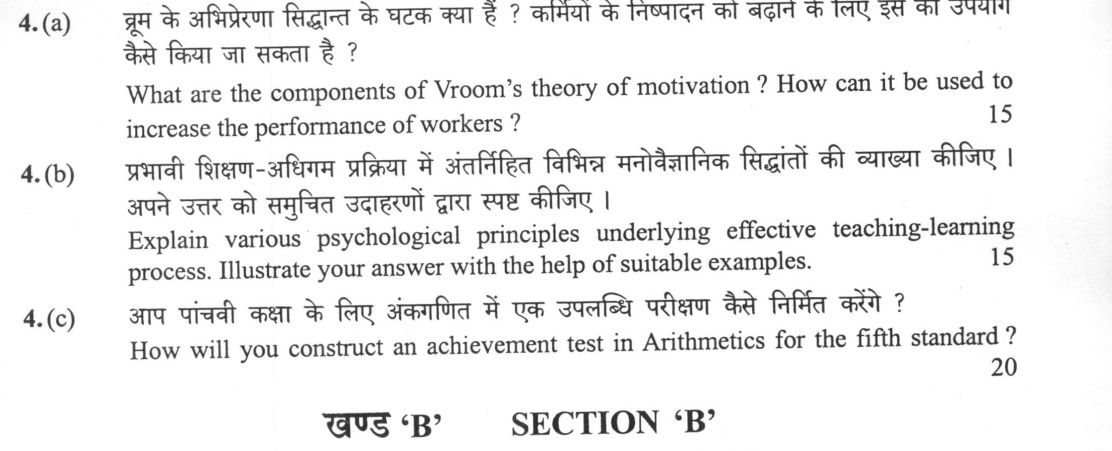
(a) What are the components of Vroom's theory of motivation ? How can it be used to increase the performance of workers ? 15 (b)…
What are the components of Vroom's theory of motivation ? How can it be used to increase the performance of workers ? 15 marks
Explain various psychological principles underlying effective teaching-learning process. Illustrate your answer with the help of suitable examples. 15 marks
How will you construct an achievement test in Arithmetics for the fifth standard ? 20 marks
हिंदी में प्रश्न पढ़ें
व्रूम के अभिप्रेरणा सिद्धांत के घटक क्या हैं ? कर्मियों के निष्पादन को बढ़ाने के लिए इस का उपयोग कैसे किया जा सकता है ? 15 marks
प्रभावी शिक्षण-अधिगम प्रक्रिया में अंतर्निहित विभिन्न मनोवैज्ञानिक सिद्धांतों की व्याख्या कीजिए । अपने उत्तर को समुचित उदाहरणों द्वारा स्पष्ट कीजिए । 15
आप पांचवीं कक्षा के लिए अंकगणित में एक उपलब्धि परीक्षण कैसे निर्मित करेंगे ? 20 marks
Model answer
Written by UPSC Answer Check against this question's marking rubric, to the expected length. UPSC does not publish answers for Mains — this is one way to score well, not an official key.
(a) Vroom’s Expectancy Theory, also called VIE theory, explains motivation through three perceptual components. Expectancy (E → P) is the belief that effort will lead to successful performance. Instrumentality (P → O) is the belief that performance will lead to outcomes or rewards. Valence (V) is the value or attractiveness of those outcomes to the worker. Motivation Force = Expectancy × Instrumentality × Valence. Since it is multiplicative, if any component is zero, motivation becomes zero.
To increase worker performance, managers should strengthen each link. First, raise expectancy by giving training, resources, role clarity, feedback, self-efficacy building, and removing obstacles. For example, if a worker believes extra effort cannot improve output because machines are faulty, expectancy is low; repairing machines raises it. Second, raise instrumentality by making rewards contingent on measurable performance, using transparent appraisal, timely rewards, and trustworthy contracts. If workers doubt that high performance will actually bring promotion or bonus, instrumentality is low. Third, raise valence by individualising incentives such as bonus, recognition, autonomy, career growth, or leave, because the same reward may not be valued by all. Fourth, use goal setting, periodic feedback, distributive and procedural justice, and supportive supervision. Example: a salesperson will be motivated if she values bonus, believes more calls yield sales, and believes sales yield bonus. If appraisal is biased, instrumentality collapses. The theory assumes rational perceived contingencies; cultural differences may alter valence and instrumentality.
(b) Effective teaching-learning rests on several psychological principles. Readiness and maturation: teach when the learner is developmentally ready; for example, fifth graders learn fractions better with concrete rotis or chocolate pieces before abstract symbols. Motivation: intrinsic curiosity and extrinsic rewards sustain attention; a puzzle-based arithmetic task increases engagement. Active participation: learning by doing; students measure classroom objects to learn length. Reinforcement and feedback: immediate, specific feedback strengthens correct responses; the teacher corrects the method of long division, not merely the answer. Law of effect: pleasant consequences strengthen learning. Meaningful learning: connect new material to prior knowledge; decimals can be linked to money. Organisation and chunking: present information in structured steps; the teacher chunks long division into divide, multiply, subtract, bring down. Individual differences: use varied methods and pace; remedial and enrichment tasks for different learners. Vygotsky’s zone of proximal development and scaffolding: teacher models a sum, then gives hints, then withdraws support. Metacognition: students check whether an answer is reasonable. Spaced practice and overlearning: weekly revision prevents forgetting. Transfer: apply arithmetic to shopping bills. Social learning: peer modelling and cooperative learning help slower learners. Emotional safety: a positive error climate reduces maths anxiety. Gagne’s events of instruction—gaining attention, stating objectives, recalling prior learning, presenting stimuli, providing learning guidance, eliciting performance, giving feedback, assessing performance, and enhancing retention and transfer—also guide effective teaching. These principles work when matched to age, subject, and cultural context.
(c) To construct an achievement test in Arithmetic for the fifth standard, I will follow these steps. Step 1: Define purpose and population—10–11-year-old fifth graders, school syllabus, achievement and diagnostic purpose. Step 2: Prepare a blueprint. Content domains may include number system and operations; factors and multiples; fractions and decimals; measurement, time and money; geometry, area and perimeter; data handling. Objectives should cover knowledge, understanding, application, and problem-solving skill. For a 50-mark, 90-minute test, an example weightage is: number system 15, fractions/decimals 10, measurement/money/time 10, geometry 10, data handling 5; objectives: knowledge 10, understanding 15, application 20, skill 5. Step 3: Choose item types—MCQ, fill in the blanks, true/false, matching, short answer, and word problems. Examples: “Write the place value of 7 in 4,73,218”; “Solve 3/4 + 2/5”; “A rectangle is 8 cm by 5 cm, find its area”; “Find the average of 12, 15, 18.” Step 4: Write items in simple language, one idea per item, no clues, grade-level vocabulary. Step 5: Expert review and pre-tryout for content validity and clarity. Step 6: Conduct a preliminary tryout on a representative sample. Step 7: Do item analysis. Use difficulty index P = R/N, where R is number correct and N is total. Use discrimination index D = (RU − RL)/n, where RU and RL are correct in upper and lower 27% groups and n is number in each group. Retain items with P around 0.2–0.8 and D ≥ 0.2; revise or delete poor items. Step 8: Assemble the final test: easy to hard order, clear instructions, scoring key, and adequate time. Step 9: Estimate reliability using test-retest, split-half with Spearman-Brown, or KR-20/Cronbach alpha. Step 10: Establish validity—content validity through blueprint and experts; concurrent validity with teacher ratings and previous arithmetic marks; construct validity through factor analysis or correlation with related arithmetic abilities. Step 11: Standardise by administering to a large representative fifth-standard sample and computing mean, SD, percentile or grade norms. Step 12: Score objectively for MCQs and use step-marking for problems; interpret content-wise and objective-wise to plan remedial teaching. The test is valid only if the blueprint matches the syllabus, administration is uniform, and norms come from a comparable population.
What "Construct" is asking you to do
Build the required object — a velocity diagram, a sequential test, a control chart, a geometrical figure — step by step, so the sequence is visible on the page. The steps are marked, not only the finished thing.
Structure that answers it
Data and requirement → scale or basis chosen, stated → construction steps in order → the finished construction, labelled → quantities read off, or the result it yields
Where marks are lost
A diagram drawn without a stated scale, so nothing can be scaled off it and the quantities that follow lose their support. In statistics, writing down the procedure without fixing its defining constants — stopping bounds in terms of the two error probabilities, or the control limits — leaves it unmarkable.
How this answer will be evaluated
Approach
Framework: Vroom's Expectancy Theory (VIE Model). (a) explain: definition/context > points in order > small example > short close | (b) explain: definition/context > points in order > small example > short close | (c) derive: given > assumptions > stepwise derivation > result > check Full marks: Comprehensive, accurate, well-structured with specific examples and diagrams.
Key points expected
- Define Expectancy, Instrumentality, Valence
- Explain the multiplicative relationship (E x I x V)
- Link components to specific worker performance strategies
- Provide a practical example of application
- Identify at least 3 distinct psychological principles
- Explain the mechanism of each principle
- Provide a suitable example for each principle
- Link principles to the effective teaching process
Evaluation rubric
Each sub-part is marked on its own, against the marks and word limit printed on the paper.
- (a) Define Vroom's theory components and apply to worker performance. 15 marks
explain— definition/context → points in order → small example → short close
Must cover
- Define Expectancy, Instrumentality, Valence
- Explain the multiplicative relationship (E x I x V)
- Link components to specific worker performance strategies
- Provide a practical example of application
Loses marks
- Confusing Vroom's theory with Maslow or Herzberg
- Listing components without explaining their interaction
- Generic advice without linking to the theory's mechanics
Earns more
- Mention Vroom's 1964 book 'Work and Motivation'
- Discuss the role of individual differences in Valence
- Compare briefly with other motivation theories
Extra mark
- Draw a diagram of the E-I-V chain
- Cite a specific study on expectancy in Indian industry
- (b) Explain psychological principles of teaching-learning with examples. 15 marks
explain— definition/context → points in order → small example → short close
Must cover
- Identify at least 3 distinct psychological principles
- Explain the mechanism of each principle
- Provide a suitable example for each principle
- Link principles to the effective teaching process
Loses marks
- Vague generalities without specific psychological terms
- Examples that do not clearly illustrate the principle
- Ignoring the 'learning' aspect and focusing only on teaching
Earns more
- Reference specific psychologists (e.g., Skinner, Piaget, Vygotsky)
- Discuss the role of reinforcement or scaffolding
- Mention the importance of feedback in learning
Extra mark
- Reference a specific named experiment (e.g., Pavlov, Skinner box)
- Use a table to map principles to teaching strategies
- (c) Construct an achievement test in Arithmetics for 5th standard. 20 marks
derive— given → assumptions → stepwise derivation → result → check
Must cover
- Define the scope of 5th standard Arithmetics
- Outline the test construction steps (specification table)
- Provide sample questions covering different cognitive levels
- Discuss validity and reliability of the test
Loses marks
- Failing to mention the specification table/blueprint
- Sample questions that are too easy or too hard for 5th standard
- Ignoring the 'Arithmetics' specific content
Earns more
- Mention Bloom's Taxonomy for cognitive levels
- Include a sample specification table (blueprint)
- Discuss item analysis and difficulty index
Extra mark
- Provide a full sample test paper
- Reference specific psychometric tools for test evaluation
Practice this exact question
Write your answer and it is marked point by point against the model answer above — what you covered, what you missed, what you got wrong.
Evaluate my answer →More from Psychology 2024 Paper II
- Q1 Answer the following questions in about 150 words each: (a) Distinguish hallucinations an…
- Q2 (a) Evaluate effectiveness of ABCD Model in the treatment of psychological disorders. 15…
- Q3 (a) Discuss rehabilitation of juvenile delinquents in Indian context. 15 (b) What is lear…
- Q4 (a) What are the components of Vroom's theory of motivation ? How can it be used to incre…
- Q5 Answer the following questions in about 150 words each: (a) Explain multilevel marketing…
- Q6 (a) What are the prevalent forms of gender discrimination in Indian society ? Discuss the…
- Q7 (a) What is social integration ? Explain the psychological measures that can be taken to…