Paper II — Q3
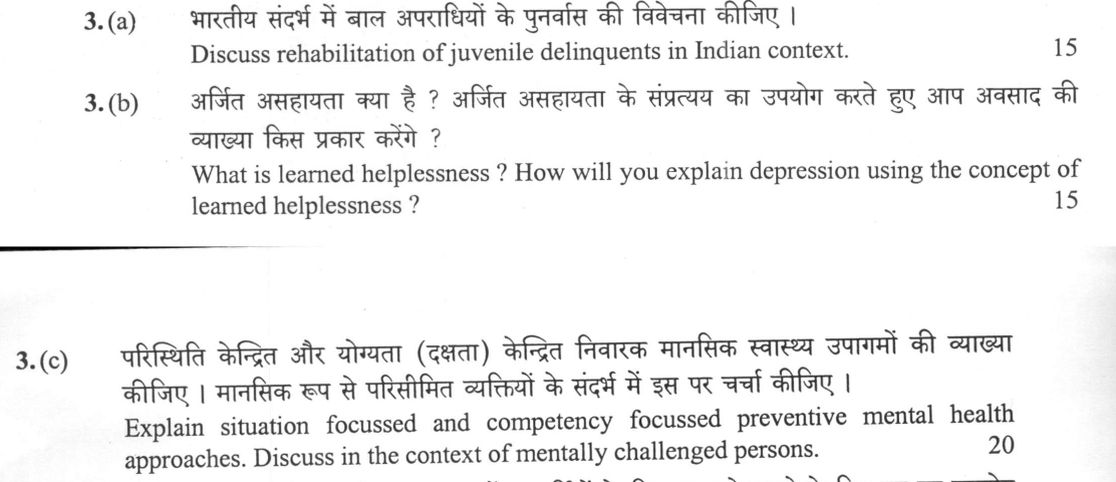
(a) Discuss rehabilitation of juvenile delinquents in Indian context. 15 (b) What is learned helplessness ? How will you explain…
Discuss rehabilitation of juvenile delinquents in Indian context. 15 marks
What is learned helplessness ? How will you explain depression using the concept of learned helplessness ? 15 marks
Explain situation focussed and competency focussed preventive mental health approaches. Discuss in the context of mentally challenged persons. 20 marks
हिंदी में प्रश्न पढ़ें
भारतीय संदर्भ में बाल अपराधियों के पुनर्वास की विवेचना कीजिए । 15
अर्जित असहायता क्या है ? अर्जित असहायता के संप्रत्यय का उपयोग करते हुए आप अवसाद की व्याख्या किस प्रकार करेंगे ? 15 marks
परिस्थिति केंद्रित और योग्यता (दक्षता) केंद्रित निवारक मानसिक स्वास्थ्य उपागमों की व्याख्या कीजिए । मानसिक रूप से परिसीमित व्यक्तियों के संदर्भ में इस पर चर्चा कीजिए । 20
Model answer
Written by UPSC Answer Check against this question's marking rubric, to the expected length. UPSC does not publish answers for Mains — this is one way to score well, not an official key.
Rehabilitation and preventive mental health frameworks are vital for safeguarding vulnerable populations in India. The Juvenile Justice (Care and Protection of Children) Act, 2015 provides the statutory foundation for transforming juvenile delinquents through restorative rather than retributive justice, balancing institutional and non-institutional pathways.
Rehabilitation of Juvenile Delinquents in India
Institutional rehabilitation operates through Observation Homes for temporary custody during inquiry, Special Homes for long-term reformative custody up to three years, and Places of Safety for older adolescents committing heinous offences. In contrast, non-institutional measures prioritize social integration through probation, foster care, sponsorship, community service, and aftercare organizations.
However, National Crime Records Bureau (NCRB) data indicates persistent recidivism and rising juvenile pendency. Institutional facilities face critical deficits including severe overcrowding, custodial abuse, inadequate psychiatric evaluation, and custodial violence. True rehabilitation requires tailoring Individual Care Plans (ICPs) for every juvenile, structured vocational training matched with market demand, psycho-social counselling for substance abuse, and active family reintegration to mitigate post-release stigmatization.
Learned Helplessness and Depression
Martin Seligman formulated the learned helplessness model through experimental paradigms with dogs exposed to inescapable electric shocks in a triadic design. The animals learned that outcomes were independent of their voluntary responses, causing subsequent passivity even when escape was possible.
Abramson, Seligman, and Teasdale reformulated this into an attributional and hopelessness framework. Depression develops when an individual attributes aversive, uncontrollable events to causes that are internal ("it is my fault"), stable ("it will never change"), and global ("it ruins everything"). This attributional style triggers three major deficits: motivational deficits (passivity, psychomotor retardation), cognitive deficits (impaired problem-solving, belief in future failure), and emotional deficits (depressed mood, apathy, loss of self-esteem).
While Aaron Beck’s cognitive triad focuses on pervasive negative schemata regarding the self, world, and future, learned helplessness specifically emphasizes perceived uncontrollability and explanatory style. In India, National Mental Health Survey (NMHS) findings underscore rising adolescent depression, often precipitated by intense academic stress and familial pressures where students develop learned helplessness regarding rigid socio-educational expectations.
Preventive Mental Health Approaches and Intellectual Disabilities
Preventive mental health operates through two complementary paradigms. Situation-focussed prevention seeks to modify external environmental stressors, provide crisis intervention, and eliminate systemic barriers. Competency-focussed prevention aims to enhance individual psychosocial resources, resilience, coping repertoires, and self-efficacy.
In the context of mentally challenged persons (individuals with intellectual and developmental disabilities), both approaches are essential:
Situation-focussed interventions include early screening and intervention clinics, structural accessibility, crisis support for caregiver burnout, and Community-Based Rehabilitation (CBR). The Rights of Persons with Disabilities (RPwD) Act, 2016 provides the statutory backing for reasonable accommodation, anti-discrimination, and subsidized welfare.
Competency-focussed interventions emphasize tailored life-skills training, functional communication, adaptive behavioral therapy, and special education provisions under Samagra Shiksha (incorporating the Inclusive Education for Disabled Children framework). Supported vocational training institutes build economic competencies and task-specific proficiencies, enabling gainful employment.
Way Forward
Western psychological paradigms must be critically adapted to Indian socio-cultural realities, where familial interdependence, community networks, and structural inequalities shape mental health. A rights-based approach aligned with the United Nations Convention on the Rights of Persons with Disabilities (UNCRPD) and Sustainable Development Goals (SDGs 3 and 10) is imperative. Bridging policy and ground realities through decentralized mental health services under the National Mental Health Programme (NMHP), combined with community-led empowerment, offers the most viable path toward sustainable rehabilitation and mental well-being across all vulnerable groups.
What "Discuss" is asking you to do
Lay the issue out from more than one side — how it arose, what is claimed for it, what is held against it, and where it now stands. UPSC attaches discuss to broad topics with several live dimensions, so coverage of the dimensions earns more than the strength of your opinion.
Structure that answers it
Set the issue up → the case as it is made → the case against → the dimension both sides leave out → where the balance now lies
Where marks are lost
Listing facts with no thread between them, or arguing one side throughout and calling it a discussion.
How this answer will be evaluated
Approach
Framework: null. (a) discuss: intro > 3-4 dimensions > example > balanced close | (b) explain: definition/context > points in order > small example > short close | (c) explain: definition/context > points in order > small example > short close Full marks: Precise definitions, specific legal/psychological references, clear application to the context.
Key points expected
- Define juvenile delinquency and rehabilitation
- Cite Juvenile Justice (Care and Protection of Children) Act
- Discuss institutional mechanisms (Observation/Reformatories)
- Evaluate challenges in Indian context
- Define learned helplessness (Seligman)
- Explain the three explanatory styles (Pessimistic)
- Link the concept to the onset of depression
- Mention the 'explanatory style' mechanism
Evaluation rubric
Each sub-part is marked on its own, against the marks and word limit printed on the paper.
- (a) Analytical overview of juvenile delinquency rehabilitation in India. 15 marks
discuss— intro → 3-4 dimensions → example → balanced close
Must cover
- Define juvenile delinquency and rehabilitation
- Cite Juvenile Justice (Care and Protection of Children) Act
- Discuss institutional mechanisms (Observation/Reformatories)
- Evaluate challenges in Indian context
Loses marks
- General advice without legal framework
- Ignoring the 'Indian context' aspect
Earns more
- Mention specific committees (e.g., Justice Verma)
- Reference specific case laws
- Discuss non-institutional measures (probation)
Extra mark
- Cite specific statistics on juvenile crime
- Mention specific NGO initiatives
- (b) Definition of learned helplessness and its application to depression. 15 marks
explain— definition/context → points in order → small example → short close
Must cover
- Define learned helplessness (Seligman)
- Explain the three explanatory styles (Pessimistic)
- Link the concept to the onset of depression
- Mention the 'explanatory style' mechanism
Loses marks
- Confusing with general stress response
- Failing to link to depression specifically
Earns more
- Reference Seligman's original dog experiments
- Mention Abramson's reformulation (Attributional Theory)
Extra mark
- Cite specific psychometric tools (e.g., ASQ)
- Mention specific clinical studies
- (c) Comparison of situation vs competency focused prevention for mentally challenged. 20 marks
explain— definition/context → points in order → small example → short close
Must cover
- Define situation-focused preventive approach
- Define competency-focused preventive approach
- Apply both to mentally challenged persons
- Provide specific examples for each approach
Loses marks
- Defining without application to the specific group
- Confusing the two approaches
Earns more
- Mention specific interventions (e.g., social skills training)
- Discuss the role of family/community
- Reference specific mental health programs
Extra mark
- Cite specific government schemes (e.g., NIMHANS)
- Mention specific research findings
Practice this exact question
Write your answer and it is marked point by point against the model answer above — what you covered, what you missed, what you got wrong.
Evaluate my answer →More from Psychology 2024 Paper II
- Q1 Answer the following questions in about 150 words each: (a) Distinguish hallucinations an…
- Q2 (a) Evaluate effectiveness of ABCD Model in the treatment of psychological disorders. 15…
- Q3 (a) Discuss rehabilitation of juvenile delinquents in Indian context. 15 (b) What is lear…
- Q4 (a) What are the components of Vroom's theory of motivation ? How can it be used to incre…
- Q5 Answer the following questions in about 150 words each: (a) Explain multilevel marketing…
- Q6 (a) What are the prevalent forms of gender discrimination in Indian society ? Discuss the…