Paper II — Q6
(a) What are the prevalent forms of gender discrimination in Indian society ? Discuss the measures that can be taken to eradicate…
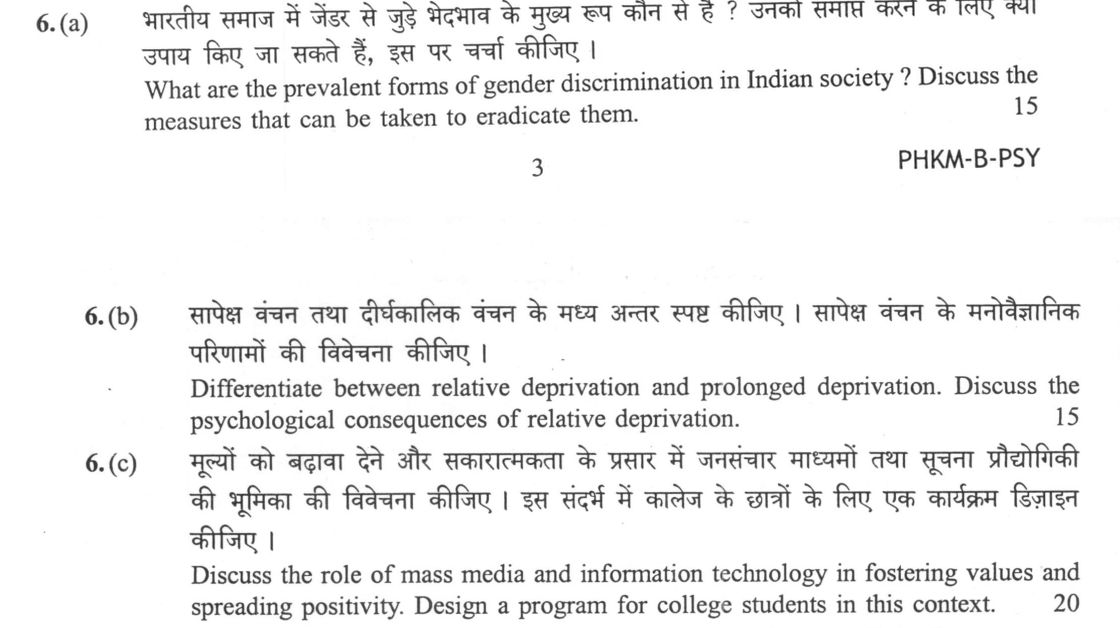
What are the prevalent forms of gender discrimination in Indian society ? Discuss the measures that can be taken to eradicate them. 15 marks
Differentiate between relative deprivation and prolonged deprivation. Discuss the psychological consequences of relative deprivation. 15 marks
Discuss the role of mass media and information technology in fostering values and spreading positivity. Design a program for college students in this context. 20 marks
हिंदी में प्रश्न पढ़ें
भारतीय समाज में जेंडर से जुड़े भेदभाव के मुख्य रूप कौन से हैं ? उनको समाप्त करने के लिए क्या उपाय किए जा सकते हैं, इस पर चर्चा कीजिए । 15
सापेक्ष वंचन तथा दीर्घकालिक वंचन के मध्य अंतर स्पष्ट कीजिए। सापेक्ष वंचन के मनोवैज्ञानिक परिणामों की विवेचना कीजिए। 15
मूल्यों को बढ़ावा देने और सकारात्मकता के प्रसार में जनसंचार माध्यमों तथा सूचना प्रौद्योगिकी की भूमिका की विवेचना कीजिए। इस संदर्भ में कॉलेज के छात्रों के लिए एक कार्यक्रम डिजाइन कीजिए। 20
Model answer
Written by UPSC Answer Check against this question's marking rubric, to the expected length. UPSC does not publish answers for Mains — this is one way to score well, not an official key.
In Indian society, gender discrimination manifests across structural and socio-psychological planes, restricting women's agency as conceptualised in Amartya Sen’s capability approach. Prevalent forms include persistent son preference leading to adverse child sex ratios (NFHS-5), the gender wage gap and informalised labour, educational disparities in higher STEM disciplines, domestic and intimate partner violence (reflected in high NCRB reporting rates), political underrepresentation, and a widening digital gender divide. Eradication requires multi-level interventions: stringent enforcement of legal provisions (PNDT Act, POSH Act), economic empowerment through targeted credit and formalisation (e.g., Mission Shakti), educational reforms that destereotype curricula (Beti Bachao Beti Padhao), and community-level cognitive-behavioural reframing of patriarchal social norms.
Relative Deprivation versus Prolonged Deprivation
Deprivation in social psychology denotes perceived or actual denial of essential resources. Relative deprivation, grounded in Ted Gurr and W.G. Runciman’s formulations, is subjective, arising from a perceived discrepancy between value expectations and value capabilities, mediated by Leon Festinger’s social comparison processes. It is typically time-bound and reference-group dependent. In contrast, prolonged deprivation, extensively studied by Girishwar Misra and L.B. Tripathi in the Indian context, refers to chronic, pervasive, structural, and intergenerational denial of physical, cognitive, and social stimulation, leading to enduring structural and developmental deficits. The intersectionality of caste, class, and gender deeply amplifies both conditions.
The psychological consequences of relative deprivation are multifaceted:
Frustration-Aggression: Unmet comparative expectations generate intense frustration, often externalised as hostile aggression, interpersonal friction, or social unrest in line with the frustration-aggression hypothesis.
Affective Distress and Anomie: Chronic comparative inferiority fosters envy, diminished self-esteem, subjective well-being deficits, and psychological anomie or normlessness.
Learned Helplessness: When systemic barriers repeatedly thwart upward mobility despite subjective effort, individuals may develop Martin Seligman’s learned helplessness, apathy, and depression.
Collective Action: When relative deprivation is framed collectively (fraternalistic deprivation), it acts as a catalyst for constructive social movements, identity assertion, and social change.
Mass Media, IT, and Intervention Design
Mass media and Information Technology function as potent socio-cognitive agents. Grounded in Albert Bandura’s Social Learning Theory and George Gerbner’s Cultivation Theory, media constructs social reality, provides prosocial behavioural models, and cultivates digital citizenship. Indian initiatives and cinematic narratives (e.g., Padman de-stigmatising menstrual health) illustrate media's power to shift taboos. However, media displays a dual role: algorithmic echo chambers, hyper-commercialised body standards, and misinformation can exacerbate toxic comparison and polarization, necessitating structured digital literacy.
Program Design: Project SAMVEDNA (Social Media and Value Education for Digital Agency)
Targeted at undergraduate college students, Project SAMVEDNA is a 12-week structured psycho-educational initiative designed to build ethical digital citizenship and foster prosocial values.
Structure and Activities: Phase 1: Digital Deconstruction Labs (Weeks 1–4): Interactive modules on algorithmic awareness, detecting fake news, and mitigating social comparison anxiety. Phase 2: Empathy and Value Inculcation (Weeks 5–8): Peer-led workshops utilizing digital storytelling, perspective-taking exercises, and gender-sensitisation simulations. Phase 3: Digital Positivity Sandbox (Weeks 9–12): Student-led creation of positive social media campaigns, podcasts, and digital art promoting mental health and community cohesion.
Implementation and Evaluation: The program is anchored by the Department of Psychology in collaboration with the National Service Scheme (NSS), employing a peer-mentor model. Evaluation incorporates pre- and post-intervention assessments on the Prosocial Tendencies Measure (PTM) and the Critical Media Literacy Scale, alongside digital campaign reach metrics. Sustainability is secured by integrating the modules into the co-curricular credit framework and establishing an ongoing student-led Digital Ethics and Well-being Club.
Addressing systemic gender discrimination and structural deprivation ultimately requires leveraging media technologies as active vehicles for socio-cognitive restructuring, transforming comparative vulnerabilities into collective empowerment and egalitarian social change.
What "Discuss" is asking you to do
Lay the issue out from more than one side — how it arose, what is claimed for it, what is held against it, and where it now stands. UPSC attaches discuss to broad topics with several live dimensions, so coverage of the dimensions earns more than the strength of your opinion.
Structure that answers it
Set the issue up → the case as it is made → the case against → the dimension both sides leave out → where the balance now lies
Where marks are lost
Listing facts with no thread between them, or arguing one side throughout and calling it a discussion.
How this answer will be evaluated
Approach
Framework: null. (a) discuss: intro > 3-4 dimensions > example > balanced close | (b) compare: paired headings or table > key differences > significance > conclusion | (c) discuss: intro > 3-4 dimensions > example > balanced close Full marks: Comprehensive, specific, and well-structured answers with clear differentiation and practical application.
Key points expected
- Identify 3-4 specific forms (e.g., son preference, domestic violence, workplace bias)
- Link forms to social or economic contexts
- Propose 3-4 specific eradication measures (e.g., legal, educational, economic)
- Balanced conclusion on societal change
- Clear definition of relative deprivation
- Clear definition of prolonged deprivation
- Explicit differentiation (e.g., reference group vs. duration)
- Discussion of psychological consequences (e.g., frustration, aggression, alienation)
Evaluation rubric
Each sub-part is marked on its own, against the marks and word limit printed on the paper.
- (a) Identify prevalent forms of gender discrimination in India and propose eradication measures. 15 marks
discuss— intro → 3-4 dimensions → example → balanced close
Must cover
- Identify 3-4 specific forms (e.g., son preference, domestic violence, workplace bias)
- Link forms to social or economic contexts
- Propose 3-4 specific eradication measures (e.g., legal, educational, economic)
- Balanced conclusion on societal change
Loses marks
- Vague generalities without specific examples
- Measures that are not implementable or realistic
- Ignoring the 'eradication' aspect (only describing the problem)
Earns more
- Reference to specific laws (e.g., 2005 Domestic Violence Act)
- Mention of specific schemes (e.g., Beti Bachao Beti Padhao)
- Use of sociological concepts (e.g., patriarchy, socialization)
Extra mark
- Citation of specific data (e.g., NFHS-5 sex ratio)
- Reference to a specific Supreme Court judgment
- (b) Differentiate relative and prolonged deprivation and discuss psychological consequences of relative deprivation. 15 marks
compare— paired headings or table → key differences → significance → conclusion
Must cover
- Clear definition of relative deprivation
- Clear definition of prolonged deprivation
- Explicit differentiation (e.g., reference group vs. duration)
- Discussion of psychological consequences (e.g., frustration, aggression, alienation)
Loses marks
- Confusing the two concepts
- Failing to discuss the psychological consequences of relative deprivation
- Lack of clear differentiation
Earns more
- Reference to Runciman's theory of relative deprivation
- Mention of specific psychological outcomes (e.g., relative deprivation syndrome)
- Use of a table or structured comparison
Extra mark
- Citation of a specific study on relative deprivation
- Reference to a specific psychological scale or tool
- (c) Discuss the role of mass media and IT in fostering values and design a program for college students. 20 marks
discuss— intro → 3-4 dimensions → example → balanced close
Must cover
- Discuss the role of mass media in fostering values
- Discuss the role of IT in spreading positivity
- Design a specific program for college students
- Program must be relevant to the context of values and positivity
Loses marks
- Vague discussion of media/IT roles
- Program that is not specific or implementable
- Ignoring the 'college students' target audience
Earns more
- Mention of specific media types (e.g., social media, TV, radio)
- Mention of specific IT tools (e.g., apps, websites, online platforms)
- Program includes specific activities and objectives
- Program is feasible and realistic
Extra mark
- Reference to a specific media campaign or IT initiative
- Inclusion of evaluation metrics for the program
Practice this exact question
Write your answer and it is marked point by point against the model answer above — what you covered, what you missed, what you got wrong.
Evaluate my answer →More from Psychology 2024 Paper II
- Q3 (a) Discuss rehabilitation of juvenile delinquents in Indian context. 15 (b) What is lear…
- Q4 (a) What are the components of Vroom's theory of motivation ? How can it be used to incre…
- Q5 Answer the following questions in about 150 words each: (a) Explain multilevel marketing…
- Q6 (a) What are the prevalent forms of gender discrimination in Indian society ? Discuss the…
- Q7 (a) What is social integration ? Explain the psychological measures that can be taken to…
- Q8 (a) Discuss the role of media in the present scenario of antisocial behaviour ? Consideri…