Paper I — Q1
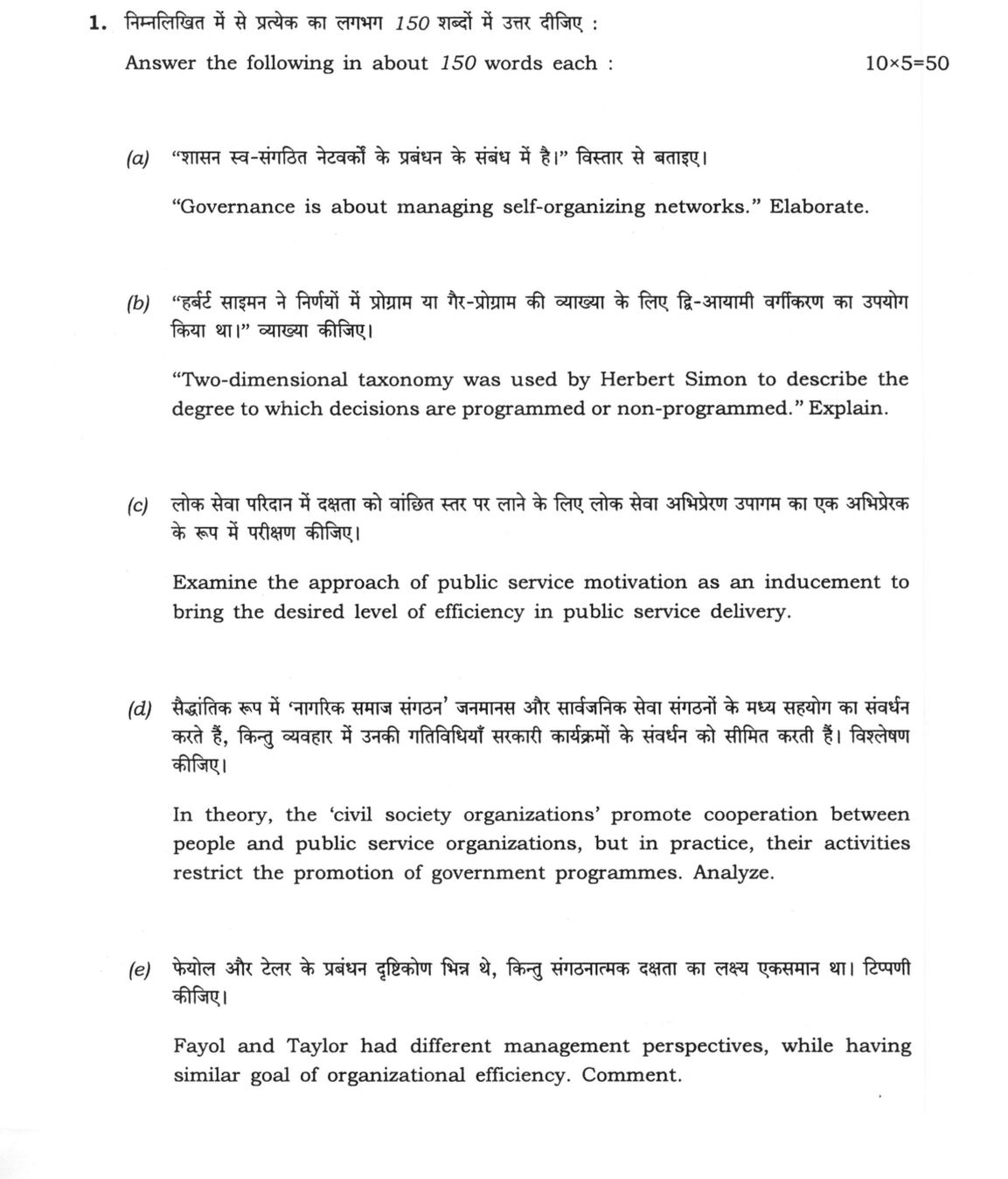
Answer the following in about 150 words each: (a) "Governance is about managing self-organizing networks." Elaborate. (10…
Answer the following in about 150 words each:
"Governance is about managing self-organizing networks." Elaborate. 10 marks
"Two-dimensional taxonomy was used by Herbert Simon to describe the degree to which decisions are programmed or non-programmed." Explain. 10 marks
Examine the approach of public service motivation as an inducement to bring the desired level of efficiency in public service delivery. 10 marks
In theory, the 'civil society organizations' promote cooperation between people and public service organizations, but in practice, their activities restrict the promotion of government programmes. Analyze. 10 marks
Fayol and Taylor had different management perspectives, while having similar goal of organizational efficiency. Comment. 10 marks
हिंदी में प्रश्न पढ़ें
निम्नलिखित में से प्रत्येक का लगभग 150 शब्दों में उत्तर दीजिए :
"शासन स्व-संगठित नेटवर्कों के प्रबंधन के संबंध में है।" विस्तार से बताइए। (10 अंक)
"हर्बर्ट साइमन ने निर्णयों में प्रोग्राम या गैर-प्रोग्राम की व्याख्या के लिए द्वि-आयामी वर्गीकरण का उपयोग किया था।" व्याख्या कीजिए। (10 अंक)
लोक सेवा प्रदान में दक्षता को वांछित स्तर पर लाने के लिए लोक सेवा अभिप्रेरण उपागम का एक अभिप्रेरक के रूप में परीक्षण कीजिए। (10 अंक)
सैद्धांतिक रूप से 'नागरिक समाज संगठन' जनमानस और सार्वजनिक सेवा संगठनों के मध्य सहयोग का संवर्धन करते हैं, किन्तु व्यवहार में उनकी गतिविधियाँ सरकारी कार्यक्रमों के संवर्धन को सीमित करती हैं। विश्लेषण कीजिए। (10 अंक)
फेयोल और टेलर के प्रबंध दृष्टिकोण भिन्न थे, किन्तु संगठनात्मक दक्षता का लक्ष्य एकसमान था। टिप्पणी कीजिए। (10 अंक)
Model answer
Written by UPSC Answer Check against this question's marking rubric, to the 150-word length. UPSC does not publish answers for Mains — this is one way to score well, not an official key.
(a) R. A. W. Rhodes famously conceptualized governance as "governing without government," characterized by the proliferation of self-organizing, inter-organizational networks. As societal problems have grown complex, traditional Weberian bureaucratic hierarchies and purely competitive market mechanisms have proven inadequate. Network governance recognizes that public policy is formulated and implemented through interdependent clusters of state, private, and civil society actors. In these networks, actors operate autonomously based on resource interdependence and shared goals, resisting unilateral top-down sovereign control. Consequently, the state's role shifts fundamentally from direct service provision ("rowing") to strategic enablement, facilitation, and mediation ("steering," as articulated by Osborne and Gaebler). Managing these self-organizing networks demands indirect coordination mechanisms—such as boundary-spanning, trust-building, and consensus-building—rather than traditional command-and-control. While network governance fosters flexibility and multi-actor synergy, it introduces critical challenges for democratic accountability, requiring the state to act as a "meta-governor" establishing ultimate ground rules.
(b) Herbert Simon articulated a two-dimensional taxonomy to classify administrative decisions based on the nature of the decision problem and the techniques deployed to resolve it. The first dimension differentiates decisions along a spectrum from programmed to non-programmed. Programmed decisions are repetitive, routine, and structured, handled through established standard operating procedures and specific decision rules (such as routine inventory replenishment). Non-programmed decisions are novel, ill-structured, highly complex, and consequential, lacking pre-set protocols (such as crisis response or major policy formulation). The second dimension contrasts traditional decision-making techniques (habit, standard operating procedures, and clerical routines for programmed; judgment, intuition, and trial-and-error for non-programmed) with modern techniques (operations research, mathematical modeling, and electronic data processing for programmed; heuristic problem-solving and computerized simulation for non-programmed). This taxonomy is anchored in Simon’s concept of bounded rationality, demonstrating how administrators compensate for cognitive limitations to achieve "satisficing" rather than optimal decisions across varying organizational contexts.
(c) Public Service Motivation (PSM), systematically theorized by James Perry and Lois Wise, conceptualizes an individual's predisposition to respond to motives grounded primarily in public institutions and prosocial goals. Perry and Wise delineated three primary dimensions of PSM: rational (attraction to public policy-making), norm-based (commitment to social justice and the public interest), and affective (compassion and self-sacrifice). Unlike New Public Management approaches that rely heavily on extrinsic, material incentives (such as performance-related pay) derived from rational-choice assumptions, PSM prioritizes intrinsic motivation. Empirical research demonstrates that high PSM correlates positively with increased job satisfaction, organizational commitment, and ethical resilience among civil servants. In public service delivery, fostering PSM reduces agency costs, minimizes opportunistic rent-seeking, and encourages street-level bureaucrats to exercise discretion empathetically. Aligning recruitment, socialization, and task design with PSM principles provides a durable, non-monetary inducement for institutional efficiency, ethical integrity, and citizen-centric governance.
(d) In democratic theory, Civil Society Organizations (CSOs) serve as vital intermediaries that generate social capital—as posited by Robert Putnam—fostering participatory governance and co-producing public services. They articulate marginalized demands, mobilize community participation, and enhance administrative accountability (as seen in India's Mazdoor Kisan Shakti Sangathan pioneering the Right to Information). In practice, however, operational distortions often create friction with state initiatives. Many CSOs face "NGO-ization," characterized by donor-driven agendas, professionalization detached from grassroots realities, elite capture, and weak internal financial transparency. Furthermore, ideological contestation surrounding environmental and development projects has sometimes resulted in protracted litigation, project delays, and developmental paralysis. Consequently, the state has intervened with stringent regulatory oversight, exemplified by amendments to the Foreign Contribution (Regulation) Act (FCRA). Moving forward, overcoming this friction requires institutionalizing transparent consultative platforms to reconcile CSO autonomy with state developmental priorities.
(e) Henri Fayol and Frederick Winslow Taylor approached organizational efficiency from distinct conceptual standpoints within classical administrative theory. Taylor founded Scientific Management using an inductive, bottom-up approach focused on the shop floor and worker-machine interfaces. He sought to maximize productivity by eliminating physical waste through time-and-motion studies, task standardization, differential piece-rate wage systems, and "functional foremanship," which explicitly divided supervisory authority among eight functional specialists. Conversely, Fayol formulated Administrative Theory through a deductive, top-down perspective focused on executive management and the total enterprise. Fayol identified universal managerial functions (Planning, Organizing, Commanding, Coordinating, Controlling) and fourteen principles, emphasizing structural coherence and staunchly defending the principle of "Unity of Command" in direct opposition to Taylor’s functional foremanship. Despite these operational differences, both theorists shared the overarching positivist goal of rationalizing organizational processes to eliminate waste, systemic soldiering, and managerial arbitrariness, establishing the foundational bedrock of modern administrative science.
What "Elaborate" is asking you to do
Give the full detailed account the question has compressed into a line — every dimension of it, with specifics. Elaborate rewards completeness and detail rather than clarification or argument: the examiner is checking whether you can fill out a topic without being told what its parts are.
Structure that answers it
State the proposition → first dimension in detail → second dimension in detail → the part the statement leaves implicit → the consolidated picture
Where marks are lost
Repeating the statement at greater length instead of adding substance. Elaborate also punishes narrowness: omitting a whole dimension costs more here than anywhere else in this family.
How this answer will be evaluated
Approach
Framework: Public Administration, Paper 1. (a) discuss: intro > 3-4 dimensions > example > balanced close | (b) explain: definition/context > points in order > small example > short close | (c) examine: intro > how/why with reasoning > evidence > conclusion | (d) analyse: intro > causes > effects > stakeholders/linkages > way forward | (e) comment: context > arguments both sides > judgment > close Full marks: Clear, specific, well-structured with Indian anchors and 2nd ARC references
Key points expected
- Define self-organizing networks in governance context
- Explain the shift from hierarchy to network
- Identify key actors in the network
- Provide an Indian governance example
- Define programmed decisions
- Define non-programmed decisions
- Explain the two dimensions (frequency/complexity)
- Give examples of each type
Evaluation rubric
Each sub-part is marked on its own, against the marks and word limit printed on the paper.
- (a) Elaborate the concept of governance as managing self-organizing networks. · 150 words
discuss— intro → 3-4 dimensions → example → balanced close
Must cover
- Define self-organizing networks in governance context
- Explain the shift from hierarchy to network
- Identify key actors in the network
- Provide an Indian governance example
Loses marks
- Treating governance as mere administration
- Ignoring the 'self-organizing' aspect
- No Indian institutional anchor
Earns more
- Mention New Public Governance (NPG)
- Reference 2nd ARC on networks
- Discuss digital governance platforms
- Mention specific Indian network (e.g., e-Governance)
Extra mark
- Cite specific 2nd ARC recommendation
- Reference a specific recent reform
- (b) Explain Herbert Simon's two-dimensional taxonomy of decisions. · 150 words
explain— definition/context → points in order → small example → short close
Must cover
- Define programmed decisions
- Define non-programmed decisions
- Explain the two dimensions (frequency/complexity)
- Give examples of each type
Loses marks
- Confusing programmed with routine
- Ignoring the 'two-dimensional' aspect
- No clear distinction between types
Earns more
- Mention bounded rationality
- Link to administrative decision-making
- Reference Simon's 'Administrative Behavior'
- Provide Indian administrative examples
Extra mark
- Cite specific Simon quote
- Reference modern application in policy
- (c) Examine public service motivation as an inducement for efficiency. · 150 words
examine— intro → how/why with reasoning → evidence → conclusion
Must cover
- Define public service motivation (PSM)
- Explain how PSM drives efficiency
- Identify mechanisms of PSM
- Provide evidence of PSM impact
Loses marks
- Treating PSM as mere job satisfaction
- Ignoring the 'inducement' aspect
- No link to efficiency
Earns more
- Mention PSM theory (Perry)
- Reference Indian civil service ethos
- Discuss intrinsic vs extrinsic motivation
- Provide Indian examples of PSM
Extra mark
- Cite specific PSM study
- Reference 2nd ARC on motivation
- (d) Analyze the gap between theory and practice of CSOs. · 150 words
analyse— intro → causes → effects → stakeholders/linkages → way forward
Must cover
- Explain the theoretical role of CSOs
- Identify how CSOs restrict government programs
- Analyze the causes of this gap
- Provide examples of CSO-government conflict
Loses marks
- Treating CSOs as purely positive
- Ignoring the 'restrict' aspect
- No analysis of the gap
Earns more
- Mention specific Indian CSOs
- Reference 2nd ARC on CSOs
- Discuss funding and accountability issues
- Provide specific examples of conflict
Extra mark
- Cite specific 2nd ARC recommendation
- Reference a specific CSO-government conflict
- (e) Comment on Fayol and Taylor's different perspectives and similar goals. · 150 words
comment— context → arguments both sides → judgment → close
Must cover
- Explain Fayol's management perspective
- Explain Taylor's management perspective
- Identify their different approaches
- Show their similar goal of efficiency
Loses marks
- Treating Fayol and Taylor as identical
- Ignoring the 'different perspectives' aspect
- No clear comparison
Earns more
- Mention Fayol's 14 principles
- Reference Taylor's scientific management
- Discuss top-down vs bottom-up
- Provide Indian administrative examples
Extra mark
- Cite specific Fayol principle
- Reference specific Taylor technique
Practice this exact question
Write your answer and it is marked point by point against the model answer above — what you covered, what you missed, what you got wrong.
Evaluate my answer →More from Public Administration 2021 Paper I
- Q1 Answer the following in about 150 words each: (a) "Governance is about managing self-orga…
- Q2 (a) Behavioural approach has been questioned on the basis of its utility in the analysis…
- Q3 (a) Integration of different streams of administrative thought to propound a universal ad…
- Q4 (a) The new public service model approaches governance on the premises of an active and i…