Paper I — Q3
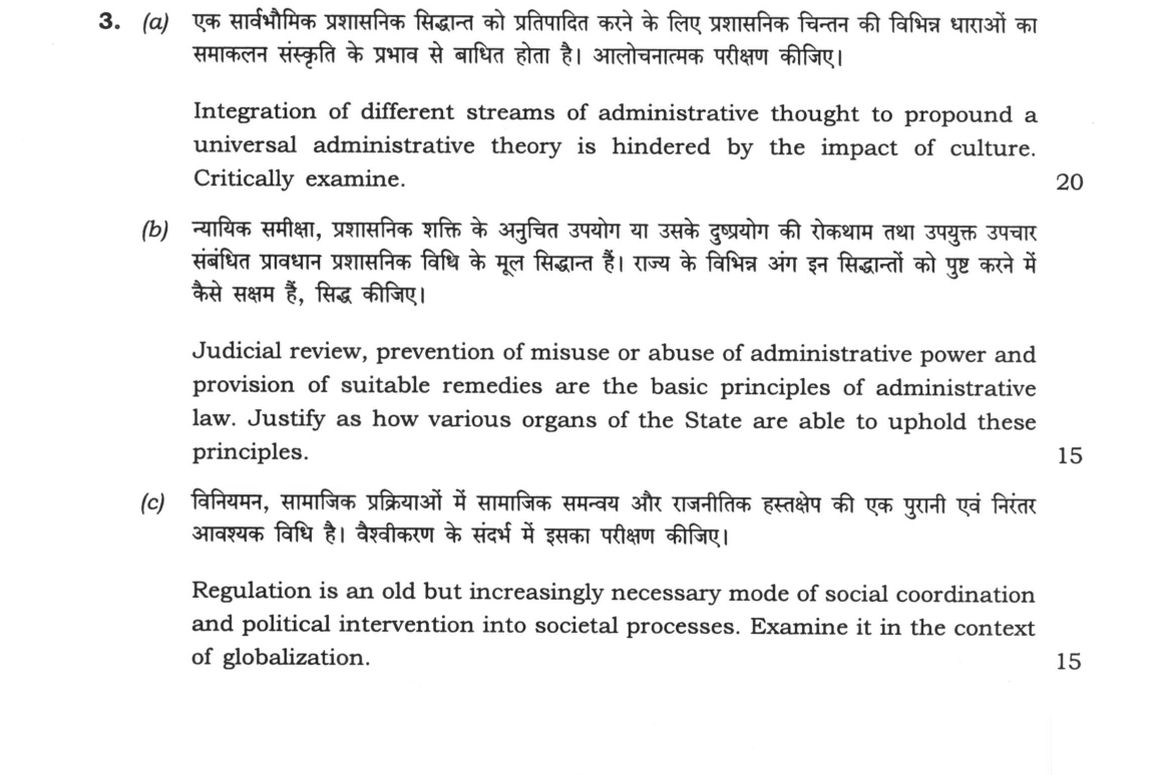
(a) Integration of different streams of administrative thought to propound a universal administrative theory is hindered by the…
Integration of different streams of administrative thought to propound a universal administrative theory is hindered by the impact of culture. Critically examine. 20 marks
Judicial review, prevention of misuse or abuse of administrative power and provision of suitable remedies are the basic principles of administrative law. Justify as how various organs of the State are able to uphold these principles. 15 marks
Regulation is an old but increasingly necessary mode of social coordination and political intervention into societal processes. Examine it in the context of globalization. 15 marks
हिंदी में प्रश्न पढ़ें
एक सार्वभौमिक प्रशासनिक सिद्धांत को प्रतिपादित करने के लिए प्रशासनिक चिंतन की विभिन्न धाराओं का समाकलन संस्कृति के प्रभाव से बाधित होता है। आलोचनात्मक परीक्षण कीजिए। (20 अंक)
न्यायिक समीक्षा, प्रशासनिक शक्ति के अनुचित उपयोग या उसके दुरुपयोग की रोकथाम तथा उपयुक्त उपचार संबंधित प्रावधान प्रशासनिक विधि के मूल सिद्धांत हैं। राज्य के विभिन्न अंग इन सिद्धांतों को पृथ करने में कैसे सक्षम हैं, सिद्ध कीजिए। (15 अंक)
विनियमन, सामाजिक प्रक्रियाओं में सामाजिक समन्वय और राजनीतिक हस्तक्षेप की एक पुरानी एवं निरंतर आवश्यक विधि है। वैश्वीकरण के संदर्भ में इसका परीक्षण कीजिए। (15 अंक)
Model answer
Written by UPSC Answer Check against this question's marking rubric, to the expected length. UPSC does not publish answers for Mains — this is one way to score well, not an official key.
Administrative thought, administrative law, and regulatory design represent interdependent facets of public administration that continuously evolve in response to cultural contexts, constitutional mandates, and global economic forces.
Culture and Universal Administrative Theory
The classical quest for a universal administrative theory—championed by early theorists like Henri Fayol and Luther Gulick—assumed that principles of administration were culture-neutral and universally applicable. However, cross-cultural realities fundamentally hinder this integration. F.W. Riggs demonstrated through his Prismatic-Sala model that administrative behavior in transitional societies is characterized by formalism, heterogeneity, and overlapping, where formal rational structures are subverted by traditional practices like nepotism and poly-communalism. Geert Hofstede’s cultural dimensions further show that variations in power distance, collectivism, and uncertainty avoidance fundamentally alter leadership and motivational dynamics across borders.
Dwight Waldo contended in The Administrative State that administration is culturally conditioned and value-laden, whereas Ferrel Heady’s comparative administration emphasized that structural-functional adaptations vary systematically across political regimes. India exemplifies this tension through a hybrid administrative model that marries formal Weberian legal-rationalism with informal kinship networks and patron-client dynamics.
Conversely, globalization, New Public Management (NPM), and ubiquitous digital governance have driven administrative convergence. Digital platforms, performance metrics, and standardized service-delivery architectures cross national boundaries. Nonetheless, administrative convergence remains operational rather than theoretical. Culture acts as an inescapable filter; thus, a singular universal administrative theory is unattainable, leaving contextual, hybrid administrative paradigms as the reality.
State Organs and the Principles of Administrative Law
Administrative law operationalizes the rule of law by subjecting administrative action to judicial review, curbing abuse of discretion, and providing remedies to citizens. The organs of the State uphold these principles through interconnected mechanisms:
The Judiciary exercises judicial review under Articles 32 and 226 of the Indian Constitution, issuing prerogative writs (certiorari, mandamus, prohibition) to quash ultra vires administrative actions. Through Public Interest Litigation (PIL) and doctrines like proportionality and natural justice, the courts prevent arbitrariness.
The Legislature checks executive overreach through scrutiny of delegated legislation via the Committee on Subordinate Legislation, alongside budgetary controls and parliamentary questioning.
The Executive and autonomous statutory bodies enforce internal discipline and external accountability. Article 311 provides constitutional safeguards to civil servants against arbitrary dismissal while maintaining accountability. The Central Vigilance Commission (CVC) and the Right to Information (RTI) Act, 2005 dismantle bureaucratic opacity, while the Lokpal and Lokayuktas Act, 2013 institutionalizes extra-judicial remedy against administrative corruption. Together, these mechanisms balance administrative efficiency with the protection of individual rights.
Regulation in the Context of Globalization
Regulation has transformed from direct state control into a sophisticated mechanism of social coordination and market governance. In India, the post-1991 retreat from the command-and-control "Licence Raj" led to the rise of independent regulatory agencies like the Securities and Exchange Board of India (SEBI), the Telecom Regulatory Authority of India (TRAI), and the Competition Commission of India (CCI). These bodies coordinate complex market processes, protect consumer interests, and correct market failures, though they face persistent risks of regulatory capture and executive interference.
Globalization necessitates transnational regulatory convergence. Global standards—such as the Basel III norms for banking supervision and the World Trade Organization’s Sanitary and Phytosanitary (SPS) and Technical Barriers to Trade (TBT) agreements—harmonize national rules to facilitate trade and financial stability. However, globalization also generates challenges like regulatory arbitrage, where multinational entities exploit jurisdictional disparities in tax, labor, and environmental standards. Developing nations like India counter this through "calibrated globalization"—selectively harmonizing regulations in financial markets while asserting regulatory sovereignty in sensitive areas such as Foreign Direct Investment (FDI) caps and the Digital Personal Data Protection Act, 2023.
Ultimately, modern public administration demonstrates that while globalization and legal norms drive structural standardization, enduring cultural realities necessitate context-specific administrative and regulatory frameworks to ensure both state efficacy and democratic accountability.
What "Critically examine" is asking you to do
Test the proposition the question puts to you and return a finding on how far it holds. Examine stems carry a claim, or ask whether something has happened, and expect evidence weighed both ways before the extent is stated — often with remedial measures attached. “Critically” is not a section added at the end: name the yardstick you are judging by — the evidence, the stated objective, a constitutional principle, a rival explanation — and let a verdict close each part of the body. Where the question quotes a claim, that verdict must land on the claim itself, accepted, qualified or rejected, and not on the theme in general.
Structure that answers it
Restate the claim as the question frames it → evidence that supports it → evidence that undercuts it → the conditions under which it holds → verdict on how far it stands
Where marks are lost
Merits in one paragraph, demerits in the next, and a conclusion calling for a balanced and holistic approach. That is a survey with the judgement left out and it holds the answer in the middle band. The opposite error is reading “critically” as permission to attack — and with the odd pairings, critically describe or critically explain, the exposition still carries most of the marks, the judgement being a layer on it rather than a substitute for it.
How this answer will be evaluated
Approach
Framework: null. (a) critically evaluate: positives > negatives/limits > conditions/safeguards > conclusion | (b) justify: claim > 3-4 reasons > evidence > conclusion | (c) examine: intro > how/why with reasoning > evidence > conclusion Full marks: Deep theoretical integration with specific Indian administrative examples and statutory references.
Key points expected
- Define 'universal administrative theory' and its proponents (e.g., Weber, Fayol).
- Identify specific cultural variables (e.g., hierarchy, individualism) that distort theory.
- Provide Indian administrative instances where Western theory failed due to culture.
- Conclude on the feasibility of universality vs. context-specificity.
- Link Judiciary to 'Judicial Review' and 'Remedies' (Writs).
- Link Legislature to 'Prevention of Abuse' via statutes (e.g., RTI Act).
- Link Executive to internal controls (CVC, CAG, Ombudsman).
- Justify the interplay of these organs in maintaining checks and balances.
Evaluation rubric
Each sub-part is marked on its own, against the marks and word limit printed on the paper.
- (a) Assess the validity of the claim that culture hinders the creation of a universal administrative theory. 20 marks
critically evaluate— positives → negatives/limits → conditions/safeguards → conclusion
Must cover
- Define 'universal administrative theory' and its proponents (e.g., Weber, Fayol).
- Identify specific cultural variables (e.g., hierarchy, individualism) that distort theory.
- Provide Indian administrative instances where Western theory failed due to culture.
- Conclude on the feasibility of universality vs. context-specificity.
Loses marks
- Generic discussion of culture without administrative examples.
- Ignoring the 'universal theory' aspect and focusing only on culture.
- GS-2 style policy answers without theoretical depth.
Earns more
- Reference to Max Weber's bureaucracy vs. Indian 'Sarkari' culture.
- Mention of 'Jugaad' or 'Ghar-Mohalla' culture as counter-examples.
- Comparison of Western 'Rule of Law' vs. Indian 'Rule by Law'.
Extra mark
- Reference to 2nd ARC recommendations on cultural sensitivity.
- Citation of specific scholars like M.P. Jain or D.D. Basu.
- (b) Explain how State organs (Legislature, Executive, Judiciary) uphold administrative law principles. 15 marks
justify— claim → 3-4 reasons → evidence → conclusion
Must cover
- Link Judiciary to 'Judicial Review' and 'Remedies' (Writs).
- Link Legislature to 'Prevention of Abuse' via statutes (e.g., RTI Act).
- Link Executive to internal controls (CVC, CAG, Ombudsman).
- Justify the interplay of these organs in maintaining checks and balances.
Loses marks
- Focusing only on the Judiciary and ignoring Legislature/Executive.
- Defining principles without explaining the 'how' of upholding them.
- Vague statements like 'courts are independent' without mechanism.
Earns more
- Mention of specific Articles (32, 136, 226).
- Reference to 'Mansingh Committee' on administrative law.
- Citing 'Keshavananda Bharati' or 'Minerva Mills' for judicial role.
Extra mark
- Reference to recent 'Judicial Activism' vs. 'Judicial Restraint' debates.
- Mention of 'Administrative Tribunals' (CAT, SAT) as specialized organs.
- (c) Analyze the role of regulation in social coordination and political intervention under globalization. 15 marks
examine— intro → how/why with reasoning → evidence → conclusion
Must cover
- Define 'Regulation' as a mode of social coordination.
- Explain how globalization challenges traditional state regulation (e.g., capital flows).
- Discuss the shift from 'Command' to 'Regulatory' state (e.g., SEBI, TRAI).
- Evaluate the necessity of regulation in a globalized, market-driven economy.
Loses marks
- Treating 'regulation' only as 'law making' without social coordination angle.
- Ignoring the 'globalization' context and writing a general note on regulation.
- Failing to link 'political intervention' to the regulatory process.
Earns more
- Reference to 'New Public Management' (NPM) and deregulation trends.
- Mention of 'Global Regulatory Competition' or 'Race to the bottom'.
- Examples of Indian regulatory bodies (RBI, FSSAI) in global context.
Extra mark
- Reference to 'World Bank' or 'IMF' structural adjustment policies.
- Mention of 'Digital Regulation' (e.g., IT Rules) in the global context.
Practice this exact question
Write your answer and it is marked point by point against the model answer above — what you covered, what you missed, what you got wrong.
Evaluate my answer →More from Public Administration 2021 Paper I
- Q1 Answer the following in about 150 words each: (a) "Governance is about managing self-orga…
- Q2 (a) Behavioural approach has been questioned on the basis of its utility in the analysis…
- Q3 (a) Integration of different streams of administrative thought to propound a universal ad…
- Q4 (a) The new public service model approaches governance on the premises of an active and i…
- Q5 Answer the following in about 150 words each: (a) The approach to the study of administra…
- Q6 (a) Emphasis on cost control and reducing public expenditure has diverted the focus of go…