Paper I — Q5
Answer the following in about 150 words each: (a) The approach to the study of administration in its environmental context is…
Answer the following in about 150 words each:
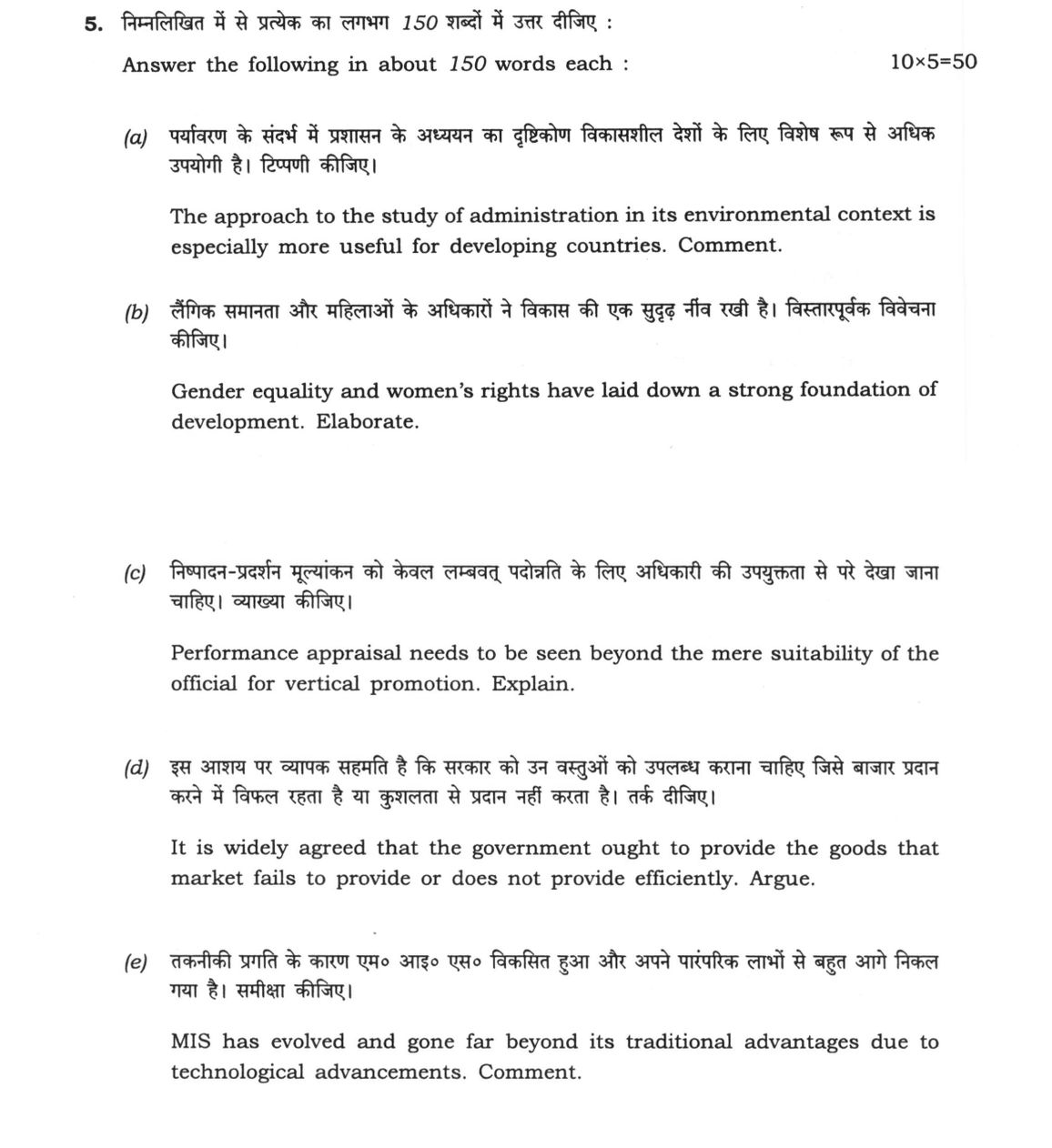
The approach to the study of administration in its environmental context is especially more useful for developing countries. Comment. 10 marks
Gender equality and women's rights have laid down a strong foundation of development. Elaborate. 10 marks
Performance appraisal needs to be seen beyond the mere suitability of the official for vertical promotion. Explain. 10 marks
It is widely agreed that the government ought to provide the goods that market fails to provide or does not provide efficiently. Argue. 10 marks
MIS has evolved and gone far beyond its traditional advantages due to technological advancements. Comment. 10 marks
हिंदी में प्रश्न पढ़ें
निम्नलिखित में से प्रत्येक का लगभग 150 शब्दों में उत्तर दीजिए :
पर्यावरण के संदर्भ में प्रशासन के अध्ययन का दृष्टिकोण विकासशील देशों के लिए विशेष रूप से अधिक उपयोगी है। टिप्पणी कीजिए। (10 अंक)
लैंगिक समानता और महिलाओं के अधिकारों ने विकास की एक सुदृढ़ नींव रखी है। विस्तारपूर्वक विवेचना कीजिए। (10 अंक)
निष्पादन-प्रदर्शन मूल्यांकन को केवल लम्बवत पदोन्नति के लिए अधिकारी की उपयुक्तता से परे देखा जाना चाहिए। व्याख्या कीजिए। (10 अंक)
इस आशय पर व्यापक सहमति है कि सरकार को उन वस्तुओं को उपलब्ध कराना चाहिए जिसे बाजार प्रदान करने में विफल रहता है या कुशलता से प्रदान नहीं करता है। तर्क दीजिए। (10 अंक)
तकनीकी प्रगति के कारण एम० आई० एस० विकसित हुआ और अपने पारंपरिक लाभों से बहुत आगे निकल गया है। समीक्षा कीजिए। (10 अंक)
Model answer
Written by UPSC Answer Check against this question's marking rubric, to the 150-word length. UPSC does not publish answers for Mains — this is one way to score well, not an official key.
(a) Administration in its Environmental Context
The ecological approach, pioneered by John Gaus and systematically formulated by Fred W. Riggs, demonstrates that administrative structures cannot function in isolation from their socio-cultural, economic, and political environments. This approach is especially indispensable for developing nations undergoing rapid structural transitions.
In Riggs’ Fused-Prismatic-Diffracted model, developing societies represent prismatic systems characterized by a distinct administrative lag. In these settings, formal administrative structures imported from the West interact with traditional socio-political environments, producing distinct characteristics: heterogeneity (the simultaneous coexistence of modern and traditional systems), overlapping (the dominance of non-administrative structures like caste, kinship, and clientelism over formal bureaucratic authority), and formalism (a wide divergence between prescribed laws and actual implementation).
Unlike developed nations, which possess diffracted, stable ecologies with functional specificity and congruence between norms and behavior, developing countries face institutional frictions shaped by environmental realities. Therefore, studying administration through an ecological lens remains vital to prevent the blind adoption of foreign models and ensure context-specific administrative reforms.
(b) Gender Equality and Development
Gender equality and women’s rights serve as the cornerstone of sustainable socio-economic progress rather than mere welfare objectives. As Amartya Sen emphasized through his capability approach and the concept of "missing women," expanding women's agency and legal freedoms is central to human development.
Empowering women acts as a powerful development multiplier. Sustainable Development Goal 5 (Gender Equality) directly underpins and accelerates progress toward SDG 1 (No Poverty), SDG 4 (Quality Education), and SDG 8 (Decent Work and Economic Growth). Increasing women’s access to education, property rights, and financial capital leads to higher household investments in child nutrition, healthcare, and education, thereby breaking the intergenerational cycle of deprivation.
In India, state interventions like Beti Bachao Beti Padhao seek to rectify adverse demographic distortions, while the Deendayal Antyodaya Yojana–National Rural Livelihoods Mission (DAY-NRLM) Self-Help Group (SHG)-Bank Linkage Programme has leveraged female micro-entrepreneurship to drive grassroots poverty reduction. Securing women's rights is thus the primary engine of structural transformation.
(c) Performance Appraisal Beyond Promotion
Historically, performance appraisal systems in public administration operated as retroactive, subjective assessments primarily used to determine an official's suitability for vertical, seniority-based promotion. Modern administrative theory, however, demands that appraisal functions as a dynamic, continuous human resource development tool.
An effective appraisal framework focuses on holistic talent management. It incorporates potential appraisal to align an individual’s future capabilities with institutional requirements, facilitates proactive career planning, and serves as an instrument for Training Needs Analysis (TNA). Modern appraisals also systematically evaluate behavioural competencies, emotional intelligence, leadership, and integrity rather than procedural compliance alone.
Implementing multi-source mechanisms, such as 360-degree feedback, captures perspectives from peers, subordinates, and external stakeholders, mitigating hierarchical bias. In India, the institutional shift from the opaque Annual Confidential Report (ACR) to the target-driven Annual Performance Appraisal Report (APAR/SPARROW), complemented by Mission Karmayogi's Competency Framework, reflects this transition. Appraisal must function as a developmental diagnostic tool to enhance administrative capacity rather than a static administrative filter for promotion.
(d) Government Role and Market Failure
Welfare economics demonstrates that while competitive markets allocate private goods efficiently, systemic market failures necessitate direct government intervention. Grounded in the Samuelson-Musgrave theory of public expenditure, the state must ensure the provision of pure public goods, which are strictly non-excludable and non-rivalrous in consumption.
Because private firms cannot exclude non-payers, market mechanisms fail due to the free-rider problem, leaving essential public goods—such as national defense, judicial administration, and core public infrastructure—underprovided or neglected. Furthermore, markets underperform in the presence of externalities, information asymmetries, and natural monopolies. Negative externalities like pollution require regulatory correctives, while positive externalities in sectors like healthcare demand state funding.
The state also plays an irreplaceable role in supplying merit goods like primary education and universal immunization, which individuals might otherwise under-consume, and in managing Common Pool Resources to prevent their depletion. Government provision in areas of market failure is therefore vital to ensure economic efficiency, social equity, and optimal resource allocation.
(e) Evolution of Management Information Systems (MIS)
Management Information Systems (MIS) have evolved substantially beyond their traditional utility of basic data aggregation, record-keeping, and transaction processing. Advanced technological innovations have converted MIS into a strategic asset for real-time decision-making and governance.
With the integration of Artificial Intelligence, Machine Learning, cloud computing, and big data analytics, modern MIS has transitioned from passive reporting into dynamic Decision Support Systems (DSS) and Executive Information Systems (EIS). These advanced architectures facilitate predictive policy analysis, automate grievance redressal, map spatial data via GIS integration, and eliminate structural redundancies.
In Indian governance, this transformation is exemplified by Digital India initiatives such as the Unified Mobile Application for New-age Governance (UMANG), the Public Financial Management System (PFMS), Direct Benefit Transfer (DBT) MIS platforms, and the PRAGATI platform for real-time monitoring of mega-projects. These systems have eliminated leakages, dismantled administrative silos, and enhanced public accountability. MIS has thus evolved from a back-office administrative tool into an indispensable driver of citizen-centric public administration.
What "Comment" is asking you to do
Take a position on the statement and support it. Comment usually attaches to a quoted line in the short slots, so the reasoning must be compressed — an opening view, a few load-bearing reasons, and the limit of the claim.
Structure that answers it
Unpack what the statement asserts → your stance → two or three supporting reasons → the qualification that limits it
Where marks are lost
Neutral summary; a comment without a stance has not answered. Equally costly is accepting the quoted line wholesale and never testing where it fails.
How this answer will be evaluated
Approach
Framework: Public Administration Paper I (UPSC). (a) comment: context > arguments both sides > judgment > close | (b) explain: definition/context > points in order > small example > short close | (c) explain: definition/context > points in order > small example > short close | (d) justify: claim > 3-4 reasons > evidence > conclusion | (e) comment: context > arguments both sides > judgment > close Full marks: Comprehensive, well-structured, with specific Indian examples and theoretical depth.
Key points expected
- Define environmental context in administration
- Contrast Western vs. developing country variables
- Cite specific Indian administrative challenges
- Provide a balanced judgment on utility
- Define gender equality in administrative context
- Explain the link to human capital development
- Cite Indian policy or institutional examples
- Show how it strengthens development foundation
Evaluation rubric
Each sub-part is marked on its own, against the marks and word limit printed on the paper.
- (a) Contextualize comparative administration for developing nations. · 150 words
comment— context → arguments both sides → judgment → close
Must cover
- Define environmental context in administration
- Contrast Western vs. developing country variables
- Cite specific Indian administrative challenges
- Provide a balanced judgment on utility
Loses marks
- Generic discussion of 'development' without administrative link
- Ignoring the 'environmental' aspect of the study
Earns more
- Reference to Woodrow Wilson's politics-administration dichotomy
- Mention of 2nd ARC on administrative context
- Reference to 'Indigenization' of public administration
Extra mark
- Citing specific Indian administrative failures/successes
- Reference to specific scholars like D.D. Basu
- (b) Link gender equality to the foundation of development. · 150 words
explain— definition/context → points in order → small example → short close
Must cover
- Define gender equality in administrative context
- Explain the link to human capital development
- Cite Indian policy or institutional examples
- Show how it strengthens development foundation
Loses marks
- Treating it as a social issue only, not administrative
- Lack of specific Indian examples
Earns more
- Reference to Article 14 or 15 of the Constitution
- Mention of NITI Aayog's SDG Index
- Reference to specific women-centric schemes
Extra mark
- Citing specific statistics on women's participation
- Reference to specific committees on women's rights
- (c) Explain performance appraisal beyond vertical promotion. · 150 words
explain— definition/context → points in order → small example → short close
Must cover
- Define performance appraisal in public service
- List objectives beyond promotion (e.g., training, accountability)
- Cite Indian administrative practices or reforms
- Explain the broader impact on organizational goals
Loses marks
- Focusing only on promotion as the sole goal
- Lack of specific administrative examples
Earns more
- Reference to 2nd ARC recommendations on appraisal
- Mention of specific appraisal systems (e.g., ACRs)
- Link to merit-based administration
Extra mark
- Citing specific cases of appraisal reform
- Reference to specific administrative thinkers
- (d) Argue for government provision of market-failed goods. · 150 words
justify— claim → 3-4 reasons → evidence → conclusion
Must cover
- Define market failure in public goods
- List types of goods (e.g., public, merit, natural monopoly)
- Cite Indian examples of government provision
- Provide a reasoned argument for government role
Loses marks
- Ignoring the 'market failure' aspect
- Lack of specific Indian examples
Earns more
- Reference to specific public goods (e.g., defense, infrastructure)
- Mention of specific government schemes or policies
- Link to welfare state concept
Extra mark
- Citing specific economic theories on market failure
- Reference to specific administrative challenges in provision
- (e) Comment on MIS evolution beyond traditional advantages. · 150 words
comment— context → arguments both sides → judgment → close
Must cover
- Define MIS in administrative context
- List traditional advantages (e.g., data processing)
- Explain new technological advancements (e.g., AI, Big Data)
- Provide a judgment on the evolution
Loses marks
- Focusing only on traditional advantages
- Lack of specific technological examples
Earns more
- Reference to specific Indian e-governance initiatives
- Mention of specific technologies (e.g., AI, blockchain)
- Link to modern administrative practices
Extra mark
- Citing specific examples of AI in administration
- Reference to specific administrative reforms
Practice this exact question
Write your answer and it is marked point by point against the model answer above — what you covered, what you missed, what you got wrong.
Evaluate my answer →More from Public Administration 2021 Paper I
- Q2 (a) Behavioural approach has been questioned on the basis of its utility in the analysis…
- Q3 (a) Integration of different streams of administrative thought to propound a universal ad…
- Q4 (a) The new public service model approaches governance on the premises of an active and i…
- Q5 Answer the following in about 150 words each: (a) The approach to the study of administra…
- Q6 (a) Emphasis on cost control and reducing public expenditure has diverted the focus of go…
- Q7 (a) Policy problems are increasingly tending towards being wicked. Discuss the capacity a…
- Q8 (a) The successful attainment of SDGs objectives largely depends upon the wisdom, experie…