Paper I — Q7
(a) Policy problems are increasingly tending towards being wicked. Discuss the capacity and preparedness of the State to tackle…
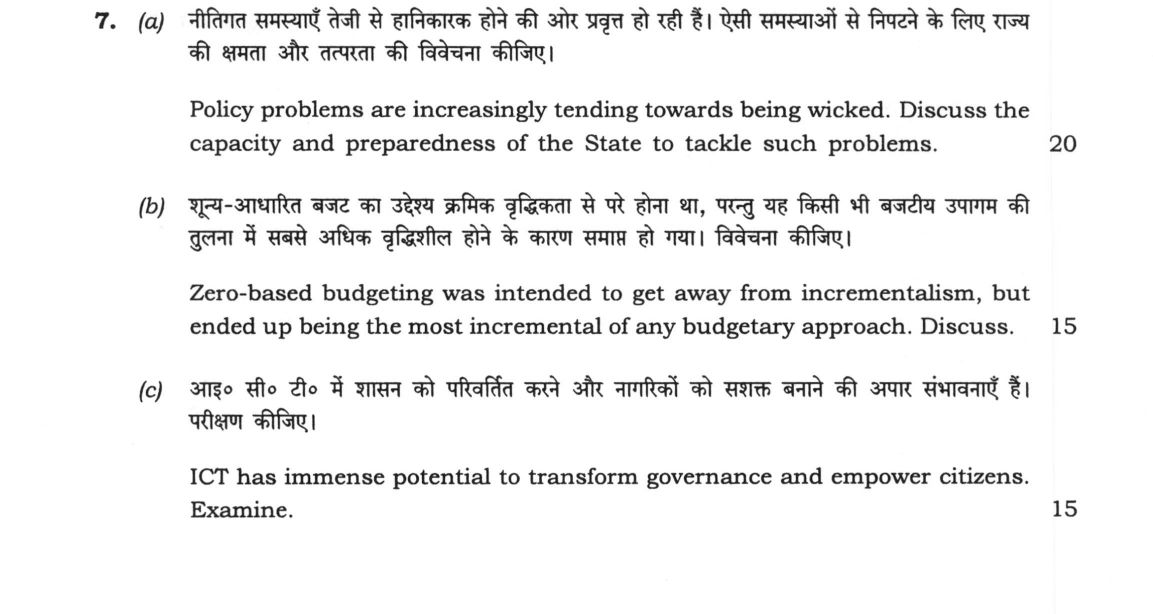
Policy problems are increasingly tending towards being wicked. Discuss the capacity and preparedness of the State to tackle such problems. 20 marks
Zero-based budgeting was intended to get away from incrementalism, but ended up being the most incremental of any budgetary approach. Discuss. 15 marks
ICT has immense potential to transform governance and empower citizens. Examine. 15 marks
हिंदी में प्रश्न पढ़ें
नीतिगत समस्याएं तेजी से हानिकारक होने की ओर प्रवृत्त हो रही हैं। ऐसी समस्याओं से निपटने के लिए राज्य की क्षमता और तत्परता की विवेचना कीजिए। (20 अंक)
शून्य-आधारित बजट का उद्देश्य क्रमिक वृद्धिकता से परे होना था, परन्तु यह किसी भी बजटीय उपागम की तुलना में सबसे अधिक वृद्धिशील होने के कारण समाप्त हो गया। विवेचना कीजिए। (15 अंक)
आई० सी० टी० में शासन को परिवर्तित करने और नागरिकों को सशक्त बनाने की अपार संभावनाएं हैं। परीक्षण कीजिए। (15 अंक)
Model answer
Written by UPSC Answer Check against this question's marking rubric, to the expected length. UPSC does not publish answers for Mains — this is one way to score well, not an official key.
Wicked Problems and State Capacity
Rittel and Webber defined wicked problems as policy challenges characterized by extreme complexity, open-ended boundaries, and contested definitions, where solving one dimension often generates unforeseen contradictions. In India, such challenges manifest in accelerating climate vulnerabilities, chaotic urbanization, and public health shocks like the COVID-19 pandemic.
Evaluating the State’s capacity and preparedness reveals significant institutional adaptation juxtaposed with structural limitations. The State has demonstrated capacity through statutory and strategic frameworks, notably the Disaster Management Act 2005, the institutional mechanisms under the National Action Plan on Climate Change, and NITI Aayog’s SDG Localization frameworks that benchmark sub-national performance. However, preparedness is constrained by deep administrative silos. Horizontal coordination across fragmented ministries remains weak, while vertical coordination between the Centre, States, and local bodies suffers from asymmetric fiscal and technical capabilities. Furthermore, bounded epistemic competence within generalist civil services limits data-driven forecasting and adaptive governance. Consequently, the administrative apparatus frequently addresses complex, non-linear wicked crises through rigid, linear, and departmentalized interventions.
The Paradox of Zero-Based Budgeting
Conceptualized by Peter Pyhrr in the 1970s and adopted during the Carter administration, Zero-Based Budgeting (ZBB) was designed to shatter incrementalism—the Wildavskyan model of budgetary drift based on historical baselines—by requiring every programme and expenditure to be justified afresh from ground zero using decision packages.
Paradoxically, ZBB degenerated into one of the most incremental techniques in practice. The immense cognitive burden, excessive documentation, and acute time constraints overwhelmed administrative systems. Faced with information asymmetry between line departments and finance divisions, bureaucrats routinely conducted superficial reviews, reducing "sunrise-sunset" assessments to ritualistic compliance. Moreover, the steep political costs of defunding established programmes and entrenched interest groups rendered comprehensive reappraisals impossible.
In India, ZBB was formally introduced in 1986 by the Ministry of Finance under the Seventh Five-Year Plan, but administrative inertia and calculation overload led to its quiet abandonment, echoing the historical failure of the Planning-Programming-Budgeting System (PPBS). The budgeting framework subsequently transitioned toward Outcome Budgeting in 2005 and the current Performance-cum-Outcome Budgeting architecture, acknowledging that administrative systems operate under bounded rationality where targeted, marginal evaluations are far more workable than recurrent zero-base overhauls.
ICT, Governance, and Citizen Empowerment
Information and Communication Technology (ICT) serves as a potent catalyst for structural transformation in public governance. Platforms under the Digital India umbrella—such as UMANG for unified service delivery, the e-Courts mission mode project for judicial pendency, and GIS-based platforms under PM GatiShakti for coordinated infrastructure planning—have streamlined processes and minimized administrative discretion.
In terms of citizen empowerment, ICT democratizes administrative interfaces. Platforms like CPGRAMS enhance grievance redressal accountability, MyGov fosters crowdsourced policy formulation, and RTI Online enforces transparency. Direct Benefit Transfer via the JAM trinity has circumscribed traditional rent-seeking intermediaries.
However, ICT is not an unalloyed solution. A pronounced digital divide across gender, income, and geography persists, compounded by sluggish last-mile broadband connectivity in rural and tribal interiors under BharatNet. Technical vulnerabilities, algorithmic rigidity, and biometric authentication failures frequently cause exclusion errors in essential welfare distribution, such as the public distribution system. Furthermore, the absence of robust data protection frameworks deepens concerns over unchecked state surveillance and privacy infringements.
Addressing contemporary public administration requires building agile epistemic capacity to tackle wicked problems, moving past procedural budgeting rituals toward outcome-oriented fiscal management, and bridging digital divides to ensure ICT remains an instrument of universal democratic empowerment.
What "Discuss" is asking you to do
Lay the issue out from more than one side — how it arose, what is claimed for it, what is held against it, and where it now stands. UPSC attaches discuss to broad topics with several live dimensions, so coverage of the dimensions earns more than the strength of your opinion.
Structure that answers it
Set the issue up → the case as it is made → the case against → the dimension both sides leave out → where the balance now lies
Where marks are lost
Listing facts with no thread between them, or arguing one side throughout and calling it a discussion.
How this answer will be evaluated
Approach
Framework: Public Administration Paper I (UPSC). (a) discuss: intro > 3-4 dimensions > example > balanced close | (b) discuss: intro > 3-4 dimensions > example > balanced close | (c) examine: intro > how/why with reasoning > evidence > conclusion Full marks: Precise definitions, strong Indian institutional anchors, clear distinction between theory and field reality, and specific 2nd ARC/reform references.
Key points expected
- Define 'wicked problems' (Rittel/Webber) with policy examples
- Analyze State capacity: institutional, technical, and political
- Analyze State preparedness: legal frameworks and planning mechanisms
- Provide Indian institutional examples (e.g., NITI Aayog, NCRB)
- Define ZBB and its intent to break incrementalism
- Explain the 'incremental' nature of ZBB in practice
- Analyze the administrative burden and data requirements of ZBB
- Provide Indian context (e.g., ZBB in specific states or sectors)
Evaluation rubric
Each sub-part is marked on its own, against the marks and word limit printed on the paper.
- (a) Define wicked problems and evaluate the State's capacity/preparedness to handle them. 20 marks
discuss— intro → 3-4 dimensions → example → balanced close
Must cover
- Define 'wicked problems' (Rittel/Webber) with policy examples
- Analyze State capacity: institutional, technical, and political
- Analyze State preparedness: legal frameworks and planning mechanisms
- Provide Indian institutional examples (e.g., NITI Aayog, NCRB)
Loses marks
- Treating 'wicked problems' as simple technical issues
- Ignoring the 'preparedness' aspect of the question
- GS-2 style policy advocacy without administrative analysis
Earns more
- Mention 2nd ARC recommendations on institutional reform
- Reference specific recent governance reforms (e.g., Digital India)
- Distinguish between 'capacity' and 'preparedness' clearly
- Cite specific 'wicked' Indian issues (e.g., climate change, urbanization)
Extra mark
- Reference specific 2nd ARC report on 'Reforming the State'
- Mention specific NITI Aayog policy documents
- (b) Explain why Zero-Based Budgeting (ZBB) failed to escape incrementalism. 15 marks
discuss— intro → 3-4 dimensions → example → balanced close
Must cover
- Define ZBB and its intent to break incrementalism
- Explain the 'incremental' nature of ZBB in practice
- Analyze the administrative burden and data requirements of ZBB
- Provide Indian context (e.g., ZBB in specific states or sectors)
Loses marks
- Defining ZBB without explaining its 'incremental' failure
- Ignoring the 'administrative burden' argument
- Treating ZBB as a purely technical accounting method
Earns more
- Mention the 'base year' problem in ZBB
- Reference the 'political' nature of budgeting
- Compare ZBB with traditional incremental budgeting
- Cite specific Indian states that tried ZBB (e.g., Kerala, Karnataka)
Extra mark
- Reference specific 2nd ARC recommendations on budgeting
- Mention specific 'wasted' budgetary allocations in India
- (c) Evaluate ICT's potential to transform governance and empower citizens. 15 marks
examine— intro → how/why with reasoning → evidence → conclusion
Must cover
- Define ICT in the context of governance
- Analyze how ICT transforms governance (e.g., e-governance)
- Analyze how ICT empowers citizens (e.g., access to information)
- Provide Indian examples (e.g., Digital India, MyGov, e-Courts)
Loses marks
- Treating ICT as a 'magic bullet' for governance
- Ignoring the 'empowerment' aspect of the question
- GS-2 style policy advocacy without administrative analysis
Earns more
- Mention the 'Digital Divide' as a limitation
- Reference specific ICT initiatives (e.g., UMANG, DigiLocker)
- Discuss the 'privacy' and 'security' concerns of ICT
- Cite specific 'citizen empowerment' outcomes (e.g., RTI, grievance redressal)
Extra mark
- Reference specific 2nd ARC recommendations on e-governance
- Mention specific 'data-driven' governance initiatives in India
Practice this exact question
Write your answer and it is marked point by point against the model answer above — what you covered, what you missed, what you got wrong.
Evaluate my answer →More from Public Administration 2021 Paper I
- Q4 (a) The new public service model approaches governance on the premises of an active and i…
- Q5 Answer the following in about 150 words each: (a) The approach to the study of administra…
- Q6 (a) Emphasis on cost control and reducing public expenditure has diverted the focus of go…
- Q7 (a) Policy problems are increasingly tending towards being wicked. Discuss the capacity a…
- Q8 (a) The successful attainment of SDGs objectives largely depends upon the wisdom, experie…