Paper I — Q6
(a) Emphasis on cost control and reducing public expenditure has diverted the focus of government budgets from the basic…
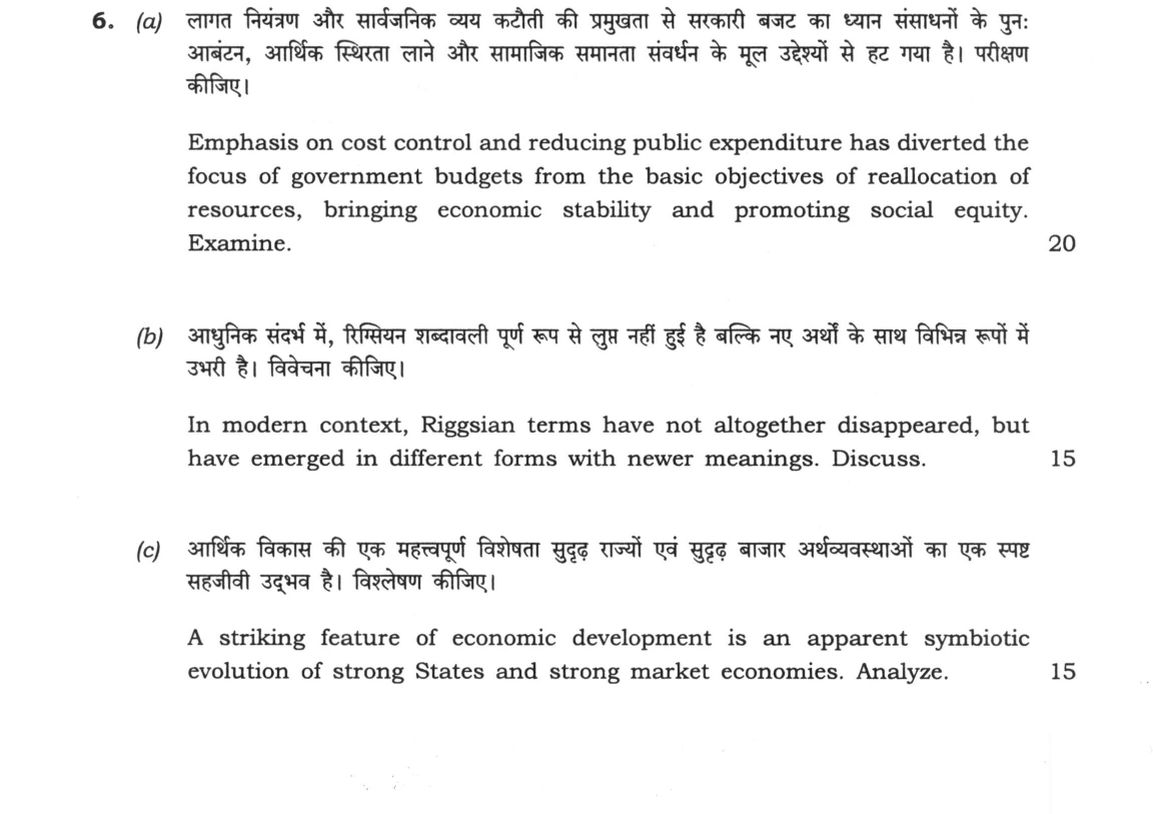
Emphasis on cost control and reducing public expenditure has diverted the focus of government budgets from the basic objectives of reallocation of resources, bringing economic stability and promoting social equity. Examine. 20 marks
In modern context, Riggsian terms have not altogether disappeared, but have emerged in different forms with newer meanings. Discuss. 15 marks
A striking feature of economic development is an apparent symbiotic evolution of strong States and strong market economies. Analyze. 15 marks
हिंदी में प्रश्न पढ़ें
लागत नियंत्रण और सार्वजनिक व्यय कटौती की प्रमुखता से सरकारी बजट का ध्यान संसाधनों के पुनः आवंटन, आर्थिक स्थिरता लाने और सामाजिक समानता संवर्धन के मूल उद्देश्यों से हट गया है। परीक्षण कीजिए। (20 अंक)
आधुनिक संदर्भ में, रिग्सियन शब्दावली पूर्ण रूप से लुप्त नहीं हुई है बल्कि नए अर्थों के साथ विभिन्न रूपों में उभरी है। विवेचना कीजिए। (15 अंक)
आर्थिक विकास की एक महत्वपूर्ण विशेषता सुदृढ़ राज्यों एवं सुदृढ़ बाजार अर्थव्यवस्थाओं का एक स्पष्ट सहजीवी उद्भव है। विश्लेषण कीजिए। (15 अंक)
Model answer
Written by UPSC Answer Check against this question's marking rubric, to the expected length. UPSC does not publish answers for Mains — this is one way to score well, not an official key.
Public budgeting fundamentally performs Richard Musgrave’s classic triadic functions: resource allocation, macroeconomic stabilization, and socio-economic distribution. Under the influence of New Public Management (NPM) and neoliberal orthodoxy, an aggressive emphasis on cost control, expenditure compression, and fiscal consolidation has often strained these foundational objectives.
Fiscal Consolidation vs. Musgravian Budgetary Functions
Expenditure containment regimes frequently enforce fiscal contraction by reducing capital expenditure and compressing social sector outlays in health, education, and rural development, thereby weakening redistributive justice and equity. In India, rigid compliance targets under the Fiscal Responsibility and Budget Management (FRBM) Act have at times constrained fiscal space for critical welfare commitments, such as MGNREGA, PM-KISAN, and targeted nutrition schemes.
However, examining this dynamic reveals that fiscal discipline and social equity are not inherently antithetical. Unchecked fiscal deficits trigger macroeconomic instability, sovereign rating downgrades, and high inflation—an implicit tax that disproportionately hurts the poor. Fiscal discipline creates the macro-stability necessary to sustain long-term resource reallocation. The critical imperative is not blind expenditure curtailment, but restructuring expenditure quality by reducing non-merit subsidies while protecting growth-enhancing social and capital investments.
Evolution of Riggsian Ecology in the Modern Context
Fred Riggs’ ecological model of prismatic societies—defined by formalism, heterogeneity, and overlapping—has not become obsolete; rather, its structural traits have assumed new forms. Formalism, the divergence between de jure rules and de facto administrative practices, manifests today as "e-formalism," where digital portals, citizen charters, and real-time dashboards mask persistent administrative discretion, offline rent-seeking, and manual workarounds.
Similarly, "overlapping" endures within hybrid regimes and modern neopatrimonialism, where rational-legal Weberian administrative structures operate alongside informal patron-client networks, caste alignments, and politicized transfers. The Riggsian "bazaar-canteen" economy finds modern parallels in unequal access to digital public goods and selective regulatory enforcement. In Indian administration, technological interventions layered onto entrenched administrative hierarchies demonstrate that absent institutional transformation, prismatic characteristics continuously adapt to modern public management reforms.
Symbiotic Evolution of Strong States and Market Economies
Economic history refutes the orthodox dichotomy between the state and the market. As demonstrated by the East Asian developmental state experience and Peter Evans’ concept of "embedded autonomy," robust market economies depend on an autonomous, institutionally capable state to guarantee property rights, enforce contracts, mitigate market failures, and develop human capital.
Conversely, a thriving market economy provides the expanding tax base and technological innovations essential for sustaining state capacity and financing public goods. In post-1991 India, economic liberalization did not produce state retreat; instead, it prompted an expansion of "regulatory capitalism." The state transitioned from a direct producer to a regulator and facilitator through institutions like SEBI, CCI, and TRAI, alongside extensive public-private partnerships (PPPs). However, this symbiosis requires continuous institutional insulation to prevent regulatory capture and crony capitalism, ensuring that market growth genuinely reinforces state capacity.
A mature governance architecture requires fiscal consolidation to be balanced with Musgravian equity, administrative reforms to address underlying prismatic realities rather than mere formalities, and the state to maintain embedded autonomy while steering competitive markets toward sustainable development.
What "Examine" is asking you to do
Test the proposition the question puts to you and return a finding on how far it holds. Examine stems carry a claim, or ask whether something has happened, and expect evidence weighed both ways before the extent is stated — often with remedial measures attached.
Structure that answers it
Restate the claim as the question frames it → evidence that supports it → evidence that undercuts it → the conditions under which it holds → verdict on how far it stands
Where marks are lost
Stopping at description. An examination has to reach a finding, and “examine with justification” means the extent must be stated, not implied.
How this answer will be evaluated
Approach
Framework: null. (a) examine: intro > how/why with reasoning > evidence > conclusion | (b) discuss: intro > 3-4 dimensions > example > balanced close | (c) analyse: intro > causes > effects > stakeholders/linkages > way forward Full marks: Comprehensive, well-structured, with specific Indian examples and theoretical depth.
Key points expected
- Define the three basic objectives: reallocation, stability, equity
- Explain the rationale for cost control (fiscal deficit, debt)
- Provide evidence of diverted focus (e.g., capex vs opex)
- Conclude on the impact on social equity and growth
- Define key Riggsian terms (e.g., fused, prismatic, diffusion)
- Identify modern forms (e.g., e-governance, digital divide)
- Explain how 'newer meanings' have emerged
- Provide an Indian example of a 'prismatic' feature today
Evaluation rubric
Each sub-part is marked on its own, against the marks and word limit printed on the paper.
- (a) Critically assess the shift from developmental to fiscal consolidation in Indian budgeting. 20 marks
examine— intro → how/why with reasoning → evidence → conclusion
Must cover
- Define the three basic objectives: reallocation, stability, equity
- Explain the rationale for cost control (fiscal deficit, debt)
- Provide evidence of diverted focus (e.g., capex vs opex)
- Conclude on the impact on social equity and growth
Loses marks
- Generic discussion of budgeting without Indian context
- Ignoring the 'social equity' aspect of the prompt
- Treating cost control as purely negative without nuance
Earns more
- Reference to FRBM Act or Fiscal Responsibility
- Mention of specific schemes (e.g., MGNREGA) vs cuts
- Distinction between revenue and capital expenditure
- Reference to 2nd ARC recommendations on budgeting
Extra mark
- Specific data on fiscal deficit trends
- Reference to specific budget documents (e.g., Economic Survey)
- (b) Analyze the persistence and evolution of Riggs' concepts in modern administration. 15 marks
discuss— intro → 3-4 dimensions → example → balanced close
Must cover
- Define key Riggsian terms (e.g., fused, prismatic, diffusion)
- Identify modern forms (e.g., e-governance, digital divide)
- Explain how 'newer meanings' have emerged
- Provide an Indian example of a 'prismatic' feature today
Loses marks
- Defining Riggs' terms without linking to modern context
- Ignoring the 'newer meanings' aspect of the prompt
- Generic discussion of bureaucracy without Riggsian framework
Earns more
- Reference to 'Fused' vs 'Diffused' in modern context
- Mention of 'Prismatic' nature of Indian bureaucracy
- Link to 'New Public Management' or 'Digital India'
- Reference to specific Indian administrative challenges
Extra mark
- Reference to specific modern reforms (e.g., RTI, e-governance)
- Mention of specific scholars who extended Riggs' work
- (c) Explain the interdependent relationship between strong states and market economies. 15 marks
analyse— intro → causes → effects → stakeholders/linkages → way forward
Must cover
- Define 'strong state' and 'strong market economy'
- Explain the 'symbiotic' nature of their evolution
- Provide examples of state intervention enabling markets
- Analyze the balance between regulation and deregulation
Loses marks
- Treating state and market as mutually exclusive
- Ignoring the 'symbiotic' aspect of the prompt
- Generic discussion of economics without state-market focus
Earns more
- Reference to 'Developmental State' model
- Mention of specific Indian policies (e.g., LPG reforms)
- Link to 'Institutional Economics' or 'Public Choice Theory'
- Reference to specific examples of state-market interaction
Extra mark
- Reference to specific economic data or growth figures
- Mention of specific international examples (e.g., East Asian Tigers)
Practice this exact question
Write your answer and it is marked point by point against the model answer above — what you covered, what you missed, what you got wrong.
Evaluate my answer →More from Public Administration 2021 Paper I
- Q3 (a) Integration of different streams of administrative thought to propound a universal ad…
- Q4 (a) The new public service model approaches governance on the premises of an active and i…
- Q5 Answer the following in about 150 words each: (a) The approach to the study of administra…
- Q6 (a) Emphasis on cost control and reducing public expenditure has diverted the focus of go…
- Q7 (a) Policy problems are increasingly tending towards being wicked. Discuss the capacity a…
- Q8 (a) The successful attainment of SDGs objectives largely depends upon the wisdom, experie…