Paper I — Q2
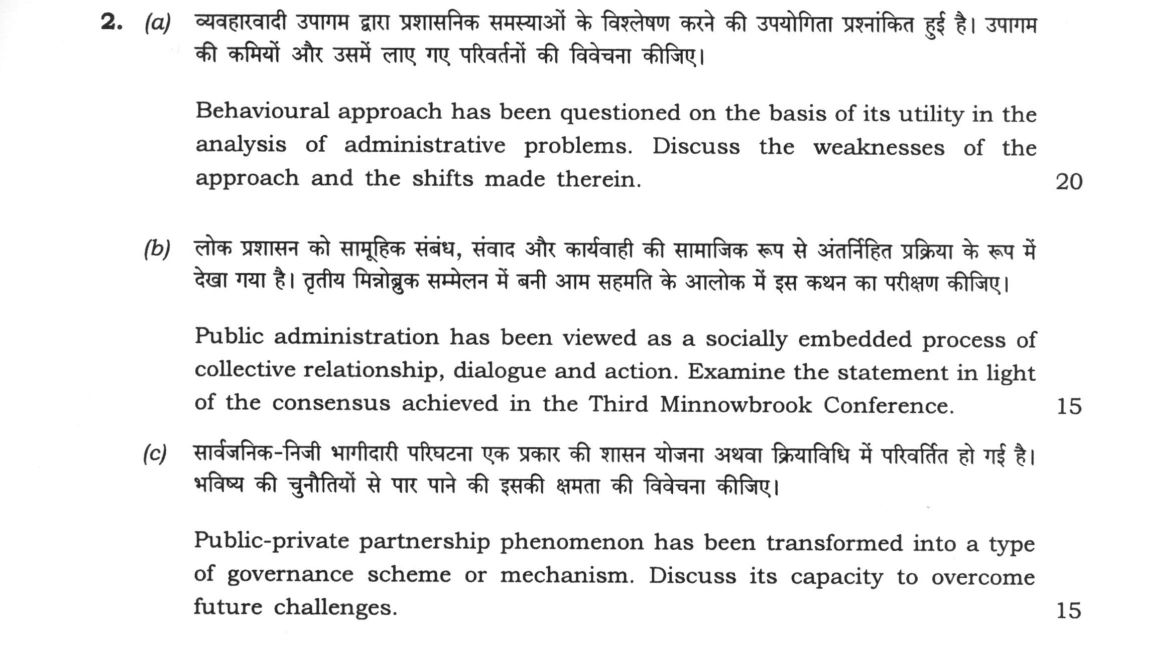
(a) Behavioural approach has been questioned on the basis of its utility in the analysis of administrative problems. Discuss the…
Behavioural approach has been questioned on the basis of its utility in the analysis of administrative problems. Discuss the weaknesses of the approach and the shifts made therein. 20 marks
Public administration has been viewed as a socially embedded process of collective relationship, dialogue and action. Examine the statement in light of the consensus achieved in the Third Minnowbrook Conference. 15 marks
Public-private partnership phenomenon has been transformed into a type of governance scheme or mechanism. Discuss its capacity to overcome future challenges. 15 marks
हिंदी में प्रश्न पढ़ें
व्यवहारवादी उपागम द्वारा प्रशासनिक समस्याओं के विश्लेषण करने की उपयोगिता प्रश्नांकित हुई है। उपागम की कमियों और उसमें लाए गए परिवर्तनों की विवेचना कीजिए। (20 अंक)
लोक प्रशासन को सामूहिक संबंध, संवाद और कार्यवाही की सामाजिक रूप से अंतर्निहित प्रक्रिया के रूप में देखा गया है। तृतीय मिनोब्रुक सम्मेलन में बनी आम सहमति के आलोक में इस कथन का परीक्षण कीजिए। (15 अंक)
सार्वजनिक-निजी भागीदारी परिपटना एक प्रकार की शासन योजना अथवा क्रियाविधि में परिवर्तित हो गई है। भविष्य की चुनौतियों से पार पाने की इसकी क्षमता की विवेचना कीजिए। (15 अंक)
Model answer
Written by UPSC Answer Check against this question's marking rubric, to the expected length. UPSC does not publish answers for Mains — this is one way to score well, not an official key.
Behavioural Approach: Weaknesses and Methodological Shifts
The behavioural revolution sought to establish a value-free, empirical science of administrative behaviour. However, its utility in solving real-world administrative problems faced severe limitations. Robert Dahl critiqued its universalist claims, arguing that public administration cannot be divorced from normative values, historical settings, and sociological contexts. Herbert Simon, in Administrative Behavior, provided an internal critique of classical rationality by formulating "bounded rationality" and "satisficing", yet his fact-value dichotomy was criticized for ignoring political and moral realities. Methodologically, the approach suffered from over-quantification, sterile empiricism, and a neglect of macro-institutional structures, reducing dynamic policy dilemmas to micro-level psychological variables.
These weaknesses catalyzed significant theoretical shifts. Post-behaviouralism emerged, emphasizing relevance and action alongside empirical rigor. Administrative scholarship integrated policy sciences, shaped by Charles Lindblom’s incrementalism and Yehezkel Dror’s normative-optimal policy turn, re-establishing ethical values, social equity, and institutional context as core administrative concerns.
Minnowbrook III: Socially Embedded Administration and Dialogue
The Third Minnowbrook Conference (2008), shaped by the Blue Ribbon Commission, consolidated public administration as an inherently socially embedded process grounded in relational governance, collective dialogue, and public action. While Minnowbrook I (1968) reacted against classical positivism with normative equity and Minnowbrook II (1988) engaged with market-driven managerialism, Minnowbrook III rejected value-neutral positivism in favor of democratic governance.
Scholars like Terry Cooper emphasized democratic citizenship and collaborative problem-solving, while David Rosenbloom’s constitutional approach re-anchored administration in legal and democratic values. Legitimacy was thus repositioned away from bureaucratic insularity and top-down authority toward deliberative, relational processes where public administrators facilitate civic dialogue, co-create solutions with citizens, and navigate networked governance structures.
Public-Private Partnerships as Governance Schemes and Future Challenges
Public-Private Partnerships (PPPs) have transformed from narrow, contractual procurement instruments into comprehensive governance schemes. As articulated by the Vijay Kelkar Committee (2015), modern PPPs function as institutionalized networked arrangements characterized by long-term risk-sharing, the co-production of public goods, and hybrid accountability frameworks bridging state, market, and civil society.
Regarding future challenges—such as climate-resilient urbanization, green transitions, and digital public infrastructure—PPPs offer substantial capacity through collaborative advantage:
- In Smart Cities and clean energy projects, PPPs mobilize private technological innovation and capital while retaining sovereign oversight.
- In digital infrastructure and public service delivery, hybrid platforms expand scale and operational agility.
However, realizing this potential requires overcoming deficits in stakeholder trust, information asymmetry, and rigid contract designs. Building adaptive governance capacities, transparent risk-allocation matrices, dynamic renegotiation frameworks, and robust dispute-resolution bodies is essential to safeguard the public interest against commercial opportunism.
Conclusion
The intellectual evolution from behavioural positivism to Minnowbrook III's socially embedded governance, and structurally to multi-actor PPPs, reflects a broader paradigm shift. To navigate contemporary complexities, public administration must integrate empirical competence with democratic dialogue, collaborative networks, and adaptive institutional designs.
What "Discuss" is asking you to do
Lay the issue out from more than one side — how it arose, what is claimed for it, what is held against it, and where it now stands. UPSC attaches discuss to broad topics with several live dimensions, so coverage of the dimensions earns more than the strength of your opinion.
Structure that answers it
Set the issue up → the case as it is made → the case against → the dimension both sides leave out → where the balance now lies
Where marks are lost
Listing facts with no thread between them, or arguing one side throughout and calling it a discussion.
How this answer will be evaluated
Approach
Framework: Public Administration, Paper 1. (a) discuss: intro > 3-4 dimensions > example > balanced close | (b) examine: intro > how/why with reasoning > evidence > conclusion | (c) discuss: intro > 3-4 dimensions > example > balanced close Full marks: Comprehensive, well-structured, with strong Indian anchors and specific examples.
Key points expected
- Identify specific weaknesses of the Behavioural approach
- Explain the shift from Behavioural to Post-Behavioural approach
- Link the approach to the analysis of administrative problems
- Provide an Indian administrative instance or context
- Define the 'socially embedded process' concept
- Explain the consensus of the Third Minnowbrook Conference
- Connect the conference outcomes to the statement
- Provide evidence or reasoning for the examination
Evaluation rubric
Each sub-part is marked on its own, against the marks and word limit printed on the paper.
- (a) Critique the utility of the Behavioural approach in administrative analysis and detail the subsequent theoretical shifts. 20 marks
discuss— intro → 3-4 dimensions → example → balanced close
Must cover
- Identify specific weaknesses of the Behavioural approach
- Explain the shift from Behavioural to Post-Behavioural approach
- Link the approach to the analysis of administrative problems
- Provide an Indian administrative instance or context
Loses marks
- Theory with no Indian anchor
- GS-2 style answers without administrative focus
- Failing to distinguish administration from politics
Earns more
- Mention key thinkers like Simon, March, or Simon's bounded rationality
- Reference the 'Politics-Administration' dichotomy debate
- Discuss the 'value-free' vs 'value-laden' controversy
- Reference the 2nd ARC recommendations on administrative reform
Extra mark
- Cite a specific Indian administrative reform or committee
- Reference a specific Supreme Court judgment on administrative law
- (b) Analyze the statement on public administration as a socially embedded process using the Third Minnowbrook Conference consensus. 15 marks
examine— intro → how/why with reasoning → evidence → conclusion
Must cover
- Define the 'socially embedded process' concept
- Explain the consensus of the Third Minnowbrook Conference
- Connect the conference outcomes to the statement
- Provide evidence or reasoning for the examination
Loses marks
- Failing to link the statement to the Third Minnowbrook Conference
- Lack of reasoning or evidence in the examination
- Ignoring the 'socially embedded' aspect of the statement
Earns more
- Mention the shift from 'New Public Administration' to 'New Public Governance'
- Reference the role of dialogue and collective action
- Discuss the 'socially embedded' nature of administrative action
- Link to Indian administrative practices or reforms
Extra mark
- Cite a specific Indian governance reform or policy
- Reference a specific committee or commission report
- (c) Evaluate the capacity of Public-Private Partnerships (PPP) to overcome future governance challenges. 15 marks
discuss— intro → 3-4 dimensions → example → balanced close
Must cover
- Define PPP as a governance scheme or mechanism
- Identify specific future challenges PPP can address
- Discuss the capacity of PPP to overcome these challenges
- Provide a balanced view of its effectiveness
Loses marks
- Failing to link PPP to future challenges
- Lack of balance in discussing its capacity
- Ignoring the 'governance scheme' aspect of PPP
Earns more
- Mention specific Indian PPP projects or sectors (e.g., infrastructure, healthcare)
- Reference the PPP policy or framework in India
- Discuss the role of private sector in public service delivery
- Link to recent governance reforms or initiatives
Extra mark
- Cite a specific Indian PPP project or case study
- Reference a specific government policy or scheme
Practice this exact question
Write your answer and it is marked point by point against the model answer above — what you covered, what you missed, what you got wrong.
Evaluate my answer →More from Public Administration 2021 Paper I
- Q1 Answer the following in about 150 words each: (a) "Governance is about managing self-orga…
- Q2 (a) Behavioural approach has been questioned on the basis of its utility in the analysis…
- Q3 (a) Integration of different streams of administrative thought to propound a universal ad…
- Q4 (a) The new public service model approaches governance on the premises of an active and i…
- Q5 Answer the following in about 150 words each: (a) The approach to the study of administra…