Paper I — Q8
(a) The successful attainment of SDGs objectives largely depends upon the wisdom, experience and farsightedness of the actors…
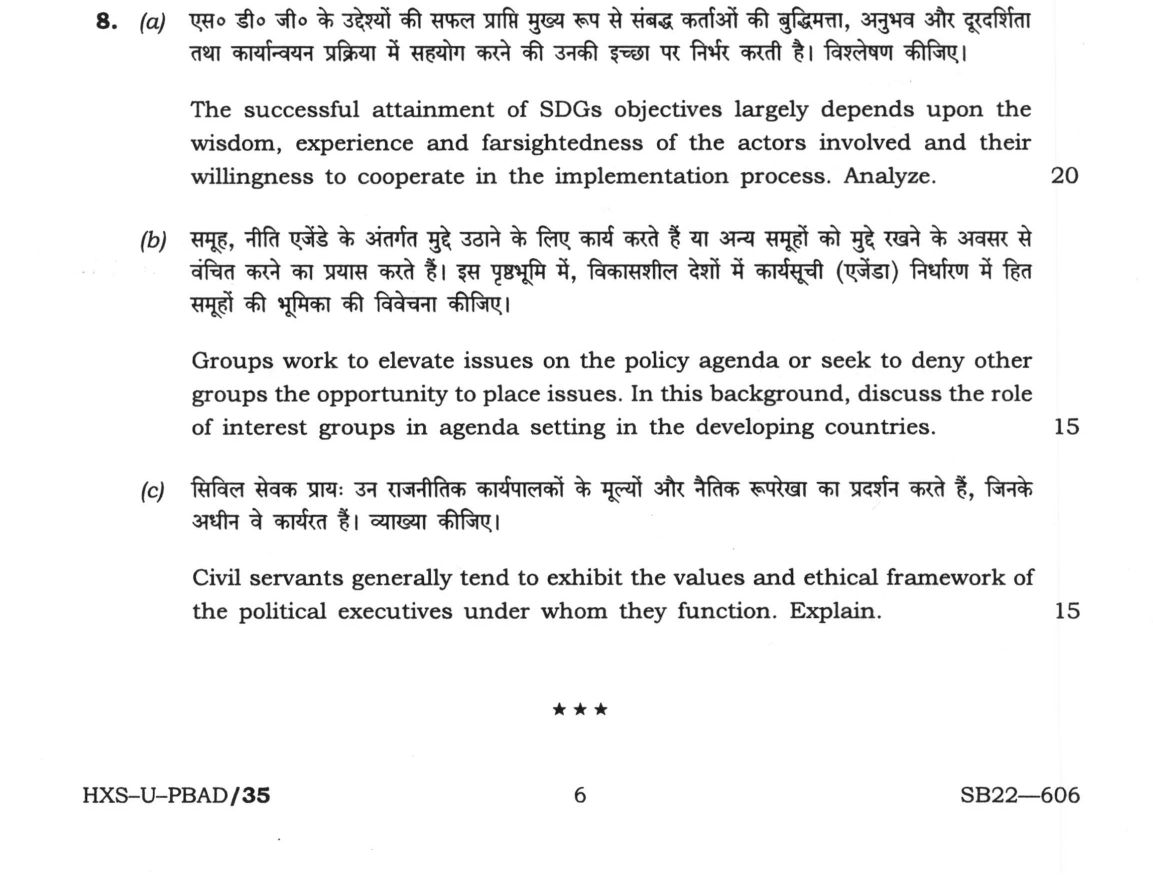
The successful attainment of SDGs objectives largely depends upon the wisdom, experience and farsightedness of the actors involved and their willingness to cooperate in the implementation process. Analyze. 20 marks
Groups work to elevate issues on the policy agenda or seek to deny other groups the opportunity to place issues. In this background, discuss the role of interest groups in agenda setting in the developing countries. 15 marks
Civil servants generally tend to exhibit the values and ethical framework of the political executives under whom they function. Explain. 15 marks
हिंदी में प्रश्न पढ़ें
एस० डी० जी० के उद्देश्यों की सफल प्राप्ति मुख्य रूप से संबद्ध कर्ताओं की बुद्धिमत्ता, अनुभव और दूरदर्शिता तथा कार्यान्वयन प्रक्रिया में सहयोग करने की उनकी इच्छा पर निर्भर करती है। विश्लेषण कीजिए। (20 अंक)
समूह, नीति एजेंडे के अंतर्गत मुद्दे उठाने के लिए कार्य करते हैं या अन्य समूहों को मुद्दे रखने के अवसर से वंचित करने का प्रयास करते हैं। इस पृष्ठभूमि में, विकासशील देशों में कार्यसूची (एजेंडा) निर्धारण में हित समूहों की भूमिका की विवेचना कीजिए। (15 अंक)
सिविल सेवक प्रायः उन राजनीतिक कार्यपालकों के मूल्यों और नैतिक रूपरेखा का प्रदर्शन करते हैं, जिनके अधीन वे कार्यरत हैं। व्याख्या कीजिए। (15 अंक)
Model answer
Written by UPSC Answer Check against this question's marking rubric, to the expected length. UPSC does not publish answers for Mains — this is one way to score well, not an official key.
SDG Realization: Multi-Level Actors, Farsightedness, and Cooperation
The attainment of the 2030 Agenda relies on a multi-level governance architecture spanning international bodies, national governments, sub-national entities, civil society organizations (CSOs), and the private sector. The interconnected nature of the 17 Sustainable Development Goals (SDGs) requires institutionalized cooperative mechanisms for SDG localization, exemplified in India by NITI Aayog’s SDG India Index, which drives vertical convergence across states and horizontal integration across ministries.
Wisdom and farsightedness among governance actors are operationalized through anticipatory governance, scenario planning, and adaptive management. Cross-cutting goals, such as climate action (SDG 13) and reduced inequalities (SDG 10), operate on long-term ecological and demographic cycles that clash with short-term political horizons. Farsighted actors transcend administrative departmentalism and bureaucratic path-dependency by deploying evidence-based scenario modeling. Furthermore, adaptive management allows implementing agencies to adjust policies dynamically through iterative feedback loops, ensuring that collaborative networks pool resources and build resilience against systemic socio-economic disruptions.
Interest Groups and Agenda Setting in Developing Nations
Policy agenda setting is a contested domain where interest groups either mobilize issue expansion to elevate policy demands or practice non-decision making (Bachrach and Baratz) to prevent critical challenges from reaching the institutional agenda. In contrast to classical pluralist models with balanced competition, or corporatist arrangements with institutionalized interest intermediation, agenda setting in developing nations is deeply asymmetric.
Organized interest groups leverage strategies like venue shopping—shifting advocacy between executive agencies, legislative committees, and the judiciary (such as public interest litigation in India)—alongside media campaigns to build public salience. However, structural constraints in developing contexts systematically distort agenda access. Pervasive patron-client networks, weak grassroots civil society infrastructure, and elite capture allow powerful industrial lobbies and agrarian elites to gatekeep policy priorities. Consequently, marginalized segments—such as unorganized labor and indigenous populations—are denied agenda space, reinforcing non-decisions on redistributive reforms and structural inequalities.
Political-Bureaucratic Interface and Ethical Value Transmission
The political-bureaucratic interface frequently sees civil servants mirroring the values, priorities, and ethical frameworks of incumbent political executives. Bureaucratic politics and politicization theories show that political executives wield significant discretionary authority over postings, promotions, and policy directives. Under such structural pressure, civil servants may align their professional ethos with the executive's ideological agenda, transforming bureaucratic responsiveness into programmatic commitment or a latent spoils system.
However, constitutional and administrative frameworks establish definitive safeguards against political value capture. The Weberian doctrine of civil service neutrality, reinforced by institutional safeguards such as Article 311 of the Indian Constitution, mandates that the permanent executive remains politically non-aligned and functionally objective. Furthermore, statutory conduct rules, vigilance institutions (Central Vigilance Commission), and the judiciary enforce adherence to constitutional morality over partisan preferences. An ethically grounded civil service derives its primary framework from constitutional values—equity, secularism, and the rule of law—enabling administrators to maintain independent professional judgment and resist unethical political dictates.
Conclusion
Navigating developmental challenges requires an integrated governance paradigm: SDG localization demands multi-actor foresight and collaborative networks, agenda setting must be safeguarded against elite-driven non-decisions through inclusive public spheres, and the civil service must balance functional responsiveness to elected executives with uncompromising adherence to constitutional values and institutional integrity.
What "Analyse" is asking you to do
Break the subject into its working parts and show how they act on each other. The marks are in the interconnections — which factor drives which, and what the resulting structure explains — not in the inventory of factors.
Structure that answers it
Define the whole → separate it into its parts → show which part drives which → what that interaction produces → what the structure implies
Where marks are lost
A flat list of causes with no account of which drives which. An answer of neatly separated headings, each self-contained, scores as description.
How this answer will be evaluated
Approach
Framework: null. (a) analyse: intro > causes > effects > stakeholders/linkages > way forward | (b) discuss: intro > 3-4 dimensions > example > balanced close | (c) explain: definition/context > points in order > small example > short close Full marks: Comprehensive analysis with specific Indian examples, clear distinction between theory and practice, and strong critical evaluation.
Key points expected
- Identify key actors (State, private, civil society)
- Link 'wisdom' to policy design and 'experience' to execution
- Analyze 'willingness to cooperate' via multi-stakeholder partnerships
- Provide Indian institutional examples (e.g., NITI Aayog, PM-KISAN)
- Define 'agenda setting' in the context of policy
- Explain how groups elevate issues (e.g., lobbying, media)
- Explain how groups deny others (e.g., gatekeeping, resources)
- Contextualize specifically for developing countries (e.g., resource constraints)
Evaluation rubric
Each sub-part is marked on its own, against the marks and word limit printed on the paper.
- (a) Analyze the role of actor wisdom, experience, and cooperation in SDG implementation. 20 marks
analyse— intro → causes → effects → stakeholders/linkages → way forward
Must cover
- Identify key actors (State, private, civil society)
- Link 'wisdom' to policy design and 'experience' to execution
- Analyze 'willingness to cooperate' via multi-stakeholder partnerships
- Provide Indian institutional examples (e.g., NITI Aayog, PM-KISAN)
Loses marks
- Generic listing of SDGs without analyzing the 'actors' aspect
- Ignoring the 'willingness to cooperate' dimension
- Theory without Indian administrative context
Earns more
- Mention specific SDG targets (e.g., SDG 1, 3, 7)
- Discuss the role of local governance (Panchayati Raj)
- Reference the 2030 Agenda for Sustainable Development
- Discuss the role of technology in implementation
Extra mark
- Cite specific data from India's NITI Aayog SDG Index
- Reference the 2nd ARC recommendations on governance
- (b) Discuss the role of interest groups in agenda setting in developing countries. 15 marks
discuss— intro → 3-4 dimensions → example → balanced close
Must cover
- Define 'agenda setting' in the context of policy
- Explain how groups elevate issues (e.g., lobbying, media)
- Explain how groups deny others (e.g., gatekeeping, resources)
- Contextualize specifically for developing countries (e.g., resource constraints)
Loses marks
- Confusing 'interest groups' with 'political parties'
- Ignoring the 'developing countries' context
- Failing to address the 'denial' aspect of agenda setting
Earns more
- Mention specific Indian interest groups (e.g., CII, FICCI, farmers' unions)
- Discuss the role of social media in modern agenda setting
- Reference the concept of 'policy windows' (Kingdon)
- Discuss the influence of NGOs on policy (e.g., RTI Act)
Extra mark
- Cite a specific case study of agenda setting success/failure
- Reference the 2nd ARC on civil society engagement
- (c) Explain why civil servants exhibit the values of political executives. 15 marks
explain— definition/context → points in order → small example → short close
Must cover
- Define the relationship between political and administrative executives
- Explain the 'subordinate' nature of civil service
- Discuss the 'political neutrality' vs 'political responsiveness' tension
- Provide examples of policy implementation reflecting political will
Loses marks
- Ignoring the 'ethical framework' aspect
- Failing to distinguish between 'values' and 'actions'
- Generic discussion without specific administrative examples
Earns more
- Reference the 'Principle of Political Neutrality'
- Discuss the role of the 'Cabinet' in policy direction
- Mention the 'Rule of Law' and 'Due Process'
- Discuss the 'Ethical Framework' of the civil service
Extra mark
- Cite a specific instance of political-administrative conflict
- Reference the 2nd ARC on ethical governance
Practice this exact question
Write your answer and it is marked point by point against the model answer above — what you covered, what you missed, what you got wrong.
Evaluate my answer →More from Public Administration 2021 Paper I
- Q5 Answer the following in about 150 words each: (a) The approach to the study of administra…
- Q6 (a) Emphasis on cost control and reducing public expenditure has diverted the focus of go…
- Q7 (a) Policy problems are increasingly tending towards being wicked. Discuss the capacity a…
- Q8 (a) The successful attainment of SDGs objectives largely depends upon the wisdom, experie…