Paper I — Q4
(a) The new public service model approaches governance on the premises of an active and involved citizenship, wherein the role of…
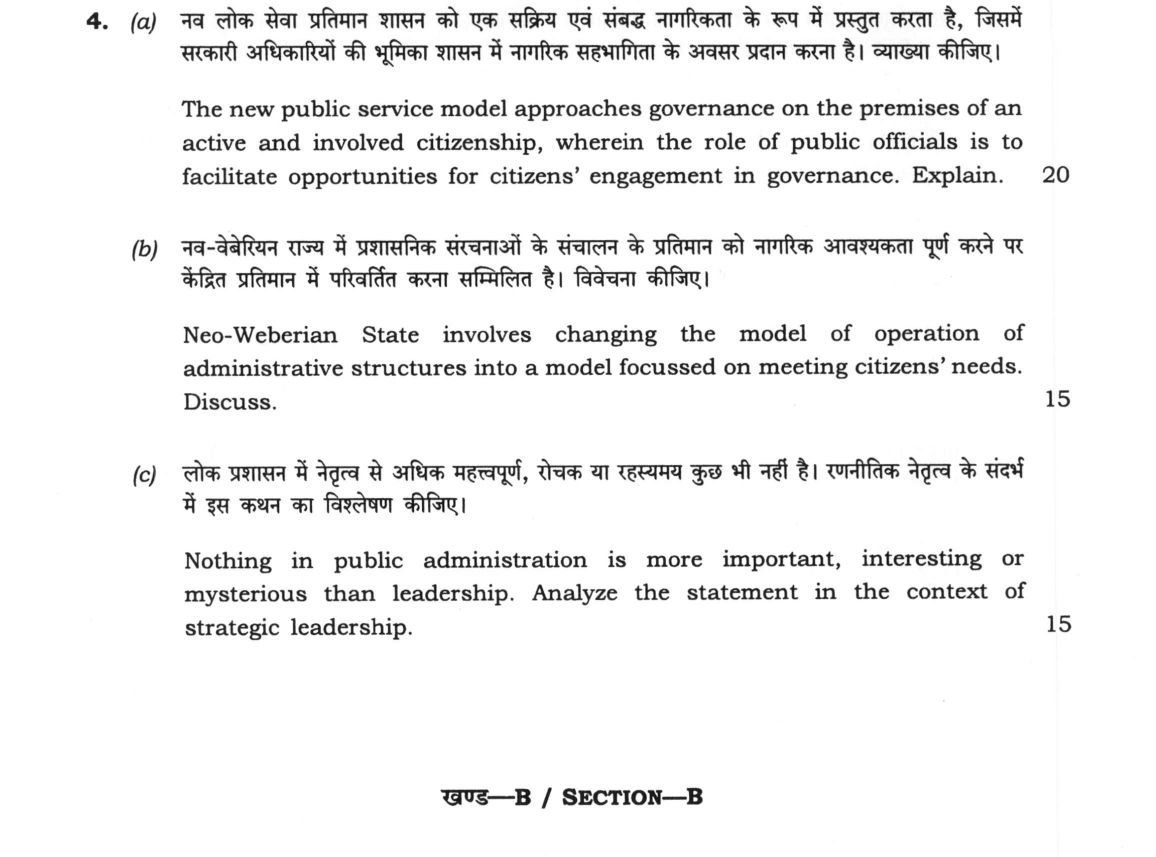
The new public service model approaches governance on the premises of an active and involved citizenship, wherein the role of public officials is to facilitate opportunities for citizens' engagement in governance. Explain. 20 marks
Neo-Weberian State involves changing the model of operation of administrative structures into a model focussed on meeting citizens' needs. Discuss. 15 marks
Nothing in public administration is more important, interesting or mysterious than leadership. Analyze the statement in the context of strategic leadership. 15 marks
हिंदी में प्रश्न पढ़ें
नव लोक सेवा प्रतिमान शासन को एक सक्रिय एवं संबद्ध नागरिकता के रूप में प्रस्तुत करता है, जिसमें सरकारी अधिकारियों की भूमिका शासन में नागरिक सहभागिता के अवसर प्रदान करना है। व्याख्या कीजिए। (20 अंक)
नव-वेबेरियन राज्य में प्रशासनिक संरचनाओं के संचालन के प्रतिमान को नागरिक आवश्यकता पूर्ण करने पर केंद्रित प्रतिमान में परिवर्तित करना सम्मिलित है। विवेचना कीजिए। (15 अंक)
लोक प्रशासन में नेतृत्व से अधिक महत्वपूर्ण, रोचक या रहस्यमय कुछ भी नहीं है। रणनीतिक नेतृत्व के संदर्भ में इस कथन का विश्लेषण कीजिए। (15 अंक)
Model answer
Written by UPSC Answer Check against this question's marking rubric, to the expected length. UPSC does not publish answers for Mains — this is one way to score well, not an official key.
New Public Service and Active Citizenship
Denhardt and Denhardt’s New Public Service (NPS) shifts administrative ontology from New Public Management’s (NPM) transactional customer orientation to a democratic citizen ethos. Grounded in democratic theory, communitarianism, and humanistic public administration, NPS rests on four foundational pillars: serve citizens rather than customers; pursue the public interest as an emergent dialogue rather than an aggregation of individual market choices; value citizenship over entrepreneurship; and think strategically while acting democratically. Unlike NPM's reliance on market-based steering and competitive privatism, NPS redefines the causal role of public officials from controllers or market arbiters to civic facilitators, mediators, and navigators of shared societal interests.
This facilitation operates through institutionalized mechanisms of civic engagement, including social audits under schemes like MGNREGA, participatory budgeting, Citizen Charters, and deliberative digital platforms such as MyGov. By operationalizing frameworks like the Sevottam model, public administrators foster civic capability, resolve competing interests through open discourse, and facilitate the co-production of public value. The official’s primary duty becomes building institutional spaces where citizens actively deliberate, ensuring governance is driven by collective public interest rather than managerial discretion.
Neo-Weberian State: Reconciling Legality with Responsiveness
Conceptualized by Christopher Pollitt and Geert Bouckaert, the Neo-Weberian State (NWS) emerged as a post-NPM reform paradigm across continental Europe. It structurally synthesizes the classic Weberian elements of rule of law, administrative stability, professionalization, and constitutional authority with modern managerial adaptations focused on results orientation, external consultation, and citizen needs.
While traditional Weberian administration often calcified into rigid proceduralism, and NPM risked hollowing out the state through marketization, NWS reaffirms the state as the primary guarantor of collective welfare while modernizing administrative structures to make them directly responsive to citizens. For developing contexts like India, where market mechanisms often exclude vulnerable populations, NWS provides an optimal institutional vehicle. Reforms like Mission Karmayogi, institutionalized service delivery standards, and NITI Aayog's push for cooperative outcomes modernize the bureaucracy into a professional, outcome-driven, yet legally anchored apparatus.
Strategic Leadership in Public Administration
Strategic leadership in public administration, conceptualized by theorists like Warren Bennis, John Kotter, and Montgomery Van Wart, entails setting long-term institutional vision, aligning multi-stakeholder coalitions, orchestrating systemic change, and maintaining normative ethical integrity amidst public sector complexity.
Leadership is fundamentally important because modern administrative reforms inevitably stall without champions who can convert institutional mandates into operational outcomes. Yet, it remains inherently mysterious: it is highly context-contingent, relies heavily on tacit judgment rather than standardized codification, and operates within the delicate constitutional dialectic between the elected political executive and the permanent civil service. Transformational figures such as T.N. Seshan in reforming electoral integrity, E. Sreedharan in executing large-scale public infrastructure, and District Collectors leading rapid inter-agency crisis responses in disaster management illustrate how public leaders mobilize administrative machinery under extreme uncertainty.
Way Forward
Modern governance demands an integrated synthesis where New Public Service supplies the democratic normative vision of active citizenship, the Neo-Weberian State provides the resilient and modernized administrative machinery, and strategic leadership injects the transformational agency needed to steer both toward public value creation.
What "Explain" is asking you to do
Make the working of something clear — what sets it off, what follows from what, and what it produces. Explain is the Commission's mechanism word: it dominates the technical papers and the “explain why” stems, where the marks sit in the causal chain and not in the label.
Structure that answers it
State what it is → the initiating condition → the chain of cause, step by step → an instance where it plays out → what the chain produces
Where marks are lost
Describing what something looks like instead of why it works that way. Naming the stages without linking them reads as description too.
How this answer will be evaluated
Approach
Framework: New Public Service (NPS) & Neo-Weberian State. (a) explain: definition/context > points in order > small example > short close | (b) discuss: intro > 3-4 dimensions > example > balanced close | (c) analyse: intro > causes > effects > stakeholders/linkages > way forward Full marks: Clear definitions, strong Indian examples, specific references to 2nd ARC or recent reforms, balanced analysis.
Key points expected
- Define New Public Service (Denhardt & Denhardt)
- Contrast NPS with New Public Management (NPM)
- Role of officials as facilitators, not just providers
- Indian example: Digital India or Citizen Charters
- Define Neo-Weberian State (Hood)
- Shift from rule-bound to outcome-focused administration
- Focus on citizen needs and responsiveness
- Indian context: Service delivery reforms
Evaluation rubric
Each sub-part is marked on its own, against the marks and word limit printed on the paper.
- (a) Define NPS and explain the shift from 'serving' to 'engaging' citizens in governance. 20 marks
explain— definition/context → points in order → small example → short close
Must cover
- Define New Public Service (Denhardt & Denhardt)
- Contrast NPS with New Public Management (NPM)
- Role of officials as facilitators, not just providers
- Indian example: Digital India or Citizen Charters
Loses marks
- Confusing NPS with NPM (efficiency vs engagement)
- Generic talk on democracy without administrative context
- Ignoring the specific role of public officials
Earns more
- Mention of 'Citizen as Customer' vs 'Citizen as Partner'
- Reference to 2nd ARC on Citizen Centric Administration
- Mention of e-governance as a tool for engagement
- Discussion on transparency and accountability
Extra mark
- Specific mention of 'MyGov' or 'Swachh Bharat' citizen engagement
- Reference to specific NPS principles (e.g., dialogue over debate)
- (b) Discuss the Neo-Weberian State's focus on meeting citizen needs vs traditional bureaucracy. 15 marks
discuss— intro → 3-4 dimensions → example → balanced close
Must cover
- Define Neo-Weberian State (Hood)
- Shift from rule-bound to outcome-focused administration
- Focus on citizen needs and responsiveness
- Indian context: Service delivery reforms
Loses marks
- Confusing Neo-Weberian with traditional Weberian bureaucracy
- Ignoring the 'citizen needs' aspect
- Generic talk on administrative reform without specific model
Earns more
- Mention of 'New Public Governance' (NPG)
- Reference to 2nd ARC on Citizen Centric Administration
- Discussion on 'Citizen as Customer' in service delivery
- Mention of performance-based management
Extra mark
- Specific mention of 'One Window' clearance or 'Single Window' systems
- Reference to specific state-level reforms (e.g., Kerala or Gujarat)
- (c) Analyze the importance of leadership in public administration, focusing on strategic leadership. 15 marks
analyse— intro → causes → effects → stakeholders/linkages → way forward
Must cover
- Define Strategic Leadership in public sector
- Role of leadership in policy implementation
- Importance of vision and direction setting
- Indian example: A specific leader or reform
Loses marks
- Generic talk on leadership without public sector context
- Ignoring the 'strategic' aspect
- Confusing leadership with management
Earns more
- Mention of 'Transformational Leadership' vs 'Transactional'
- Reference to 2nd ARC on Leadership in Public Administration
- Discussion on 'Ethical Leadership' in public service
- Mention of 'Change Management' in administration
Extra mark
- Specific mention of a leader like L.K. Advani or S. Jaishankar
- Reference to specific leadership theories (e.g., Kotter's 8 steps)
Practice this exact question
Write your answer and it is marked point by point against the model answer above — what you covered, what you missed, what you got wrong.
Evaluate my answer →More from Public Administration 2021 Paper I
- Q1 Answer the following in about 150 words each: (a) "Governance is about managing self-orga…
- Q2 (a) Behavioural approach has been questioned on the basis of its utility in the analysis…
- Q3 (a) Integration of different streams of administrative thought to propound a universal ad…
- Q4 (a) The new public service model approaches governance on the premises of an active and i…
- Q5 Answer the following in about 150 words each: (a) The approach to the study of administra…
- Q6 (a) Emphasis on cost control and reducing public expenditure has diverted the focus of go…
- Q7 (a) Policy problems are increasingly tending towards being wicked. Discuss the capacity a…