Paper II — Q1
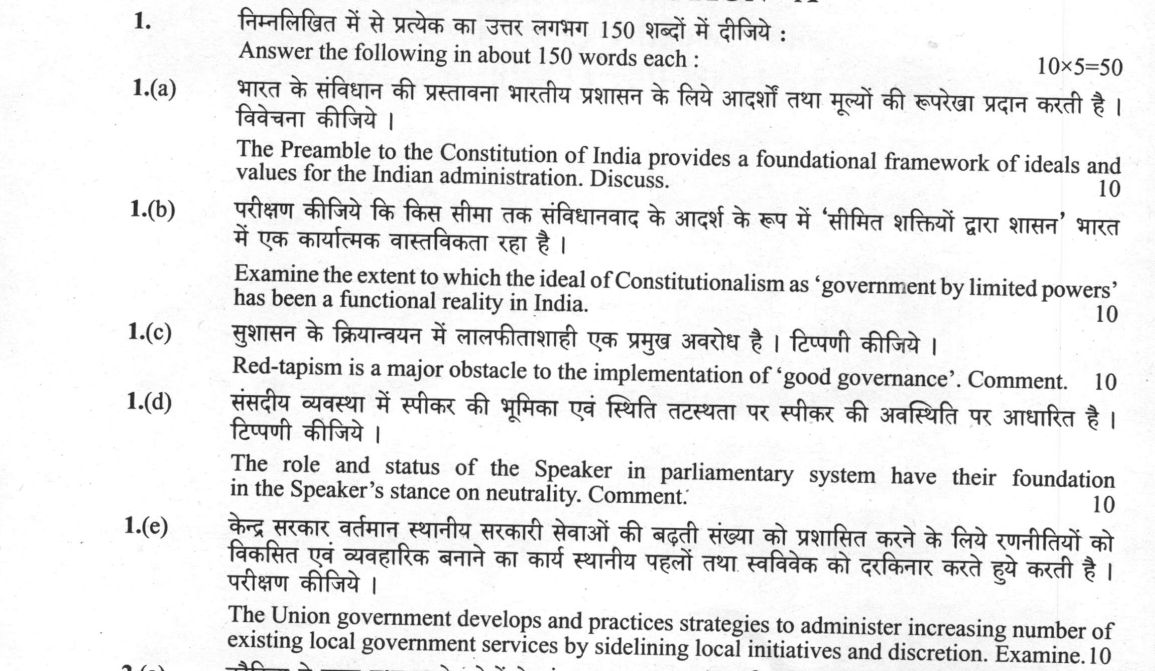
Answer the following in about 150 words each: (a) The Preamble to the Constitution of India provides a foundational framework of…
Answer the following in about 150 words each:
The Preamble to the Constitution of India provides a foundational framework of ideals and values for the Indian administration. Discuss. 10 marks
Examine the extent to which the ideal of Constitutionalism as 'government by limited powers' has been a functional reality in India. 10 marks
Red-tapism is a major obstacle to the implementation of 'good governance'. Comment. 10 marks
The role and status of the Speaker in parliamentary system have their foundation in the Speaker's stance on neutrality. Comment. 10 marks
The Union government develops and practices strategies to administer increasing number of existing local government services by sidelining local initiatives and discretion. Examine. 10 marks
हिंदी में प्रश्न पढ़ें
निम्नलिखित में से प्रत्येक का उत्तर लगभग 150 शब्दों में दीजिये :
भारत के संविधान की प्रस्तावना भारतीय प्रशासन के लिये आदर्शों तथा मूल्यों की रूपरेखा प्रदान करती है । विवेचना कीजिये । (10 अंक)
परीक्षण कीजिये कि किस सीमा तक संविधानवाद के आदर्श के रूप में 'सीमित शक्तियों द्वारा शासन' भारत में एक कार्यात्मक वास्तविकता रहा है । (10 अंक)
सुशासन के क्रियान्वयन में लालफीताशाही एक प्रमुख अवरोध है । टिप्पणी कीजिये । (10 अंक)
संसदीय व्यवस्था में स्पीकर की भूमिका एवं स्थिति तटस्थता पर स्पीकर की अवस्थिति पर आधारित है । टिप्पणी कीजिये । (10 अंक)
केन्द्र सरकार वर्तमान स्थानीय सरकारी सेवाओं की बढ़ती संख्या को प्रशासित करने के लिये रणनीतियों को विकसित एवं व्यवहारिक बनाने का कार्य स्थानीय पहलों तथा स्वविवेक को दरकिनार करते हुये करती है । परीक्षण कीजिये । (10 अंक)
Model answer
Written by UPSC Answer Check against this question's marking rubric, to the 150-word length. UPSC does not publish answers for Mains — this is one way to score well, not an official key.
(a) Preamble and Administrative Values
The Preamble to the Constitution encapsulates the core philosophy that directs Indian public administration. The declaration of India as a Sovereign, Socialist, Secular, Democratic, Republic serves as the normative charter for the administrative machinery. Administrative sovereignty manifests in autonomous public policy formulation free from external dictates. The ideal of socialism obligates the civil service to function as an instrument of redistributive justice, driving welfare schemes such as the Public Distribution System and MGNREGA to bridge socioeconomic divides. Secularism translates into strict bureaucratic neutrality and non-discrimination across religious divides under Article 15. The democratic and republican values foster participatory, transparent, and accountable administration, operationalized through mechanisms like the Right to Information. Furthermore, the commitment to secure justice, liberty, equality, and fraternity guides administrative discretion, ensuring that state power upholds the rule of law and affirmative action. Translating these preambular ideals into institutional culture remains essential to sustain a citizen-centric administration.
(b) Constitutionalism and Limited Government in India
Constitutionalism posits that government authority is circumscribed by institutional checks, ensuring the rule of law rather than arbitrary rule. In India, this ideal has achieved substantial functional reality through robust structural restraints. The judiciary has acted as a primary bulwark, utilizing judicial review and establishing the Basic Structure doctrine in Kesavananda Bharati (1973) to prevent legislative overreach. Fundamental Rights, federal distribution of powers, and independent oversight bodies like the Election Commission and the Comptroller and Auditor General institutionalize accountability.
However, constitutionalism faces functional erosions. The historic misuse of Article 356 to dismiss state governments, reliance on the "ordinance raj" under Articles 123 and 213 to bypass legislative debate, and the unchecked proliferation of executive-driven delegated legislation test these constitutional limits. Thus, while institutional architecture structurally secures limited government, upholding constitutionalism dynamically requires active judicial vigilance and legislative restraint.
(c) Red-Tapism and Good Governance
Red-tapism denotes excessive adherence to formal rules, procedural rigidity, and redundant paperwork, serving as a primary impediment to good governance. Rooted in the classic Weberian bureaucratic model, it arises from strict hierarchy, risk-averse decision-making, and fear of post-facto vigilance audits by agencies like the CVC and CAG.
This procedural paralysis severely undermines the pillars of good governance. It delays public service delivery, alienates citizens, and breeds corruption by encouraging "speed money" to navigate administrative bottlenecks. Furthermore, it shifts administrative focus from qualitative outcomes to mechanical rule-compliance. Mitigating red-tapism requires structural simplification, as demonstrated by digital interventions such as faceless tax assessments, single-window clearances, and enforceable Citizen's Charters under the Sevottam framework. Red-tapism fundamentally contradicts the tenets of responsive governance, necessitating a shift from procedural orthodoxy toward an outcome-oriented, empathetic administrative culture.
(d) Speaker’s Neutrality in the Parliamentary System
The Speaker embodies the authority, dignity, and impartiality of the legislative assembly, with constitutional foundations laid down in Articles 93 and 178. Effective parliamentary functioning depends entirely on the Speaker's neutrality, which safeguards minority party rights, regulates fair debate, and maintains legislative discipline.
However, the politicization of this office has raised recurring concerns. Under the Tenth Schedule, the Speaker acts as a quasi-judicial authority for disqualification on grounds of defection. Partisan delays in deciding petitions and selective enforcement have led to frequent judicial interventions, as seen in Kihoto Hollohan (1992) and subsequent rulings. The convention of the Speaker resigning from party affiliations remains unadopted in India. To insulate this office from executive and political patronage, reforms such as those suggested by the Justice K. Subba Rao Committee and the adoption of the British convention—"once a Speaker, always a Speaker"—are vital to restore the institutional credibility of the chair.
(e) Centralization in Local Governance
While the 73rd and 74th Constitutional Amendment Acts aimed to establish decentralized local self-governance, administrative practice has often witnessed centralizing tendencies by the Union government. This trend operates primarily through fiscal dominance and Centrally Sponsored Schemes (CSS), which impose rigid, standardized execution guidelines that leave little room for local discretion and contextual planning.
Moreover, the proliferation of parallel parastatal bodies, Special Purpose Vehicles (SPVs) under programs like the Smart Cities Mission, and centrally directed mission directorates bypasses elected Municipalities and Panchayats. Tied fiscal transfers through Finance Commission grants further constrain the functional autonomy of local bodies, reducing them to mere implementation agencies rather than self-governing institutions. To realize genuine grassroots democracy, the Union must transition from programmatic centralization to empowering local bodies through unconditional untied grants, institutional capacity building, and respect for the devolved 3Fs: funds, functions, and functionaries.
What "Discuss" is asking you to do
Lay the issue out from more than one side — how it arose, what is claimed for it, what is held against it, and where it now stands. UPSC attaches discuss to broad topics with several live dimensions, so coverage of the dimensions earns more than the strength of your opinion.
Structure that answers it
Set the issue up → the case as it is made → the case against → the dimension both sides leave out → where the balance now lies
Where marks are lost
Listing facts with no thread between them, or arguing one side throughout and calling it a discussion.
How this answer will be evaluated
Approach
Framework: Concept > Thinker > Indian institutional application > Reform. (a) discuss: intro > 3-4 dimensions > example > balanced close | (b) examine: intro > how/why with reasoning > evidence > conclusion | (c) comment: context > arguments both sides > judgment > close | (d) comment: context > arguments both sides > judgment > close | (e) examine: intro > how/why with reasoning > evidence > conclusion Full marks: Precise administrative concepts, specific Indian examples, clear link to prompt, balanced analysis.
Key points expected
- Define Preamble as 'key to Constitution'
- Link 'Secular' to administrative neutrality
- Link 'Socialist' to welfare administration
- Link 'Justice' to rule of law
- Define Constitutionalism as 'limited government'
- Cite Fundamental Rights as check on power
- Cite Judicial Review as enforcement mechanism
- Acknowledge gap between ideal and reality
Evaluation rubric
Each sub-part is marked on its own, against the marks and word limit printed on the paper.
- (a) Link Preamble values (Sovereign, Secular, etc.) to administrative ideals. 10 marks · 150 words
discuss— intro → 3-4 dimensions → example → balanced close
Must cover
- Define Preamble as 'key to Constitution'
- Link 'Secular' to administrative neutrality
- Link 'Socialist' to welfare administration
- Link 'Justice' to rule of law
Loses marks
- Reciting Preamble text without analysis
- Ignoring the 'administration' aspect of the prompt
Earns more
- Mention 'Preamble is not justiciable' (Kesavananda Bharati)
- Reference 42nd Amendment additions
- Connect to 'Good Governance' concept
Extra mark
- Cite specific Article (e.g., Art 38) linked to Preamble
- Reference 2nd ARC on administrative values
- (b) Assess if 'limited powers' is a functional reality in India. 10 marks · 150 words
examine— intro → how/why with reasoning → evidence → conclusion
Must cover
- Define Constitutionalism as 'limited government'
- Cite Fundamental Rights as check on power
- Cite Judicial Review as enforcement mechanism
- Acknowledge gap between ideal and reality
Loses marks
- Treating Constitutionalism as just 'following the Constitution'
- Ignoring the 'functional reality' (implementation) aspect
Earns more
- Mention 'Basic Structure' doctrine
- Reference separation of powers
- Discuss role of Fundamental Duties
Extra mark
- Cite specific landmark judgment (e.g., Maneka Gandhi)
- Reference specific constitutional amendment limiting power
- (c) Analyze Red-tapism as an obstacle to good governance. 10 marks · 150 words
comment— context → arguments both sides → judgment → close
Must cover
- Define Red-tapism (excessive formalism)
- Explain how it hinders 'Good Governance' (delay, cost)
- Identify causes (rigid rules, lack of discretion)
- Suggest reforms (delegation, digitization)
Loses marks
- Confusing Red-tapism with corruption
- Vague generalities without administrative examples
Earns more
- Mention 'Single Window Clearance'
- Reference 'Ease of Doing Business' reforms
- Cite specific example of bureaucratic delay
Extra mark
- Reference 2nd ARC on 'Red-tapism'
- Mention specific Act (e.g., RTI) as a check
- (d) Discuss Speaker's role/status based on neutrality. 10 marks · 150 words
comment— context → arguments both sides → judgment → close
Must cover
- Define Speaker's role as 'impartial arbiter'
- Explain 'neutrality' in context of party politics
- Link neutrality to 'status' and 'authority'
- Mention role in protecting minority rights
Loses marks
- Treating Speaker as just a 'chairman'
- Ignoring the 'neutrality' foundation mentioned in prompt
Earns more
- Reference 'Speaker's Rules of Conduct'
- Mention 'Presiding Officer' duties
- Cite example of Speaker's ruling
Extra mark
- Reference specific controversy or ruling
- Mention 'Speaker's Committee' on privileges
- (e) Examine Union's strategy to sideline local discretion. 10 marks · 150 words
examine— intro → how/why with reasoning → evidence → conclusion
Must cover
- Identify 'Union government' strategies (fiscal, administrative)
- Explain 'sidelining local initiatives' (centralization)
- Analyze impact on 'local discretion'
- Critique the 'increasing number of services' aspect
Loses marks
- Ignoring the 'sidelining' aspect of the prompt
- Vague discussion of federalism without specific strategies
Earns more
- Mention 'Fiscal Federalism' issues
- Reference '14th Finance Commission' recommendations
- Cite specific scheme (e.g., PMAY) as example
Extra mark
- Reference 2nd ARC on 'Local Governance'
- Mention 'Gram Sabha' role in contrast
Practice this exact question
Write your answer and it is marked point by point against the model answer above — what you covered, what you missed, what you got wrong.
Evaluate my answer →More from Public Administration 2021 Paper II
- Q1 Answer the following in about 150 words each: (a) The Preamble to the Constitution of Ind…
- Q2 (a) Kautilya envisages protection, welfare and prosperity of the State and its people as…
- Q3 (a) Recruitment is the cornerstone of the whole public personnel structure and it revolve…
- Q4 (a) As a constitutionally mandated body the Finance Commission stands at the centre of fi…