Paper II — Q7
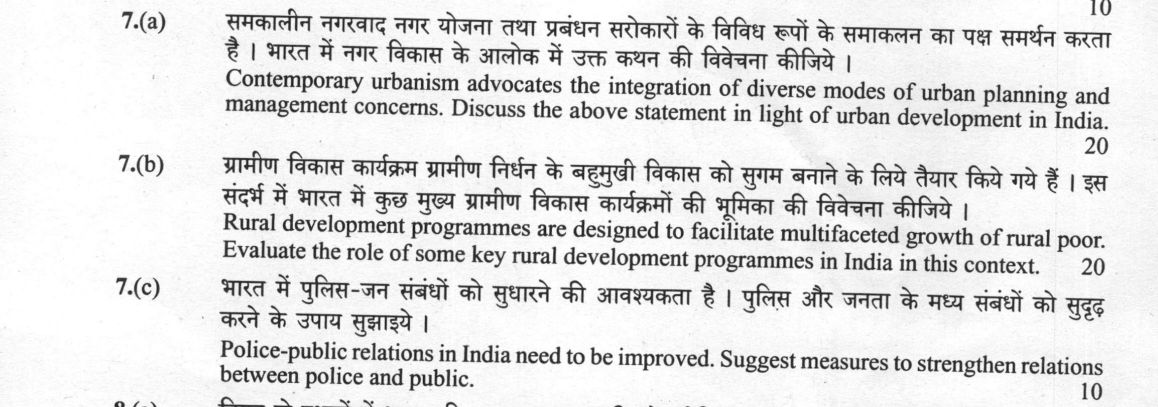
(a) Contemporary urbanism advocates the integration of diverse modes of urban planning and management concerns. Discuss the above…
Contemporary urbanism advocates the integration of diverse modes of urban planning and management concerns. Discuss the above statement in light of urban development in India. 20 marks
Rural development programmes are designed to facilitate multifaceted growth of rural poor. Evaluate the role of some key rural development programmes in India in this context. 20 marks
Police-public relations in India need to be improved. Suggest measures to strengthen relations between police and public. 10 marks
हिंदी में प्रश्न पढ़ें
समकालीन नगरवाद नगर योजना तथा प्रबंधन सरोकारों के विविध रूपों के समाकलन का पक्ष समर्थन करता है। भारत में नगर विकास के आलोक में उक्त कथन की विवेचना कीजिये। (20 अंक)
ग्रामीण विकास कार्यक्रम ग्रामीण निर्धन के बहुमुखी विकास को सुगम बनाने के लिये तैयार किये गये हैं। इस संदर्भ में भारत में कुछ मुख्य ग्रामीण विकास कार्यक्रमों की भूमिका की विवेचना कीजिये। (20 अंक)
भारत में पुलिस-जन संबंधों को सुधारने की आवश्यकता है। पुलिस और जनता के मध्य संबंधों को सुदृढ़ करने के उपाय सुझाइये। (10 अंक)
Model answer
Written by UPSC Answer Check against this question's marking rubric, to the expected length. UPSC does not publish answers for Mains — this is one way to score well, not an official key.
Integrated Urbanism and Contemporary Indian Planning
Contemporary urbanism conceptualises the city not merely as a physical space, but as a complex ecosystem requiring the integration of spatial, environmental, social, and economic planning. Moving beyond traditional master-planning, it embraces paradigms such as compact cities (Transit-Oriented Development), digital governance, and climate-resilient infrastructure to manage rapid urbanisation.
In India, recent national missions reflect this shift towards integrated planning. The Smart Cities Mission (SCM) combines spatial upgrades with digital technology through Integrated Command and Control Centres (ICCCs). The Atal Mission for Rejuvenation and Urban Transformation (AMRUT) targets universal basic services like water supply and sewerage, while HRIDAY integrates heritage conservation with urban infrastructure renewal.
However, Indian urban development often falters in practice due to fragmented governance. The incomplete devolution of the 18 functions under the Twelfth Schedule (74th Constitutional Amendment Act), non-functional Metropolitan Planning Committees (Article 243ZE), and overlapping parastatal agencies (such as Urban Development Authorities) perpetuate siloed implementation. Consequently, area-based interventions frequently generate isolated pockets of modern infrastructure, while wider challenges of informal settlements, urban flooding, and ecological stress remain unaddressed.
Evaluating Rural Development Programmes for Multifaceted Growth
Rural development strategies in India have evolved from standalone income-generation schemes to multifaceted interventions addressing multidimensional poverty, asset creation, and social empowerment.
Flagship schemes address diverse dimensions of rural vulnerability. The Mahatma Gandhi National Rural Employment Guarantee Act (MGNREGA) guarantees a rights-based safety net, prevents distress migration, and builds community-level water and soil conservation assets. Deendayal Antyodaya Yojana–National Rural Livelihoods Mission (DAY-NRLM) mobilises women into Self-Help Groups (SHGs), fostering social capital, financial inclusion, and micro-entrepreneurship. Similarly, Pradhan Mantri Awas Yojana–Gramin (PMAY-G) integrates housing with basic utilities (sanitation via Swachh Bharat Mission and electricity via Saubhagya), while DDU-GKY focuses on market-aligned skill development for rural youth.
Despite these achievements, structural gaps constrain multifaceted outcomes. Programmes suffer from convergence deficits across line departments, leading to fragmented delivery. MGNREGA continues to face implementation bottlenecks like delayed wage disbursements and variable asset quality. Furthermore, elite capture within Panchayati Raj Institutions and weak institutional Monitoring and Evaluation (M&E) mechanisms often limit the reach of welfare benefits among the most marginalised.
Strengthening Police-Public Relations
Police-public relations in India remain hindered by a persistent trust deficit, roots in the colonial Police Act of 1861, operational politicisation, and insufficient community engagement.
To build a responsive and citizen-centric police apparatus, key structural and functional measures are essential:
Implementation of the Supreme Court directives in Prakash Singh vs. Union of India (2006), particularly setting up independent Police Complaints Authorities and State Security Commissions to curb extraneous interference and enforce accountability.
Scaling up community policing initiatives, drawing on successful models such as Kerala’s Janamaithri Suraksha and Tamil Nadu’s Friends of Police, to foster institutional trust, grievance redressal, and collaborative crime prevention.
Decolonising institutional culture through systematic training in human rights, soft skills, and gender sensitization, alongside leveraging the Crime and Criminal Tracking Network & Systems (CCTNS) for transparent, citizen-friendly service delivery.
Conclusion
Addressing the complexities of urban development, rural transformation, and responsive policing requires overcoming institutional fragmentation. Aligning these domains under a participatory, accountable, and citizen-centric governance framework is critical to achieving inclusive and sustainable national development.
What "Discuss" is asking you to do
Lay the issue out from more than one side — how it arose, what is claimed for it, what is held against it, and where it now stands. UPSC attaches discuss to broad topics with several live dimensions, so coverage of the dimensions earns more than the strength of your opinion.
Structure that answers it
Set the issue up → the case as it is made → the case against → the dimension both sides leave out → where the balance now lies
Where marks are lost
Listing facts with no thread between them, or arguing one side throughout and calling it a discussion.
How this answer will be evaluated
Approach
Framework: Public Administration Paper II: Concept > Thinker > Indian institutional application > Reform. (a) discuss: intro > 3-4 dimensions > example > balanced close | (b) evaluate: criteria > evidence > balanced judgment | (c) suggest: the problem in one line > implementable measures > who acts > conclusion Full marks: Comprehensive analysis with specific Indian examples, clear structure, and critical evaluation
Key points expected
- Define contemporary urbanism and its integrated approach
- Cite specific Indian urban planning acts or policies
- Discuss challenges in integrating diverse management concerns
- Provide examples of successful or failed integration
- Identify 3-4 key rural development programs
- Evaluate their impact on multifaceted growth
- Analyze effectiveness in reaching rural poor
- Provide evidence of program outcomes
Evaluation rubric
Each sub-part is marked on its own, against the marks and word limit printed on the paper.
- (a) Analyze the integration of diverse urban planning modes in India. 20 marks
discuss— intro → 3-4 dimensions → example → balanced close
Must cover
- Define contemporary urbanism and its integrated approach
- Cite specific Indian urban planning acts or policies
- Discuss challenges in integrating diverse management concerns
- Provide examples of successful or failed integration
Loses marks
- Generic discussion without Indian context
- Ignoring the 'integration' aspect of the question
- No mention of specific planning modes or concerns
Earns more
- Reference to Smart Cities Mission
- Mention of 74th/75th Constitutional Amendments
- Discussion of urban governance structures
- Comparison of pre and post-reform urban planning
Extra mark
- Reference to 2nd ARC recommendations on urban governance
- Mention of specific urban development projects
- (b) Assess the role of key rural development programs in India. 20 marks
evaluate— criteria → evidence → balanced judgment
Must cover
- Identify 3-4 key rural development programs
- Evaluate their impact on multifaceted growth
- Analyze effectiveness in reaching rural poor
- Provide evidence of program outcomes
Loses marks
- Listing programs without evaluation
- Ignoring the 'multifaceted growth' aspect
- No analysis of impact on rural poor specifically
Earns more
- Mention of MGNREGA, PM-KISAN, or similar schemes
- Discussion of implementation challenges
- Reference to specific rural development acts
- Analysis of program design vs field reality
Extra mark
- Reference to 2nd ARC recommendations on rural development
- Mention of specific success stories or failure cases
- (c) Propose measures to strengthen police-public relations in India. 10 marks
suggest— the problem in one line → implementable measures → who acts → conclusion
Must cover
- Identify current issues in police-public relations
- Suggest 3-4 implementable measures
- Specify who should implement each measure
- Provide rationale for each suggestion
Loses marks
- Generic suggestions without implementation details
- Ignoring the 'strengthen relations' aspect
- No consideration of practical feasibility
Earns more
- Mention of citizen police committees
- Reference to police modernization initiatives
- Discussion of community policing models
- Suggestion of accountability mechanisms
Extra mark
- Reference to 2nd ARC recommendations on police reform
- Mention of specific successful police reform initiatives
Practice this exact question
Write your answer and it is marked point by point against the model answer above — what you covered, what you missed, what you got wrong.
Evaluate my answer →More from Public Administration 2021 Paper II
- Q4 (a) As a constitutionally mandated body the Finance Commission stands at the centre of fi…
- Q5 Answer the following in about 150 words each: (a) No rural development strategy can succe…
- Q6 (a) Budget proposals in the Parliament / State Legislatures fail to ensure their effectiv…
- Q7 (a) Contemporary urbanism advocates the integration of diverse modes of urban planning an…
- Q8 (a) In past two decades India's public policy on Disaster Management has shifted its focu…