Paper II — Q3
(a) Recruitment is the cornerstone of the whole public personnel structure and it revolves around the problem of attracting the…
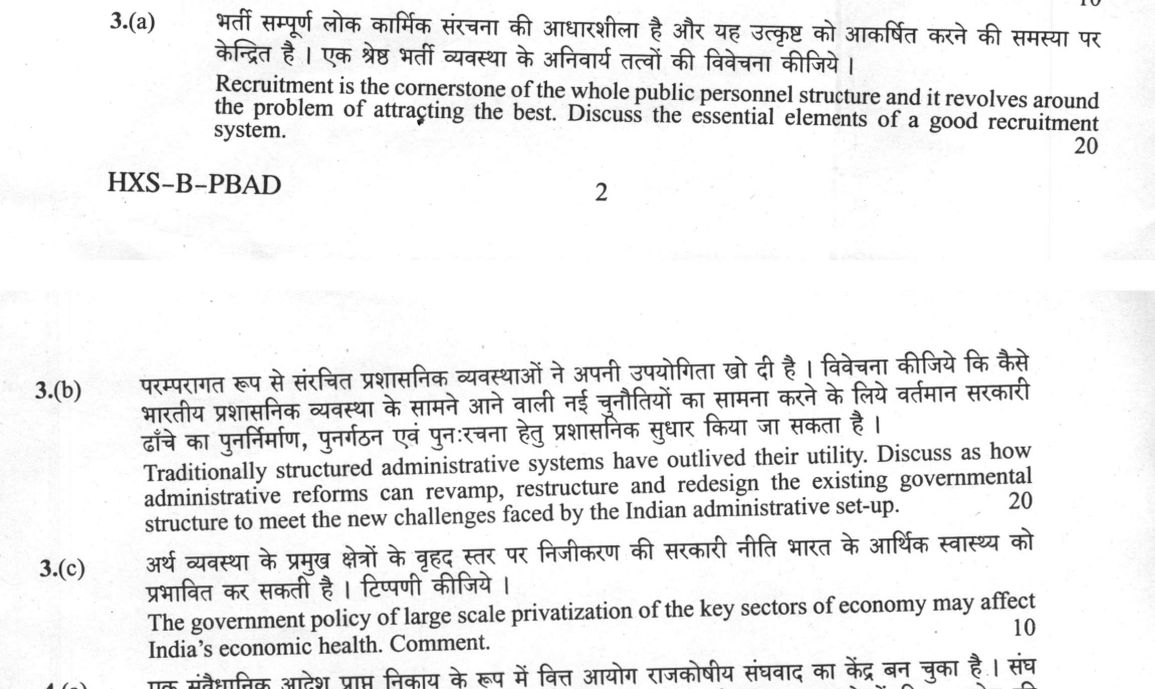
Recruitment is the cornerstone of the whole public personnel structure and it revolves around the problem of attracting the best. Discuss the essential elements of a good recruitment system. 20 marks
Traditionally structured administrative systems have outlived their utility. Discuss as how administrative reforms can revamp, restructure and redesign the existing governmental structure to meet the new challenges faced by the Indian administrative set-up. 20 marks
The government policy of large scale privatization of the key sectors of economy may affect India's economic health. Comment. 10 marks
हिंदी में प्रश्न पढ़ें
भर्ती सम्पूर्ण लोक कर्मिक संरचना की आधारशिला है और यह उत्कृष्ट को आकर्षित करने की समस्या पर केन्द्रित है । एक श्रेष्ठ भर्ती व्यवस्था के अनिवार्य तत्वों की विवेचना कीजिये । (20 अंक)
परम्परागत रूप से संरचित प्रशासनिक व्यवस्थाओं ने अपनी उपयोगिता खो दी है। विवेचना कीजिये कि कैसे भारतीय प्रशासनिक व्यवस्था के सामने आने वाली नई चुनौतियों का सामना करने के लिये वर्तमान सरकारी ढाँचे का पुनर्निर्माण, पुनर्गठन एवं पुनःरचना हेतु प्रशासनिक सुधार किया जा सकता है। (20 अंक)
अर्थ व्यवस्था के प्रमुख क्षेत्रों के बृहद् स्तर पर निजीकरण की सरकारी नीति भारत के आर्थिक स्वास्थ्य को प्रभावित कर सकती है। टिप्पणी कीजिये। (10 अंक)
Model answer
Written by UPSC Answer Check against this question's marking rubric, to the expected length. UPSC does not publish answers for Mains — this is one way to score well, not an official key.
Recruitment establishes the qualitative foundation of public administration. While recruitment is the positive process of actively attracting an optimal talent pool, selection is the regulatory process of screening and filtering out unsuitable candidates. A robust recruitment system requires open competitive examinations ensuring equality of opportunity; comprehensive job analysis and position classification to match specialized roles with appropriate competencies; scientific and objective testing methods encompassing psychometric and cognitive assessments; principles of representative bureaucracy to reflect societal diversity; and clear career progression planning to ensure personnel retention.
In India, Articles 315 to 323 establish the Union and State Public Service Commissions as independent constitutional bodies, decisively moving away from the colonial system of patronage and discretionary recruitment. Constitutional safeguards—including security of tenure, charged expenditure on the Consolidated Fund, and post-retirement employment restrictions—guarantee the institutional autonomy of the UPSC, ensuring meritocratic selection insulated from executive interference.
Revamping Traditional Administrative Structures
Traditional administrative structures, rooted in Weberian monocratic hierarchy, rigid proceduralism, compartmentalized departmental silos, and colonial command-and-control orientations, have outlived their utility in an era demanding agile, citizen-centric, and technology-driven governance.
To redesign the administrative architecture, structural reforms must align with recommendations of the Second Administrative Reforms Commission (ARC-II) and the Punchhi Commission:
Structural Agility: Transitioning from rigid bureaucratic tiers to mission-mode organizations, autonomous executive agencies, and Special Purpose Vehicles (SPVs) for accelerated project implementation.
Professionalization and Expertise: Institutionalizing lateral entry at senior policy levels (Joint Secretary and Director) to bridge the gap between generalist administration and techno-managerial domain expertise.
Process Re-engineering and Digital Governance: Replacing paper-heavy workflows with integrated digital platforms (e-Office, PRAGATI) to collapse administrative layers, alongside rightsizing the administrative machinery.
Performance and Accountability: Shifting from input-based compliance to outcome budgeting and competency-linked performance management, as envisioned under Mission Karmayogi to transform civil services from a "rule-based" to a "role-based" framework.
Privatization and Economic Health
The government’s strategic disinvestment policy presents significant structural implications for the economy. On the positive side, privatizing non-strategic and chronically loss-making Public Sector Undertakings (PSUs) alleviates the sovereign fiscal burden, eliminates capital misallocation, promotes market competitiveness, and unlocks private technological innovation.
However, unchecked privatization in core and strategic sectors—such as banking, railways, and defense production—poses severe risks. It may transform public monopolies into private oligopolies, compromise economic sovereignty in critical infrastructure, undermine affirmative action policies (reservations) embedded in public employment, and lead to the under-provisioning of social and unprofitable public goods in underdeveloped regions.
Way Forward
A dynamic 21st-century developmental state requires an integrated tripartite approach: a recruitment system that selects specialized, ethically grounded personnel; an agile administrative apparatus liberated from siloed hierarchies; and a calibrated state-market balance where strategic public presence ensures socio-economic equity while private enterprise drives market efficiency.
What "Discuss" is asking you to do
Lay the issue out from more than one side — how it arose, what is claimed for it, what is held against it, and where it now stands. UPSC attaches discuss to broad topics with several live dimensions, so coverage of the dimensions earns more than the strength of your opinion.
Structure that answers it
Set the issue up → the case as it is made → the case against → the dimension both sides leave out → where the balance now lies
Where marks are lost
Listing facts with no thread between them, or arguing one side throughout and calling it a discussion.
How this answer will be evaluated
Approach
Framework: null. (a) discuss: intro > 3-4 dimensions > example > balanced close | (b) discuss: intro > 3-4 dimensions > example > balanced close | (c) comment: context > arguments both sides > judgment > close Full marks: Comprehensive, well-structured, with Indian examples and balanced analysis.
Key points expected
- Merit-based selection and transparency
- Institutional mechanisms (UPSC/State PSCs)
- Fairness and non-discrimination
- Efficiency and quality of candidates
- Outdated traditional administrative systems
- Reforms for modernization and efficiency
- Restructuring for new challenges
- Redesigning for governance effectiveness
Evaluation rubric
Each sub-part is marked on its own, against the marks and word limit printed on the paper.
- (a) Essential elements of a good recruitment system in public personnel structure. 20 marks
discuss— intro → 3-4 dimensions → example → balanced close
Must cover
- Merit-based selection and transparency
- Institutional mechanisms (UPSC/State PSCs)
- Fairness and non-discrimination
- Efficiency and quality of candidates
Loses marks
- Generic theory without Indian context
- Ignoring institutional mechanisms
- No mention of fairness or merit
Earns more
- Role of competitive examinations
- Screening and assessment methods
- Legal safeguards (Articles 320, 321)
- Balancing merit and representation
Extra mark
- 2nd ARC recommendations on recruitment
- Recent reforms in recruitment processes
- (b) How administrative reforms can revamp, restructure, and redesign governmental structure. 20 marks
discuss— intro → 3-4 dimensions → example → balanced close
Must cover
- Outdated traditional administrative systems
- Reforms for modernization and efficiency
- Restructuring for new challenges
- Redesigning for governance effectiveness
Loses marks
- No mention of specific reforms
- Ignoring new challenges
- No link to Indian administrative context
Earns more
- Digital governance and e-governance
- Decentralization and local governance
- Streamlining bureaucracy
- Performance-based administration
Extra mark
- 2nd ARC recommendations on restructuring
- Recent governance reforms (e.g., e-governance)
- (c) Impact of large-scale privatization on India's economic health. 10 marks
comment— context → arguments both sides → judgment → close
Must cover
- Arguments for privatization
- Arguments against privatization
- Balanced judgment on economic impact
- Relevance to key sectors
Loses marks
- One-sided argument without balance
- No mention of key sectors
- Ignoring economic health implications
Earns more
- Efficiency and competition benefits
- Job losses and inequality concerns
- Sector-specific impacts
- Policy safeguards for privatization
Extra mark
- Specific examples of privatized sectors
- Recent privatization policies or outcomes
Practice this exact question
Write your answer and it is marked point by point against the model answer above — what you covered, what you missed, what you got wrong.
Evaluate my answer →More from Public Administration 2021 Paper II
- Q1 Answer the following in about 150 words each: (a) The Preamble to the Constitution of Ind…
- Q2 (a) Kautilya envisages protection, welfare and prosperity of the State and its people as…
- Q3 (a) Recruitment is the cornerstone of the whole public personnel structure and it revolve…
- Q4 (a) As a constitutionally mandated body the Finance Commission stands at the centre of fi…
- Q5 Answer the following in about 150 words each: (a) No rural development strategy can succe…
- Q6 (a) Budget proposals in the Parliament / State Legislatures fail to ensure their effectiv…