Paper II — Q5
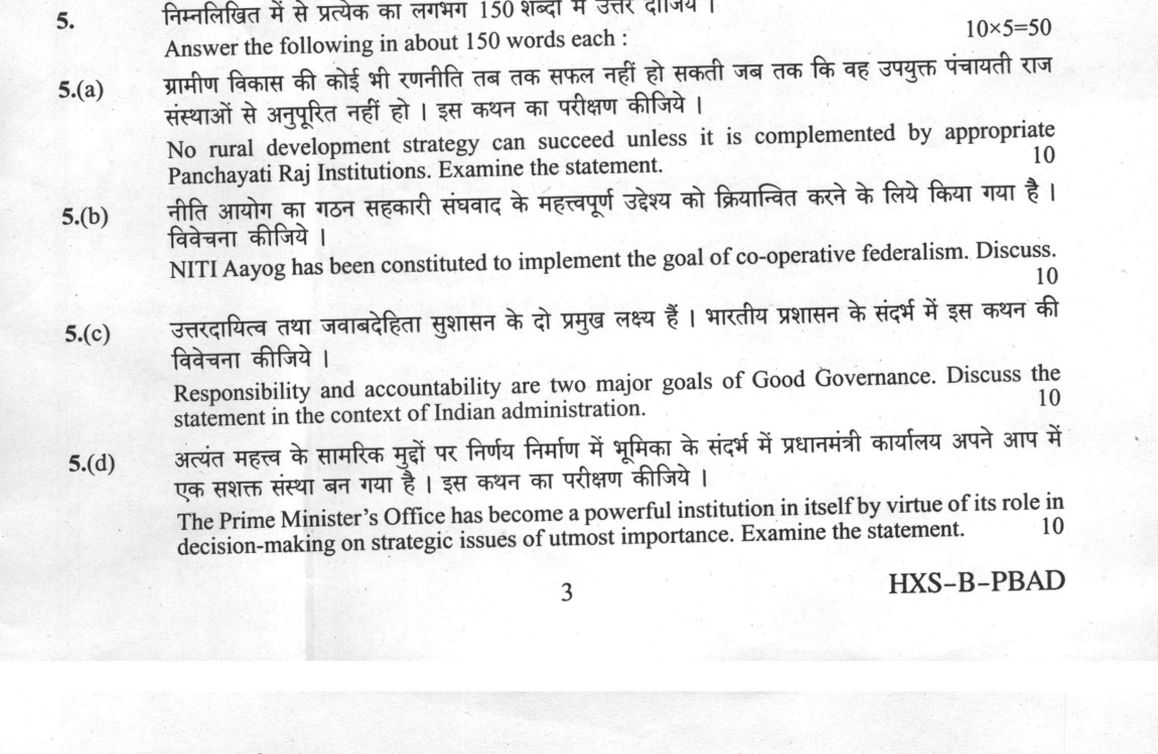
Answer the following in about 150 words each: (a) No rural development strategy can succeed unless it is complemented by…
Answer the following in about 150 words each:
No rural development strategy can succeed unless it is complemented by appropriate Panchayati Raj Institutions. Examine the statement. 10 marks
NITI Aayog has been constituted to implement the goal of co-operative federalism. Discuss. 10 marks
Responsibility and accountability are two major goals of Good Governance. Discuss the statement in the context of Indian administration. 10 marks
The Prime Minister's Office has become a powerful institution in itself by virtue of its role in decision-making on strategic issues of utmost importance. Examine the statement. 10 marks
Well planned and goal oriented training programmes are the backbone of the civil service system in India. Examine the statement. 10 marks
हिंदी में प्रश्न पढ़ें
निम्नलिखित में से प्रत्येक का लगभग 150 शब्दों में उत्तर दीजिये।
ग्रामीण विकास की कोई भी रणनीति तब तक सफल नहीं हो सकती जब तक कि वह उपयुक्त पंचायती राज संस्थाओं से अनुपूरित नहीं हो। इस कथन का परीक्षण कीजिये। (10 अंक)
नीति आयोग का गठन सहकारी संघवाद के महत्वपूर्ण उद्देश्य को क्रियान्वित करने के लिये किया गया है। विवेचना कीजिये। (10 अंक)
उत्तरदायित्व तथा जवाबदेहीता सुशासन के दो प्रमुख लक्ष्य हैं। भारतीय प्रशासन के संदर्भ में इस कथन की विवेचना कीजिये। (10 अंक)
अत्यंत महत्व के सामरिक मुद्दों पर निर्णय निर्माण में भूमिका के संदर्भ में प्रधानमंत्री कार्यालय अपने आप में एक सशक्त संस्था बन गया है। इस कथन का परीक्षण कीजिये। (10 अंक)
सुनियोजित और उद्देश्योन्मुखी प्रशिक्षण कार्यक्रम भारत में सिविल सेवा व्यवस्था की रीढ़ की हड्डी है। इस कथन का परीक्षण कीजिये। (10 अंक)
Model answer
Written by UPSC Answer Check against this question's marking rubric, to the 150-word length. UPSC does not publish answers for Mains — this is one way to score well, not an official key.
(a) The statement is largely correct. The 73rd Constitutional Amendment gave Panchayati Raj Institutions (PRIs) constitutional status, a three-tier structure and regular elections, while Article 243G assigns them 29 subjects such as agriculture, rural roads, drinking water and poverty alleviation. The 11th Finance Commission’s devolution of funds and functions made PRIs the institutional base for participatory rural development. Kerala’s People’s Plan Campaign showed that when Gram Sabhas, planning and funds are effectively linked, local priorities can be translated into development. PESA, 1996, extends similar logic to tribal areas by recognising self-governance. However, PRIs alone cannot guarantee success. Many states face devolution deficits, weak fiscal resources, dependence on state governments, limited administrative capacity and poor convergence with line departments. Thus rural development succeeds only when PRIs are complemented by real financial devolution, technical support and accountable state institutions, with convergence of schemes, data, monitoring and citizen participation.
(b) NITI Aayog was constituted in 2015 to replace the Planning Commission and shift from a top-down planning model to cooperative federalism. Its Governing Council, chaired by the Prime Minister and comprising Chief Ministers and Union Ministers, gives states a formal forum for consultation. Regional Councils, Thematic Councils and SDG verticals encourage policy learning, convergence, evidence-based dialogue and competitive federalism. By moving away from the Planning Commission’s one-way flow of plans and targets, NITI Aayog recognises states as partners in development. Yet its federalism remains limited. It has no constitutional status, no independent financial powers and no authority to allocate resources. Its role remains largely advisory and non-binding, and states may resist uniformity, central policy preferences or perceived centralisation. Therefore, NITI Aayog advances cooperative federalism in idea and coordination, but not fully in fiscal and institutional autonomy.
(c) Responsibility and accountability are distinct but interlinked goals of good governance. Responsibility means answerability: an officer or minister must act within law, policy and delegated authority. Accountability means enforceability: the same actor must answer to a superior, legislature, court or citizen for that action. In Indian administration, political accountability operates through ministers answering to Parliament and public questions, while administrative accountability operates through service rules, superior officers, vigilance, performance appraisal and departmental proceedings. The Comptroller and Auditor General, a constitutional office under Article 148, audits public expenditure; the Lokpal, state Lokayuktas and the Central Vigilance Commission, along with the Right to Information Act, 2005 and Citizen’s Charters, strengthen citizen and institutional checks. Yet gaps remain: delayed enforcement, weak follow-up, political interference and limited access to information, timely disclosure and effective redressal. Thus good governance requires responsibility to guide conduct and accountability to enforce it.
(d) The Prime Minister’s Office has become a powerful institution, but its power is derivative of the Prime Minister’s constitutional and political position. In Nehru’s time it was a small secretariat; today it coordinates national security, economic reforms, crisis management and strategic policy. The Prime Minister chairs the Nuclear Command Authority’s Political Council, while the National Security Advisor chairs the Executive Council; the PMO provides secretariat support rather than exercising control. Its influence grows by pre-empting issues, coordinating ministries and shaping the Cabinet’s agenda. This can create a “super cabinet” perception when major decisions are taken in small groups before Cabinet approval. Tension with the Cabinet Secretariat is significant. The Cabinet Secretariat is an executive office, not a constitutionally designated organ; the Government of India (Allocation of Business) Rules, made under Article 77(3), do not constitutionally designate it. Overlap can blur responsibility. Nevertheless, the PMO’s power is real but not absolute; it remains within the constitutional framework of Cabinet and parliamentary accountability.
(e) Well planned and goal-oriented training is indeed a backbone of the civil service system. The Kothari Committee (1973) recommended training at induction, mid-career and in-service stages, leading to institutions such as the Lal Bahadur Shastri National Academy of Administration and state academies. Training inducts officers into constitutional values, policy frameworks and administrative ethics, and prepares them for leadership. Mission Karmayogi, 2019, seeks to make this backbone more responsive through a competency framework, e-learning, citizen-centric training and continuous skill upgrading. Its goal is to move from qualification-based training to performance-based capability. Yet the claim needs qualification. Mid-career training is often inadequate, practical exposure is limited, evaluation is weak, and training can become formalistic if not linked to field performance. Thus training is essential, but it becomes a true backbone only when outcome-based and integrated with service reforms. Along with PRIs, NITI Aayog, accountability mechanisms and PMO coordination, it completes India’s administrative reform architecture.
What "Examine" is asking you to do
Test the proposition the question puts to you and return a finding on how far it holds. Examine stems carry a claim, or ask whether something has happened, and expect evidence weighed both ways before the extent is stated — often with remedial measures attached.
Structure that answers it
Restate the claim as the question frames it → evidence that supports it → evidence that undercuts it → the conditions under which it holds → verdict on how far it stands
Where marks are lost
Stopping at description. An examination has to reach a finding, and “examine with justification” means the extent must be stated, not implied.
How this answer will be evaluated
Approach
Framework: Concept > Thinker > Indian institutional application > Reform. (a) examine: intro > how/why with reasoning > evidence > conclusion | (b) discuss: intro > 3-4 dimensions > example > balanced close | (c) discuss: intro > 3-4 dimensions > example > balanced close | (d) examine: intro > how/why with reasoning > evidence > conclusion | (e) examine: intro > how/why with reasoning > evidence > conclusion Full marks: Precise institutional references, clear analytical structure, strong Indian examples, and 2nd ARC/recent reform citations.
Key points expected
- Link rural development strategy to Panchayati Raj Institutions
- Cite 73rd Constitutional Amendment (1992)
- Explain role of PRIs in local resource mobilization
- Provide example of PRI-led rural development success
- Define co-operative federalism in Indian context
- Explain NITI Aayog's structure and mandate
- Describe mechanisms for inter-state cooperation
- Provide example of NITI Aayog-led federal initiative
Evaluation rubric
Each sub-part is marked on its own, against the marks and word limit printed on the paper.
- (a) Examine the necessity of Panchayati Raj Institutions for rural development success. 10 marks · 150 words
examine— intro → how/why with reasoning → evidence → conclusion
Must cover
- Link rural development strategy to Panchayati Raj Institutions
- Cite 73rd Constitutional Amendment (1992)
- Explain role of PRIs in local resource mobilization
- Provide example of PRI-led rural development success
Loses marks
- Generic rural development discussion without PRI focus
- No constitutional or institutional reference
- Theory without Indian administrative context
Earns more
- Mention Gram Sabha's role in participatory planning
- Reference specific rural development schemes (e.g., MGNREGA)
- Discuss challenges in PRI implementation
- Link to Sustainable Development Goals (SDGs)
Extra mark
- Cite 2nd ARC recommendations on Panchayati Raj
- Reference recent state-level PRI reforms
- (b) Discuss NITI Aayog's role in implementing co-operative federalism. 10 marks · 150 words
discuss— intro → 3-4 dimensions → example → balanced close
Must cover
- Define co-operative federalism in Indian context
- Explain NITI Aayog's structure and mandate
- Describe mechanisms for inter-state cooperation
- Provide example of NITI Aayog-led federal initiative
Loses marks
- Generic federalism discussion without NITI Aayog focus
- No institutional or mechanism details
- Confusing co-operative with competitive federalism
Earns more
- Contrast with Planning Commission approach
- Mention State Development Index or similar tools
- Discuss role in policy convergence
- Reference specific NITI Aayog initiatives
Extra mark
- Cite 2nd ARC recommendations on federalism
- Reference recent NITI Aayog policy documents
- (c) Discuss responsibility and accountability as goals of Good Governance in Indian administration. 10 marks · 150 words
discuss— intro → 3-4 dimensions → example → balanced close
Must cover
- Define responsibility and accountability in governance
- Explain their role in Indian administrative context
- Provide institutional mechanisms ensuring accountability
- Give example of accountability mechanism in action
Loses marks
- Generic governance discussion without Indian context
- No institutional or mechanism details
- Confusing responsibility with mere duty
Earns more
- Mention RTI Act, CVC, or Lokpal
- Discuss performance-based accountability systems
- Reference specific accountability failures and reforms
- Link to citizen-centric governance
Extra mark
- Cite 2nd ARC recommendations on accountability
- Reference recent governance reforms (e.g., e-governance)
- (d) Examine PMO's role as powerful institution in strategic decision-making. 10 marks · 150 words
examine— intro → how/why with reasoning → evidence → conclusion
Must cover
- Define PMO's constitutional and administrative role
- Explain PMO's role in strategic decision-making
- Provide examples of PMO-led strategic initiatives
- Discuss PMO's coordination role across ministries
Loses marks
- Generic PMO description without strategic focus
- No examples of strategic decision-making
- Confusing PMO with Cabinet or Council of Ministers
Earns more
- Mention specific PMO initiatives (e.g., Swachh Bharat, Digital India)
- Discuss PMO's role in crisis management
- Reference PMO's advisory and monitoring functions
- Link to national development priorities
Extra mark
- Cite 2nd ARC recommendations on PMO
- Reference recent PMO organizational changes
- (e) Examine the role of training programmes as backbone of Indian civil service. 10 marks · 150 words
examine— intro → how/why with reasoning → evidence → conclusion
Must cover
- Define goal-oriented training in civil service context
- Explain LDO, AFO, and other training stages
- Describe role of LBSNAA and other training institutions
- Provide example of training impact on administrative performance
Loses marks
- Generic training discussion without civil service focus
- No institutional or programme details
- Confusing training with mere orientation
Earns more
- Mention specific training programmes (e.g., AFO, LDO)
- Discuss training in policy implementation
- Reference training in emerging areas (e.g., AI, data analytics)
- Link training to administrative reform
Extra mark
- Cite 2nd ARC recommendations on training
- Reference recent training reforms (e.g., e-learning)
Practice this exact question
Write your answer and it is marked point by point against the model answer above — what you covered, what you missed, what you got wrong.
Evaluate my answer →More from Public Administration 2021 Paper II
- Q2 (a) Kautilya envisages protection, welfare and prosperity of the State and its people as…
- Q3 (a) Recruitment is the cornerstone of the whole public personnel structure and it revolve…
- Q4 (a) As a constitutionally mandated body the Finance Commission stands at the centre of fi…
- Q5 Answer the following in about 150 words each: (a) No rural development strategy can succe…
- Q6 (a) Budget proposals in the Parliament / State Legislatures fail to ensure their effectiv…
- Q7 (a) Contemporary urbanism advocates the integration of diverse modes of urban planning an…
- Q8 (a) In past two decades India's public policy on Disaster Management has shifted its focu…