Paper II — Q4
(a) As a constitutionally mandated body the Finance Commission stands at the centre of fiscal federalism. Evaluate the role of…
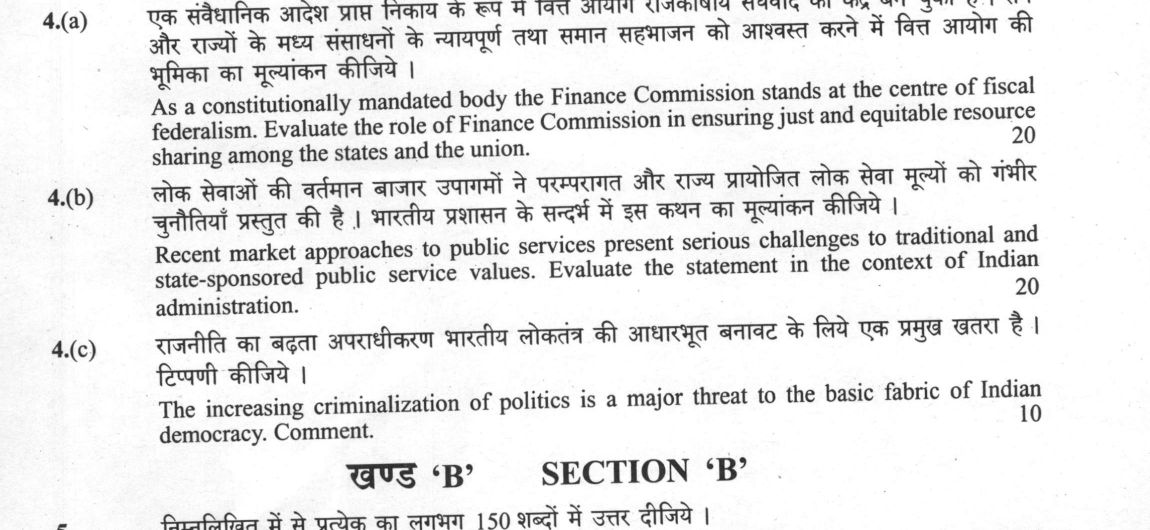
As a constitutionally mandated body the Finance Commission stands at the centre of fiscal federalism. Evaluate the role of Finance Commission in ensuring just and equitable resource sharing among the states and the union. 20 marks
Recent market approaches to public services present serious challenges to traditional and state-sponsored public service values. Evaluate the statement in the context of Indian administration. 20 marks
The increasing criminalization of politics is a major threat to the basic fabric of Indian democracy. Comment. 10 marks
हिंदी में प्रश्न पढ़ें
एक संवैधानिक आदेश प्राप्त निकाय के रूप में वित्त आयोग राजकोषीय संघवाद का केंद्र बन चुका है। संघ और राज्यों के मध्य संसाधनों के न्यायपूर्ण तथा समान सहभाजन को आश्वस्त करने में वित्त आयोग की भूमिका का मूल्यांकन कीजिये। (20 अंक)
लोक सेवाओं की वर्तमान बाजार उपागमों ने परम्परागत और राज्य प्रायोजित लोक सेवा मूल्यों को गंभीर चुनौतियाँ प्रस्तुत की हैं। भारतीय प्रशासन के संदर्भ में इस कथन का मूल्यांकन कीजिये। (20 अंक)
राजनीति का बढ़ता अपराधीकरण भारतीय लोकतंत्र की आधारभूत बनावट के लिये एक प्रमुख खतरा है। टिप्पणी कीजिये। (10 अंक)
Model answer
Written by UPSC Answer Check against this question's marking rubric, to the expected length. UPSC does not publish answers for Mains — this is one way to score well, not an official key.
(a) The Finance Commission and Fiscal Federalism
Article 280 mandates the Finance Commission (FC) as an independent constitutional arbiter to correct vertical fiscal imbalances between the Union and States, and horizontal disparities across regions. Over its evolution from the 1st to the 15th FC, the institution has progressively refined its criteria to balance equity with efficiency. In vertical transfers, the 14th and 15th FCs structurally enhanced state fiscal autonomy by recommending 42% and 41% tax devolution respectively. Horizontally, the 15th FC reconciled equity—primarily through the fiscal capacity/income distance model (45%)—with performance incentives, including demographic performance (12.5%), forest cover, and tax effort (2.5%).
However, the FC's role in ensuring just resource sharing faces structural constraints:
The equity-efficiency trade-off remains contested. The adoption of the 2011 Census population data drew sharp criticism from demographically prudent southern states, who perceived it as an efficiency penalty despite demographic performance weightages.
The proliferation of non-shareable cesses and surcharges by the Union has compressed the divisible pool, resulting in actual devolution falling significantly below the headline 41%.
The post-Planning Commission era and the cessation of Special Category Status have strained the FC’s grant mechanism, compelling heavier reliance on post-devolution revenue deficit grants.
The structural rigidities of the Goods and Services Tax (GST) regime and anxieties surrounding the end of the GST compensation mechanism have amplified inter-state revenue volatility, testing cooperative federalism.
While the Finance Commission has successfully maintained its credibility through formulaic and transparent transfers, its capacity to guarantee equitable federal outcomes is increasingly undermined by Union-level fiscal centralization. A binding constitutional ceiling on cesses and surcharges is essential to restore genuine fiscal equity.
(b) Market Approaches versus Public Service Values
The integration of New Public Management (NPM) and Public Choice Theory into Indian administration has challenged traditional Weberian and constitutional public service values—such as equity, universal access, neutrality, and procedural accountability—by prioritizing managerial efficiency, cost recovery, and market competition.
In the Indian context, this shift is manifested across key sectors:
In public infrastructure and utilities, Public-Private Partnerships (PPPs) in metro rail projects and discom privatization models have prioritized commercial viability. This has led to disputes over tariff hikes, cherry-picking of lucrative urban zones, and viability gap funding pressures, often compromising equitable access for vulnerable sections.
In social provisioning, market instruments such as publicly funded health insurance (Ayushman Bharat-PMJAY) and education vouchers shift the state’s role from a direct provider to a purchaser of services. While enhancing consumer choice, this approach often diverts public funds to private healthcare and education providers, leaving primary public infrastructure under-resourced.
Citizen's Charters risk dilution when converted into commercial service-level agreements, reducing citizens to "customers" and weakening grievance redressal for non-remunerative public goods.
Outsourcing and privatization have increased the risk of regulatory capture across sectors like power and telecom, where independent regulators struggle to balance private investor returns with public interest.
Market approaches have brought technological modernism and execution efficiency to Indian governance. However, they cannot substitute for the state’s constitutional obligation to ensure social justice. A calibrated model is required where market efficiencies are bound by strong regulatory governance and a resilient public delivery backbone.
(c) Criminalization of Politics and Democratic Fabric
The criminalization of politics corrodes democratic legitimacy, rule of law, and administrative neutrality. Data from the Association for Democratic Reforms (ADR) reveals an alarming trajectory: MPs with declared criminal cases in the Lok Sabha rose from 24% in 2004 to over 43% in 2019, with a substantial portion facing serious charges.
This crisis is sustained by an electoral ecosystem where illicit money power and candidate "winnability" override public probity, eroding public trust in legislative institutions and institutionalizing rent-seeking in governance.
The Supreme Court, in Public Interest Foundation v. Union of India (2018) and subsequent rulings, mandated the public disclosure of candidates' criminal antecedents by political parties and the establishment of designated fast-track courts for trial of MPs and MLAs. Earlier, the Justice J.S. Verma Committee and the Law Commission’s 244th Report emphasized the urgency of disqualifying candidates against whom courts have framed charges for heinous crimes.
Containing this decay requires comprehensive structural reforms: amending Section 8 of the Representation of the People Act, 1951 to debar individuals facing serious charges upon judicial framing; legally institutionalizing inner-party democracy; introducing state funding of elections; and enhancing the autonomy and regulatory powers of the Election Commission of India under Article 324.
What "Evaluate" is asking you to do
Judge how well something has performed against the standard it set for itself — its stated aim, mandate or promise — and commit to a verdict. Name the yardstick before you judge; an unanchored judgement reads as opinion.
Structure that answers it
Name the yardstick — stated aim, mandate or benchmark → performance against it → shortfall against it → why the gap exists → verdict
Where marks are lost
Presenting both sides and then declining to decide, or delivering a verdict against a standard you never stated, which makes it look arbitrary.
How this answer will be evaluated
Approach
Framework: Concept > Thinker > Indian institutional application > Reform. (a) evaluate: criteria > evidence > balanced judgment | (b) evaluate: criteria > evidence > balanced judgment | (c) comment: context > arguments both sides > judgment > close Full marks: Comprehensive, well-structured, with specific Indian examples and references to relevant articles/committees.
Key points expected
- Cite Article 280 and 14th Finance Commission
- Explain vertical devolution (Centre-State)
- Explain horizontal devolution (State-State)
- Mention GST Council's role in tax sharing
- Define 'market approaches' (e.g., PPP, outsourcing)
- Contrast with 'traditional state-sponsored values' (equity, welfare)
- Provide Indian examples (e.g., healthcare, education)
- Discuss the 'gap' between theory and field reality
Evaluation rubric
Each sub-part is marked on its own, against the marks and word limit printed on the paper.
- (a) Assess the Finance Commission's role in fiscal federalism and equitable resource sharing. 20 marks
evaluate— criteria → evidence → balanced judgment
Must cover
- Cite Article 280 and 14th Finance Commission
- Explain vertical devolution (Centre-State)
- Explain horizontal devolution (State-State)
- Mention GST Council's role in tax sharing
Loses marks
- Confusing Finance Commission with GST Council
- Ignoring the horizontal devolution aspect
- Failing to mention Article 280
Earns more
- Reference 15th Finance Commission recommendations
- Discuss the 'equalization' vs 'incentive' principle
- Mention the role of Grants-in-Aid
- Reference the 13th Finance Commission's formula
Extra mark
- Cite specific data on devolution percentages
- Mention the 14th FC's 'equalization' principle
- (b) Critique market approaches to public services against traditional state values in India. 20 marks
evaluate— criteria → evidence → balanced judgment
Must cover
- Define 'market approaches' (e.g., PPP, outsourcing)
- Contrast with 'traditional state-sponsored values' (equity, welfare)
- Provide Indian examples (e.g., healthcare, education)
- Discuss the 'gap' between theory and field reality
Loses marks
- Ignoring the 'traditional values' aspect
- Failing to provide Indian examples
- Confusing 'market approaches' with 'privatization'
Earns more
- Mention 2nd ARC recommendations on public services
- Reference specific schemes (e.g., Ayushman Bharat, Swachh Bharat)
- Discuss the role of NGOs in service delivery
- Mention the 'New Public Management' (NPM) paradigm
Extra mark
- Cite specific PPP projects (e.g., Delhi Metro, Smart Cities)
- Mention the 'Right to Public Services' (RTPS) initiative
- (c) Comment on the threat of criminalization of politics to Indian democracy. 10 marks
comment— context → arguments both sides → judgment → close
Must cover
- Define 'criminalization of politics'
- Explain its impact on 'basic fabric of democracy'
- Provide evidence (e.g., data on candidates with cases)
- Suggest remedies (e.g., electoral bonds, disqualification)
Loses marks
- Ignoring the 'basic fabric of democracy' aspect
- Failing to provide evidence
- Confusing 'criminalization' with 'corruption'
Earns more
- Mention the 'Model Code of Conduct'
- Reference the 'Electoral Bonds Scheme'
- Discuss the role of the Election Commission
- Mention the 'Lokpal and Lokayuktas Act'
Extra mark
- Cite specific data on candidates with criminal cases
- Mention the '2G spectrum scam' or 'Coal scam'
Practice this exact question
Write your answer and it is marked point by point against the model answer above — what you covered, what you missed, what you got wrong.
Evaluate my answer →More from Public Administration 2021 Paper II
- Q1 Answer the following in about 150 words each: (a) The Preamble to the Constitution of Ind…
- Q2 (a) Kautilya envisages protection, welfare and prosperity of the State and its people as…
- Q3 (a) Recruitment is the cornerstone of the whole public personnel structure and it revolve…
- Q4 (a) As a constitutionally mandated body the Finance Commission stands at the centre of fi…
- Q5 Answer the following in about 150 words each: (a) No rural development strategy can succe…
- Q6 (a) Budget proposals in the Parliament / State Legislatures fail to ensure their effectiv…
- Q7 (a) Contemporary urbanism advocates the integration of diverse modes of urban planning an…