Paper II — Q6
(a) Budget proposals in the Parliament / State Legislatures fail to ensure their effective scrutiny. Identify the factors which…
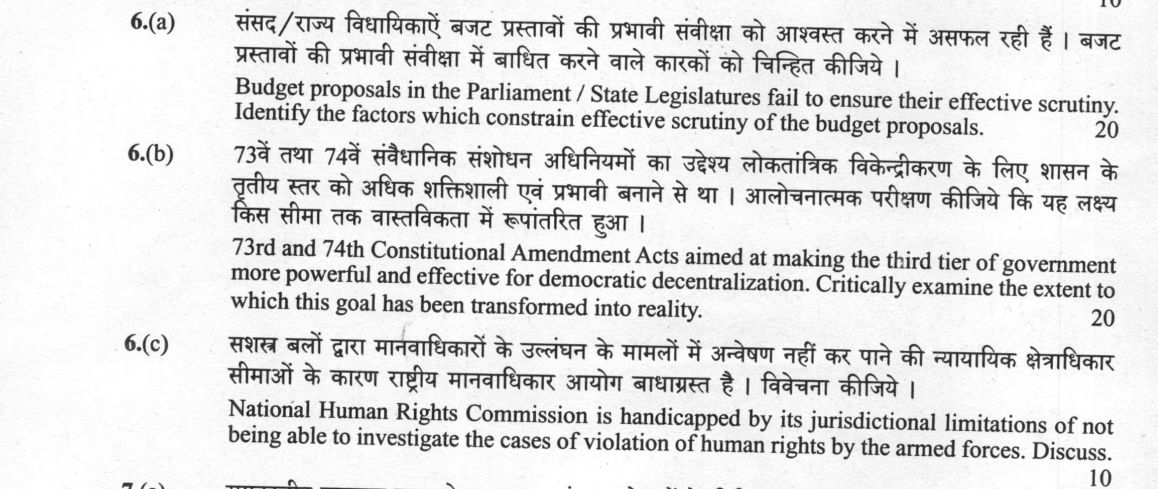
Budget proposals in the Parliament / State Legislatures fail to ensure their effective scrutiny. Identify the factors which constrain effective scrutiny of the budget proposals. 20 marks
73rd and 74th Constitutional Amendment Acts aimed at making the third tier of government more powerful and effective for democratic decentralization. Critically examine the extent to which this goal has been transformed into reality. 20 marks
National Human Rights Commission is handicapped by its jurisdictional limitations of not being able to investigate the cases of violation of human rights by the armed forces. Discuss. 10 marks
हिंदी में प्रश्न पढ़ें
संसद/राज्य विधायिकाएँ बजट प्रस्तावों की प्रभावी संवीक्षा को आश्वस्त करने में असफल रही हैं। बजट प्रस्तावों की प्रभावी संवीक्षा में बाधित करने वाले कारकों को चिन्हित कीजिये। (20 अंक)
73वें तथा 74वें संवैधानिक संशोधन अधिनियमों का उद्देश्य लोकतांत्रिक विकेन्द्रीकरण के लिए शासन के तृतीय स्तर को अधिक शक्तिशाली एवं प्रभावी बनाने से था। आलोचनात्मक परीक्षण कीजिये कि यह लक्ष्य किस सीमा तक वास्तविकता में रूपांतरित हुआ। (20 अंक)
सशस्त्र बलों द्वारा मानवाधिकारों के उल्लंघन के मामलों में अन्वेषण नहीं कर पाने की न्यायिक क्षेत्राधिकार सीमाओं के कारण राष्ट्रीय मानवाधिकार आयोग बाधाग्रस्त है। विवेचना कीजिये। (10 अंक)
Model answer
Written by UPSC Answer Check against this question's marking rubric, to the expected length. UPSC does not publish answers for Mains — this is one way to score well, not an official key.
Indian democracy’s accountability is tested at three levels: Parliament’s control over money, local self-government’s control over services, and institutions’ control over state power. In all three, formal structures exist, but effective operation is constrained by executive dominance, fiscal weakness and jurisdictional limits.
Constraints on budget scrutiny. Budget proposals are not effectively scrutinised because the process is compressed, technical and politically controlled. The presentation of the Union Budget leaves little time for detailed examination, and the merger of the Railway Budget into the main Budget in 2017 reduced the separate window for sectoral scrutiny. Demands for grants are discussed, but often limited to general policy rather than line-item expenditure. Technical complexity defeats legislators: estimates, appropriation bills, contingent and supplementary grants, and CAG reports require specialised knowledge that most MPs and MLAs lack. The executive dominates budget formulation through the Finance Ministry and departmental estimates, leaving Parliament largely to ratify. Whipped voting undermines committee recommendations, as members may vote against PAC or departmental standing committee advice. Follow-up is weak: PAC and CAG recommendations are not binding, and implementation is monitored mainly by the executive itself.
Local self-government under the 73rd and 74th Amendments. The 73rd and 74th Constitutional Amendment Acts gave panchayats and municipalities constitutional status, mandatory reservation for women, SCs and STs, fixed five-year tenure, State Election Commissions and State Finance Commissions. These were important steps towards democratic decentralisation. Yet the goal has only partially become reality. The amendments created constitutional bodies subordinate to state governments; their powers, functions and finances are largely determined by state legislation. Article 243G and state government orders decide devolution, and many states have not transferred meaningful functions, funds or functionaries. Fiscal autonomy remains inadequate: local bodies depend on grants, have weak own-tax bases, and often lack capacity to levy or collect taxes. Elections have been delayed or irregular in some states. In rural areas, bureaucratic capture persists through the close alignment of the Chief Executive Officer with the District Collector. In urban areas, municipal corporations face weak revenue bases, while parastatal bodies such as water boards and development authorities control key services. 74th Amendment implementation gaps in mega-cities, and limited “meaningful autonomy” recommended by the Sivaramakrishnan Committee, show that the 74th Amendment has not fully transformed urban local government. Thus, the amendments strengthened representation but not real authority.
NHRC and armed forces. The National Human Rights Commission is handicapped by jurisdictional limitations in cases involving the armed forces. Section 19 of the Protection of Human Rights Act, 1993 requires prior intimation to the Ministry of Defence before the NHRC investigates violations by armed forces in areas where the Armed Forces Special Powers Act is in operation. AFSPA-operated areas are therefore effectively excluded from direct NHRC investigation, and the Commission often relies on court-monitored inquiries. It also channels investigation through the CBI or other agencies, limiting its direct role. The NHRC has limited follow-up power over the armed forces, and its recommendations are not enforceable like court orders. Some state human rights commissions have had broader access to investigate security-related complaints, highlighting the structural weakness at the national level.
The common finding is a democratic deficit across three tiers: parliamentary oversight is weakened by executive control, local self-government is emasculated by state dominance, and human rights accountability is diluted in the security sector. Strengthening these institutions requires stronger budget committees, genuine fiscal and administrative devolution to local bodies, and removal of jurisdictional safeguards that shield armed forces from independent human rights investigation.
What "Critically examine" is asking you to do
Test the proposition the question puts to you and return a finding on how far it holds. Examine stems carry a claim, or ask whether something has happened, and expect evidence weighed both ways before the extent is stated — often with remedial measures attached. “Critically” is not a section added at the end: name the yardstick you are judging by — the evidence, the stated objective, a constitutional principle, a rival explanation — and let a verdict close each part of the body. Where the question quotes a claim, that verdict must land on the claim itself, accepted, qualified or rejected, and not on the theme in general.
Structure that answers it
Restate the claim as the question frames it → evidence that supports it → evidence that undercuts it → the conditions under which it holds → verdict on how far it stands
Where marks are lost
Merits in one paragraph, demerits in the next, and a conclusion calling for a balanced and holistic approach. That is a survey with the judgement left out and it holds the answer in the middle band. The opposite error is reading “critically” as permission to attack — and with the odd pairings, critically describe or critically explain, the exposition still carries most of the marks, the judgement being a layer on it rather than a substitute for it.
How this answer will be evaluated
Approach
(a) highlight: name the salient points > one line of substance each > close | (b) critique: the claim > its strengths > its weaknesses > your judgment | (c) discuss: intro > 3-4 dimensions > example > balanced close Full marks: Comprehensive, analytical, and well-structured with specific examples and references.
Key points expected
- Structural constraints: lack of time and technical capacity
- Institutional constraints: weak role of Public Accounts Committee
- Political constraints: party discipline overriding individual scrutiny
- Information asymmetry: complex jargon and opaque data
- Assessment of financial devolution (14th/15th Finance Commission)
- Analysis of administrative capacity and training gaps
- Evaluation of state government interference in local bodies
- Discussion of the role of State Election Commissions
Evaluation rubric
Each sub-part is marked on its own, against the marks and word limit printed on the paper.
- (a) Identify factors constraining effective scrutiny of budget proposals in Parliament/State Legislatures. 20 marks
highlight— name the salient points → one line of substance each → close
Must cover
- Structural constraints: lack of time and technical capacity
- Institutional constraints: weak role of Public Accounts Committee
- Political constraints: party discipline overriding individual scrutiny
- Information asymmetry: complex jargon and opaque data
Loses marks
- Generic political commentary without administrative focus
- Ignoring the specific role of legislative committees
- Failing to distinguish between central and state levels
Earns more
- Mention of 2nd ARC recommendations on budget scrutiny
- Reference to specific committees like Estimates Committee
- Comparison of central vs state legislative scrutiny
- Mention of recent reforms like Zero-Based Budgeting
Extra mark
- Citing specific data on time spent on budget
- Reference to specific 2nd ARC report volume
- (b) Critically examine the extent to which 73rd/74th Amendments made the third tier effective. 20 marks
critique— the claim → its strengths → its weaknesses → your judgment
Must cover
- Assessment of financial devolution (14th/15th Finance Commission)
- Analysis of administrative capacity and training gaps
- Evaluation of state government interference in local bodies
- Discussion of the role of State Election Commissions
Loses marks
- Listing amendments without critical analysis of implementation
- Ignoring the financial aspect of decentralization
- Treating Panchayats and Municipalities as identical
Earns more
- Mention of specific state models (e.g., Kerala, Karnataka)
- Reference to 2nd ARC recommendations on local governance
- Discussion of the 11th Finance Commission's role
- Mention of specific challenges like fund flow delays
Extra mark
- Citing specific data on fund utilization rates
- Reference to specific state Panchayati Raj Acts
- (c) Discuss the jurisdictional limitations of the NHRC regarding armed forces. 10 marks
discuss— intro → 3-4 dimensions → example → balanced close
Must cover
- Explanation of the Armed Forces (Special Powers) Act (AFSPA)
- Analysis of the NHRC's inability to investigate AF cases
- Discussion of the conflict between human rights and security
- Mention of the role of the Supreme Court in filling gaps
Loses marks
- Ignoring the specific legal basis of the limitation
- Failing to distinguish between investigation and inquiry
- Treating the NHRC as a judicial body
Earns more
- Reference to the National Commission for Protection of Human Rights
- Mention of specific cases like the Bhopal gas tragedy
- Discussion of the 2019 NHRC amendment bill
- Reference to the role of the Human Rights Courts
Extra mark
- Citing specific Supreme Court judgments on AFSPA
- Reference to specific NHRC annual report data
Practice this exact question
Write your answer and it is marked point by point against the model answer above — what you covered, what you missed, what you got wrong.
Evaluate my answer →More from Public Administration 2021 Paper II
- Q3 (a) Recruitment is the cornerstone of the whole public personnel structure and it revolve…
- Q4 (a) As a constitutionally mandated body the Finance Commission stands at the centre of fi…
- Q5 Answer the following in about 150 words each: (a) No rural development strategy can succe…
- Q6 (a) Budget proposals in the Parliament / State Legislatures fail to ensure their effectiv…
- Q7 (a) Contemporary urbanism advocates the integration of diverse modes of urban planning an…
- Q8 (a) In past two decades India's public policy on Disaster Management has shifted its focu…