Paper II — Q8
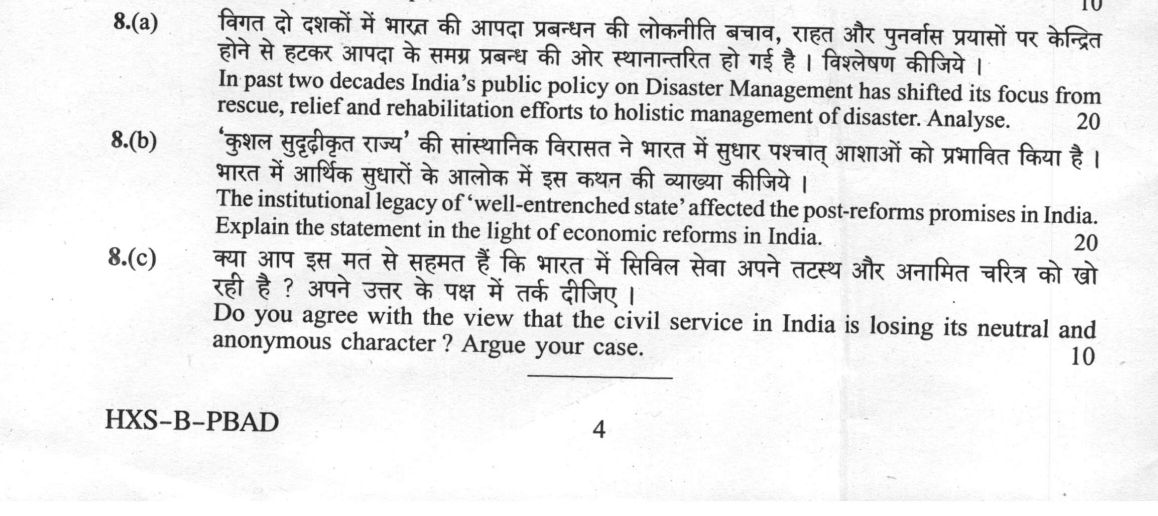
(a) In past two decades India's public policy on Disaster Management has shifted its focus from rescue, relief and rehabilitation…
In past two decades India's public policy on Disaster Management has shifted its focus from rescue, relief and rehabilitation efforts to holistic management of disaster. Analyse. 20 marks
The institutional legacy of 'well-entrenched state' affected the post-reforms promises in India. Explain the statement in the light of economic reforms in India. 20 marks
Do you agree with the view that the civil service in India is losing its neutral and anonymous character ? Argue your case. 10 marks
हिंदी में प्रश्न पढ़ें
विगत दो दशकों में भारत की आपदा प्रबंधन की लोकनीति बचाव, राहत और पुनर्वास प्रयासों पर केंद्रित होने से हटकर आपदा के समग्र प्रबंध की ओर स्थानांतरित हो गई है। विश्लेषण कीजिये। (20 अंक)
'कुशल सुदृढ़ीकृत राज्य' की संस्थानिक विरासत ने भारत में सुधार पश्चात् आशाओं को प्रभावित किया है। भारत में आर्थिक सुधारों के आलोक में इस कथन की व्याख्या कीजिये। (20 अंक)
क्या आप इस मत से सहमत हैं कि भारत में सिविल सेवा अपने तटस्थ और अनामित चरित्र को खो रही है ? अपने उत्तर के पक्ष में तर्क दीजिए। (10 अंक)
Model answer
Written by UPSC Answer Check against this question's marking rubric, to the expected length. UPSC does not publish answers for Mains — this is one way to score well, not an official key.
The evolution of Indian disaster governance marks a decisive paradigm shift from a reactive, ex-post relief-and-rescue model to a proactive, ex-ante holistic risk-governance framework. Historically governed by colonial-era Famine Codes and post-calamity financial relief under the Calamity Relief Fund, disaster administration treated hazards as episodic aberrations managed through ad-hoc relief and rehabilitation.
Holistic Disaster Management: Paradigm and Institutional Shift
The enactment of the Disaster Management Act, 2005 institutionalized a comprehensive multi-hazard cycle integrating prevention, mitigation, preparedness, capacity building, response, and 'build-back-better' recovery. Structurally, it established a decentralized three-tier institutional apparatus: the National Disaster Management Authority (NDMA) headed by the Prime Minister, State Disaster Management Authorities (SDMAs), and District Disaster Management Authorities (DDMAs) headed by District Collectors.
This institutionalization was reinforced by specialized operational and knowledge arms: the National Disaster Response Force (NDRF) for dedicated multi-hazard response and the National Institute of Disaster Management (NIDM) for human resource capacity building. India further aligned its public policy with the Sendai Framework for Disaster Risk Reduction (2015–2030), mainstreaming Disaster Risk Reduction (DRR) into developmental planning via the National Disaster Management Plan. However, this holistic transition faces operational friction within disaster federalism, where weak institutional capabilities at the DDMA level and asymmetrical Centre-State financial coordination during calamity relief often disrupt mitigation-first planning.
Institutional Legacy of the 'Well-Entrenched State' and Economic Reforms
India’s 1991 Liberalization, Privatization, and Globalization (LPG) reforms promised market efficiency, deregulation, and administrative retreat. However, the realization of these promises was heavily conditioned by the path dependency of India's 'well-entrenched state'—a colonial-bureaucratic apparatus anchored in the Permit-Inspector Raj, procedural dirigisme, and an expansive redistributive welfare mandate.
Rather than dismantling bureaucratic dominance, reforms yielded partial liberalization characterized by institutional inertia, reform fatigue, and regulatory capture across newly formed statutory watchdogs. State dominance persisted in strategic sectors including banking, energy, and transport. While economic reforms significantly expanded state fiscal capacity—enabling higher public outlays for socio-economic safety nets and modern disaster resilience infrastructure—the legacy of administrative centralism and procedural rigidity continues to impose high transaction costs on private enterprise.
Neutrality and Anonymity in the Indian Civil Service
The Weberian ethos of political neutrality and the tradition of bureaucratic anonymity face severe contemporary strains. Administrative neutrality has been compromised by arbitrary transfers, political clientelism, the enticement of lucrative post-retirement appointments, and recurring pressures towards an ideologically 'committed bureaucracy'. Concurrently, the proliferation of official social media self-branding has severely eroded traditional civil service anonymity, substituting institutional accountability with individualized public profiling.
Nevertheless, institutional safeguards persist through constitutional protections under Article 311 and the structural ethos of the All India Services. To preserve institutional integrity, the Supreme Court in T.S.R. Subramanian v. Union of India (2013) mandated the operationalization of Civil Services Boards to ensure fixed tenures and required public servants to record oral political instructions. Furthermore, the Second Administrative Reforms Commission (2nd ARC) underscored the necessity of statutory codes of ethics and independent appointment mechanisms to insulate the civil service from political volatility.
Way Forward
Sustaining democratic governance requires synchronizing disaster resilience, economic liberalization, and bureaucratic integrity. Administrative capability must transition from an entrenched, procedural bureaucracy to a rule-governed, autonomous, and agile developmental state capable of managing 21st-century polycentric governance challenges.
What "Analyse" is asking you to do
Break the subject into its working parts and show how they act on each other. The marks are in the interconnections — which factor drives which, and what the resulting structure explains — not in the inventory of factors.
Structure that answers it
Define the whole → separate it into its parts → show which part drives which → what that interaction produces → what the structure implies
Where marks are lost
A flat list of causes with no account of which drives which. An answer of neatly separated headings, each self-contained, scores as description.
How this answer will be evaluated
Approach
Framework: UPSC Public Administration Paper II (HXS-B-PBAD). (a) analyse: intro > causes > effects > stakeholders/linkages > way forward | (b) explain: definition/context > points in order > small example > short close | (c) comment: context > arguments both sides > judgment > close Full marks: Precise, well-structured, with specific Indian institutional anchors and 2nd ARC references.
Key points expected
- Define 'holistic management' vs 'rescue/relief' paradigm
- Cite Disaster Management Act, 2005 as the pivot
- Identify NDRF/SDRF as institutional anchors
- Link to Sendai Framework or 2nd ARC
- Define 'well-entrenched state' (bureaucratic inertia)
- Link to 1991 LPG reforms
- Identify specific regulatory bottlenecks (e.g., licensing)
- Show gap between policy intent and field reality
Evaluation rubric
Each sub-part is marked on its own, against the marks and word limit printed on the paper.
- (a) Trace the shift from reactive relief to holistic disaster management in Indian policy. 20 marks
analyse— intro → causes → effects → stakeholders/linkages → way forward
Must cover
- Define 'holistic management' vs 'rescue/relief' paradigm
- Cite Disaster Management Act, 2005 as the pivot
- Identify NDRF/SDRF as institutional anchors
- Link to Sendai Framework or 2nd ARC
Loses marks
- Focusing only on relief operations
- Ignoring the legal framework (DM Act)
- No mention of institutional changes
Earns more
- Mention NDRMA's role in policy shift
- Reference specific disasters (e.g., 2001, 2013) as catalysts
- Discuss 'Build Back Better' concept
Extra mark
- Cite specific 2nd ARC recommendation on DM
- Reference specific SDRF fund allocation changes
- (b) Explain how the 'well-entrenched state' legacy hindered post-reform economic promises. 20 marks
explain— definition/context → points in order → small example → short close
Must cover
- Define 'well-entrenched state' (bureaucratic inertia)
- Link to 1991 LPG reforms
- Identify specific regulatory bottlenecks (e.g., licensing)
- Show gap between policy intent and field reality
Loses marks
- Generic discussion of economic reforms
- Ignoring the 'institutional legacy' aspect
- No specific examples of state inertia
Earns more
- Mention 'License Raj' as a legacy
- Reference specific committees (e.g., Narasimham Committee)
- Discuss 'Ease of Doing Business' reforms
Extra mark
- Cite specific 2nd ARC recommendation on bureaucracy
- Reference specific economic data on FDI growth
- (c) Argue whether the civil service is losing its neutral and anonymous character. 10 marks
comment— context → arguments both sides → judgment → close
Must cover
- Define 'neutral and anonymous' character
- Provide arguments for the loss (e.g., social media)
- Provide arguments for retention (e.g., service ethos)
- Conclude with a balanced judgment
Loses marks
- One-sided argument without balance
- Ignoring the 'anonymous' aspect
- No specific examples or evidence
Earns more
- Mention specific instances of IAS officers on social media
- Reference 2nd ARC on 'ethical governance'
- Discuss the 'politicalization' of bureaucracy
Extra mark
- Cite specific 2nd ARC recommendation on IAS code of conduct
- Reference specific court judgments on IAS conduct
Practice this exact question
Write your answer and it is marked point by point against the model answer above — what you covered, what you missed, what you got wrong.
Evaluate my answer →More from Public Administration 2021 Paper II
- Q5 Answer the following in about 150 words each: (a) No rural development strategy can succe…
- Q6 (a) Budget proposals in the Parliament / State Legislatures fail to ensure their effectiv…
- Q7 (a) Contemporary urbanism advocates the integration of diverse modes of urban planning an…
- Q8 (a) In past two decades India's public policy on Disaster Management has shifted its focu…