Paper II — Q2
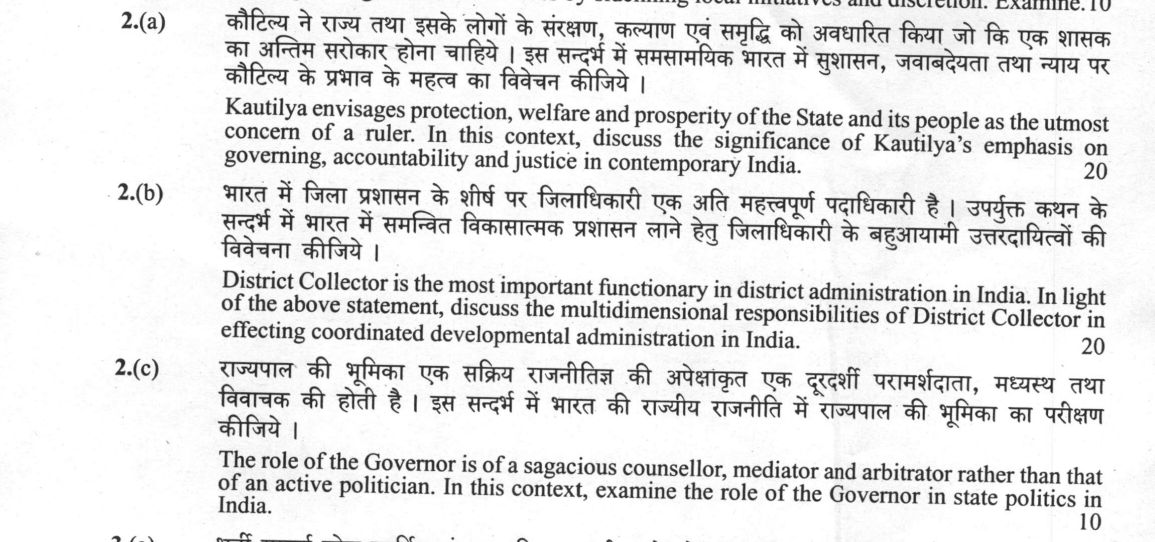
(a) Kautilya envisages protection, welfare and prosperity of the State and its people as the utmost concern of a ruler. In this…
Kautilya envisages protection, welfare and prosperity of the State and its people as the utmost concern of a ruler. In this context, discuss the significance of Kautilya's emphasis on governing, accountability and justice in contemporary India. 20 marks
District Collector is the most important functionary in district administration in India. In light of the above statement, discuss the multidimensional responsibilities of District Collector in effecting coordinated developmental administration in India. 20 marks
The role of the Governor is of a sagacious counsellor, mediator and arbitrator rather than that of an active politician. In this context, examine the role of the Governor in state politics in India. 10 marks
हिंदी में प्रश्न पढ़ें
कौटिल्य ने राज्य तथा इसके लोगों के संरक्षण, कल्याण एवं समृद्धि को अवधारित किया जो कि एक शासक का अंतिम सरोकार होना चाहिये । इस संदर्भ में समसामयिक भारत में सुशासन, जवाबदेहता तथा न्याय पर कौटिल्य के प्रभाव के महत्व का विवेचन कीजिये । (20 अंक)
भारत में जिला प्रशासन के शीर्ष पर जिलाधिकारी एक अति महत्वपूर्ण पदाधिकारी है । उपर्युक्त कथन के संदर्भ में भारत में समन्वित विकासात्मक प्रशासन लाने हेतु जिलाधिकारी के बहुआयामी उत्तरदायित्वों की विवेचना कीजिये । (20 अंक)
राज्यपाल की भूमिका एक सक्रिय राजनीतिज्ञ की अपेक्षाकृत एक दूरदर्शी परामर्शदाता, मध्यस्थ तथा विवाचक की होती है । इस संदर्भ में भारत की राज्यीय राजनीति में राज्यपाल की भूमिका का परीक्षण कीजिये । (10 अंक)
Model answer
Written by UPSC Answer Check against this question's marking rubric, to the expected length. UPSC does not publish answers for Mains — this is one way to score well, not an official key.
Kautilyan Governance, Accountability, and Justice in Contemporary India
Kautilya's Arthashastra conceptualizes the state as an organic welfare entity where the Rajarshi (philosopher-king) subordinates personal interest to the happiness of the people ("Prajasukhe Sukham Rajnah"). In his Saptanga theory, the ruler (Swami) preserves the state through institutional balance, accountability, and the judicious application of Danda (sanction/punishment) to uphold Nyaya (justice). In contemporary India, this ancient philosophy aligns with the welfare state obligations enshrined in the Directive Principles of State Policy (Part IV), the rule of law, and an independent judiciary.
Kautilya's elaborate network of secret agents (Gudhapurushas) and stringent internal auditing to deter bureaucratic malfeasance foreshadow modern integrity mechanisms. The transition from monarchical oversight to modern constitutional democracy is realized through institutions like the Comptroller and Auditor General (CAG), Central Vigilance Commission (CVC), Lokpal, the Right to Information (RTI) Act, and the Election Commission. As emphasized by the Second Administrative Reforms Commission (2nd ARC), ancient insights on ethical governance and systemic accountability remain vital for institutionalizing citizen-centric administration and combating corruption today.
Multidimensional Developmental Coordination by the District Collector
The District Collector remains the pivotal functionary of grassroots administration, evolving from a colonial revenue collector and magistrate into the chief coordinator of developmental administration. Beyond managing revenue administration and maintaining public order, the Collector coordinates diverse, compartmentalized line departments to implement flagship welfare and infrastructure programs such as MGNREGA and PMGSY.
Developmental administration at the district level requires managing significant structural complexities:
First, the Collector must harmonize vertical departmental hierarchies with decentralized local governance, bridging district bureaucracy and Panchayati Raj Institutions through District Planning Committees (Article 243ZD).
Second, under National Disaster Management Authority (NDMA) guidelines, the Collector leads the District Disaster Management Authority (DDMA), ensuring multi-agency coordination during crises.
Third, modern developmental administration demands the localization of Sustainable Development Goals (SDGs), where the Collector must drive data-backed convergence among health, education, and nutrition sectors. Effective developmental administration thus rests on the Collector's ability to balance regulatory authority with collaborative leadership.
The Governor: Sagacious Counsellor versus Political Functionary
Under Articles 153 to 167 of the Constitution, the Governor is designed as a non-partisan constitutional head—a sagacious counsellor, mediator, and arbitrator safeguarding the constitutional bridge between the Union and the States. However, the operational reality of state politics has often witnessed Governors acting as active political instruments of the Union government.
Frictions arise primarily from the controversial exercise of gubernatorial discretion: recommending the imposition of President’s Rule under Article 356, selectively reserving state bills for presidential consideration, and exercising partisan bias during government formation in hung assemblies. Both the Sarkaria Commission (1988) and the Punchhi Commission (2010) underscored that the Governor must be an eminent, detached figure free from active politics, exercising discretion strictly within constitutional conventions and established judicial benchmarks (such as the S.R. Bommai principles).
Way Forward
Sustaining democratic governance in India requires synthesizing historical principles of ethical stewardship with constitutional mandates. Strengthening institutional accountability through 2nd ARC integrity frameworks, empowering District Planning Committees for converged grassroots development, and ensuring non-partisan gubernatorial functioning are essential steps to realize an effective, coordinated, and citizen-centric administrative structure.
What "Discuss" is asking you to do
Lay the issue out from more than one side — how it arose, what is claimed for it, what is held against it, and where it now stands. UPSC attaches discuss to broad topics with several live dimensions, so coverage of the dimensions earns more than the strength of your opinion.
Structure that answers it
Set the issue up → the case as it is made → the case against → the dimension both sides leave out → where the balance now lies
Where marks are lost
Listing facts with no thread between them, or arguing one side throughout and calling it a discussion.
How this answer will be evaluated
Approach
Framework: Concept > Thinker > Indian institutional application > Reform. (a) discuss: intro > 3-4 dimensions > example > balanced close | (b) discuss: intro > 3-4 dimensions > example > balanced close | (c) examine: intro > how/why with reasoning > evidence > conclusion Full marks: Precise application of theory to Indian context, specific institutional references, balanced analysis.
Key points expected
- Define Kautilya's concept of 'Rajyapala' or state protection.
- Link 'Arthashastra' principles to modern Indian governance.
- Discuss accountability mechanisms (e.g., RTI, CAG) as Kautilyan legacy.
- Connect 'Nyaya' (justice) to contemporary judicial/administrative reforms.
- Identify Collector as 'District Magistrate' and 'District Collector'.
- Detail developmental roles (e.g., PM-GAY, MGNREGA implementation).
- Explain coordination with other district officers (SDM, DPO).
- Discuss role in disaster management and law & order.
Evaluation rubric
Each sub-part is marked on its own, against the marks and word limit printed on the paper.
- (a) Significance of Kautilya's emphasis on governing, accountability, and justice in contemporary India. 20 marks
discuss— intro → 3-4 dimensions → example → balanced close
Must cover
- Define Kautilya's concept of 'Rajyapala' or state protection.
- Link 'Arthashastra' principles to modern Indian governance.
- Discuss accountability mechanisms (e.g., RTI, CAG) as Kautilyan legacy.
- Connect 'Nyaya' (justice) to contemporary judicial/administrative reforms.
Loses marks
- Theory without Indian administrative anchor.
- GS-2 style political analysis instead of administrative focus.
Earns more
- Mention 'Saptanga' theory of state.
- Reference 'Danda' (punishment) in context of rule of law.
- Cite specific modern schemes reflecting Kautilyan welfare.
Extra mark
- Reference 2nd ARC recommendations on accountability.
- Mention specific recent governance reforms (e.g., e-governance).
- (b) Multidimensional responsibilities of District Collector in coordinated developmental administration. 20 marks
discuss— intro → 3-4 dimensions → example → balanced close
Must cover
- Identify Collector as 'District Magistrate' and 'District Collector'.
- Detail developmental roles (e.g., PM-GAY, MGNREGA implementation).
- Explain coordination with other district officers (SDM, DPO).
- Discuss role in disaster management and law & order.
Loses marks
- Ignoring the 'developmental' aspect of the question.
- Focusing only on law and order, neglecting welfare.
Earns more
- Mention 'District Administration' structure.
- Reference specific developmental schemes (e.g., Jal Jeevan Mission).
- Discuss 'Gram Sabha' interaction.
Extra mark
- Reference 2nd ARC recommendations on district administration.
- Mention specific recent reforms in district governance.
- (c) Role of Governor as counsellor, mediator, and arbitrator in state politics. 10 marks
examine— intro → how/why with reasoning → evidence → conclusion
Must cover
- Define Governor's constitutional role (Article 153, 163).
- Explain 'sagacious counsellor' role (advising CM).
- Discuss 'mediator' role in hung assemblies or coalition politics.
- Analyze 'arbitrator' role in disputes between state and center.
Loses marks
- Treating Governor as an 'active politician' (contradicting prompt).
- Ignoring the 'mediator' and 'arbitrator' aspects.
Earns more
- Mention 'discretionary powers' of Governor.
- Reference specific instances of Governor's intervention.
- Discuss 'constitutional morality' in Governor's actions.
Extra mark
- Reference 2nd ARC recommendations on Governor's role.
- Mention specific recent controversies or reforms.
Practice this exact question
Write your answer and it is marked point by point against the model answer above — what you covered, what you missed, what you got wrong.
Evaluate my answer →More from Public Administration 2021 Paper II
- Q1 Answer the following in about 150 words each: (a) The Preamble to the Constitution of Ind…
- Q2 (a) Kautilya envisages protection, welfare and prosperity of the State and its people as…
- Q3 (a) Recruitment is the cornerstone of the whole public personnel structure and it revolve…
- Q4 (a) As a constitutionally mandated body the Finance Commission stands at the centre of fi…
- Q5 Answer the following in about 150 words each: (a) No rural development strategy can succe…