Paper I — Q1
Answer the following in about 150 words each : 10×5=50 (a) Public Management takes 'what' and 'why' from Public Administration…
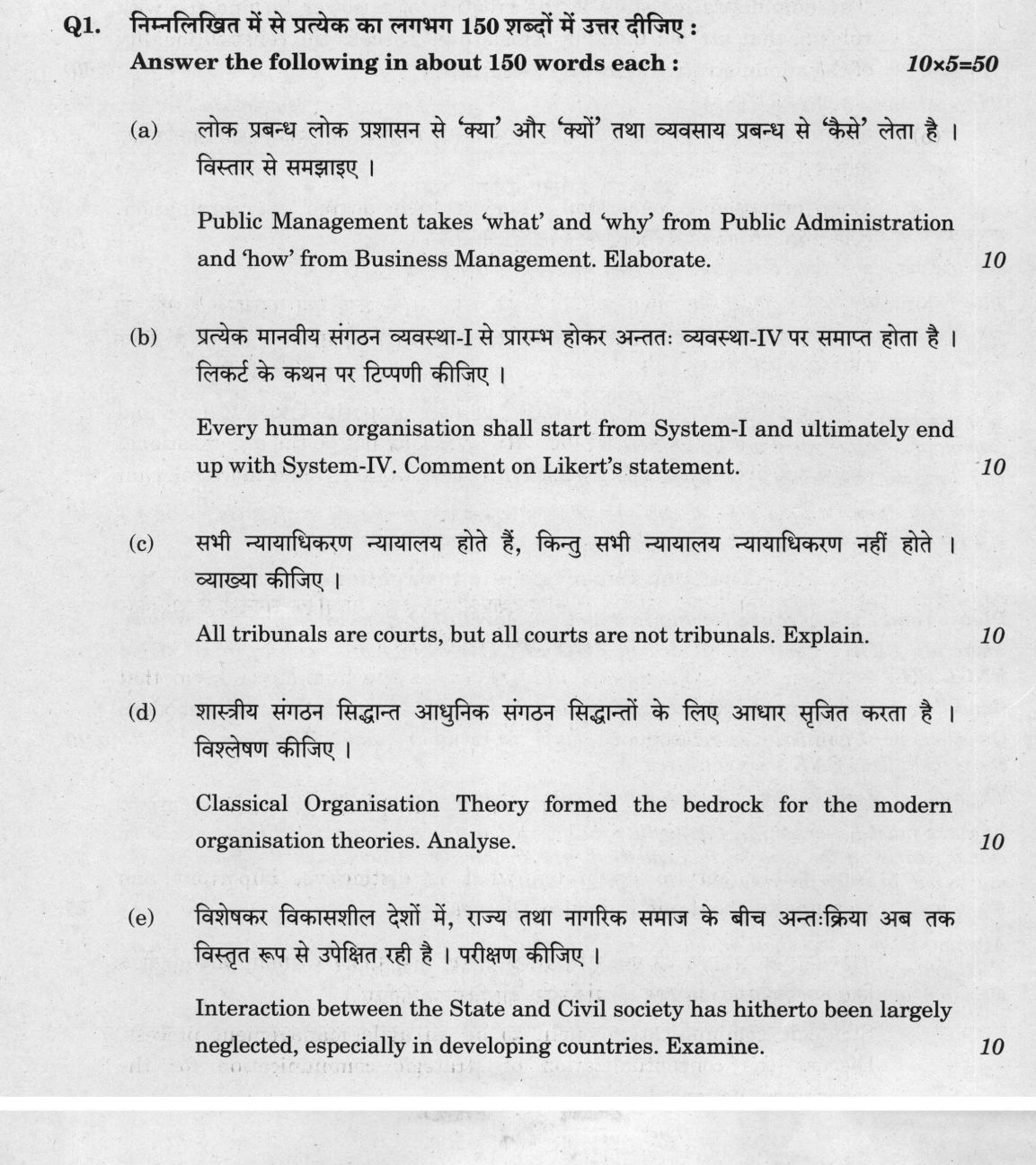
Answer the following in about 150 words each : 10×5=50
Public Management takes 'what' and 'why' from Public Administration and 'how' from Business Management. Elaborate. 10 marks
Every human organisation shall start from System-I and ultimately end up with System-IV. Comment on Likert's statement. 10 marks
All tribunals are courts, but all courts are not tribunals. Explain. 10 marks
Classical Organisation Theory formed the bedrock for the modern organisation theories. Analyse. 10 marks
Interaction between the State and Civil society has hitherto been largely neglected, especially in developing countries. Examine. 10 marks
हिंदी में प्रश्न पढ़ें
निम्नलिखित में से प्रत्येक का लगभग 150 शब्दों में उत्तर दीजिए : 10×5=50
लोक प्रबन्ध लोक प्रशासन से 'क्या' और 'क्यों' तथा व्यवसाय प्रबन्ध से 'कैसे' लेता है । विस्तार से समझाइए । 10
प्रत्येक मानवीय संगठन व्यवस्था-I से प्रारम्भ होकर अन्ततः व्यवस्था-IV पर समाप्त होता है । लिकर्ट के कथन पर टिप्पणी कीजिए । 10
सभी न्यायाधिकरण न्यायालय होते हैं, किन्तु सभी न्यायालय न्यायाधिकरण नहीं होते । व्याख्या कीजिए । 10
शास्त्रीय संगठन सिद्धान्त आधुनिक संगठन सिद्धान्तों के लिए आधार सृजित करता है । विश्लेषण कीजिए । 10
विशेषकर विकासशील देशों में, राज्य तथा नागरिक समाज के बीच अन्तःक्रिया अब तक विस्तृत रूप से उपेक्षित रही है । परीक्षण कीजिए । 10
Model answer
Written by UPSC Answer Check against this question's marking rubric, to the 150-word length. UPSC does not publish answers for Mains — this is one way to score well, not an official key.
(a) Public Management represents a functional synthesis that fuses the democratic ends of Public Administration with the operational means of Business Management. As Christopher Hood noted in conceptualising New Public Management (NPM), the discipline inherits its 'what' and 'why' from traditional public administration. This encompasses the teleological rationale of governance: upholding public interest, constitutional equity, accountability, social justice, and creating 'public value' (Mark Moore).
Conversely, it borrows its 'how' from business administration, integrating private-sector managerialism to achieve these democratic ends. This incorporates the 'Three Es'—economy, efficiency, and effectiveness—alongside performance monitoring, customer orientation, decentralisation, and contract management. In India, this synthesis is visible in initiatives like the Citizen's Charters, Sevottam model, and the Performance Monitoring and Evaluation System (PMES), where bureaucratic authority is married with corporate performance metrics to deliver public goods efficiently without compromising public accountability.
(b) Rensis Likert conceptualised leadership through a continuum of four organisational systems: System-I (Exploitative-Authoritative), System-II (Benevolent-Authoritative), System-III (Consultative), and System-IV (Participative Group). Likert posited that as organisations mature in response to complexity, human aspirations, and communication needs, they inevitably transition toward System-IV, which relies on mutual trust, overlapping group structures ('linking pins'), decentralised decision-making, and high-performance goals.
While Likert view this evolution as an imperative for long-term productivity, empirical reality reveals that structural inertia and environmental constraints often stall progress. In developing public bureaucracies like India's, administrative systems frequently oscillate between System-II and System-III due to rigid hierarchy and procedural compliance. However, recent paradigms like Mission Karmayogi, lateral entry, and agile project teams reflect an intentional shift toward Likert’s System-IV by embedding collaborative, participative problem-solving within the civil services.
(c) The aphorism that "all tribunals are courts, but all courts are not tribunals" highlights the shared judicial character and distinct operational boundaries of the two institutions. In Associated Cement Companies Ltd. v. P.N. Sharma, the Supreme Court affirmed that both courts and tribunals derive adjudicatory authority from the sovereign state to resolve disputes and deliver binding decisions. Hence, functionally, all tribunals are courts.
However, traditional courts (established under Articles 124, 214, and the Civil/Criminal Procedure Codes) possess universal jurisdiction and strict adherence to technical rules of evidence. In contrast, tribunals—such as those under Articles 323-A and 323-B (e.g., Central Administrative Tribunal, National Green Tribunal)—are specialized, statutory, quasi-judicial bodies. They are guided by principles of natural justice rather than rigid procedure, and incorporate domain experts alongside judicial members to deliver expeditious, technocratic justice without replacing the constitutional courts (L. Chandra Kumar case).
(d) Classical Organisation Theory—anchored by F.W. Taylor’s Scientific Management, Henri Fayol’s Administrative Theory, and Max Weber’s Bureaucratic Model—established the fundamental architecture of formal organisations. It introduced indispensable foundational concepts: functional division of labour, scalar chain, hierarchy, unity of command, span of control, and rational-legal authority.
Rather than rendering Classical Theory obsolete, subsequent paradigms evolved by responding directly to its foundational premises. Elton Mayo’s Human Relations Theory addressed the classical neglect of informal groups and human social needs. Chester Barnard and Herbert Simon refined classical structuralism by analysing informal systems and bounded rationality. Furthermore, Systems and Contingency theories (Kast, Rosenzweig, Lawrence, and Lorsch) built upon classical formal frameworks by integrating dynamic open-system interactions. Consequently, the classical school remains the structural bedrock upon which all contemporary organisational designs and behavioural modifications are constructed.
(e) In post-colonial developing nations, the interaction between the State and Civil Society was historically underdeveloped. The post-independence state assumed the "commanding heights" of socioeconomic transformation through a paternalistic, top-down bureaucratic apparatus. This state-centric model viewed civil society either as an administrative rival or as a passive beneficiary, resulting in weak institutional interfaces and chronic consultative deficits.
In recent decades, governance failures and fiscal limitations necessitated a paradigm shift toward collaborative governance. In India, this transformation is institutionalised through mechanisms such as the Right to Information Act 2005, mandatory Social Audits under MGNREGA, and partnerships with Self-Help Groups (e.g., Kudumbashree) for service delivery. Bridging this historical divide through institutionalised Jan Bhagidari (citizen participation) is now recognised as essential for deepening democracy and ensuring transparent, accountable administration.
What "Elaborate" is asking you to do
Give the full detailed account the question has compressed into a line — every dimension of it, with specifics. Elaborate rewards completeness and detail rather than clarification or argument: the examiner is checking whether you can fill out a topic without being told what its parts are.
Structure that answers it
State the proposition → first dimension in detail → second dimension in detail → the part the statement leaves implicit → the consolidated picture
Where marks are lost
Repeating the statement at greater length instead of adding substance. Elaborate also punishes narrowness: omitting a whole dimension costs more here than anywhere else in this family.
How this answer will be evaluated
Approach
Framework: Public Administration Paper I (UPSC). (a) explain: definition/context > points in order > small example > short close | (b) comment: context > arguments both sides > judgment > close | (c) explain: definition/context > points in order > small example > short close | (d) analyse: intro > causes > effects > stakeholders/linkages > way forward | (e) examine: intro > how/why with reasoning > evidence > conclusion Full marks: Precise definitions, clear distinction between concepts, strong Indian examples, and critical analysis.
Key points expected
- Define 'what' and 'why' as PA's domain (policy, equity, law)
- Define 'how' as BM's domain (efficiency, tools, KPIs)
- Explain the synthesis of both in Public Management
- Provide an Indian administrative instance (e.g., e-Governance or NITI Aayog)
- Define System-I (Exploitative Authoritative) and System-IV (Participative/Clan)
- Explain the evolutionary logic of the transition
- Provide a counter-argument or limitation of the model
- Apply to an Indian organizational context (e.g., PSU modernization)
Evaluation rubric
Each sub-part is marked on its own, against the marks and word limit printed on the paper.
- (a) Distinguish the normative/constitutional role of PA from the operational/efficiency role of BM in Public Management. 10 marks · 150 words
explain— definition/context → points in order → small example → short close
Must cover
- Define 'what' and 'why' as PA's domain (policy, equity, law)
- Define 'how' as BM's domain (efficiency, tools, KPIs)
- Explain the synthesis of both in Public Management
- Provide an Indian administrative instance (e.g., e-Governance or NITI Aayog)
Loses marks
- Treating Public Management and Public Administration as identical
- Ignoring the 'why' (normative) aspect of administration
Earns more
- Mention New Public Management (NPM) as the theoretical bridge
- Reference specific Indian reforms (e.g., MCA 2013 or GST implementation)
Extra mark
- Cite 2nd ARC recommendations on performance management
- Reference specific NITI Aayog frameworks
- (b) Critically assess Likert's evolutionary model of management systems (Exploitative to Clan). 10 marks · 150 words
comment— context → arguments both sides → judgment → close
Must cover
- Define System-I (Exploitative Authoritative) and System-IV (Participative/Clan)
- Explain the evolutionary logic of the transition
- Provide a counter-argument or limitation of the model
- Apply to an Indian organizational context (e.g., PSU modernization)
Loses marks
- Describing only System-I and System-IV without the transition
- Treating the model as a rigid linear path rather than a continuum
Earns more
- Mention System-II (Benevolent) and System-III (Consultative) as intermediate stages
- Reference Likert's 'Yerkes-Dodson' law or motivation theories
Extra mark
- Cite specific Indian case studies of System-IV adoption
- Reference modern agile management practices as System-IV evolution
- (c) Distinguish the legal status and jurisdiction of Tribunals versus Courts in India. 10 marks · 150 words
explain— definition/context → points in order → small example → short close
Must cover
- Define 'Tribunal' (quasi-judicial, specialized) and 'Court' (judicial, general)
- Explain why all tribunals are courts (quasi-judicial nature)
- Explain why all courts are not tribunals (hierarchy, jurisdiction)
- Cite an Indian example (e.g., NCLT vs. High Court)
Loses marks
- Confusing 'Tribunal' with 'Court' in terms of hierarchy
- Ignoring the constitutional basis for tribunals
Earns more
- Reference Article 323A and 323B of the Constitution
- Mention the Administrative Tribunals Act, 1985
Extra mark
- Cite specific Supreme Court judgments on tribunal jurisdiction
- Reference recent reforms in tribunal functioning (e.g., 2nd ARC)
- (d) Trace the foundational contributions of Classical Theory to modern organizational concepts. 10 marks · 150 words
analyse— intro → causes → effects → stakeholders/linkages → way forward
Must cover
- Identify key Classical thinkers (Taylor, Fayol, Weber)
- Explain specific Classical concepts (e.g., division of labor, hierarchy)
- Show how these concepts underpin modern theories (e.g., systems, contingency)
- Provide an Indian administrative example (e.g., UPSC structure)
Loses marks
- Listing Classical thinkers without explaining their contribution
- Ignoring the link to modern theories
Earns more
- Mention Scientific Management (Taylor) and Bureaucracy (Weber) specifically
- Reference the 'Principles of Management' (Fayol)
Extra mark
- Cite 2nd ARC recommendations on organizational structure
- Reference modern Indian administrative reforms (e.g., MCA 2013)
- (e) Critically assess the neglect of State-Civil Society interaction in developing countries. 10 marks · 150 words
examine— intro → how/why with reasoning → evidence → conclusion
Must cover
- Define 'State' and 'Civil Society' in the context of governance
- Explain why interaction is neglected (e.g., top-down approach)
- Provide evidence of neglect in developing countries (e.g., India)
- Suggest ways to improve interaction (e.g., participatory governance)
Loses marks
- Treating 'State' and 'Civil Society' as identical
- Ignoring the specific context of developing countries
Earns more
- Reference specific Indian initiatives (e.g., Panchayati Raj, RTI)
- Mention the role of NGOs and CSOs in governance
Extra mark
- Cite 2nd ARC recommendations on citizen participation
- Reference specific Indian case studies of successful interaction
Practice this exact question
Write your answer and it is marked point by point against the model answer above — what you covered, what you missed, what you got wrong.
Evaluate my answer →More from Public Administration 2022 Paper I
- Q1 Answer the following in about 150 words each : 10×5=50 (a) Public Management takes 'what'…
- Q2 (a) 'The administrative state is the creation of a power to bind us, with rules ... that…
- Q3 (a) Barnard posits the zone of indifference as the human condition that animates authorit…
- Q4 (a) 'Leadership is seen as dealing with change, whereas administration is viewed as copin…