Paper I — Q2
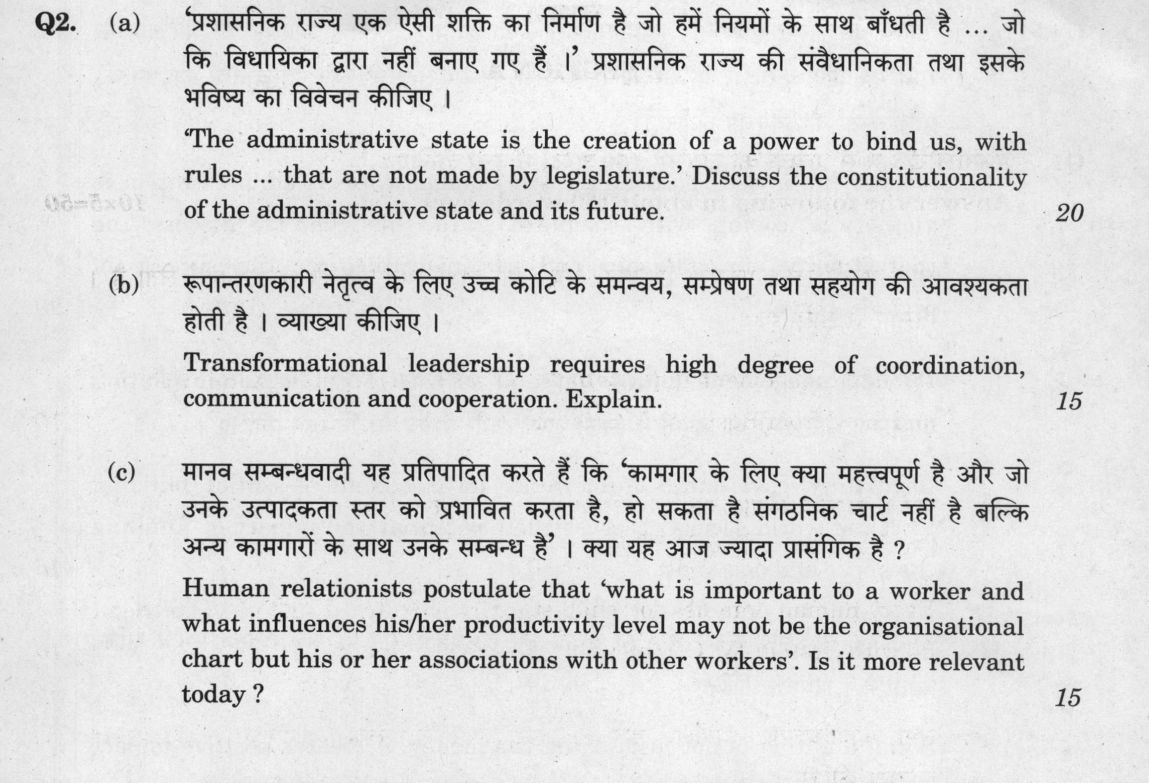
(a) 'The administrative state is the creation of a power to bind us, with rules ... that are not made by legislature.' Discuss…
'The administrative state is the creation of a power to bind us, with rules ... that are not made by legislature.' Discuss the constitutionality of the administrative state and its future. 20 marks
Transformational leadership requires high degree of coordination, communication and cooperation. Explain. 15 marks
Human relationists postulate that 'what is important to a worker and what influences his/her productivity level may not be the organisational chart but his or her associations with other workers'. Is it more relevant today? 15 marks
हिंदी में प्रश्न पढ़ें
'प्रशासनिक राज्य एक ऐसी शक्ति का निर्माण है जो हमें नियमों के साथ बाँधती है ... जो कि विधायिका द्वारा नहीं बनाए गए हैं ।' प्रशासनिक राज्य की संवैधानिकता तथा इसके भविष्य का विवेचन कीजिए । 20
रूपान्तरणकारी नेतृत्व के लिए उच्च कोटि के समन्वय, सम्प्रेषण तथा सहयोग की आवश्यकता होती है । व्याख्या कीजिए । 15
मानव सम्बन्धवादी यह प्रतिपादित करते हैं कि 'कामगार के लिए क्या महत्वपूर्ण है और जो उनके उत्पादकता स्तर को प्रभावित करता है, हो सकता है संगठनिक चार्ट नहीं है बल्कि अन्य कामगारों के साथ उनके सम्बन्ध हैं' । क्या यह आज ज्यादा प्रासंगिक है ? 15 marks
Model answer
Written by UPSC Answer Check against this question's marking rubric, to the expected length. UPSC does not publish answers for Mains — this is one way to score well, not an official key.
The evolution of modern governance reflects a continuous interplay between administrative authority, organizational leadership, and workplace behavioral dynamics.
Constitutionality and Future of the Administrative State
The administrative state derives power through delegated legislation, exercising quasi-legislative authority to formulate binding rules and standards. This rise of executive rule-making creates sharp constitutional tensions. Under the Indian constitutional framework, administrative rule-making must conform to Article 14 (non-arbitrariness) and Article 21 (due process and procedure established by law). The doctrine of excessive delegation prohibits the legislature from abdicating its essential functions, requiring parent statutes to lay down clear policy guidelines (In re Delhi Laws Act).
Judicial review serves as the primary mechanism for preserving democratic accountability. In Vineet Narain v. Union of India, the Supreme Court demonstrated judicial oversight by framing binding guidelines to ensure institutional integrity in executive agencies. Similarly, in K.S. Puttaswamy v. Union of India, the Court held that administrative and delegated actions impacting fundamental rights must satisfy the strict tests of legality, legitimate state aim, and proportionality.
The future trajectory of the administrative state relies on structural reforms that enhance democratic legitimacy without paralyzing administrative agility. This demands institutionalizing Regulatory Impact Assessments (RIA) to evaluate socio-economic consequences before notification, embedding statutory sunset clauses to prevent obsolete regulatory accumulation, and institutionalizing pre-promulgation participatory rule-making via mandatory notice-and-comment procedures.
Transformational Leadership: Coordination, Communication, and Cooperation
According to Bernard Bass and Bruce Avolio, transformational leadership transcends transactional reward systems to motivate followers toward collective transformation through four dimensions: idealized influence, inspirational motivation, intellectual stimulation, and individualized consideration. This model relies on three integrative mechanisms:
Communication functions as the core vehicle for inspirational motivation. Leaders must articulate a compelling vision, decode complex public goals, and build transparency across administrative echelons.
Coordination ensures structural alignment between the leader’s vision and operational reality. It integrates fragmented bureaucratic silos, aligns cross-functional workflows, and allocates institutional resources effectively.
Cooperation builds upon individualized consideration and trust. By fostering psychological safety and peer collaboration, transformational leaders generate voluntary compliance and discretionary effort among subordinates.
Together, structural coordination, vision-led communication, and trust-based cooperation prevent organizational inertia and drive public sector innovation.
Human Relations Approach in Contemporary Organizations
The Human Relations School, pioneered by Elton Mayo and Fritz Roethlisberger through the Hawthorne Studies, established that social affiliations, peer group norms, and informal structures exert a greater influence on worker productivity than the formal organizational chart.
This premise has acquired heightened relevance in contemporary work environments: In the platform economy, agile enterprises, and remote-work environments, traditional hierarchies are increasingly replaced by fluid, decentralized teams. In virtual and distributed workspaces, the absence of physical supervision means productivity depends heavily on digital informal networks, peer trust, and collaborative social capital.
However, viewing informal dynamics as the sole driver of productivity is an oversimplification. Unregulated informal groups can reinforce echo chambers, burnout, or resistance to change. Modern organizational productivity is best explained through hybrid models where formal organizational architecture (clear performance metrics, statutory mandates, objective accountability frameworks) provides the necessary structural backbone, while informal human networks provide the emotional resilience, adaptability, and social cohesion required for sustainable output.
Contemporary administration requires balancing legitimate delegated rule-making with constitutional oversight, steered by transformational leaders who integrate formal governance structures with informal, human-centric collaborative networks.
What "Discuss" is asking you to do
Lay the issue out from more than one side — how it arose, what is claimed for it, what is held against it, and where it now stands. UPSC attaches discuss to broad topics with several live dimensions, so coverage of the dimensions earns more than the strength of your opinion.
Structure that answers it
Set the issue up → the case as it is made → the case against → the dimension both sides leave out → where the balance now lies
Where marks are lost
Listing facts with no thread between them, or arguing one side throughout and calling it a discussion.
How this answer will be evaluated
Approach
Framework: UPSC Public Administration Paper 1. (a) discuss: intro > 3-4 dimensions > example > balanced close | (b) explain: definition/context > points in order > small example > short close | (c) comment: context > arguments both sides > judgment > close Full marks: Comprehensive, well-structured, with strong Indian anchors and specific examples.
Key points expected
- Define administrative state and its non-legislative rule-making power
- Cite Indian constitutional provisions (Art 12, 13, 312, 324)
- Discuss judicial review and delegation of legislative power
- Analyze the future of administrative state in modern governance
- Define transformational leadership and its core components
- Explain the role of coordination in transformational leadership
- Explain the role of communication in transformational leadership
- Explain the role of cooperation in transformational leadership
Evaluation rubric
Each sub-part is marked on its own, against the marks and word limit printed on the paper.
- (a) Analyze the constitutional validity of the administrative state and its future trajectory. 20 marks
discuss— intro → 3-4 dimensions → example → balanced close
Must cover
- Define administrative state and its non-legislative rule-making power
- Cite Indian constitutional provisions (Art 12, 13, 312, 324)
- Discuss judicial review and delegation of legislative power
- Analyze the future of administrative state in modern governance
Loses marks
- GS-2 style answer without administrative focus
- Theory with no Indian constitutional anchor
- Failure to distinguish administration from politics
Earns more
- Reference to specific Supreme Court judgments on delegation
- Distinction between administrative and legislative functions
- Discussion of the 'welfare state' concept
- Mention of specific administrative agencies (e.g., SEBI, RBI)
Extra mark
- Reference to 2nd ARC recommendations on administrative law
- Mention of recent governance reforms (e.g., GST Council)
- (b) Explain the role of coordination, communication, and cooperation in transformational leadership. 15 marks
explain— definition/context → points in order → small example → short close
Must cover
- Define transformational leadership and its core components
- Explain the role of coordination in transformational leadership
- Explain the role of communication in transformational leadership
- Explain the role of cooperation in transformational leadership
Loses marks
- GS-2 style answer without administrative focus
- Theory with no Indian administrative anchor
- Failure to distinguish administration from politics
Earns more
- Reference to specific leadership theories (e.g., Bass, Burns)
- Use of Indian administrative examples (e.g., PM Modi's leadership)
- Discussion of the 'vision' component of transformational leadership
- Mention of the 'inspirational motivation' component
Extra mark
- Reference to 2nd ARC recommendations on leadership
- Mention of specific governance reforms (e.g., Mission Karmayogi)
- (c) Comment on the relevance of human relations theory in the modern workplace. 15 marks
comment— context → arguments both sides → judgment → close
Must cover
- Define human relations theory and its core tenets
- Explain the 'informal group' concept
- Discuss the relevance of human relations theory today
- Provide a balanced judgment on its current applicability
Loses marks
- GS-2 style answer without administrative focus
- Theory with no Indian administrative anchor
- Failure to distinguish administration from politics
Earns more
- Reference to specific human relations theorists (e.g., Mayo, Follett)
- Use of Indian administrative examples (e.g., modern HR practices)
- Discussion of the 'social man' concept
- Mention of the 'Hawthorne studies'
Extra mark
- Reference to 2nd ARC recommendations on HRM
- Mention of specific governance reforms (e.g., Mission Karmayogi)
Practice this exact question
Write your answer and it is marked point by point against the model answer above — what you covered, what you missed, what you got wrong.
Evaluate my answer →More from Public Administration 2022 Paper I
- Q1 Answer the following in about 150 words each : 10×5=50 (a) Public Management takes 'what'…
- Q2 (a) 'The administrative state is the creation of a power to bind us, with rules ... that…
- Q3 (a) Barnard posits the zone of indifference as the human condition that animates authorit…
- Q4 (a) 'Leadership is seen as dealing with change, whereas administration is viewed as copin…
- Q5 Answer the following in about 150 words each : 10×5=50 (a) Development Administration 'em…