Paper I — Q8
(a) The audit function has always been viewed as an integral part of government financial management. Discuss the significance of…
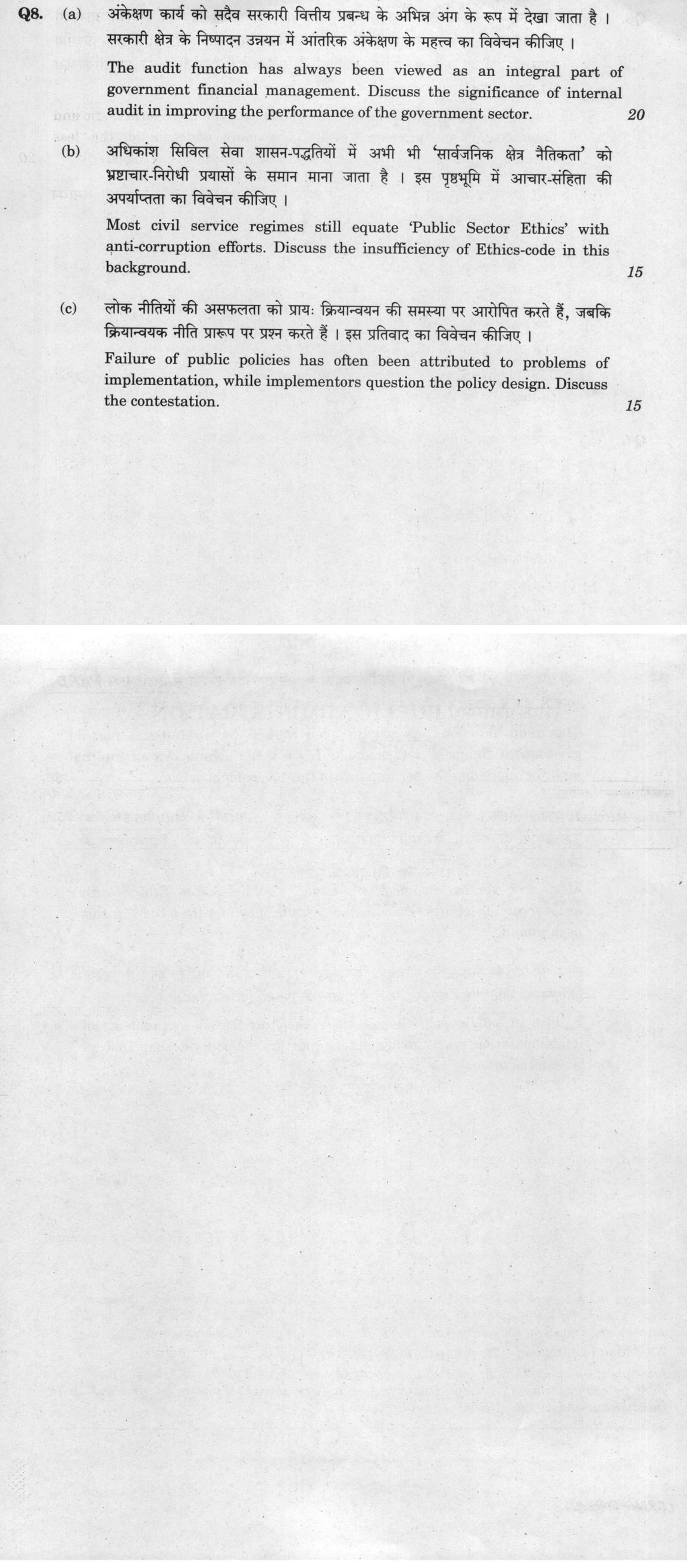
The audit function has always been viewed as an integral part of government financial management. Discuss the significance of internal audit in improving the performance of the government sector. 20 marks
Most civil service regimes still equate 'Public Sector Ethics' with anti-corruption efforts. Discuss the insufficiency of Ethics-code in this background. 15 marks
Failure of public policies has often been attributed to problems of implementation, while implementors question the policy design. Discuss the contestation. 15 marks
हिंदी में प्रश्न पढ़ें
अंकेक्षण कार्य को सदैव सरकारी वित्तीय प्रबंध के अभिन्न अंग के रूप में देखा जाता है । सरकारी क्षेत्र के निष्पादन उन्नयन में आंतरिक अंकेक्षण के महत्व का विवेचन कीजिए । 20
अधिकांश सिविल सेवा शासन-पद्धतियों में अभी भी 'सार्वजनिक क्षेत्र नैतिकता' को भ्रष्टाचार-निरोधी प्रयासों के समान माना जाता है । इस पृष्ठभूमि में आचार-संहिता की अपर्याप्तता का विवेचन कीजिए । 15
लोक नीतियों की असफलता को प्रायः क्रियान्वयन की समस्या पर आरोपित करते हैं, जबकि क्रियान्वयक नीति प्रारूप पर प्रश्न करते हैं । इस प्रतिवाद का विवेचन कीजिए । 15
Model answer
Written by UPSC Answer Check against this question's marking rubric, to the expected length. UPSC does not publish answers for Mains — this is one way to score well, not an official key.
Public administration relies on a robust architecture of financial oversight, ethical infrastructure, and policy execution to achieve development outcomes.
Significance of Internal Audit in Government Performance
While external audit under the Comptroller and Auditor General (CAG) provides post-facto legislative oversight, internal audit functions as an integral, real-time management tool for the executive. Traditionally confined to a compliance audit of financial vouchers, modern internal audit has evolved into performance auditing and Risk-Based Internal Audit (RBIA). It systematically evaluates the '3Es'—economy, efficiency, and effectiveness—identifying systemic bottlenecks and resource leakages before external scrutiny.
By integrating with platforms like the Public Financial Management System (PFMS) and adopting reforms led by the Indian Audit and Accounts Department (IA&AD), internal audit provides actionable intelligence that feeds directly into the Output-Outcome Monitoring Framework. This enables mid-course corrections, minimizes fiscal waste, and tightens budgetary controls. Furthermore, citizen-centric mechanisms such as the Right to Information (RTI) Act and grassroots social audits serve as external complements, creating a feedback loop that enhances administrative responsiveness and managerial accountability.
Insufficiency of Ethics Codes and Anti-Corruption Regimes
Public sector ethics is often reduced to anti-corruption measures, creating an enforcement-heavy, punitive paradigm. This Lokpal-centric and vigilance-dominated discourse views civil servants through a lens of negative deterrence, focusing on what officials must not do rather than what they ought to do.
A formal code of ethics or conduct that only penalizes malfeasance is fundamentally insufficient. Public administration demands proactive, aspirational values: dedication to public interest, procedural transparency, administrative responsiveness, accountability, and empathy for marginalized sections. As underscored by the Nolan Committee’s Seven Principles of Public Life—Selflessness, Integrity, Objectivity, Accountability, Openness, Honesty, and Leadership—ethical governance requires an internalized normative compass. In India, the proposed Public Service Bill sought to address this gap by legally institutionalizing positive public service values, shifting the administrative culture from rule-bound avoidance of corruption to value-driven public service delivery.
Contestation between Policy Design and Implementation
The debate over policy failure reflects the classic top-down versus bottom-up administrative tension. Central planners frequently attribute failure to bureaucratic inertia and poor field execution, while field implementors point to flawed, hyper-rational policy designs that ignore local complexities.
Pressman and Wildavsky conceptualized this as the 'implementation gap', where complex decision chains and divergent actor interests dilute policy goals. Complementing this, Michael Lipsky’s concept of 'street-level bureaucracy' demonstrates that frontline administrators, constrained by inadequate resources and conflicting directives, develop coping routines that reshape policy outcomes on the ground.
Indian administrative experience illustrates this contestation clearly. The rollout of the Goods and Services Tax (GST) suffered from initial technological and design misalignments with field realities; MGNREGA frequently faces implementation hurdles due to rigid top-down technological mandates detached from local banking infrastructure; and the repeal of the 2020 Farm Laws demonstrated how technocratic design without adequate bottom-up consultation precipitates execution failure. To bridge this divide, the 2nd Administrative Reforms Commission (ARC) emphasized enhancing field implementation capacity, designing flexible citizen-centric policies, and institutionalizing pre-legislative consultative processes.
Way Forward
Financial audit, administrative ethics, and policy execution form an interdependent governance tripod. Weak internal audit blinds policymakers to operational failures, ethical deficits erode implementation fidelity, and detached policy designs demoralize field bureaucracy. Resolving these challenges requires an integrated governance framework that pairs risk-based internal auditing and value-based ethical training with decentralized, participatory policy design.
What "Discuss" is asking you to do
Lay the issue out from more than one side — how it arose, what is claimed for it, what is held against it, and where it now stands. UPSC attaches discuss to broad topics with several live dimensions, so coverage of the dimensions earns more than the strength of your opinion.
Structure that answers it
Set the issue up → the case as it is made → the case against → the dimension both sides leave out → where the balance now lies
Where marks are lost
Listing facts with no thread between them, or arguing one side throughout and calling it a discussion.
How this answer will be evaluated
Approach
Framework: Public Administration Paper I (General Studies II/III interface). (a) discuss: intro > 3-4 dimensions > example > balanced close | (b) discuss: intro > 3-4 dimensions > example > balanced close | (c) discuss: intro > 3-4 dimensions > example > balanced close Full marks: Comprehensive, well-structured, with specific Indian examples and references to 2nd ARC.
Key points expected
- Define internal audit vs external audit (CAG)
- Link to financial management and accountability
- Discuss performance improvement (efficiency/effectiveness)
- Provide Indian institutional context (e.g., CVC, CAG, CVC)
- Define 'Public Sector Ethics' vs 'Anti-corruption'
- Explain the narrowness of anti-corruption focus
- Discuss broader ethical dimensions (integrity, accountability, transparency)
- Provide examples of ethical failures beyond corruption
Evaluation rubric
Each sub-part is marked on its own, against the marks and word limit printed on the paper.
- (a) Analytical discussion of internal audit's role in enhancing government sector performance. 20 marks
discuss— intro → 3-4 dimensions → example → balanced close
Must cover
- Define internal audit vs external audit (CAG)
- Link to financial management and accountability
- Discuss performance improvement (efficiency/effectiveness)
- Provide Indian institutional context (e.g., CVC, CAG, CVC)
Loses marks
- Confusing internal audit with external audit (CAG)
- Generic discussion of audit without government context
- Ignoring the 'performance improvement' aspect
Earns more
- Mention specific audit techniques (compliance, performance, financial)
- Reference to 2nd ARC recommendations on audit
- Discuss role in fraud detection and prevention
- Mention specific government schemes audited
Extra mark
- Reference to specific CAG report findings
- Mention of specific audit reforms (e.g., CAG Act amendments)
- (b) Critical discussion of why equating ethics with anti-corruption is insufficient. 15 marks
discuss— intro → 3-4 dimensions → example → balanced close
Must cover
- Define 'Public Sector Ethics' vs 'Anti-corruption'
- Explain the narrowness of anti-corruption focus
- Discuss broader ethical dimensions (integrity, accountability, transparency)
- Provide examples of ethical failures beyond corruption
Loses marks
- Defining ethics only as anti-corruption
- Ignoring the 'insufficiency' aspect of the question
- Generic discussion of ethics without public sector context
Earns more
- Reference to 2nd ARC recommendations on ethics
- Mention specific ethical codes (e.g., Central Civil Services Conduct Rules)
- Discuss role of ethics in public trust
- Reference to specific cases of ethical failure
Extra mark
- Reference to specific ethical frameworks (e.g., deontological, utilitarian)
- Mention of specific ethics training programs
- (c) Discussion of the debate between policy design and implementation failures. 15 marks
discuss— intro → 3-4 dimensions → example → balanced close
Must cover
- Define 'policy design' and 'implementation'
- Explain the 'implementation failure' argument
- Explain the 'policy design failure' argument
- Provide examples of both types of failures
Loses marks
- Ignoring the 'contestation' aspect of the question
- Generic discussion of policy failure without specific examples
- Failing to distinguish between design and implementation
Earns more
- Reference to specific policy failures (e.g., NREGA, MGNREGA)
- Discuss role of bureaucracy in implementation
- Mention specific policy design flaws
- Reference to 2nd ARC recommendations on policy implementation
Extra mark
- Reference to specific policy evaluation reports
- Mention of specific policy design tools (e.g., cost-benefit analysis)
Practice this exact question
Write your answer and it is marked point by point against the model answer above — what you covered, what you missed, what you got wrong.
Evaluate my answer →More from Public Administration 2022 Paper I
- Q5 Answer the following in about 150 words each : 10×5=50 (a) Development Administration 'em…
- Q6 (a) 'The more exogenetic the process of diffraction, the more formalistic and heterogenou…
- Q7 (a) The results of Washington Consensus were far from optimal for transitional economies.…
- Q8 (a) The audit function has always been viewed as an integral part of government financial…