Paper I — Q7
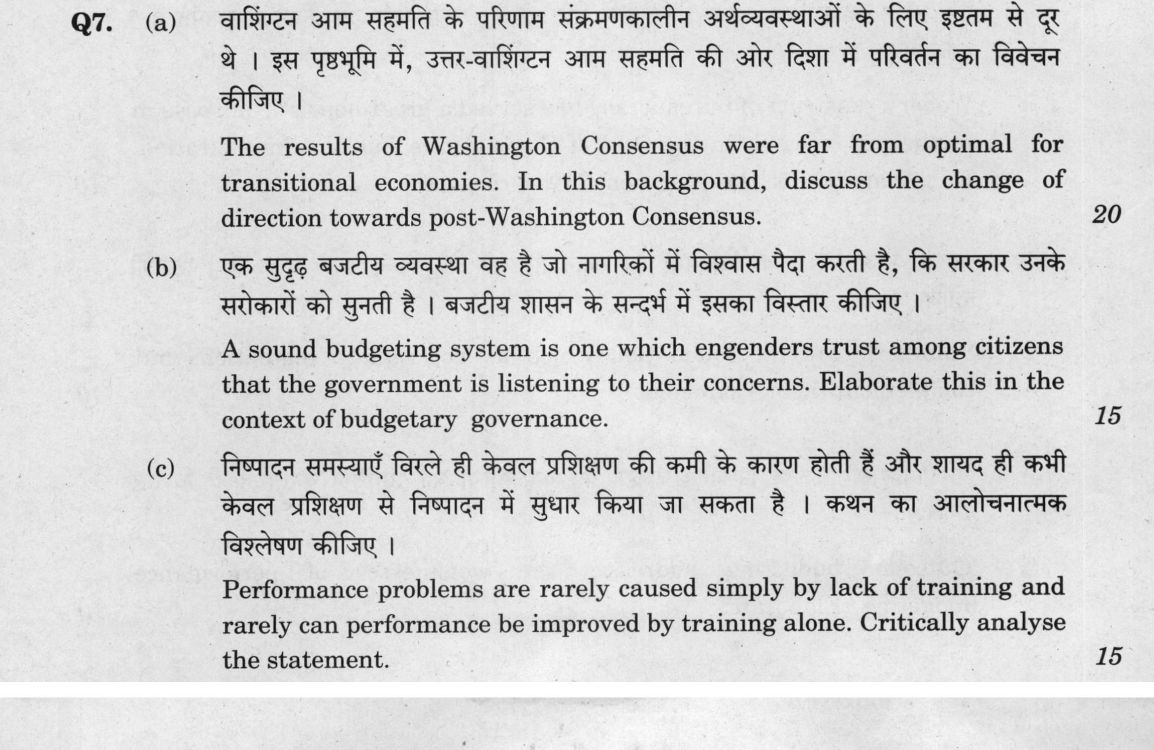
(a) The results of Washington Consensus were far from optimal for transitional economies. In this background, discuss the change…
The results of Washington Consensus were far from optimal for transitional economies. In this background, discuss the change of direction towards post-Washington Consensus. 20 marks
A sound budgeting system is one which engenders trust among citizens that the government is listening to their concerns. Elaborate this in the context of budgetary governance. 15 marks
Performance problems are rarely caused simply by lack of training and rarely can performance be improved by training alone. Critically analyse the statement. 15 marks
हिंदी में प्रश्न पढ़ें
वाशिंगटन आम सहमति के परिणाम संक्रमणकालीन अर्थव्यवस्थाओं के लिए इष्टतम से दूर थे। इस पृष्ठभूमि में, उत्तर-वाशिंगटन आम सहमति की ओर दिशा में परिवर्तन का विवेचन कीजिए। 20
एक सुदृढ़ बजटीय व्यवस्था वह है जो नागरिकों में विश्वास पैदा करती है, कि सरकार उनके सरोकारों को सुनती है। बजटीय शासन के संदर्भ में इसका विस्तार कीजिए। 15
निष्पादन समस्याएँ बिरले ही केवल प्रशिक्षण की कमी के कारण होती हैं और शायद ही कभी केवल प्रशिक्षण से निष्पादन में सुधार किया जा सकता है। कथन का आलोचनात्मक विश्लेषण कीजिए। 15
Model answer
Written by UPSC Answer Check against this question's marking rubric, to the expected length. UPSC does not publish answers for Mains — this is one way to score well, not an official key.
(a) The Washington Consensus, associated with stabilization, liberalization and privatization, was presented as a universal reform package for economies moving from state control to markets. It was originally framed for Latin America, but in post-communist transitional economies such as Russia and Eastern Europe, rapid liberalization and privatization often produced asset stripping, oligarchic concentration, weak regulation, high unemployment and rising inequality. In Latin America, where the Consensus was first applied, liberalization also exposed vulnerabilities such as debt crises and uneven gains, though the sharpest institutional failures appeared in post-communist transitions. The state’s capacity to enforce contracts, provide public goods and cushion adjustment was underestimated, so markets became vulnerable to shocks and public trust eroded. The post-communist experience showed that market fundamentalism without sequencing, institutions and social protection could be far from optimal.
The post-Washington Consensus emerged from critiques, especially Joseph Stiglitz’s, that one-size-fits-all prescriptions ignored information asymmetries, market failures, power imbalances and the need for credible institutions. The change of direction is not a rejection of macroeconomic stability or markets, but a broader emphasis on governance, state capacity, social capital, inclusive growth and equitable access to opportunities. Policy design now stresses sequencing reforms, strengthening regulatory institutions, protecting vulnerable groups, and aligning liberalization with domestic institutional readiness. Thus the shift is from market fundamentalism to institution-sensitive, socially inclusive development.
(b) Budgetary governance becomes trust-building when citizens can see how public money is planned, spent and evaluated. Transparency means publishing budgets, outcomes and audit reports in accessible form; participative budgeting gives people channels to voice priorities; accountability means linking expenditure to results and corrective action. This trust is strengthened when budget documents are not only available but understandable, and when feedback from citizens influences allocations. OECD budgetary governance principles—transparency, accountability, efficiency, equity and sustainability—have citizen-centric dimensions because they require governments to explain choices, respond to concerns and demonstrate fairness.
In India, Outcome Budget and Performance Budget seek to connect allocations with deliverables and measurable outcomes, helping citizens judge whether money is producing services. RTI strengthens this by enabling scrutiny of budget implementation, while Citizens’ Charters, though administrative and voluntary rather than statutory, set service standards and redressal mechanisms. The Budget App and the Union Budget process as reform tools further widen access by presenting data in user-friendly formats and inviting public engagement. Together, these mechanisms show that a sound budget is not merely a fiscal document but a governance instrument that listens, explains and answers to citizens.
(c) The statement is valid because performance is produced by a system, not by isolated skills. Systems theory shows that inputs, processes, feedback and environment determine output; if procedures are cumbersome, targets unrealistic or information poor, training cannot fix the result. For example, a well-trained officer may still be constrained by outdated procedures, inadequate data, or a culture that punishes innovation. Organizational culture also matters: a risk-averse, blame-oriented culture can suppress initiative even among trained staff. Motivation theories reinforce this: Herzberg distinguishes hygiene factors from motivators, and McGregor’s Theory X/Y shows that assumptions about employee capability shape supervision and performance. Poor job design, unclear roles, inadequate resources, weak leadership and weak monitoring can all create systemic barriers.
Therefore, performance improvement must be holistic. Capability building should be combined with process re-engineering, better resource allocation, clearer accountability, leadership development and an enabling environment that rewards results. Training remains necessary, but it is most effective when the organization removes structural constraints and aligns incentives, information and authority. In public administration, this means treating performance as a design problem, not merely a training problem. Thus, the post-Washington turn, participative budgeting and systemic performance management all point to governance that is institutionally credible, citizen-responsive and results-oriented.
What "Discuss" is asking you to do
Lay the issue out from more than one side — how it arose, what is claimed for it, what is held against it, and where it now stands. UPSC attaches discuss to broad topics with several live dimensions, so coverage of the dimensions earns more than the strength of your opinion.
Structure that answers it
Set the issue up → the case as it is made → the case against → the dimension both sides leave out → where the balance now lies
Where marks are lost
Listing facts with no thread between them, or arguing one side throughout and calling it a discussion.
How this answer will be evaluated
Approach
Framework: Concept > Thinker > Indian institutional application > Reform. (a) discuss: intro > 3-4 dimensions > example > balanced close | (b) explain: definition/context > points in order > small example > short close | (c) critique: the claim > its strengths > its weaknesses > your judgment Full marks: All musts met, Indian anchors, 2nd ARC reference, clear structure
Key points expected
- Define Washington Consensus (10-point list)
- Identify failures in transitional economies
- Explain Post-Washington Consensus (state-led growth)
- Link to Indian institutional context
- Define budgetary governance
- Explain transparency mechanisms
- Link to citizen trust
- Mention Indian budget process
Evaluation rubric
Each sub-part is marked on its own, against the marks and word limit printed on the paper.
- (a) Critique of Washington Consensus failures and the shift to Post-Washington Consensus. 20 marks
discuss— intro → 3-4 dimensions → example → balanced close
Must cover
- Define Washington Consensus (10-point list)
- Identify failures in transitional economies
- Explain Post-Washington Consensus (state-led growth)
- Link to Indian institutional context
Loses marks
- Treating Consensus as single policy
- Ignoring transitional economy context
- No Indian administrative anchor
Earns more
- Mention IMF/World Bank role
- Reference 2008 financial crisis
- Cite specific Indian reforms
- Mention Joseph Stiglitz critique
Extra mark
- Reference 2nd ARC recommendations
- Cite specific recent governance reform
- (b) Link between sound budgeting and citizen trust in governance. 15 marks
explain— definition/context → points in order → small example → short close
Must cover
- Define budgetary governance
- Explain transparency mechanisms
- Link to citizen trust
- Mention Indian budget process
Loses marks
- GS-2 style political answer
- No Indian institutional anchor
- Ignoring citizen trust link
Earns more
- Reference FRBM Act
- Mention CAG role
- Cite public consultation
- Reference performance budgeting
Extra mark
- Reference 2nd ARC recommendations
- Cite specific recent governance reform
- (c) Critical analysis of training's limited role in performance. 15 marks
critique— the claim → its strengths → its weaknesses → your judgment
Must cover
- State the claim
- Identify non-training causes
- Explain training limitations
- Provide Indian administrative example
Loses marks
- Theory without Indian anchor
- Ignoring systemic factors
- Treating training as sole solution
Earns more
- Mention motivation factors
- Reference organizational culture
- Cite L&D frameworks
- Mention Indian training institutes
Extra mark
- Reference 2nd ARC recommendations
- Cite specific recent governance reform
Practice this exact question
Write your answer and it is marked point by point against the model answer above — what you covered, what you missed, what you got wrong.
Evaluate my answer →More from Public Administration 2022 Paper I
- Q4 (a) 'Leadership is seen as dealing with change, whereas administration is viewed as copin…
- Q5 Answer the following in about 150 words each : 10×5=50 (a) Development Administration 'em…
- Q6 (a) 'The more exogenetic the process of diffraction, the more formalistic and heterogenou…
- Q7 (a) The results of Washington Consensus were far from optimal for transitional economies.…
- Q8 (a) The audit function has always been viewed as an integral part of government financial…