Paper I — Q4
(a) 'Leadership is seen as dealing with change, whereas administration is viewed as coping with complexity.' In this context…
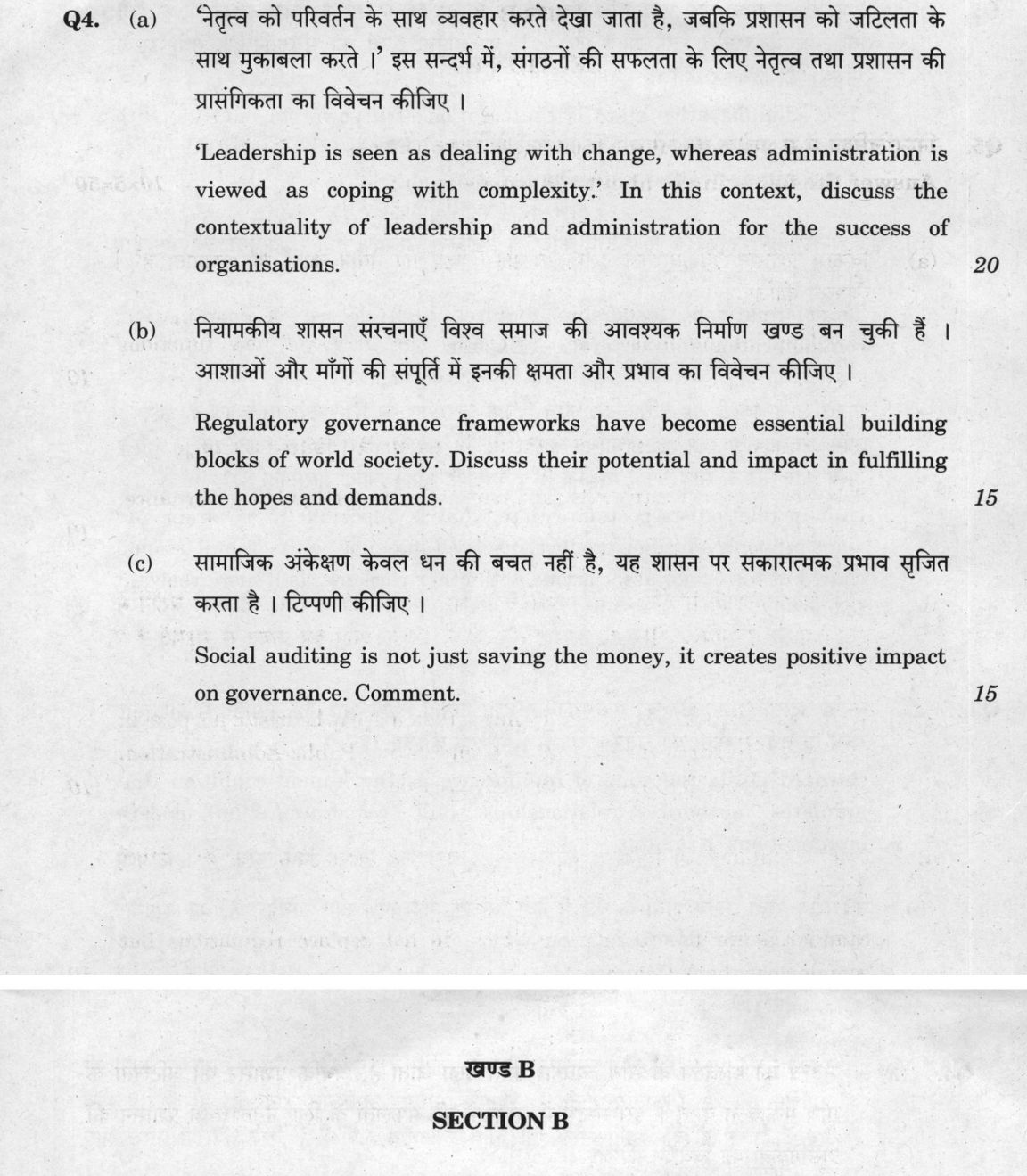
'Leadership is seen as dealing with change, whereas administration is viewed as coping with complexity.' In this context, discuss the contextuality of leadership and administration for the success of organisations. 20 marks
Regulatory governance frameworks have become essential building blocks of world society. Discuss their potential and impact in fulfilling the hopes and demands. 15 marks
Social auditing is not just saving the money, it creates positive impact on governance. Comment. 15 marks
हिंदी में प्रश्न पढ़ें
'नेतृत्व को परिवर्तन के साथ व्यवहार करते देखा जाता है, जबकि प्रशासन को जटिलता के साथ मुकाबला करते ।' इस संदर्भ में, संगठनों की सफलता के लिए नेतृत्व तथा प्रशासन की प्रासंगिकता का विवेचन कीजिए । 20
नियामकीय शासन संरचनाएँ विश्व समाज की आवश्यक निर्माण खंड बन चुकी हैं । आशाओं और माँगों की संपूर्ति में इनकी क्षमता और प्रभाव का विवेचन कीजिए । 15
सामाजिक अंकेक्षण केवल धन की बचत नहीं है, यह शासन पर सकारात्मक प्रभाव सृजित करता है । टिप्पणी कीजिए । 15
Model answer
Written by UPSC Answer Check against this question's marking rubric, to the expected length. UPSC does not publish answers for Mains — this is one way to score well, not an official key.
John Kotter posited that leadership deals with change by setting direction, inspiring vision, and aligning people, whereas administration copes with complexity through planning, organizing, staffing, and controlling. The success of modern organizations depends on the contextuality of both functions, as illuminated by situational and contingency theories (such as Fiedler’s Contingency Model and Hersey-Blanchard’s Situational Leadership). The appropriate balance between leadership style and administrative architecture is governed by external environmental turbulence, task structure, and follower readiness. Stable environments prioritize robust administrative routines to ensure predictability, efficiency, and scale; turbulent environments necessitate transformational leadership to steer change, challenge entrenched norms, and manage uncertainty.
In the Indian administrative ecosystem, transformational leadership complements bureaucratic administration rather than replacing it. During the post-1991 economic reforms, visionary political and administrative leadership redefined the state's economic role, while the Weberian civil service provided the institutional continuity and legal-administrative scaffolding required to execute complex structural adjustments. Similarly, the Indian Space Research Organisation (ISRO) under leaders like Satish Dhawan exemplified how institutional leadership fosters a culture of innovation while robust administrative systems manage matrix-based project complexity, ensuring mission success.
Regulatory Governance in World Society
Regulatory governance has emerged as a decentred, rule-based order operating beyond the nation-state, encompassing state authorities, independent agencies, civil society, and private transnational actors. Its transformative potential lies in mitigating global market failures, managing transnational commons, protecting human rights, and securing global public goods. This is evident in global institutional architectures such as the World Trade Organization (WTO) for rule-based trade, the Basel Committee for banking prudential standards, and the UNFCCC for climate action.
However, its operational impact reflects significant challenges. Regulatory regimes frequently encounter a democratic deficit, where technocratic rulemaking bypasses representative legislative oversight. In developing nations, issues of regulatory capture by dominant market incumbents and severe capacity gaps hinder equitable enforcement. In India, independent regulators like the Telecom Regulatory Authority of India (TRAI) and the Securities and Exchange Board of India (SEBI) have deepened market maturity, yet persistent frictions—such as conflicts between environmental regulatory authorities and developmental priorities, or regulatory transitions under the new Labour Codes—highlight the structural challenges of balancing social protection with market efficiency.
Social Auditing Beyond Fiscal Prudence
Social auditing extends beyond detecting financial misappropriation to fundamentally reshape democratic governance. Pioneered by grassroots mobilization like the Mazdoor Kisan Shakti Sangathan (MKSS) in Rajasthan and institutionalized under the Mahatma Gandhi National Rural Employment Guarantee Act (MGNREGA), social audit democratizes the accountability process. By transforming passive beneficiaries into vigilant stakeholders through open Jan Sunwais (public hearings), it enhances institutional responsiveness, checks bureaucratic discretion, and restores citizen trust. The Comptroller and Auditor General (CAG) has increasingly acknowledged this by integrating social audit findings into its performance audits to evaluate qualitative public value creation.
Nevertheless, social auditing faces operational bottlenecks, including capacity deficits among rural auditors, administrative non-compliance in acting upon findings, and risks of physical retaliation against whistleblowers. Realizing its full transformative potential requires institutionalizing systemic linkages with formal oversight bodies, providing legal protection to social auditors, and leveraging technological interfaces like the Public Financial Management System (PFMS) alongside geo-tagging for verifiable tracking.
Synthesizing these elements—adaptive leadership to navigate reform, robust regulatory frameworks to govern complex markets, and institutionalized social auditing for bottom-up accountability—constitutes the cornerstone of contemporary administrative reform and responsive public administration.
What "Discuss" is asking you to do
Lay the issue out from more than one side — how it arose, what is claimed for it, what is held against it, and where it now stands. UPSC attaches discuss to broad topics with several live dimensions, so coverage of the dimensions earns more than the strength of your opinion.
Structure that answers it
Set the issue up → the case as it is made → the case against → the dimension both sides leave out → where the balance now lies
Where marks are lost
Listing facts with no thread between them, or arguing one side throughout and calling it a discussion.
How this answer will be evaluated
Approach
Framework: Public Administration, Paper 1. (a) discuss: intro > 3-4 dimensions > example > balanced close | (b) discuss: intro > 3-4 dimensions > example > balanced close | (c) comment: context > arguments both sides > judgment > close Full marks: Comprehensive analysis with clear distinctions, strong Indian examples, and reference to specific reforms or bodies.
Key points expected
- Define leadership as dealing with change
- Define administration as coping with complexity
- Discuss contextuality of both for success
- Provide Indian administrative or corporate example
- Define regulatory governance frameworks
- Discuss their potential in fulfilling hopes
- Discuss their impact on societal demands
- Provide Indian regulatory example (e.g., RBI, SEBI)
Evaluation rubric
Each sub-part is marked on its own, against the marks and word limit printed on the paper.
- (a) Analyze the distinct roles of leadership (change) and administration (complexity) in organizational success. 20 marks
discuss— intro → 3-4 dimensions → example → balanced close
Must cover
- Define leadership as dealing with change
- Define administration as coping with complexity
- Discuss contextuality of both for success
- Provide Indian administrative or corporate example
Loses marks
- Treating leadership and administration as identical
- Ignoring the 'change' vs 'complexity' distinction
- No Indian context or example
Earns more
- Reference to 2nd ARC on leadership
- Distinction between management and administration
- Mention of specific Indian reform initiative
Extra mark
- Reference to specific Indian leader/administrator
- Mention of specific policy change
- (b) Evaluate the role of regulatory frameworks in meeting societal demands and hopes. 15 marks
discuss— intro → 3-4 dimensions → example → balanced close
Must cover
- Define regulatory governance frameworks
- Discuss their potential in fulfilling hopes
- Discuss their impact on societal demands
- Provide Indian regulatory example (e.g., RBI, SEBI)
Loses marks
- Vague discussion without specific examples
- Ignoring the 'hopes and demands' aspect
- No Indian context
Earns more
- Mention of specific regulatory body
- Reference to recent regulatory reform
- Discussion of regulatory challenges
Extra mark
- Reference to specific regulatory act or policy
- Mention of international regulatory comparison
- (c) Comment on the positive impact of social auditing on governance beyond financial savings. 15 marks
comment— context → arguments both sides → judgment → close
Must cover
- Define social auditing
- Explain its impact on governance
- Discuss positive impact beyond money saving
- Provide Indian example of social audit
Loses marks
- Focusing only on financial aspects
- Ignoring the governance impact
- No Indian context or example
Earns more
- Mention of specific social audit program
- Reference to transparency and accountability
- Discussion of citizen participation
Extra mark
- Reference to specific social audit report
- Mention of specific governance improvement
Practice this exact question
Write your answer and it is marked point by point against the model answer above — what you covered, what you missed, what you got wrong.
Evaluate my answer →More from Public Administration 2022 Paper I
- Q1 Answer the following in about 150 words each : 10×5=50 (a) Public Management takes 'what'…
- Q2 (a) 'The administrative state is the creation of a power to bind us, with rules ... that…
- Q3 (a) Barnard posits the zone of indifference as the human condition that animates authorit…
- Q4 (a) 'Leadership is seen as dealing with change, whereas administration is viewed as copin…
- Q5 Answer the following in about 150 words each : 10×5=50 (a) Development Administration 'em…
- Q6 (a) 'The more exogenetic the process of diffraction, the more formalistic and heterogenou…
- Q7 (a) The results of Washington Consensus were far from optimal for transitional economies.…