Paper I — Q6
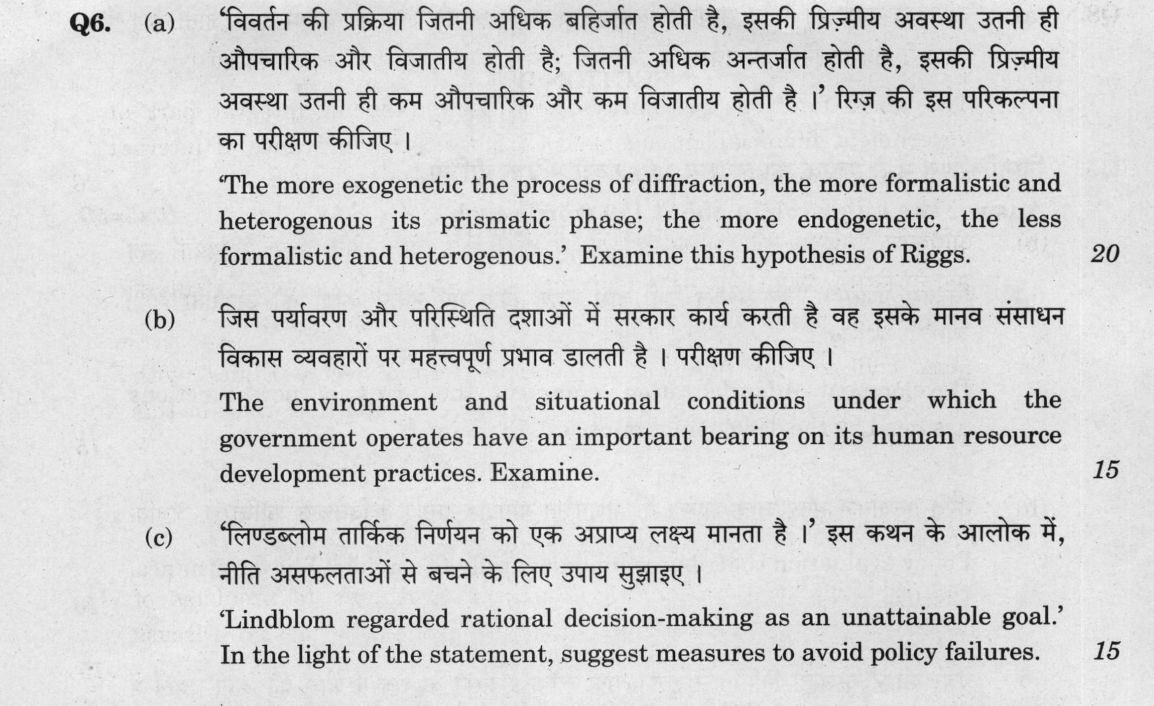
(a) 'The more exogenetic the process of diffraction, the more formalistic and heterogenous its prismatic phase; the more…
'The more exogenetic the process of diffraction, the more formalistic and heterogenous its prismatic phase; the more endogenetic, the less formalistic and heterogenous.' Examine this hypothesis of Riggs. 20 marks
The environment and situational conditions under which the government operates have an important bearing on its human resource development practices. Examine. 15 marks
'Lindblom regarded rational decision-making as an unattainable goal.' In the light of the statement, suggest measures to avoid policy failures. 15 marks
हिंदी में प्रश्न पढ़ें
'विवर्तन की प्रक्रिया जितनी अधिक बहिःजात होती है, इसकी प्रिज्मीय अवस्था उतनी ही औपचारिक और विजातीय होती है; जितनी अधिक अंतर्जात होती है, इसकी प्रिज्मीय अवस्था उतनी ही कम औपचारिक और कम विजातीय होती है।' रिग्स की इस परिकल्पना का परीक्षण कीजिए। 20
जिस पर्यावरण और परिस्थिति दशाओं में सरकार कार्य करती है वह इसके मानव संसाधन विकास व्यवहारों पर महत्वपूर्ण प्रभाव डालती है। परीक्षण कीजिए। 15
'लिंडब्लोम तार्किक निर्णयन को एक अप्राप्य लक्ष्य मानता है।' इस कथन के आलोक में, नीति असफलताओं से बचने के लिए उपाय सुझाइए। 15
Model answer
Written by UPSC Answer Check against this question's marking rubric, to the expected length. UPSC does not publish answers for Mains — this is one way to score well, not an official key.
Exogenetic Diffraction and Administrative Formalism
Fred Riggs’ ecological model conceptualizes societal transformation along the continuum of fused, prismatic, and diffracted systems. Riggs hypothesized that the origin of diffraction determines administrative pathology: exogenetic (externally induced or transplanted) modernization generates acute formalism (the divergence between legal prescriptions and actual practices) and heterogeneity (the simultaneous coexistence of modern, differentiated structures with traditional, undifferentiated practices). In contrast, endogenetic (indigenous and internally evolved) diffraction minimizes both pathologies because structural differentiation emerges in tandem with shifting social values and institutional readiness.
Evaluating this hypothesis through the Indian experience validates Riggs’ core insight while highlighting the potential for democratic adaptation. The colonial administration represented a classic exogenetic transplant, where legal-rational Weberian bureaucratic codes were imposed on an agrarian, caste-stratified society. This produced a typical prismatic sala administration marked by poly-communalism, intense formalism, and widespread discretion masked by rigid paperwork. However, post-independence India demonstrated that exogenetic legacies can be tempered through endogenetic democratization. Organic institutional reforms—such as the 73rd and 74th Constitutional Amendments empowering Panchayati Raj, the Right to Information Act, and community-led social audits—realigned administrative structures with societal demands. Where reforms emerged endogenously from democratic pressures, administrative formalism and heterogeneity declined, confirming that indigenous institutional synchronization is vital for administrative efficacy.
Environmental and Situational Determinants of HRD
Public sector Human Resource Development (HRD) operates within an open ecological system shaped by political, economic, socio-cultural, and technological environments. Situational conditions—including federal arrangements, social diversity, and the developmental stage of the state—directly govern recruitment, competency frameworks, and training pedagogies.
In India, constitutional imperatives under Articles 15(4) and 16(4) mandate a representative bureaucracy, requiring public HRD to reconcile affirmative action with professional merit. Economically, the transition from a state-led command economy to an open, regulatory regime shifted HRD priorities from procedural compliance to market-aware, domain-specialized administration. This environmental shift is visible in the pedagogical evolution at the Lal Bahadur Shastri National Academy of Administration (LBSNAA), which moved from colonial-era maintenance of order to participatory developmental immersion, multi-stakeholder negotiation, and ethical governance. Furthermore, situational digital transformations led to Mission Karmayogi and the iGOT digital platform, institutionalizing a competency-driven, role-based framework that upgrades administrative capabilities across diverse federal tiers.
Incrementalism and Preventing Policy Failure
Charles Lindblom challenged the rational-comprehensive model ('root' method), arguing that complete rationality in policy-making is unattainable due to cognitive limits, pervasive information asymmetry, conflicting social values, and severe time constraints. Instead, Lindblom advocated for disjointed incrementalism ('branch' method) and partisan mutual adjustment, where policy evolves through successive limited comparisons and continuous political bargaining, termed the art of 'muddling through'.
While incrementalism accurately reflects political realities, pure muddling through risks policy stagnation and systemic inertia. To prevent policy failures without falling into the trap of unattainable total rationality, governments must adopt structured, adaptive measures:
First, institutionalize structured stakeholder consultation and civic engagement to facilitate authentic partisan mutual adjustment and pre-empt downstream implementation resistance.
Second, deploy localized pilot projects and regulatory sandboxes—as observed in the phased rollout of the Direct Benefit Transfer system—to test operational feasibility before nationwide scale-up.
Third, embed dynamic, real-time feedback loops and digital monitoring systems, exemplified by India’s PRAGATI platform, to identify bottlenecks and trigger rapid mid-course corrections.
Fourth, adopt evidence-based adaptive management frameworks that combine long-term strategic vision with flexible, iterative execution.
Synthesis
These three dimensions are fundamentally interdependent: the prismatic pathologies of an exogenously diffracted state necessitate Lindblom’s consultative, incremental policy adaptation rather than rigid, top-down blueprints, which in turn depends on an ecologically grounded, competency-based HRD architecture. Navigating contemporary developmental complexity requires balancing rational planning with indigenous, incremental adaptation tailored to local administrative realities.
What "Examine" is asking you to do
Test the proposition the question puts to you and return a finding on how far it holds. Examine stems carry a claim, or ask whether something has happened, and expect evidence weighed both ways before the extent is stated — often with remedial measures attached.
Structure that answers it
Restate the claim as the question frames it → evidence that supports it → evidence that undercuts it → the conditions under which it holds → verdict on how far it stands
Where marks are lost
Stopping at description. An examination has to reach a finding, and “examine with justification” means the extent must be stated, not implied.
How this answer will be evaluated
Approach
Framework: Riggs' Prismatic Model. (a) examine: intro > how/why with reasoning > evidence > conclusion | (b) examine: intro > how/why with reasoning > evidence > conclusion | (c) suggest: the problem in one line > implementable measures > who acts > conclusion Full marks: Comprehensive understanding of Riggs' model, clear linkages between theory and Indian context, specific examples, and well-structured arguments.
Key points expected
- Define exogenetic and endogenetic processes in Riggs' model
- Explain the 'prismatic phase' as a transitional state
- Link exogenetic processes to formalistic/heterogeneous structures
- Link endogenetic processes to less formalistic/heterogeneous structures
- Identify key environmental/situational conditions (e.g., political, economic, social)
- Explain how these conditions shape HRD practices (recruitment, training, promotion)
- Provide specific examples of government HRD practices influenced by environment
- Discuss the impact of these conditions on administrative effectiveness
Evaluation rubric
Each sub-part is marked on its own, against the marks and word limit printed on the paper.
- (a) Explain the relationship between exogenetic/endogenetic processes and the formalistic/heterogeneous nature of the prismatic phase. 20 marks
examine— intro → how/why with reasoning → evidence → conclusion
Must cover
- Define exogenetic and endogenetic processes in Riggs' model
- Explain the 'prismatic phase' as a transitional state
- Link exogenetic processes to formalistic/heterogeneous structures
- Link endogenetic processes to less formalistic/heterogeneous structures
Loses marks
- Confusing exogenetic with endogenetic processes
- Failing to define the prismatic phase
- Treating the model as static rather than dynamic
Earns more
- Mention specific examples of exogenetic vs endogenetic processes
- Discuss the role of diffusion in the prismatic phase
- Reference the 'fused' and 'diffracted' phases for context
- Apply the model to a specific developing country context
Extra mark
- Reference specific Riggs' works or later critiques of the model
- Mention specific Indian administrative examples illustrating the prismatic phase
- (b) Examine how environmental and situational conditions influence government human resource development practices. 15 marks
examine— intro → how/why with reasoning → evidence → conclusion
Must cover
- Identify key environmental/situational conditions (e.g., political, economic, social)
- Explain how these conditions shape HRD practices (recruitment, training, promotion)
- Provide specific examples of government HRD practices influenced by environment
- Discuss the impact of these conditions on administrative effectiveness
Loses marks
- Failing to link environmental conditions to specific HRD practices
- Treating HRD as a purely internal administrative function
- Ignoring the impact of political context on HRD
Earns more
- Reference specific Indian government HRD policies or reforms
- Discuss the role of technology in changing HRD practices
- Mention the impact of globalization on government HRD
- Reference specific committees or reports on government HRD
Extra mark
- Reference specific 2nd ARC recommendations on HRD
- Mention recent digital governance reforms impacting HRD
- (c) Suggest measures to avoid policy failures, given Lindblom's view that rational decision-making is unattainable. 15 marks
suggest— the problem in one line → implementable measures → who acts → conclusion
Must cover
- Explain Lindblom's critique of rational decision-making
- Identify common causes of policy failures
- Suggest specific measures to mitigate policy failures
- Link the suggested measures to Lindblom's incrementalism or other relevant theories
Loses marks
- Failing to address Lindblom's specific critique
- Suggesting purely rational decision-making as a solution
- Ignoring the practical constraints of policy implementation
Earns more
- Reference specific policy failure examples (e.g., NREGA, UPI)
- Discuss the role of stakeholder consultation in policy design
- Mention the importance of pilot projects and iterative implementation
- Reference specific policy evaluation frameworks
Extra mark
- Reference specific Indian policy success stories that used incremental approaches
- Mention specific policy evaluation tools or methodologies
Practice this exact question
Write your answer and it is marked point by point against the model answer above — what you covered, what you missed, what you got wrong.
Evaluate my answer →More from Public Administration 2022 Paper I
- Q3 (a) Barnard posits the zone of indifference as the human condition that animates authorit…
- Q4 (a) 'Leadership is seen as dealing with change, whereas administration is viewed as copin…
- Q5 Answer the following in about 150 words each : 10×5=50 (a) Development Administration 'em…
- Q6 (a) 'The more exogenetic the process of diffraction, the more formalistic and heterogenou…
- Q7 (a) The results of Washington Consensus were far from optimal for transitional economies.…
- Q8 (a) The audit function has always been viewed as an integral part of government financial…