Paper I — Q3
(a) Barnard posits the zone of indifference as the human condition that animates authority relationships and cooperation in…
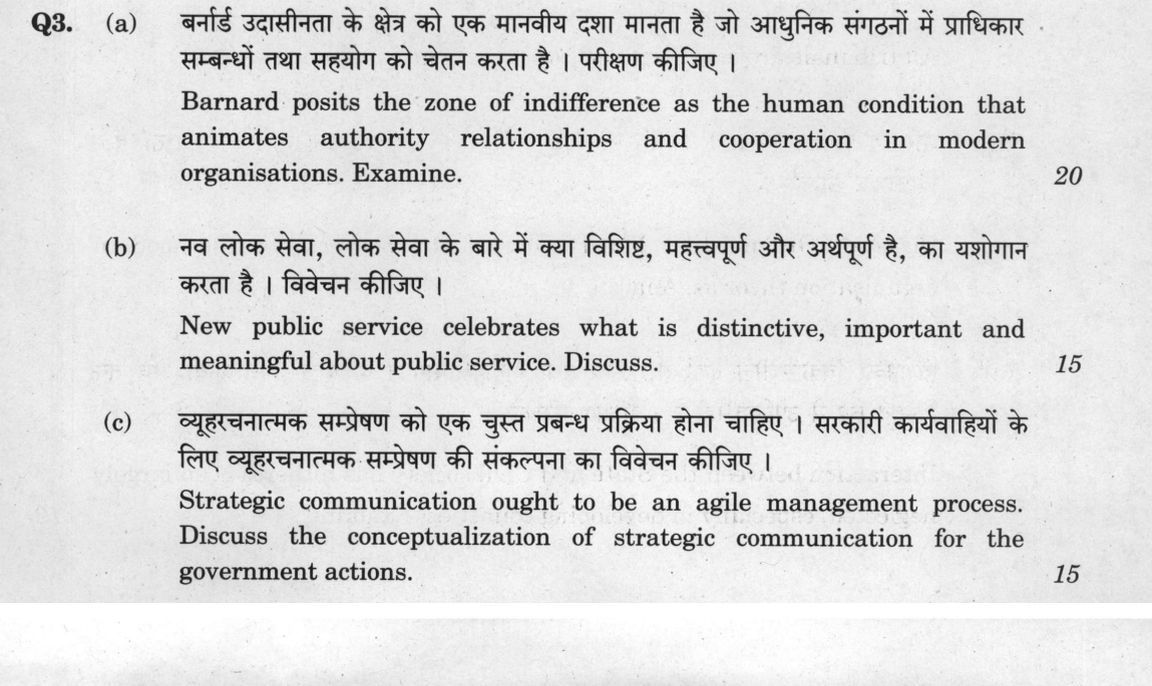
Barnard posits the zone of indifference as the human condition that animates authority relationships and cooperation in modern organisations. Examine. 20 marks
New public service celebrates what is distinctive, important and meaningful about public service. Discuss. 15 marks
Strategic communication ought to be an agile management process. Discuss the conceptualization of strategic communication for the government actions. 15 marks
हिंदी में प्रश्न पढ़ें
बर्नार्ड उदासीनता के क्षेत्र को एक मानवीय दशा मानता है जो आधुनिक संगठनों में प्राधिकार सम्बन्धों तथा सहयोग को चेतन करता है । परीक्षण कीजिए । 20
नव लोक सेवा, लोक सेवा के बारे में क्या विशिष्ट, महत्वपूर्ण और अर्थपूर्ण है, का यशोगान करता है । विवेचन कीजिए । 15
रणनीतिक सम्प्रेषण को एक चुस्त प्रबन्ध प्रक्रिया होना चाहिए । सरकारी कार्यवाहियों के लिए रणनीतिक सम्प्रेषण की संकल्पना का विवेचन कीजिए । 15
Model answer
Written by UPSC Answer Check against this question's marking rubric, to the expected length. UPSC does not publish answers for Mains — this is one way to score well, not an official key.
Barnard’s Zone of Indifference and Organisational Authority
Chester Barnard, in The Functions of the Executive (1938), reconceptualized authority from a traditional top-down command structure to an acceptance-based phenomenon. Central to this formulation is the zone of indifference, defined as the range of orders that a subordinate accepts without conscious evaluation or resistance. Within this zone, authority is effortlessly effective, animating the cooperative system by ensuring predictability, reducing friction, and translating executive decisions into coordinated action.
The boundaries of this zone are determined by both organizational and individual dynamics. Individual factors include personal motives, moral codes, and professional expectations, while organizational factors depend heavily on the *economy of incentives*—the delicate equilibrium where perceived inducements (material, non-material, and associative) outweigh personal contributions. Effective informal organizations and clear communication lines reinforce this equilibrium, conferring legitimacy upon executive commands.
Critically examining this concept reveals that the zone of indifference is neither static nor absolute. In contemporary knowledge-intensive and decentralized organizations, employees expect consultative, transparent, and value-aligned governance, which structurally narrows the traditional zone of unquestioned compliance. Herbert Simon later refined this as the zone of acceptance, yet Barnard’s enduring insight remains valid: authority does not reside in the formal position of the superior, but in the willingness of subordinates to accept it. Modern executive leadership must therefore actively enlarge this zone through moral leadership, authentic communication, and inclusive culture rather than bureaucratic fiat.
New Public Service and Democratic Values
Developed by Janet and Robert Denhardt, the New Public Service (NPS) paradigm celebrates the distinctive ethos of public administration by placing democratic citizenship, community, and the public interest at the core of governance. NPS arose as a corrective to New Public Management (NPM), which had reduced public administration to market-driven entrepreneurialism and treated citizens merely as customers or consumers of services.
NPS asserts that public administration is fundamentally about serving, not steering. It underscores the unique constitutional obligations, public-spiritedness, and ethical stewardship intrinsic to public service. Unlike market models that aggregate narrow individual preferences, NPS views the public interest as the product of continuous dialogue, civic engagement, and shared societal values.
The distinctiveness of public service lies in its accountability to the rule of law, equity, social justice, and institutional responsiveness. By shifting focus from transactional efficiency to collaborative governance, NPS reclaims the moral and democratic foundations of public servants as facilitators of community empowerment and human dignity.
Strategic Communication as an Agile Management Process
In modern governance, strategic communication has transitioned from traditional, one-way administrative dissemination into an agile management process characterized by iterative execution, stakeholder engagement, and real-time feedback loops. Agile strategic communication enables public agencies to continuously sense, adapt, and respond to evolving socio-political realities and citizen expectations.
Conceptualizing this for governmental action requires integrating S.M.A.R.T. (Specific, Measurable, Achievable, Relevant, Time-bound) objectives with digital public infrastructure to foster transparency and build institutional trust. This approach replaces bureaucratic broadcasting with multi-channel dialogue and behavioural nudges.
In India, this agility was evident during the COVID-19 pandemic, where the government combined daily dynamic media briefings, localized multilingual messaging, and interactive digital interfaces like the Aarogya Setu and CoWIN platforms to manage vaccine hesitancy and dispel misinformation in real time. Similarly, platforms like MyGov embody agile communication by transforming governance into a two-way collaborative exercise, capturing public sentiment and crowdsourcing policy inputs.
Ultimately, from Barnard’s acceptance-based cooperation to the humanistic tenets of the New Public Service and agile strategic communication, public administration increasingly recognizes that institutional effectiveness rests on collaborative engagement, human agency, and continuous dialogue.
What "Examine" is asking you to do
Test the proposition the question puts to you and return a finding on how far it holds. Examine stems carry a claim, or ask whether something has happened, and expect evidence weighed both ways before the extent is stated — often with remedial measures attached.
Structure that answers it
Restate the claim as the question frames it → evidence that supports it → evidence that undercuts it → the conditions under which it holds → verdict on how far it stands
Where marks are lost
Stopping at description. An examination has to reach a finding, and “examine with justification” means the extent must be stated, not implied.
How this answer will be evaluated
Approach
Framework: Barnard's Zone of Indifference. (a) examine: intro > how/why with reasoning > evidence > conclusion | (b) discuss: intro > 3-4 dimensions > example > balanced close | (c) discuss: intro > 3-4 dimensions > example > balanced close Full marks: Deep theoretical understanding with precise Indian administrative examples and 2nd ARC references.
Key points expected
- Define Zone of Indifference (ZDI) and its role in accepting authority
- Link ZDI to the 'acceptance test' of authority
- Explain ZDI as a condition for organizational cooperation
- Provide an Indian administrative example of ZDI in action
- Define New Public Service (NPS) and its core values
- Identify 'distinctive' features (e.g., citizenship, public interest)
- Explain the 'meaningful' aspect (e.g., democratic values, ethics)
- Contrast NPS with New Public Management (NPM)
Evaluation rubric
Each sub-part is marked on its own, against the marks and word limit printed on the paper.
- (a) Analyze the concept of Zone of Indifference as the basis of authority and cooperation. 20 marks
examine— intro → how/why with reasoning → evidence → conclusion
Must cover
- Define Zone of Indifference (ZDI) and its role in accepting authority
- Link ZDI to the 'acceptance test' of authority
- Explain ZDI as a condition for organizational cooperation
- Provide an Indian administrative example of ZDI in action
Loses marks
- Treating ZDI as mere 'obedience' rather than 'acceptance'
- Ignoring the 'cooperation' aspect of the question
- No Indian administrative anchor for the theory
Earns more
- Mention the 'system of communication' as a ZDI tool
- Discuss the limits of ZDI in modern democratic administration
- Reference the 'acceptance of authority' vs 'right to command'
Extra mark
- Cite a specific Indian case study (e.g., disaster management hierarchy)
- Reference a specific 2nd ARC recommendation on authority structures
- (b) Discuss the distinctive and meaningful aspects of public service under the NPS paradigm. 15 marks
discuss— intro → 3-4 dimensions → example → balanced close
Must cover
- Define New Public Service (NPS) and its core values
- Identify 'distinctive' features (e.g., citizenship, public interest)
- Explain the 'meaningful' aspect (e.g., democratic values, ethics)
- Contrast NPS with New Public Management (NPM)
Loses marks
- Confusing NPS with NPM (efficiency vs. citizenship)
- No discussion of 'distinctive' or 'meaningful' aspects
- No Indian administrative anchor
Earns more
- Mention Denhardt & Denhardt as key theorists
- Discuss the shift from 'customer' to 'citizen'
- Reference the role of 'trust' in public service
Extra mark
- Cite a specific Indian reform aligned with NPS (e.g., Citizen's Charter)
- Reference a specific 2nd ARC recommendation on public service values
- (c) Discuss the conceptualization of strategic communication as an agile management process for government. 15 marks
discuss— intro → 3-4 dimensions → example → balanced close
Must cover
- Define strategic communication in a government context
- Explain 'agile management process' (flexibility, responsiveness)
- Link strategic communication to government actions (policy, crisis)
- Provide an Indian example of agile strategic communication
Loses marks
- Treating strategic communication as mere 'PR' or 'propaganda'
- Ignoring the 'agile' aspect (flexibility, responsiveness)
- No Indian administrative anchor
Earns more
- Mention the role of social media in agile communication
- Discuss 'stakeholder engagement' as a key component
- Reference the 'feedback loop' in strategic communication
Extra mark
- Cite a specific Indian government campaign (e.g., Swachh Bharat)
- Reference a specific 2nd ARC recommendation on communication
Practice this exact question
Write your answer and it is marked point by point against the model answer above — what you covered, what you missed, what you got wrong.
Evaluate my answer →More from Public Administration 2022 Paper I
- Q1 Answer the following in about 150 words each : 10×5=50 (a) Public Management takes 'what'…
- Q2 (a) 'The administrative state is the creation of a power to bind us, with rules ... that…
- Q3 (a) Barnard posits the zone of indifference as the human condition that animates authorit…
- Q4 (a) 'Leadership is seen as dealing with change, whereas administration is viewed as copin…
- Q5 Answer the following in about 150 words each : 10×5=50 (a) Development Administration 'em…
- Q6 (a) 'The more exogenetic the process of diffraction, the more formalistic and heterogenou…