Paper I — Q5
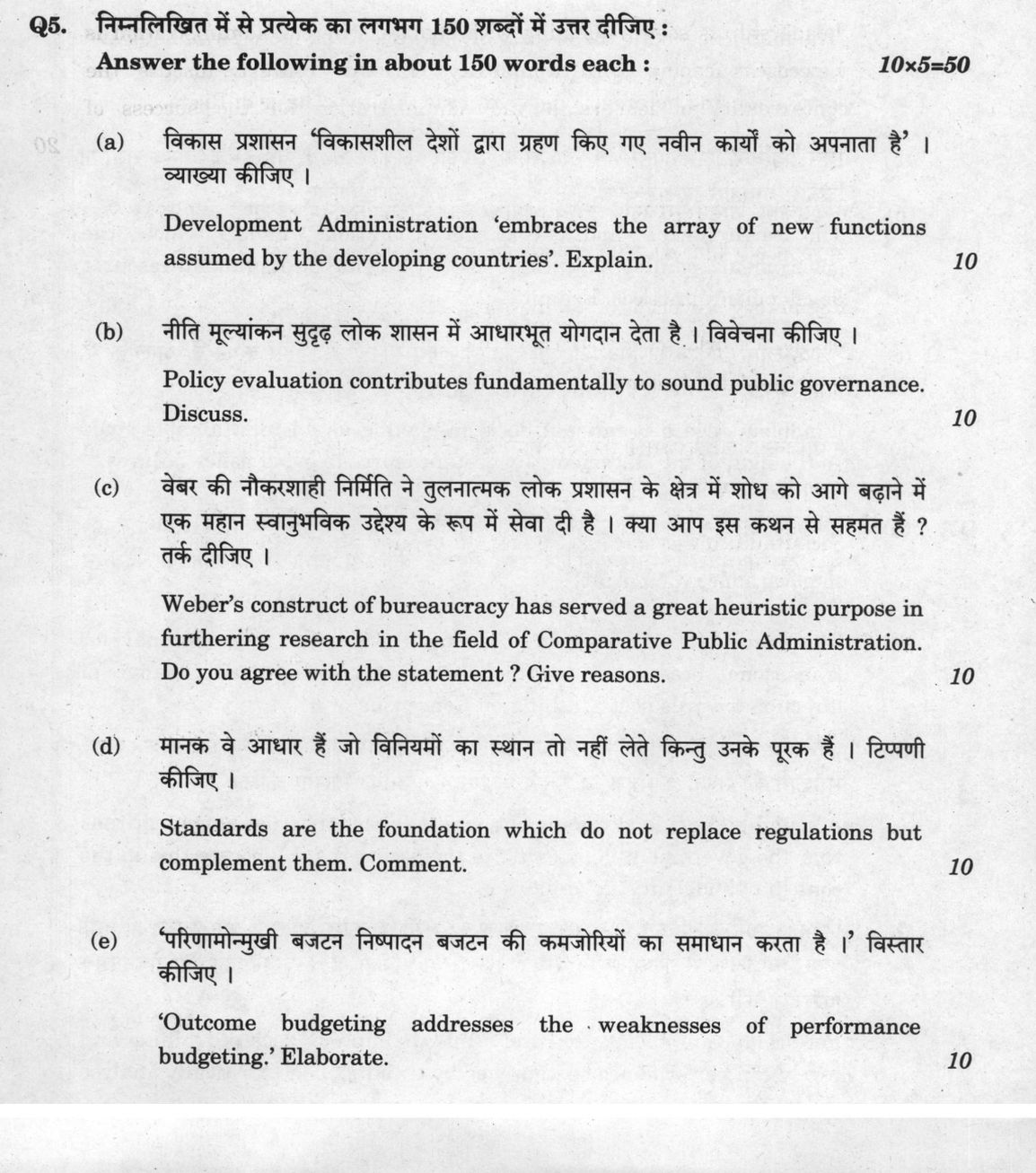
Answer the following in about 150 words each : 10×5=50 (a) Development Administration 'embraces the array of new functions…
Answer the following in about 150 words each : 10×5=50
Development Administration 'embraces the array of new functions assumed by the developing countries'. Explain. 10 marks
Policy evaluation contributes fundamentally to sound public governance. Discuss. 10 marks
Weber's construct of bureaucracy has served a great heuristic purpose in furthering research in the field of Comparative Public Administration. Do you agree with the statement ? Give reasons. 10 marks
Standards are the foundation which do not replace regulations but complement them. Comment. 10 marks
'Outcome budgeting addresses the weaknesses of performance budgeting.' Elaborate. 10 marks
हिंदी में प्रश्न पढ़ें
निम्नलिखित में से प्रत्येक का लगभग 150 शब्दों में उत्तर दीजिए : 10×5=50
विकास प्रशासन 'विकासशील देशों द्वारा ग्रहण किए गए नवीन कार्यों को अपनाता है'। व्याख्या कीजिए । 10
नीति मूल्यांकन सुदृढ़ लोक शासन में आधारभूत योगदान देता है। विवेचना कीजिए । 10
वेबर की नौकरशाही निर्मिति ने तुलनात्मक लोक प्रशासन के क्षेत्र में शोध को आगे बढ़ाने में एक महान स्वानुभविक उद्देश्य के रूप में सेवा दी है । क्या आप इस कथन से सहमत हैं ? तर्क दीजिए । 10
मानक वे आधार हैं जो विनियमों का स्थान तो नहीं लेते किन्तु उनके पूरक हैं । टिप्पणी कीजिए । 10
'परिणामोन्मुखी बजटन निष्पादन बजटन की कमजोरियों का समाधान करता है ।' विस्तार कीजिए । 10
Model answer
Written by UPSC Answer Check against this question's marking rubric, to the 150-word length. UPSC does not publish answers for Mains — this is one way to score well, not an official key.
(a) Scope of Development Administration
Edward Weidner defined development administration as an action-oriented, goal-directed administrative system designed to achieve progressive socio-economic change. This marked a deliberate departure from traditional administration, which was essentially a maintenance-oriented apparatus focused on regulatory stability, revenue collection, and law and order. Post-colonial developing nations inherited profound deficits in health, education, and infrastructure, compelling the state to assume entrepreneurial and transformative responsibilities.
Consequently, development administration embraces an array of new functions: macro-economic national planning, direct state mobilization of scarce financial and physical resources, grassroots institution-building such as Panchayati Raj and cooperatives, and targeted interventions for social justice. Fred Riggs highlighted that developing societies require public administration to possess structural capabilities matching their socio-economic ambitions. By moving beyond routine systemic maintenance to purposeful socio-economic engineering, development administration became the prime instrument for state-led modernization, nation-building, and equitable growth across the Global South.
(b) Policy Evaluation and Sound Governance
Policy evaluation contributes fundamentally to sound public governance by closing the policy cycle through systematic empirical feedback, ensuring democratic accountability and evidence-based decision-making. Far from being a mere post-mortem exercise, structured evaluation assesses whether public investments translate into intended societal changes.
Theoretical frameworks, such as Daniel Stufflebeam’s Context, Input, Process, Product (CIPP) model and Michael Patton’s Utilization-Focused Evaluation, establish clear mechanisms to diagnose implementation bottlenecks, test design validity, and inform budgetary reallocations. By generating objective data on program efficiency and equity, evaluation curbs administrative discretion, prevents policy capture by vested interests, and encourages institutional learning. In contemporary governance, robust evaluation mechanisms underpin the tracking of the Sustainable Development Goals (SDGs) and national programs through bodies like NITI Aayog’s Development Monitoring and Evaluation Office (DMEO), ensuring public policy remains dynamic, fiscally prudent, and responsive to citizen needs.
(c) Weber’s Bureaucracy and Comparative Public Administration
Yes, Max Weber’s ideal-type construct of bureaucracy has served a foundational heuristic purpose in advancing Comparative Public Administration (CPA). By formulating an analytical benchmark characterized by hierarchy, specialized jurisdictional competence, impersonal rules, and meritocratic tenure, Weber provided scholars with a standardized conceptual baseline against which diverse national administrative systems could be comparatively evaluated.
As Ferrel Heady demonstrated in his comparative analyses, Weber’s model enabled researchers to systematically map administrative variations across Western and non-Western settings. Although empirical applications in newly independent developing countries revealed significant divergences, this limitation itself catalyzed theoretical innovation. It led Fred Riggs to critique Weberian formalist assumptions and formulate his ecological approach and the prismatic-sala model to explain administrative behavior in transitional societies. Therefore, while not universally replicable in practice, Weber’s ideal-type provided the indispensable heuristic scaffolding that stimulated the structural-functional and ecological evolution of comparative administrative theory.
(d) Complementarity of Standards and Regulations
Regulations represent legally binding, state-enforced mandates designed to uphold non-negotiable baselines for public health, safety, and environmental protection. In contrast, technical standards—formulated by bodies like the Bureau of Indian Standards (BIS) and the International Organization for Standardization (ISO)—provide technical specifications, performance benchmarks, and process guidelines. Standards do not supplant legal regulations; rather, they operationalize them.
Regulations establish the mandatory legal "what" (statutory goals), whereas technical standards furnish the practical "how" (technical conformity). By embedding voluntary and consensus-based standards into technical regulations, policymakers prevent statutory frameworks from becoming obsolete amid rapid technological change. Furthermore, standard-driven compliance reduces regulatory friction, enhances industrial interoperability, and lowers compliance costs. When integrated into Regulatory Impact Assessments (RIA), the synergy between mandatory regulations and adaptive standards preserves public welfare while actively fostering industrial innovation and competitiveness.
(e) Performance Budgeting versus Outcome Budgeting
Performance budgeting, introduced on the recommendations of the First Hoover Commission, improved upon conventional line-item budgeting by linking financial outlays to quantitative physical outputs, such as kilometers of roads constructed or school buildings erected. However, its primary weakness lay in measuring programmatic effort and intermediate physical activity rather than final societal impact.
Outcome budgeting rectifies this deficiency by institutionalizing a results-based management framework that shifts administrative focus from mere output delivery to qualitative end-benefits accrued to target populations (for example, reduction in infant mortality rates rather than simply the number of primary health centres constructed). In India, the institutionalization of the Outcome Budget in 2005-06 established a binding mechanism requiring ministries to define measurable outcomes and risk factors upfront. Supported by monitoring mechanisms under NITI Aayog's Output-Outcome Monitoring Framework (OOMF), outcome budgeting addresses output distortion, curbs fiscal leakages, and aligns public expenditures with genuine socio-economic transformation.
What "Explain" is asking you to do
Make the working of something clear — what sets it off, what follows from what, and what it produces. Explain is the Commission's mechanism word: it dominates the technical papers and the “explain why” stems, where the marks sit in the causal chain and not in the label.
Structure that answers it
State what it is → the initiating condition → the chain of cause, step by step → an instance where it plays out → what the chain produces
Where marks are lost
Describing what something looks like instead of why it works that way. Naming the stages without linking them reads as description too.
How this answer will be evaluated
Approach
Framework: Concept > Thinker > Indian institutional application > Reform. (a) explain: definition/context > points in order > small example > short close | (b) discuss: intro > 3-4 dimensions > example > balanced close | (c) critique: the claim > its strengths > its weaknesses > your judgment | (d) comment: context > arguments both sides > judgment > close | (e) explain: definition/context > points in order > small example > short close Full marks: Precise definitions, clear Indian institutional anchors (NITI Aayog, 2nd ARC), and strong analytical linkages between theory and field reality.
Key points expected
- Define Development Administration (DA) distinct from traditional administration
- Identify specific new functions (e.g., planning, mobilization, social change)
- Contextualize within developing country constraints (poverty, infrastructure)
- Mention key thinkers (e.g., Riggs, Glick, Heady)
- Define policy evaluation (ex-ante vs ex-post)
- Link evaluation to 'sound governance' (transparency, accountability)
- Explain the feedback loop: evaluation -> policy correction
- Provide an Indian example of policy evaluation (e.g., CAG, NITI Aayog)
Evaluation rubric
Each sub-part is marked on its own, against the marks and word limit printed on the paper.
- (a) Define Development Administration and list the specific new functions it assumes in developing nations. 10 marks · 150 words
explain— definition/context → points in order → small example → short close
Must cover
- Define Development Administration (DA) distinct from traditional administration
- Identify specific new functions (e.g., planning, mobilization, social change)
- Contextualize within developing country constraints (poverty, infrastructure)
- Mention key thinkers (e.g., Riggs, Glick, Heady)
Loses marks
- Treating DA as identical to general public administration
- Ignoring the 'new functions' aspect of the prompt
- No mention of developing country context
Earns more
- Reference to Indian Five Year Plans as a DA tool
- Mention of 'planning commission' or 'NITI Aayog' role
- Distinction between 'development' and 'modernization'
Extra mark
- Reference to 2nd ARC recommendations on development
- Mention of specific Indian schemes (e.g., MGNREGA) as DA functions
- (b) Analyze how policy evaluation mechanisms ensure accountability and improve public governance. 10 marks · 150 words
discuss— intro → 3-4 dimensions → example → balanced close
Must cover
- Define policy evaluation (ex-ante vs ex-post)
- Link evaluation to 'sound governance' (transparency, accountability)
- Explain the feedback loop: evaluation -> policy correction
- Provide an Indian example of policy evaluation (e.g., CAG, NITI Aayog)
Loses marks
- Confusing policy evaluation with policy formulation
- No link to 'governance' or 'accountability'
- Generic answer without Indian institutional context
Earns more
- Mention of 'Outcome Budgeting' as an evaluation tool
- Reference to 'Right to Information' (RTI) facilitating evaluation
- Discussion of 'Social Audit' in India
Extra mark
- Reference to 2nd ARC on performance measurement
- Mention of specific evaluation reports (e.g., NITI Aayog reports)
- (c) Evaluate Weber's bureaucracy as a heuristic tool for Comparative Public Administration research. 10 marks · 150 words
critique— the claim → its strengths → its weaknesses → your judgment
Must cover
- Define Weber's 'Ideal Type' bureaucracy
- Explain 'heuristic purpose' (as a benchmark for comparison)
- Show how it aids Comparative PA (e.g., comparing Indian vs US bureaucracy)
- Acknowledge limitations (e.g., rigidity, red-tapism)
Loses marks
- Describing Weber's bureaucracy without linking to 'Comparative PA'
- Ignoring the 'heuristic' aspect (benchmarking)
- No critical evaluation (only praise or only criticism)
Earns more
- Mention of 'Iron Cage' concept
- Reference to Indian bureaucracy's 'colonial legacy'
- Comparison with 'New Public Management' (NPM)
Extra mark
- Reference to 2nd ARC on bureaucratic reform
- Mention of specific Indian administrative reforms (e.g., e-governance)
- (d) Explain the complementary relationship between standards and regulations in public administration. 10 marks · 150 words
comment— context → arguments both sides → judgment → close
Must cover
- Define 'standards' (performance, quality) vs 'regulations' (rules, laws)
- Explain how standards 'complement' regulations (fill gaps, guide discretion)
- Provide an Indian example (e.g., ISO standards in public sector)
- Discuss the shift from 'rule-bound' to 'performance-based' administration
Loses marks
- Treating standards as a replacement for regulations
- No distinction between standards and regulations
- No Indian institutional example
Earns more
- Mention of 'New Public Management' (NPM) focus on standards
- Reference to 'Quality Council of India' (QCI)
- Discussion of 'Outcome-based' standards
Extra mark
- Reference to 2nd ARC on performance standards
- Mention of specific Indian standards (e.g., ISO 9001 in government)
- (e) Explain how outcome budgeting overcomes the specific weaknesses of performance budgeting. 10 marks · 150 words
explain— definition/context → points in order → small example → short close
Must cover
- Define 'performance budgeting' (input-output focus)
- Define 'outcome budgeting' (impact-focus)
- Identify weaknesses of performance budgeting (e.g., output vs outcome)
- Show how outcome budgeting addresses these (e.g., citizen-centric)
Loses marks
- Confusing performance budgeting with outcome budgeting
- No specific weaknesses of performance budgeting identified
- No Indian context (e.g., Union Budget)
Earns more
- Mention of 'Outcome Budgeting' in Indian Union Budget
- Reference to 'NITI Aayog' role in outcome monitoring
- Discussion of 'Citizen-centric' budgeting
Extra mark
- Reference to 2nd ARC on budgeting reforms
- Mention of specific Indian outcome indicators (e.g., poverty reduction)
Practice this exact question
Write your answer and it is marked point by point against the model answer above — what you covered, what you missed, what you got wrong.
Evaluate my answer →More from Public Administration 2022 Paper I
- Q2 (a) 'The administrative state is the creation of a power to bind us, with rules ... that…
- Q3 (a) Barnard posits the zone of indifference as the human condition that animates authorit…
- Q4 (a) 'Leadership is seen as dealing with change, whereas administration is viewed as copin…
- Q5 Answer the following in about 150 words each : 10×5=50 (a) Development Administration 'em…
- Q6 (a) 'The more exogenetic the process of diffraction, the more formalistic and heterogenou…
- Q7 (a) The results of Washington Consensus were far from optimal for transitional economies.…
- Q8 (a) The audit function has always been viewed as an integral part of government financial…