Paper II — Q1
Answer the following in about 150 words. 10×5=50 (a) "Mughal administrative system was centralised despotism". Comment. 10 (b)…
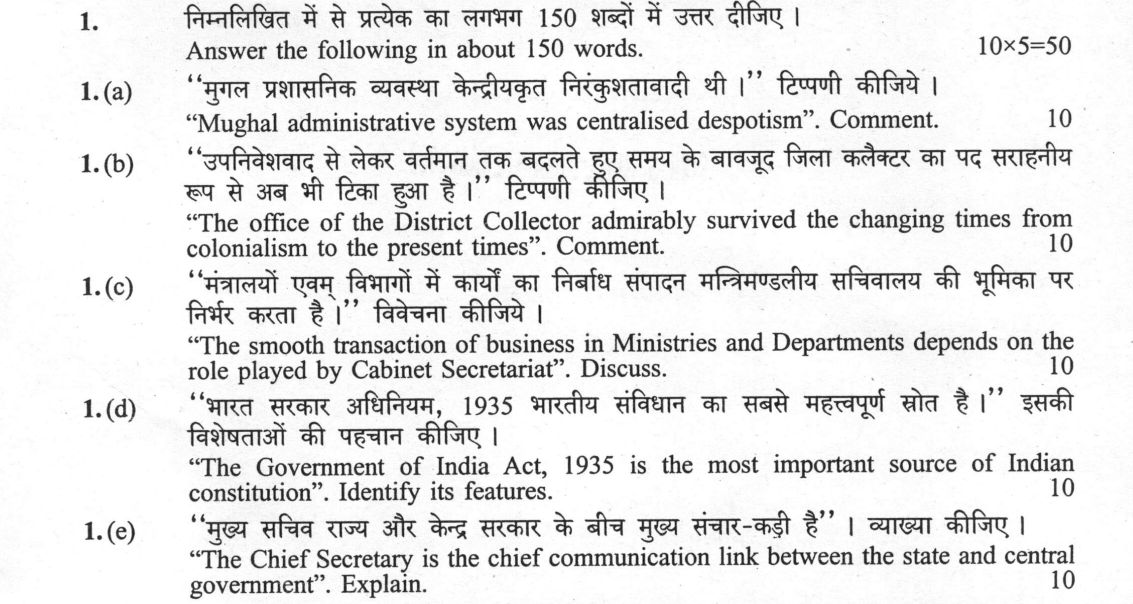
Answer the following in about 150 words. 10×5=50
"Mughal administrative system was centralised despotism". Comment. 10 marks
"The office of the District Collector admirably survived the changing times from colonialism to the present times". Comment. 10 marks
"The smooth transaction of business in Ministries and Departments depends on the role played by Cabinet Secretariat". Discuss. 10 marks
"The Government of India Act, 1935 is the most important source of Indian constitution". Identify its features. 10 marks
"The Chief Secretary is the chief communication link between the state and central government". Explain. 10 marks
हिंदी में प्रश्न पढ़ें
निम्नलिखित में से प्रत्येक का लगभग 150 शब्दों में उत्तर दीजिए। 10×5=50
"मुगल प्रशासनिक व्यवस्था केन्द्रीकृत निरंकुशतावादी थी।" टिप्पणी कीजिए। 10
"उपनिवेशवाद से लेकर वर्तमान तक बदलते हुए समय के बावजूद जिला कलेक्टर का पद सराहनीय रूप से अब भी टिका हुआ है।" टिप्पणी कीजिए। 10
"मंत्रालयों एवं विभागों में कार्यों का निर्बाध संपादन मंत्रिमण्डलीय सचिवालय की भूमिका पर निर्भर करता है।" विवेचना कीजिए। 10
"भारत सरकार अधिनियम, 1935 भारतीय संविधान का सबसे महत्वपूर्ण स्रोत है।" इसकी विशेषताओं की पहचान कीजिए। 10
"मुख्य सचिव राज्य और केन्द्र सरकार के बीच मुख्य संचार-कड़ी है"। व्याख्या कीजिए। 10
Model answer
Written by UPSC Answer Check against this question's marking rubric, to the 150-word length. UPSC does not publish answers for Mains — this is one way to score well, not an official key.
(a) Mughal administration was centralised despotism: Mansabdari concentrated power, emperor was fountain of justice, local autonomy was limited, unlike feudal decentralisation, though despotism was tempered by administrative pragmatism.
(b) The District Collector survived by evolving from revenue collector to development officer, with ICS-to-IAS continuity, post-Independence roles as DRDA, DM, CEO ZP, despite Panchayati Raj and 73rd/74th Amendments.
(c) The Cabinet Secretariat smooths business by coordinating inter-ministerial matters, preparing the Cabinet agenda, applying Rule 12 of the Transaction of Business Rules, managing crises, and assisting the Prime Minister and Cabinet.
(d) The 1935 Act is the most important source: federal structure with provincial autonomy, unimplemented All-India Federation, bicameral legislature, separation of powers, emergency provisions, direct election principle, retained in Constitution Parts V-VI.
(e) The Chief Secretary links state and Centre as administrative head of the state civil service, Secretary to the state Cabinet, channel for central directives/state reports, Planning Commission/NITI Aayog interface, and disaster-crisis coordinator.
What "Comment" is asking you to do
Take a position on the statement and support it. Comment usually attaches to a quoted line in the short slots, so the reasoning must be compressed — an opening view, a few load-bearing reasons, and the limit of the claim.
Structure that answers it
Unpack what the statement asserts → your stance → two or three supporting reasons → the qualification that limits it
Where marks are lost
Neutral summary; a comment without a stance has not answered. Equally costly is accepting the quoted line wholesale and never testing where it fails.
How this answer will be evaluated
Approach
Framework: Public Administration Paper II (UPSC). (a) comment: context > arguments both sides > judgment > close | (b) comment: context > arguments both sides > judgment > close | (c) discuss: intro > 3-4 dimensions > example > balanced close | (d) enumerate: list the items in order > one line each > no commentary | (e) explain: definition/context > points in order > small example > short close Full marks: Precise, well-structured answers with specific examples and balanced judgments.
Key points expected
- Define centralised despotism in Mughal context
- Cite Mansabdari system as evidence of centralization
- Mention Diwani and Faudsi powers
- Provide a balanced judgment on the statement
- Define the role of District Collector
- Explain its colonial origins and functions
- Describe its modern role in governance
- Provide a judgment on its survival
Evaluation rubric
Each sub-part is marked on its own, against the marks and word limit printed on the paper.
- (a) Contextualize Mughal centralization and provide a balanced judgment on the 'despotism' claim. 10 marks · 150 words
comment— context → arguments both sides → judgment → close
Must cover
- Define centralised despotism in Mughal context
- Cite Mansabdari system as evidence of centralization
- Mention Diwani and Faudsi powers
- Provide a balanced judgment on the statement
Loses marks
- Treating Mughal system as purely autocratic
- Ignoring the role of Mansabdari system
- Failing to provide a balanced judgment
Earns more
- Reference to Akbar's administrative reforms
- Mention of Mansab system hierarchy
- Comparison with other Mughal emperors
- Reference to Mughal administrative structure
Extra mark
- Reference to specific Mughal administrative documents
- Mention of specific Mughal administrative reforms
- (b) Contextualize the Collector's role and judge its survival from colonial to modern times. 10 marks · 150 words
comment— context → arguments both sides → judgment → close
Must cover
- Define the role of District Collector
- Explain its colonial origins and functions
- Describe its modern role in governance
- Provide a judgment on its survival
Loses marks
- Ignoring the colonial origins of the role
- Failing to discuss modern challenges
- Treating the role as static
Earns more
- Mention of revenue administration role
- Reference to law and order duties
- Discussion of modern challenges faced
- Mention of 2nd ARC recommendations
Extra mark
- Reference to specific modern reforms
- Mention of specific challenges in modern context
- (c) Discuss how the Cabinet Secretariat ensures smooth business in Ministries and Departments. 10 marks · 150 words
discuss— intro → 3-4 dimensions → example → balanced close
Must cover
- Define the role of Cabinet Secretariat
- Explain its coordination function
- Mention its role in policy formulation
- Provide examples of its work
Loses marks
- Confusing Cabinet Secretariat with other bodies
- Failing to explain its coordination role
- Ignoring its policy formulation function
Earns more
- Reference to Cabinet Committee structure
- Mention of inter-ministerial coordination
- Discussion of policy implementation
- Reference to specific Cabinet Secretariat functions
Extra mark
- Reference to specific Cabinet Secretariat reforms
- Mention of specific policy examples
- (d) Identify the key features of the Government of India Act, 1935 that influenced the Indian Constitution. 10 marks · 150 words
enumerate— list the items in order → one line each → no commentary
Must cover
- List key features of the 1935 Act
- Explain its influence on the Constitution
- Mention specific constitutional provisions
- Provide a balanced assessment
Loses marks
- Failing to identify specific features
- Ignoring its influence on the Constitution
- Treating the Act as irrelevant
Earns more
- Reference to federal structure
- Mention of independent judiciary
- Discussion of provincial autonomy
- Reference to specific constitutional articles
Extra mark
- Reference to specific constitutional amendments
- Mention of specific judicial interpretations
- (e) Explain how the Chief Secretary acts as the chief communication link between state and central government. 10 marks · 150 words
explain— definition/context → points in order → small example → short close
Must cover
- Define the role of Chief Secretary
- Explain its communication function
- Mention its role in policy implementation
- Provide examples of its work
Loses marks
- Confusing Chief Secretary with other roles
- Failing to explain its communication function
- Ignoring its policy implementation role
Earns more
- Reference to inter-governmental coordination
- Mention of policy implementation role
- Discussion of administrative coordination
- Reference to specific Chief Secretary functions
Extra mark
- Reference to specific inter-governmental reforms
- Mention of specific policy examples
Practice this exact question
Write your answer and it is marked point by point against the model answer above — what you covered, what you missed, what you got wrong.
Evaluate my answer →More from Public Administration 2022 Paper II
- Q1 Answer the following in about 150 words. 10×5=50 (a) "Mughal administrative system was ce…
- Q2 (a) "The Indian federal structure is largely symmetric albeit with some asymmetric featur…
- Q3 (a) "The New Economic Reforms during the past three decades have not only reduced the sco…
- Q4 (a) "The Indian judicial system has failed to deliver justice expeditiously". Examine the…