Paper II — Q2
(a) "The Indian federal structure is largely symmetric albeit with some asymmetric features". Examine the status of States and…
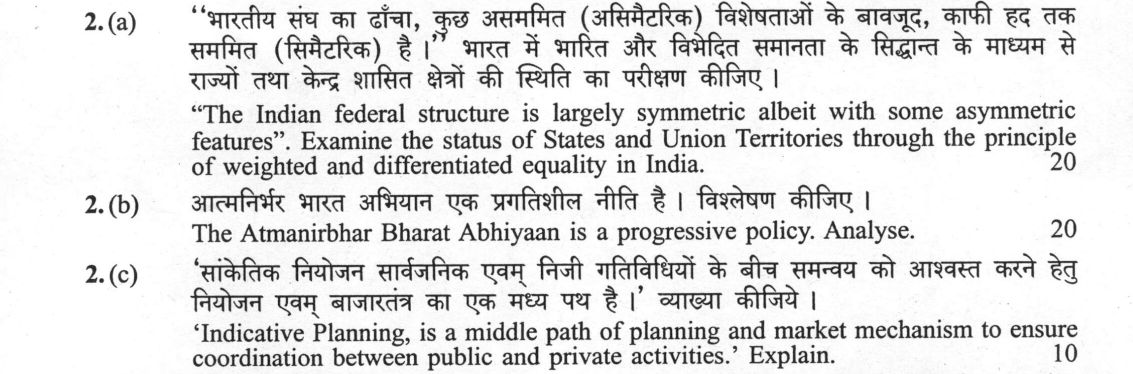
"The Indian federal structure is largely symmetric albeit with some asymmetric features". Examine the status of States and Union Territories through the principle of weighted and differentiated equality in India. 20 marks
The Atmanirbhar Bharat Abhiyaan is a progressive policy. Analyse. 20 marks
'Indicative Planning, is a middle path of planning and market mechanism to ensure coordination between public and private activities.' Explain. 10 marks
हिंदी में प्रश्न पढ़ें
"भारतीय संघ का ढाँचा, कुछ असममित (असिमेट्रिक) विशेषताओं के बावजूद, काफी हद तक सममित (सिमेट्रिक) है।" भारत में भारत और विभेदित समानता के सिद्धांत के माध्यम से राज्यों तथा केन्द्र शासित क्षेत्रों की स्थिति का परीक्षण कीजिए। 20
आत्मनिर्भर भारत अभियान एक प्रगतिशील नीति है। विश्लेषण कीजिए। 20
'संकेतिक नियोजन सार्वजनिक एवं निजी गतिविधियों के बीच समन्वय को आश्वस्त करने हेतु नियोजन एवं बाजारतंत्र का एक मध्य पथ है।' व्याख्या कीजिए। 10
Model answer
Written by UPSC Answer Check against this question's marking rubric, to the expected length. UPSC does not publish answers for Mains — this is one way to score well, not an official key.
India’s federal structure is formally symmetric because all states derive status from the same Constitution, share the Seventh Schedule distribution of legislative competence, and are represented in the Rajya Sabha on a common basis. Yet it contains asymmetric features where special provisions adjust uniformity to historical, linguistic, geographic or administrative needs. The erstwhile Article 370 gave Jammu and Kashmir a distinct position, now replaced by the 2019 reorganisation into J&K UT with legislature and Ladakh without legislature. Articles 371A–H grant special safeguards to states such as Nagaland, Sikkim, Mizoram, Manipur, Arunachal Pradesh and Goa; Article 371(2) permits special provisions for development of backward areas, such as regional development boards in Maharashtra and Gujarat; the Sixth Schedule gives tribal areas in Assam, Meghalaya, Tripura and Mizoram self-governing district councils; and several UTs are administered by an administrator or Lieutenant Governor without a full legislature. States have elected governments and legislatures, while UTs vary from administrator-controlled units to Delhi’s partial legislature. This is “weighted and differentiated equality”: formal equality in the basic federal bargain, but substantive equality through differentiated treatment where states or regions face special needs. The principle does not destroy symmetry; it corrects it, allowing the Union to accommodate diversity while preserving constitutional unity.
Atmanirbhar Bharat as progressive policy Atmanirbhar Bharat Abhiyaan was framed around five pillars: a strong economy, robust infrastructure, a dynamic system, demography and demand. Its initial package of about ₹20 lakh crore combined liquidity infusion, MSME credit guarantees, collateral-free loans, wage subsidies, food security, and sectoral measures such as Production Linked Incentive (PLI) schemes to revive production and consumption. Its progressive character lies in recognising self-reliance not as isolation but as resilience within globalisation: reducing supply-chain vulnerabilities, supporting small enterprises, and using state capacity to stabilise households. Direct benefit transfers and rural demand support also matter, but they were not the centre of the package. However, the claim must be examined critically. The stimulus was largely supply-side and credit-mediated; demand-side support was limited relative to the size of the shock. Labour code reforms and privatisation thrusts raised concerns about worker protection and public asset disposal. Thus, while the policy is progressive in intent and architecture, its progressiveness depends on implementation, social protection, and balance between market liberalisation and welfare.
Indicative planning and coordination Indicative planning differs from imperative or command planning. In command planning, the state sets binding targets, allocates resources directly and compels compliance, as in centrally planned economies. Indicative planning, associated with French planning and mixed economies, uses non-binding targets, forecasts and incentives to coordinate public and private activity. Unlike command planning, it does not fix prices or quotas; it uses fiscal, credit and regulatory signals. India adapted this after the 1991 reforms, when the Planning Commission’s command orientation softened, and its Five-Year Plans retained development goals but increasingly relied on market mechanisms. The mechanism includes Perspective Plans, Five-Year Plans, indicative targets, sectoral policies, and coordination through MoUs with states and enterprises. Today, NITI Aayog’s Three-Year Action Agenda continues this logic, replacing command-style allocation with cooperative federalism, think-tank inputs and outcome-based monitoring.
The three parts are connected. Weighted equality in federalism allows states to respond to local needs while the Union sets common direction. Atmanirbhar Bharat uses that federal space to build self-reliant capacity, but must balance market reforms with social protection. Indicative planning provides the method: the state guides rather than commands, coordinating public and private action. The verdict is that India’s model is not rigidly symmetric or purely market-driven; it is a differentiated, cooperative and indicative system, progressive only where equality, demand support and institutional coordination are sustained over the long term.
What "Examine" is asking you to do
Test the proposition the question puts to you and return a finding on how far it holds. Examine stems carry a claim, or ask whether something has happened, and expect evidence weighed both ways before the extent is stated — often with remedial measures attached.
Structure that answers it
Restate the claim as the question frames it → evidence that supports it → evidence that undercuts it → the conditions under which it holds → verdict on how far it stands
Where marks are lost
Stopping at description. An examination has to reach a finding, and “examine with justification” means the extent must be stated, not implied.
How this answer will be evaluated
Approach
Framework: Public Administration Paper II: Concept > Thinker > Indian institutional application > Reform. (a) examine: intro > how/why with reasoning > evidence > conclusion | (b) analyse: intro > causes > effects > stakeholders/linkages > way forward | (c) explain: definition/context > points in order > small example > short close Full marks: Comprehensive analysis with specific Indian institutional anchors, clear distinction between administration and politics, and reference to recent reforms or 2nd ARC.
Key points expected
- Define weighted and differentiated equality in federal context
- Explain symmetric features of Indian federal structure
- Detail asymmetric features for specific States
- Analyze status of Union Territories vs States
- Define Atmanirbhar Bharat Abhiyaan and its objectives
- Analyze causes for the policy's introduction
- Examine effects on public and private sectors
- Identify stakeholders and linkages in implementation
Evaluation rubric
Each sub-part is marked on its own, against the marks and word limit printed on the paper.
- (a) Examine the status of States and Union Territories through the principle of weighted and differentiated equality in India. 20 marks
examine— intro → how/why with reasoning → evidence → conclusion
Must cover
- Define weighted and differentiated equality in federal context
- Explain symmetric features of Indian federal structure
- Detail asymmetric features for specific States
- Analyze status of Union Territories vs States
Loses marks
- GS-2 style political analysis without administrative focus
- Theory without Indian institutional anchor
- Ignoring the 'Union Territories' part of the question
Earns more
- Cite Article 371 for special provisions
- Mention 7th Schedule distribution of powers
- Reference 2nd ARC recommendations on federalism
- Discuss GST Council as weighted equality mechanism
Extra mark
- Cite specific Article 371 clauses (e.g., 371A, 371D)
- Reference Sarkaria Commission or Punchhi Commission
- (b) Analyse the Atmanirbhar Bharat Abhiyaan as a progressive policy. 20 marks
analyse— intro → causes → effects → stakeholders/linkages → way forward
Must cover
- Define Atmanirbhar Bharat Abhiyaan and its objectives
- Analyze causes for the policy's introduction
- Examine effects on public and private sectors
- Identify stakeholders and linkages in implementation
Loses marks
- GS-2 style economic analysis without administrative focus
- Theory without Indian administrative instance
- Failing to distinguish administration from politics
Earns more
- Discuss specific administrative reforms under the policy
- Mention PLI schemes as implementation tools
- Reference recent governance reforms in procurement
- Analyze the shift from aid to self-reliance
Extra mark
- Cite specific 2nd ARC recommendations on self-reliance
- Reference specific administrative data on policy impact
- (c) Explain Indicative Planning as a middle path of planning and market mechanism to ensure coordination between public and private activities. 10 marks
explain— definition/context → points in order → small example → short close
Must cover
- Define Indicative Planning and its context
- Explain how it coordinates public and private activities
- Describe the role of market mechanism in this planning
- Provide a small example of Indicative Planning in India
Loses marks
- GS-2 style policy analysis without administrative focus
- Theory without Indian administrative instance
- Failing to explain the 'middle path' aspect
Earns more
- Mention NITI Aayog's role in Indicative Planning
- Reference specific Five Year Plans that used this approach
- Discuss the shift from Directive to Indicative planning
- Explain the role of state governments in this process
Extra mark
- Cite specific 2nd ARC recommendations on planning
- Reference specific administrative data on planning outcomes
Practice this exact question
Write your answer and it is marked point by point against the model answer above — what you covered, what you missed, what you got wrong.
Evaluate my answer →More from Public Administration 2022 Paper II
- Q1 Answer the following in about 150 words. 10×5=50 (a) "Mughal administrative system was ce…
- Q2 (a) "The Indian federal structure is largely symmetric albeit with some asymmetric featur…
- Q3 (a) "The New Economic Reforms during the past three decades have not only reduced the sco…
- Q4 (a) "The Indian judicial system has failed to deliver justice expeditiously". Examine the…
- Q5 Answer the following in about 150 words. 10×5=50 (a) Examine the lateral entry recruitmen…