Paper II — Q3
(a) "The New Economic Reforms during the past three decades have not only reduced the scope of industrial licensing and areas…
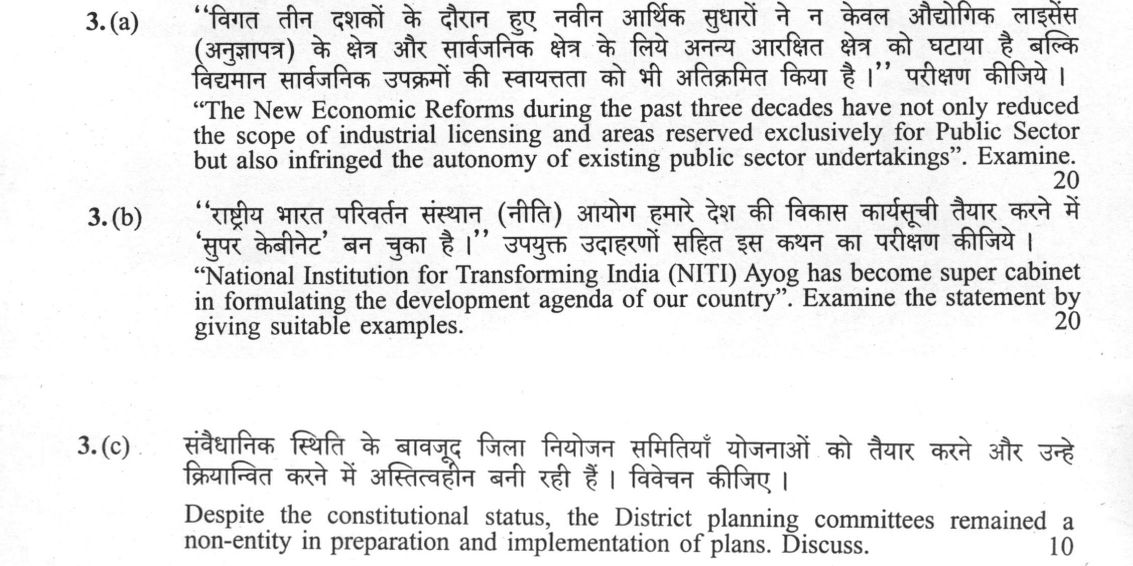
"The New Economic Reforms during the past three decades have not only reduced the scope of industrial licensing and areas reserved exclusively for Public Sector but also infringed the autonomy of existing public sector undertakings". Examine. 20 marks
"National Institution for Transforming India (NITI) Ayog has become super cabinet in formulating the development agenda of our country". Examine the statement by giving suitable examples. 20 marks
Despite the constitutional status, the District planning committees remained a non-entity in preparation and implementation of plans. Discuss. 10 marks
हिंदी में प्रश्न पढ़ें
"विगत तीन दशकों के दौरान हुए नवीन आर्थिक सुधारों ने न केवल औद्योगिक लाइसेंस (अनुज्ञापन) के क्षेत्र और सार्वजनिक क्षेत्र के लिये अन्य आरक्षित क्षेत्र को घटाया है बल्कि विद्यमान सार्वजनिक उपक्रमों की स्वायत्तता को भी अतिक्रमित किया है।" परीक्षण कीजिए। 20
"राष्ट्रीय भारत परिवर्तन संस्थान (नीति) आयोग हमारे देश की विकास कार्यसूची तैयार करने में 'सुपर केबिनेट' बन चुका है।" उपयुक्त उदाहरणों सहित इस कथन का परीक्षण कीजिए। 20
संवैधानिक स्थिति के बावजूद जिला नियोजन समितियाँ योजनाओं को तैयार करने और उन्हें क्रियान्वित करने में अस्तित्वहीन बनी रही हैं। विवेचन कीजिए। 10
Model answer
Written by UPSC Answer Check against this question's marking rubric, to the expected length. UPSC does not publish answers for Mains — this is one way to score well, not an official key.
The post-1991 New Economic Policy marked a structural shift from the 'commanding heights' model to market-led growth, fundamentally altering the Indian state's relationship with industrial licensing and public sector undertakings (PSUs).
Economic Reforms and Public Sector Autonomy
The abolition of the Monopolies and Restrictive Trade Practices (MRTP) Act, 1969, and sweeping industrial delicensing dismantled the license-permit raj, restricting compulsory licensing to a minimal set of strategic and hazardous sectors. Concurrently, public sector de-reservation opened formerly exclusive domains—such as telecommunications, power, and civil aviation—to private enterprise, later accelerated through successive disinvestment policies and the Strategic Disinvestment Policy of 2021.
While administrative innovations like the Memorandum of Understanding (MoU) system and the Maharatna, Navratna, and Miniratna categorization ostensibly devolved operational and financial powers, they paradoxically institutionalised micro-management. Bureaucratic oversight through administrative ministries, rigid performance targets, and Central Vigilance Commission vigilance guidelines circumscribed managerial discretion. Furthermore, mandated higher dividend payouts and strategic disinvestment directives often compromised corporate planning. Critical examination reveals a dual outcome: while competitive neutrality and market exposure forced cost efficiency and commercial discipline, they simultaneously eroded the traditional public purpose of PSUs, such as cross-subsidisation, regional development, and employment generation, even within sensitive sectors like defence production and railway infrastructure.
NITI Aayog: Policy Catalyst or Super Cabinet?
Replacing the Planning Commission in 2015 via an executive resolution, NITI Aayog reoriented India's development agenda from schematic, top-down allocation to bottom-up Sustainable Development Goal (SDG) localisation and cooperative federalism. It exercises substantial authority over policy formulation through flagship interventions such as the Aspirational Districts Programme (ADP), the Atal Innovation Mission (AIM), and the National Monetisation Pipeline. Its Governing Council—comprising the Prime Minister, Chief Ministers, and Lieutenant Governors—serves as the pre-eminent platform for forging national consensus, prompting the view that it acts as a 'super cabinet' steering national priorities.
However, characterizing NITI Aayog as a super cabinet overstates its institutional reach. Unlike the erstwhile Planning Commission, NITI Aayog commands no financial resource allocation powers and cannot approve state annual plans, functions now consolidated within the Ministry of Finance and the Finance Commission. Possessing neither constitutional nor statutory status, it operates as a policy think tank relying on technocratic persuasion, data-driven nudges (e.g., SDG India Index), and the direct backing of the Prime Minister’s Office (PMO) for enforcement, rather than exercising executive command over the Union Cabinet.
District Planning Committees: The Unfulfilled Mandate
Mandated under Article 243ZD by the 74th Constitutional Amendment Act, District Planning Committees (DPCs) were designed as constitutional mechanisms to consolidate rural (Panchayat) and urban (Municipal) draft development plans into comprehensive district plans. In practice, DPCs have remained largely non-entities across most states.
This stagnation stems from state government reluctance to devolve functions, funds, and functionaries. Most states delay DPC constitution, while existing committees suffer from bureaucratic capture—often chaired by nominated District Ministers or Collectors rather than elected representatives. Furthermore, DPCs lack dedicated technical secretariats, spatial planning capabilities, and untied budgetary allocations, reducing their meetings to routine administrative endorsements. The failure to integrate spatial, environmental, and infrastructure priorities between municipalities and panchayats perpetuates fragmented development. While recent interventions like the People’s Plan Campaign (Sabki Yojana Sabka Vikas) and geospatial mapping under the SVAMITVA scheme seek to revitalize local planning, DPCs require statutory resource envelopes and technical cadres to realize their constitutional mandate.
India’s governance trajectory over the last three decades illustrates a transition from centralized dirigisme to market-driven, cooperative federalism. While central planning has successfully transformed into strategic policy design under NITI Aayog, authentic federal governance requires matching these national reforms with the institutional empowerment of local planning bodies like the DPCs.
What "Examine" is asking you to do
Test the proposition the question puts to you and return a finding on how far it holds. Examine stems carry a claim, or ask whether something has happened, and expect evidence weighed both ways before the extent is stated — often with remedial measures attached.
Structure that answers it
Restate the claim as the question frames it → evidence that supports it → evidence that undercuts it → the conditions under which it holds → verdict on how far it stands
Where marks are lost
Stopping at description. An examination has to reach a finding, and “examine with justification” means the extent must be stated, not implied.
How this answer will be evaluated
Approach
Framework: Public Administration Paper II: Institutional Analysis & Policy Evaluation. (a) examine: intro > how/why with reasoning > evidence > conclusion | (b) examine: intro > how/why with reasoning > evidence > conclusion | (c) discuss: intro > 3-4 dimensions > example > balanced close Full marks: Comprehensive analysis with specific Indian examples, clear distinction between theory and field reality, and reference to relevant committees or articles.
Key points expected
- Define the scope of industrial licensing pre-1991
- Explain the reduction in public sector reserved areas
- Analyze the 'infringement' of PSU autonomy (e.g., privatization, disinvestment)
- Provide specific examples of PSUs affected by reforms
- Define the mandate and structure of NITI Aayog
- Explain how it functions as a 'super cabinet' (policy formulation, coordination)
- Provide specific examples of development agendas formulated by NITI Aayog
- Analyze the impact of NITI Aayog on state and central policy
Evaluation rubric
Each sub-part is marked on its own, against the marks and word limit printed on the paper.
- (a) Analyze the impact of NEP 1991 on industrial licensing, public sector reservation, and PSU autonomy. 20 marks
examine— intro → how/why with reasoning → evidence → conclusion
Must cover
- Define the scope of industrial licensing pre-1991
- Explain the reduction in public sector reserved areas
- Analyze the 'infringement' of PSU autonomy (e.g., privatization, disinvestment)
- Provide specific examples of PSUs affected by reforms
Loses marks
- General discussion of economic reforms without specific focus on licensing/PSUs
- Failure to address the 'autonomy' aspect of the question
- Lack of specific Indian administrative or policy examples
Earns more
- Reference to the 1991 Industrial Policy Statement
- Mention of the Public Sector Undertakings (Management and Employment) Act
- Discussion of the role of the Disinvestment Commission
- Comparison of pre- and post-reform industrial structure
Extra mark
- Citation of specific PSU privatization cases (e.g., BHEL, SAIL)
- Reference to the 2nd ARC recommendations on public sector
- (b) Evaluate NITI Aayog's role as a 'super cabinet' in formulating the development agenda with examples. 20 marks
examine— intro → how/why with reasoning → evidence → conclusion
Must cover
- Define the mandate and structure of NITI Aayog
- Explain how it functions as a 'super cabinet' (policy formulation, coordination)
- Provide specific examples of development agendas formulated by NITI Aayog
- Analyze the impact of NITI Aayog on state and central policy
Loses marks
- General description of NITI Aayog without analyzing its 'super cabinet' role
- Failure to provide specific examples of development agendas
- Lack of critical analysis of its effectiveness or limitations
Earns more
- Reference to the replacement of the Planning Commission
- Mention of specific NITI Aayog initiatives (e.g., Aspirational Districts, India 2.0)
- Discussion of the 'Cooperative Federalism' model
- Analysis of the 'Think Tank' vs 'Policy Maker' role
Extra mark
- Citation of specific NITI Aayog reports or policy documents
- Reference to the 2nd ARC recommendations on planning
- (c) Discuss the reasons for the ineffectiveness of District Planning Committees despite constitutional status. 10 marks
discuss— intro → 3-4 dimensions → example → balanced close
Must cover
- Reference the constitutional status of DPCs (74th Amendment)
- Identify reasons for their ineffectiveness (e.g., lack of funds, political interference)
- Analyze the gap between constitutional mandate and field reality
- Provide examples of DPC failures or successes
Loses marks
- General discussion of urban planning without specific focus on DPCs
- Failure to address the 'constitutional status' aspect
- Lack of specific reasons for their ineffectiveness
Earns more
- Mention of the 74th Constitutional Amendment Act, 1992
- Discussion of the role of State Governments in DPC functioning
- Reference to the 2nd ARC recommendations on urban planning
- Analysis of the 'non-entity' status in plan preparation and implementation
Extra mark
- Citation of specific state-level DPC examples
- Reference to recent governance reforms in urban planning
Practice this exact question
Write your answer and it is marked point by point against the model answer above — what you covered, what you missed, what you got wrong.
Evaluate my answer →More from Public Administration 2022 Paper II
- Q1 Answer the following in about 150 words. 10×5=50 (a) "Mughal administrative system was ce…
- Q2 (a) "The Indian federal structure is largely symmetric albeit with some asymmetric featur…
- Q3 (a) "The New Economic Reforms during the past three decades have not only reduced the sco…
- Q4 (a) "The Indian judicial system has failed to deliver justice expeditiously". Examine the…
- Q5 Answer the following in about 150 words. 10×5=50 (a) Examine the lateral entry recruitmen…
- Q6 (a) The recommendations of National Finance Commissions are more norms based than the nee…