Paper II — Q5
Answer the following in about 150 words. 10×5=50 (a) Examine the lateral entry recruitment in government in the context of Part…
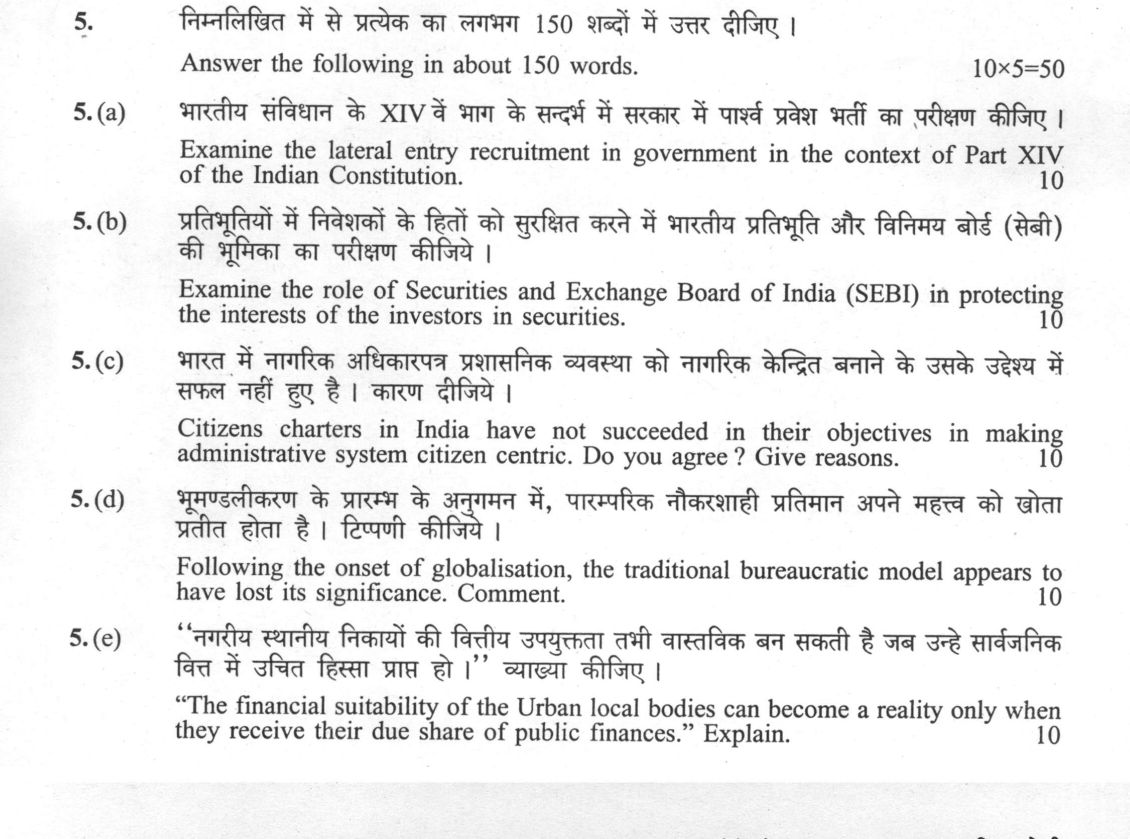
Answer the following in about 150 words. 10×5=50
Examine the lateral entry recruitment in government in the context of Part XIV of the Indian Constitution. 10 marks
Examine the role of Securities and Exchange Board of India (SEBI) in protecting the interests of the investors in securities. 10 marks
Citizens charters in India have not succeeded in their objectives in making administrative system citizen centric. Do you agree ? Give reasons. 10 marks
Following the onset of globalisation, the traditional bureaucratic model appears to have lost its significance. Comment. 10 marks
"The financial suitability of the Urban local bodies can become a reality only when they receive their due share of public finances." Explain. 10 marks
हिंदी में प्रश्न पढ़ें
निम्नलिखित में से प्रत्येक का लगभग 150 शब्दों में उत्तर दीजिए। 10×5=50
भारतीय संविधान के XIV वें भाग के संदर्भ में सरकार में पार्श्व प्रवेश भर्ती का परीक्षण कीजिए। 10
प्रतिभूतियों में निवेशकों के हितों को सुरक्षित करने में भारतीय प्रतिभूति और विनिमय बोर्ड (सेबी) की भूमिका का परीक्षण कीजिए। 10
भारत में नागरिक अधिकारपत्र प्रशासनिक व्यवस्था को नागरिक केंद्रित बनाने के उसके उद्देश्य में सफल नहीं हुए हैं। कारण दीजिए। 10
भूमण्डलीकरण के प्रारम्भ के अनुगाम में, पारम्परिक नौकरशाही प्रतिमान अपने महत्व को खोता प्रतीत होता है। टिप्पणी कीजिए। 10
"नगरीय स्थानीय निकायों की वित्तीय उपयुक्तता तभी वास्तविक बन सकती है जब उन्हें सार्वजनिक वित्त में उचित हिस्सा प्राप्त हो।" व्याख्या कीजिए। 10
Model answer
Written by UPSC Answer Check against this question's marking rubric, to the 150-word length. UPSC does not publish answers for Mains — this is one way to score well, not an official key.
(a) Lateral entry under Part XIV: Art. 309 allows recruitment rules, while Art. 311 gives procedural safeguards against dismissal, removal or reduction in rank; ARC-II’s Joint Secretary-level entry balances expertise with constitutional protections. (b) SEBI under the 1992 Act protects investors through disclosure requirements, insider-trading rules, SCORES portal, algorithmic-trading safeguards and enforcement in Sahara. (c) Citizens charters’ seven-point format and Sevottam model remain weak due to legal non-enforceability; Bangalore One improved services, but rural gaps persist, prompting 2nd ARC reforms. (d) Globalisation challenges the traditional Weberian model through NPM, networked governance and agencification; IAS officers remain relevant in regulatory roles, requiring hybrid administrative models. (e) ULB financial suitability needs its due share of public finances: 74th Amendment fiscal decentralisation; Art. 243-Y State Finance Commissions recommend devolution, Art. 280 grants supplement resources, 14th FC grants, property tax, JnNURM/Smart Cities and Ahmedabad municipal bonds. Thus, reforms must be legal, fiscal and capability-based.
What "Examine" is asking you to do
Test the proposition the question puts to you and return a finding on how far it holds. Examine stems carry a claim, or ask whether something has happened, and expect evidence weighed both ways before the extent is stated — often with remedial measures attached.
Structure that answers it
Restate the claim as the question frames it → evidence that supports it → evidence that undercuts it → the conditions under which it holds → verdict on how far it stands
Where marks are lost
Stopping at description. An examination has to reach a finding, and “examine with justification” means the extent must be stated, not implied.
How this answer will be evaluated
Approach
Framework: Concept > Thinker > Indian institutional application > Reform. (a) examine: intro > how/why with reasoning > evidence > conclusion | (b) examine: intro > how/why with reasoning > evidence > conclusion | (c) comment: context > arguments both sides > judgment > close | (d) comment: context > arguments both sides > judgment > close | (e) explain: definition/context > points in order > small example > short close Full marks: Precise constitutional/statutory references, clear analytical structure, and specific Indian examples.
Key points expected
- Cite Article 312 (recruitment by public service commissions)
- Cite Article 315 (exclusion of PSC for certain posts)
- Discuss the 2nd ARC recommendations on lateral entry
- Analyze the conflict between merit and constitutional safeguards
- Define SEBI's statutory powers under the SEBI Act
- Explain the regulatory framework for investor protection
- Discuss the role of SEBI in market surveillance
- Analyze the grievance redressal mechanisms
Evaluation rubric
Each sub-part is marked on its own, against the marks and word limit printed on the paper.
- (a) Analyze lateral entry recruitment within the constitutional framework of Part XIV. 10 marks · 150 words
examine— intro → how/why with reasoning → evidence → conclusion
Must cover
- Cite Article 312 (recruitment by public service commissions)
- Cite Article 315 (exclusion of PSC for certain posts)
- Discuss the 2nd ARC recommendations on lateral entry
- Analyze the conflict between merit and constitutional safeguards
Loses marks
- Ignoring the specific constitutional articles
- Treating lateral entry as a purely administrative issue
- Failing to link to the 'public service' concept
Earns more
- Mention the 2021 Lateral Entry Policy
- Reference the 73rd/74th Amendment context
- Discuss the role of the Union Public Service Commission
- Mention the concept of 'exceptional posts'
Extra mark
- Cite specific 2nd ARC report details
- Reference recent Supreme Court judgments on lateral entry
- (b) Evaluate SEBI's role in investor protection within the securities market. 10 marks · 150 words
examine— intro → how/why with reasoning → evidence → conclusion
Must cover
- Define SEBI's statutory powers under the SEBI Act
- Explain the regulatory framework for investor protection
- Discuss the role of SEBI in market surveillance
- Analyze the grievance redressal mechanisms
Loses marks
- Focusing only on market development, not protection
- Ignoring the statutory basis of SEBI's powers
- Failing to distinguish between primary and secondary market protection
Earns more
- Mention the Investor Education and Protection Fund (IEPF)
- Reference the SEBI (Prohibition of Fraudulent and Unfair Trade Practices) Regulations
- Discuss the role of the Ombudsman
- Mention the SEBI (Complaint Redressal) Regulations
Extra mark
- Cite specific SEBI circulars or guidelines
- Reference recent SEBI actions against market manipulators
- (c) Critically assess the failure of Citizens Charters to make administration citizen-centric. 10 marks · 150 words
comment— context → arguments both sides → judgment → close
Must cover
- Define the concept of Citizens Charters
- Identify the key objectives of Citizens Charters
- Analyze the reasons for their failure
- Provide a balanced judgment on their effectiveness
Loses marks
- Failing to provide a clear judgment
- Ignoring the structural reasons for failure
- Treating the question as a simple description
Earns more
- Mention the 2nd ARC recommendations on Citizens Charters
- Reference the lack of enforcement mechanisms
- Discuss the issue of 'paper tigers'
- Mention the role of the Right to Information Act
Extra mark
- Cite specific examples of successful or failed Charters
- Reference the 2005 Citizens Charter guidelines
- (d) Comment on the relevance of the traditional bureaucratic model in the era of globalisation. 10 marks · 150 words
comment— context → arguments both sides → judgment → close
Must cover
- Define the traditional bureaucratic model (Weberian)
- Explain the impact of globalisation on bureaucracy
- Analyze the arguments for and against the model's relevance
- Provide a balanced judgment on its current significance
Loses marks
- Failing to define the traditional model
- Ignoring the specific impact of globalisation
- Providing a one-sided argument
Earns more
- Mention the New Public Management (NPM) reforms
- Reference the 2nd ARC recommendations on bureaucracy
- Discuss the role of e-governance
- Mention the concept of 'networked bureaucracy'
Extra mark
- Cite specific examples of bureaucratic reform in India
- Reference the work of specific thinkers on globalisation and bureaucracy
- (e) Explain the link between public finances and the financial suitability of Urban Local Bodies. 10 marks · 150 words
explain— definition/context → points in order → small example → short close
Must cover
- Define 'financial suitability' of ULBs
- Explain the role of public finances in ULB operations
- Analyze the current financial position of ULBs
- Discuss the mechanisms for financial devolution
Loses marks
- Failing to define 'financial suitability'
- Ignoring the constitutional framework
- Focusing only on revenue, not expenditure
Earns more
- Mention the 74th Amendment Act
- Reference the Finance Commission recommendations
- Discuss the role of the State Finance Commissions
- Mention the concept of 'own source revenue'
Extra mark
- Cite specific data on ULB finances
- Reference the 15th Finance Commission report
Practice this exact question
Write your answer and it is marked point by point against the model answer above — what you covered, what you missed, what you got wrong.
Evaluate my answer →More from Public Administration 2022 Paper II
- Q2 (a) "The Indian federal structure is largely symmetric albeit with some asymmetric featur…
- Q3 (a) "The New Economic Reforms during the past three decades have not only reduced the sco…
- Q4 (a) "The Indian judicial system has failed to deliver justice expeditiously". Examine the…
- Q5 Answer the following in about 150 words. 10×5=50 (a) Examine the lateral entry recruitmen…
- Q6 (a) The recommendations of National Finance Commissions are more norms based than the nee…
- Q7 (a) In India, for the upliftment of majority of people, governmental intervention remains…
- Q8 (a) The main objective of Panchayats (Extension to Scheduled Areas) Act, 1996 is to enabl…