Paper II — Q4
(a) "The Indian judicial system has failed to deliver justice expeditiously". Examine the challenges faced by the judiciary and…
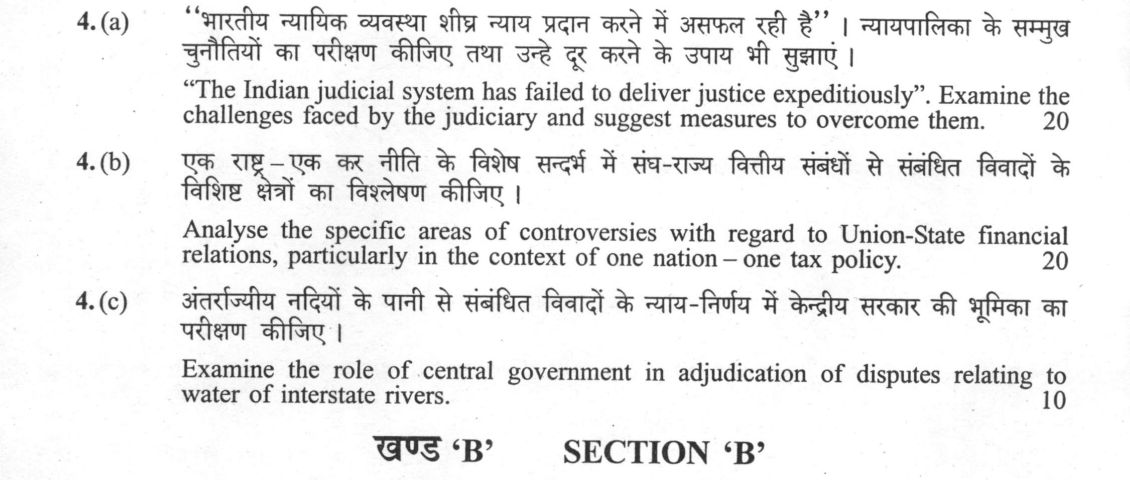
"The Indian judicial system has failed to deliver justice expeditiously". Examine the challenges faced by the judiciary and suggest measures to overcome them. 20 marks
Analyse the specific areas of controversies with regard to Union-State financial relations, particularly in the context of one nation – one tax policy. 20 marks
Examine the role of central government in adjudication of disputes relating to water of interstate rivers. 10 marks
हिंदी में प्रश्न पढ़ें
"भारतीय न्यायिक व्यवस्था शीघ्र न्याय प्रदान करने में असफल रही है"। न्यायपालिका के सम्मुख चुनौतियों का परीक्षण कीजिए तथा उन्हें दूर करने के उपाय भी सुझाइए। 20
एक राष्ट्र – एक कर नीति के विशेष संदर्भ में संघ-राज्य वित्तीय संबंधों से संबंधित विवादों के विशिष्ट क्षेत्रों का विश्लेषण कीजिए। 20
अंतर्राज्यीय नदियों के पानी से संबंधित विवादों के न्याय-निर्णय में केंद्रीय सरकार की भूमिका का परीक्षण कीजिए। 10
Model answer
Written by UPSC Answer Check against this question's marking rubric, to the expected length. UPSC does not publish answers for Mains — this is one way to score well, not an official key.
The three issues—slow justice, contested fiscal federalism and river-water disputes—test whether India’s constitutional machinery can convert formal rights into effective governance.
Judicial delays. The claim that the judiciary has failed to deliver justice expeditiously is largely true, though not absolute. India’s courts have over 5 crore pending cases, with a judge-population ratio of roughly 21 judges per million, far below comparable democracies, and many courts suffer from inadequate buildings, staff, digital records and case-management systems. A structural cause is delayed appointments: the Collegium system, after the NJAC was struck down in Supreme Court Advocates-on-Record Association v. Union of India (2015), leaves gaps in higher-judiciary appointments and creates uncertainty. Delays are compounded by procedural formalism, large case loads in lower courts and limited alternative dispute resolution. Yet the system is not stagnant. E-Courts, Lok Adalats, Fast Track Courts and ADR mechanisms have reduced disposal time in selected matters, and the 230th Law Commission Report has urged structural reforms such as case management, subordinate-court strengthening and appointment transparency. The finding is that delay is systemic, but remediable through institutional, technological and procedural reform.
Fiscal federalism and one-nation-one-tax. The GST framework, created by the 101st Constitutional Amendment, has unified taxation but exposed Union-State financial tensions. The GST Council’s composition—Centre holding one-fourth voting weight and states three-fourths—reveals asymmetry: states dominate numerically, but the Centre’s fiscal weight and veto-like position in a three-fourth majority make consensus difficult. The Amendment also reduced states’ independent tax autonomy by moving goods and services taxation to a shared, council-driven regime. A major controversy is the proliferation of surcharges and cesses, which bypass the divisible pool and reduce states’ effective share of gross central taxes, even though the Finance Commission’s vertical devolution target is calculated as a share of the divisible pool. This creates friction between vertical devolution and horizontal distribution: states contest not only the total amount devolved but also the formula used to allocate it among states. The GST compensation cess controversy sharpened this: compensation was provided for five years, but its discontinuation after 2020-21 left states dependent on a cess that had become a de facto revenue source, fuelling disputes over compensation, rate changes and loss of fiscal predictability.
River-water adjudication. For inter-State rivers, Article 262 authorises Parliament to provide for adjudication of disputes, and the Inter-State River Water Disputes Act, 1956 implements this by enabling the Centre to constitute a tribunal on a state’s request. The Centre’s role is therefore procedural and limited: it initiates or facilitates adjudication but does not itself decide the merits. The River Boards Act, 1956, enacted under Entry 56 of the Union List and Article 246 for regulation and development of inter-State rivers, is a separate cooperative instrument, not an adjudicatory one; its recent revival push seeks to strengthen consultation, not replace tribunals. Disputes over the Cauvery, Krishna and Mahanadi show the limits of central adjudication. In the Mahanadi case, Odisha’s original/writ petition under Article 32 sought constitution of a tribunal, while in the Cauvery dispute the Supreme Court’s 2018 verdict expanded judicial oversight of tribunal awards. Together, these cases show that the Centre can frame the process, but final authority often shifts to the Supreme Court, especially where states challenge tribunal awards or seek urgent relief.
In sum, the judiciary’s pendency crisis, GST-era fiscal asymmetries and river-water disputes all point to the same need: stronger institutional capacity, clearer constitutional processes and cooperative federalism. Judicial efficiency, fiscal predictability and credible water-dispute adjudication are not separate reforms; they are mutually reinforcing conditions for effective governance.
What "Examine" is asking you to do
Test the proposition the question puts to you and return a finding on how far it holds. Examine stems carry a claim, or ask whether something has happened, and expect evidence weighed both ways before the extent is stated — often with remedial measures attached.
Structure that answers it
Restate the claim as the question frames it → evidence that supports it → evidence that undercuts it → the conditions under which it holds → verdict on how far it stands
Where marks are lost
Stopping at description. An examination has to reach a finding, and “examine with justification” means the extent must be stated, not implied.
How this answer will be evaluated
Approach
Framework: Public Administration, Paper 2. (a) examine: intro > how/why with reasoning > evidence > conclusion | (b) analyse: intro > causes > effects > stakeholders/linkages > way forward | (c) examine: intro > how/why with reasoning > evidence > conclusion Full marks: Comprehensive, specific, and well-structured answers with clear administrative focus and relevant examples.
Key points expected
- Identify structural causes of pendency (judicial vacancies, infrastructure)
- Analyze procedural delays (litigation culture, adjournments)
- Suggest specific measures (e-Lokpal, Lok Adalats, case management)
- Link measures to the specific challenge of 'expeditiousness'
- Identify specific controversies (e.g., GST compensation, rate slabs)
- Explain the shift from pre-GST to GST financial relations
- Analyze the role of the GST Council in resolving disputes
- Discuss the impact on state fiscal autonomy
Evaluation rubric
Each sub-part is marked on its own, against the marks and word limit printed on the paper.
- (a) Examine challenges to expeditious justice and suggest measures to overcome them. 20 marks
examine— intro → how/why with reasoning → evidence → conclusion
Must cover
- Identify structural causes of pendency (judicial vacancies, infrastructure)
- Analyze procedural delays (litigation culture, adjournments)
- Suggest specific measures (e-Lokpal, Lok Adalats, case management)
- Link measures to the specific challenge of 'expeditiousness'
Loses marks
- Generic 'GS-2' style answers without administrative focus
- Listing challenges without mapping specific solutions to them
- Ignoring the 'expeditious' aspect and focusing only on 'quality'
Earns more
- Mention of 2nd ARC recommendations on judicial reform
- Reference to specific recent reforms (e.g., e-Courts Mission)
- Distinction between civil and criminal justice delays
Extra mark
- Citing specific statistics on pendency (e.g., NCRB data)
- Mentioning specific landmark judgments on delay (e.g., Hussainara Khatoon)
- (b) Analyse controversies in Union-State financial relations under 'One Nation One Tax'. 20 marks
analyse— intro → causes → effects → stakeholders/linkages → way forward
Must cover
- Identify specific controversies (e.g., GST compensation, rate slabs)
- Explain the shift from pre-GST to GST financial relations
- Analyze the role of the GST Council in resolving disputes
- Discuss the impact on state fiscal autonomy
Loses marks
- General discussion of federalism without specific financial focus
- Ignoring the 'One Nation One Tax' context
- Failing to identify specific 'controversies' or 'areas' of dispute
Earns more
- Mentioning the 15th Finance Commission recommendations
- Reference to specific GST Council decisions or disputes
- Discussion of the 'compensation cess' mechanism
Extra mark
- Citing specific data on state revenue loss/gain
- Mentioning specific legal challenges to GST
- (c) Examine the role of the central government in adjudicating interstate river water disputes. 10 marks
examine— intro → how/why with reasoning → evidence → conclusion
Must cover
- Identify the constitutional basis (Article 262)
- Explain the mechanism of the Inter-State River Water Disputes Act
- Describe the role of the Central Government in setting up tribunals
- Discuss the finality of tribunal awards
Loses marks
- General discussion of water management without focusing on 'adjudication'
- Ignoring the specific role of the 'central government'
- Failing to mention the legal framework (Article 262/Act)
Earns more
- Mentioning specific river disputes (e.g., Cauvery, Krishna)
- Reference to the role of the Supreme Court in appeals
- Discussion of the 'riparian rights' doctrine
Extra mark
- Citing specific tribunal awards or their impact
- Mentioning the role of the National River Linking Council
Practice this exact question
Write your answer and it is marked point by point against the model answer above — what you covered, what you missed, what you got wrong.
Evaluate my answer →More from Public Administration 2022 Paper II
- Q1 Answer the following in about 150 words. 10×5=50 (a) "Mughal administrative system was ce…
- Q2 (a) "The Indian federal structure is largely symmetric albeit with some asymmetric featur…
- Q3 (a) "The New Economic Reforms during the past three decades have not only reduced the sco…
- Q4 (a) "The Indian judicial system has failed to deliver justice expeditiously". Examine the…
- Q5 Answer the following in about 150 words. 10×5=50 (a) Examine the lateral entry recruitmen…
- Q6 (a) The recommendations of National Finance Commissions are more norms based than the nee…
- Q7 (a) In India, for the upliftment of majority of people, governmental intervention remains…