Paper II — Q6
(a) The recommendations of National Finance Commissions are more norms based than the need based. In the light of this statement…
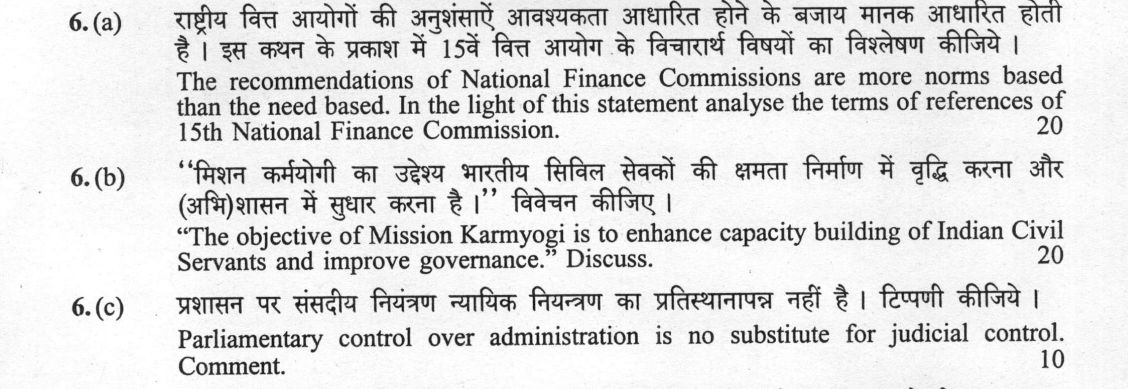
The recommendations of National Finance Commissions are more norms based than the need based. In the light of this statement analyse the terms of references of 15th National Finance Commission. 20 marks
"The objective of Mission Karmyogi is to enhance capacity building of Indian Civil Servants and improve governance." Discuss. 20 marks
Parliamentary control over administration is no substitute for judicial control. Comment. 10 marks
हिंदी में प्रश्न पढ़ें
राष्ट्रीय वित्त आयोगों की अनुशंसाएं आवश्यकता आधारित होने के बजाय मानक आधारित होती हैं। इस कथन के प्रकाश में 15वें वित्त आयोग के विचाराधीन विषयों का विश्लेषण कीजिए। 20
"मिशन कर्मयोगी का उद्देश्य भारतीय सिविल सेवकों की क्षमता निर्माण में वृद्धि करना और (अभि)शासन में सुधार करना है।" विवेचन कीजिए। 20
प्रशासन पर संसदीय नियंत्रण न्यायिक नियंत्रण का प्रतिस्थानापत्र नहीं है। टिप्पणी कीजिए। 10
Model answer
Written by UPSC Answer Check against this question's marking rubric, to the expected length. UPSC does not publish answers for Mains — this is one way to score well, not an official key.
The 15th NFC’s Terms of Reference (ToR) show that NFC awards are formula-driven: they set normative criteria and leave need-based adjustment to later judgment.
(a) 15th NFC ToR: norms over needs The ToR asked for principles for sharing net proceeds of taxes and grants-in-aid between the Union and States, and for local-body grants. It listed population as per the latest available census (2011), area, forest/ecological assets, tax-collection efficiency, income distance, demographic performance and debt holding. These are mostly normative: population, area and forest cover are fixed, easily measurable and politically stable. The components interact: fixed population/area norms anchor the formula, while income distance and demographic factors adjust it; fiscal consolidation and local-body grants extend the same normative logic. The ToR did not assign weights; the 15% population, 15% area, 10% forest/ecology and 45% income distance figures were the Commission’s final award, not ToR mandates. This matters because the population criterion freezes shares around 2011 demographics, limiting response to later demographic transition costs, urbanisation or disaster vulnerability. Income distance and demographic performance are need-based, but the ToR gives them no hierarchy or explicit weight, and disaster vulnerability is absent. The 14th FC had innovated by introducing income distance, but the 15th ToR merely carried it forward. Other ToR items reinforce norm-based control: fiscal consolidation and performance incentives are framed as compliance with targets, while local-body grants are likely to be tied to population, area and revenue capacity rather than local service deficits. Thus the ToR creates a rules-based architecture in which need-based factors are present but subordinate.
(b) Mission Karmayogi: capacity and governance Mission Karmayogi operationalises this need for better administration by shifting civil services from rule-based to role-based HR management. Its iGOT Karmayogi platform provides role-specific, competency-based learning, while the competency framework identifies 70 roles and 280 competencies, enabling continuous upskilling rather than one-time training. The objective is governance outcomes: a civil servant trained in data analytics, grievance redressal, project management and citizen-centric delivery can implement schemes more effectively. This linkage is visible in programmes such as PM Gati Shakti, where integrated logistics and last-mile delivery require trained officers to coordinate departments, and the Aspirational Districts Programme, where district-level monitoring, data use and capacity building have improved service delivery in lagging districts. By making competencies explicit, Mission Karmayogi connects individual capacity to institutional accountability.
(c) Parliamentary and judicial control: complementary, not substitutes Parliamentary control is political and prospective: Question Hour, budget, Estimates Committee, Public Accounts Committee, departmental related committees and no-confidence motions hold the executive accountable for policy and resources. Judicial control is legal, rights-based and rooted in the rule of law: Articles 32 and 226 provide writ jurisdiction, judicial review tests executive action against the Constitution, and PILs allow courts to address maladministration. The 2G spectrum allotment case illustrates the difference: parliamentary debates exposed policy concerns, but the Supreme Court’s stay and directions provided immediate, enforceable relief. Cases such as S.P. Gupta v. Union of India (1981) and Vineet Narain v. Union of India (1981) expanded judicial activism to fill accountability gaps. Separation of powers limits substitution: courts do not allocate budgets, set policy or command bureaucracy, while Parliament cannot issue writs or enforce fundamental rights. The two controls are mutually reinforcing; parliamentary control ensures political responsibility, judicial control ensures constitutional legality.
Thus, the 15th NFC’s ToR shows that fiscal federalism remains largely norms-based, with need-based criteria underweighted. Mission Karmayogi addresses the resulting administrative gap by building role-based capacity. Effective governance requires both: formulaic fiscal norms must be supplemented by need-sensitive implementation, and parliamentary accountability must be paired with judicial oversight.
What "Analyse" is asking you to do
Break the subject into its working parts and show how they act on each other. The marks are in the interconnections — which factor drives which, and what the resulting structure explains — not in the inventory of factors.
Structure that answers it
Define the whole → separate it into its parts → show which part drives which → what that interaction produces → what the structure implies
Where marks are lost
A flat list of causes with no account of which drives which. An answer of neatly separated headings, each self-contained, scores as description.
How this answer will be evaluated
Approach
Framework: Public Administration, Paper 2. (a) analyse: intro > causes > effects > stakeholders/linkages > way forward | (b) discuss: intro > 3-4 dimensions > example > balanced close | (c) comment: context > arguments both sides > judgment > close Full marks: Precise, analytical, with specific Indian institutional references and critical evaluation.
Key points expected
- Define 'norms-based' vs 'needs-based' allocation
- Cite specific 15th NFC ToR (e.g., 41:59 split)
- Link ToR to vertical/horizontal equity
- Assess impact on state fiscal autonomy
- Define Mission Karmyogi (MKS) objectives
- Link to 'capacity building' (competency mapping)
- Link to 'governance' (service delivery, ethics)
- Assess implementation (e.g., e-learning, training)
Evaluation rubric
Each sub-part is marked on its own, against the marks and word limit printed on the paper.
- (a) Critique the 'norms-based' nature of 15th NFC's ToR and its impact on fiscal federalism. 20 marks
analyse— intro → causes → effects → stakeholders/linkages → way forward
Must cover
- Define 'norms-based' vs 'needs-based' allocation
- Cite specific 15th NFC ToR (e.g., 41:59 split)
- Link ToR to vertical/horizontal equity
- Assess impact on state fiscal autonomy
Loses marks
- Generic discussion of fiscal federalism
- Ignoring the specific 'norms-based' critique
- No mention of 15th NFC specifics
Earns more
- Mention 14th vs 15th NFC comparison
- Reference GST Council role
- Discuss 'equalization' vs 'incentivization' logic
- Mention specific grants (e.g., GAD)
Extra mark
- Cite specific 15th NFC report recommendation
- Reference 13th Finance Commission's 'needs' approach
- (b) Evaluate Mission Karmyogi's role in civil servant capacity building and governance improvement. 20 marks
discuss— intro → 3-4 dimensions → example → balanced close
Must cover
- Define Mission Karmyogi (MKS) objectives
- Link to 'capacity building' (competency mapping)
- Link to 'governance' (service delivery, ethics)
- Assess implementation (e.g., e-learning, training)
Loses marks
- Generic discussion of civil service training
- Ignoring the 'governance' aspect
- No mention of Mission Karmyogi specifics
Earns more
- Mention 'Karmayogi' portal
- Reference 2nd ARC recommendations
- Discuss 'competency-based' training
- Mention 'citizen-centric' approach
Extra mark
- Cite specific MKS module or initiative
- Reference 'National e-Governance Division' (NeGD)
- (c) Argue why parliamentary control is insufficient without judicial control over administration. 10 marks
comment— context → arguments both sides → judgment → close
Must cover
- Define parliamentary control (Q&A, CAG)
- Define judicial control (Writs, PILs)
- Explain 'gap' in parliamentary oversight
- Justify judicial role in 'rule of law'
Loses marks
- Treating both as identical
- Ignoring the 'substitute' aspect
- No specific examples of judicial intervention
Earns more
- Mention 'Writ of Mandamus'
- Reference 'Public Interest Litigation' (PIL)
- Discuss 'judicial activism' vs 'activism'
- Mention 'CAG' limitations
Extra mark
- Cite specific landmark judgment (e.g., Maneka Gandhi)
- Reference 'Article 32' or 'Article 226'
Practice this exact question
Write your answer and it is marked point by point against the model answer above — what you covered, what you missed, what you got wrong.
Evaluate my answer →More from Public Administration 2022 Paper II
- Q3 (a) "The New Economic Reforms during the past three decades have not only reduced the sco…
- Q4 (a) "The Indian judicial system has failed to deliver justice expeditiously". Examine the…
- Q5 Answer the following in about 150 words. 10×5=50 (a) Examine the lateral entry recruitmen…
- Q6 (a) The recommendations of National Finance Commissions are more norms based than the nee…
- Q7 (a) In India, for the upliftment of majority of people, governmental intervention remains…
- Q8 (a) The main objective of Panchayats (Extension to Scheduled Areas) Act, 1996 is to enabl…