Paper II — Q8
(a) The main objective of Panchayats (Extension to Scheduled Areas) Act, 1996 is to enable tribal society to assume control over…
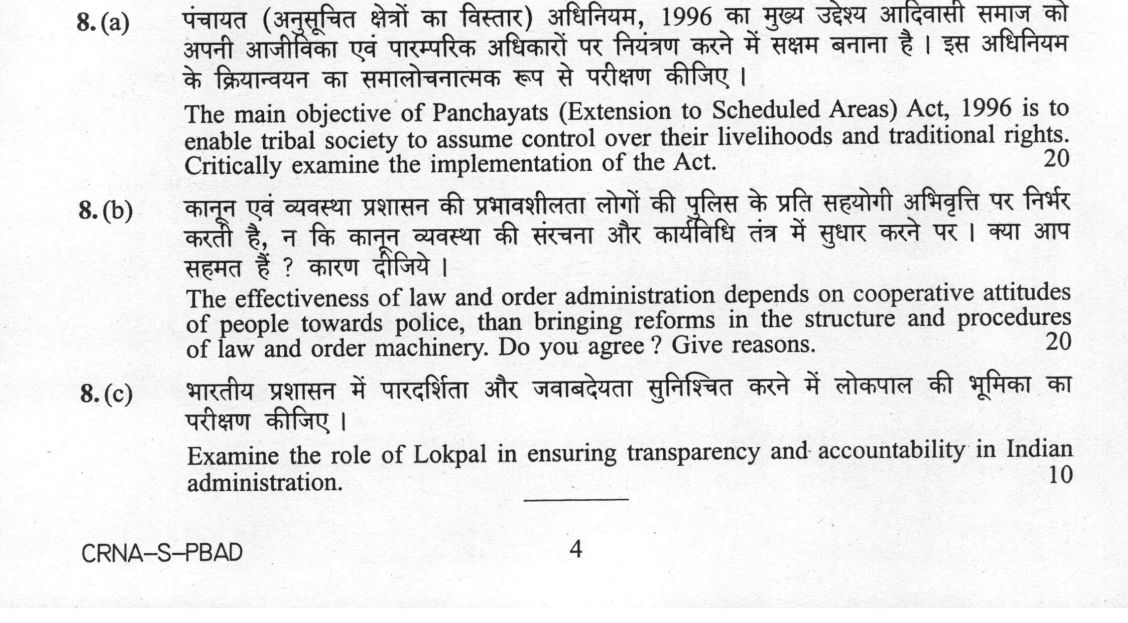
The main objective of Panchayats (Extension to Scheduled Areas) Act, 1996 is to enable tribal society to assume control over their livelihoods and traditional rights. Critically examine the implementation of the Act. 20 marks
The effectiveness of law and order administration depends on cooperative attitudes of people towards police, than bringing reforms in the structure and procedures of law and order machinery. Do you agree ? Give reasons. 20 marks
Examine the role of Lokpal in ensuring transparency and accountability in Indian administration. 10 marks
हिंदी में प्रश्न पढ़ें
पंचायत (अनुसूचित क्षेत्रों का विस्तार) अधिनियम, 1996 का मुख्य उद्देश्य आदिवासी समाज को अपनी आजीविका एवं पारंपरिक अधिकारों पर नियंत्रण करने में सक्षम बनाना है। इस अधिनियम के क्रियान्वयन का समालोचनात्मक रूप से परीक्षण कीजिए। 20
कानून एवं व्यवस्था प्रशासन की प्रभावशीलता लोगों की पुलिस के प्रति सहयोगी अभिवृत्ति पर निर्भर करती है, न कि कानून व्यवस्था की संरचना और कार्यविधि तंत्र में सुधार करने पर। क्या आप सहमत हैं ? कारण दीजिए। 20
भारतीय प्रशासन में पारदर्शिता और जवाबदेयी सुनिश्चित करने में लोकपाल की भूमिका का परीक्षण कीजिए। 10
Model answer
Written by UPSC Answer Check against this question's marking rubric, to the expected length. UPSC does not publish answers for Mains — this is one way to score well, not an official key.
(a) Implementation of the PESA Act, 1996
The Panchayats (Extension to Scheduled Areas) Act, 1996 (PESA), enacted on the recommendations of the Dilip Singh Bhuria Committee, sought to extend democratic decentralization to Fifth Schedule areas. It recognized the traditional rights of tribal communities by positioning the Gram Sabha as the central institution of self-governance. Under PESA, the Gram Sabha was endowed with wide-ranging powers: mandatory prior consultation or consent for land acquisition, ownership of Minor Forest Produce (MFP), management of minor water bodies, enforcement of prohibition, control over local money lending, and preservation of customary laws and dispute resolution mechanisms.
However, a critical examination of its implementation reveals a stark gap between legislative intent and ground reality. Several state governments delayed framing state-specific PESA rules for decades, diluting the statutory powers of the Gram Sabha through subordinate legislation. Executive evasion is frequent: the mandatory consultation requirement for land acquisition has often been reduced to a procedural formality or bypassed using administrative coercion. Furthermore, entrenched bureaucratic resistance, particularly within the forest and revenue departments, has impeded the actual transfer of MFP ownership and natural resource management to local communities.
The implementation has also suffered from persistent conflicts with overarching sectoral legislations. Contradictions with the Mines and Minerals (Development and Regulation) Act, the Indian Forest Act of 1927, and state excise laws have consistently undermined PESA's primacy. While the Scheduled Tribes and Other Traditional Forest Dwellers (Recognition of Forest Rights) Act, 2006 (FRA) reinforced community tenure, institutional harmony between PESA Gram Sabhas and FRA Forest Rights Committees remains unresolved. Thus, despite its radical potential, PESA has largely been reduced to a paper tiger due to a lack of political will and institutional reluctance to surrender paternalistic administrative control.
(b) Law and Order Administration: Public Cooperation vs. Structural Reforms
The proposition that public cooperation is more critical than structural and procedural reforms is only partially valid. Public cooperation is indispensable for effective policing. In democratic governance, law enforcement cannot rely solely on coercion. Community policing initiatives, such as Kerala’s Janamaithri Suraksha and Tamil Nadu’s Friends of Police, demonstrate that citizen partnership enhances intelligence gathering, aids crime prevention, and de-escalates public unrest.
However, cooperative attitudes cannot develop in an institutional vacuum. The reluctance of citizens to engage with the police stems directly from deep-rooted structural and procedural deficiencies. The Indian police apparatus continues to operate largely under the colonial framework of the Police Act of 1861, which was designed to enforce regime security rather than citizen service. Structural pathologies—such as political interference in transfers, lack of separation between investigation and law-and-order duties, brutal interrogation methods, and opaque grievance mechanisms—foster widespread public distrust.
Structural reforms are therefore the essential prerequisite for building public cooperation. As emphasized by the National Police Commission and the Supreme Court in Prakash Singh v. Union of India (2006), reforming the machinery through functional specialization, the establishment of State Security Commissions, transparent Police Complaints Authorities, fixed tenures, and modernized forensic infrastructure is vital. Procedural overhauls, such as mandatory electronic FIR registration and time-bound investigations, generate institutional predictability. In conclusion, structural reforms and public cooperation are dialectically linked: structural and procedural modernization institutionalizes fairness and accountability, which in turn generates the public trust necessary for cooperative law and order administration.
(c) Lokpal and Administrative Accountability
The Lokpal and Lokayuktas Act, 2013 established an apex, independent anti-corruption ombudsman to enhance transparency and integrity across Indian administration. The Lokpal's jurisdiction is broad, encompassing the Prime Minister (with specified safeguards), Union Ministers, Members of Parliament, and public servants across Groups A, B, C, and D. It possesses statutory powers of preliminary inquiry, full investigation, and prosecution, alongside superintendence over the Central Bureau of Investigation (CBI) for cases referred by it, aiming to overcome past limitations of executive influence.
Despite its robust design, the Lokpal's actual impact since its operationalization in 2019 has been modest. Its effectiveness is constrained by procedural bottlenecks, substantial delays in processing complaints, and an over-reliance on existing inquiry agencies rather than establishing its own autonomous investigative wing. The high rate of complaint dismissals on technical grounds has curtailed public confidence. Moreover, functional overlap and lack of synchronization with the Central Vigilance Commission (CVC) and CBI dilute its institutional punch. While the Lokpal represents a vital constitutional-democratic instrument for checking high-level graft, fulfilling its mandate requires building an independent investigative cadre, rationalizing procedural scrutiny, and adopting a proactive stance toward systemic administrative accountability.
What "Critically examine" is asking you to do
Test the proposition the question puts to you and return a finding on how far it holds. Examine stems carry a claim, or ask whether something has happened, and expect evidence weighed both ways before the extent is stated — often with remedial measures attached. “Critically” is not a section added at the end: name the yardstick you are judging by — the evidence, the stated objective, a constitutional principle, a rival explanation — and let a verdict close each part of the body. Where the question quotes a claim, that verdict must land on the claim itself, accepted, qualified or rejected, and not on the theme in general.
Structure that answers it
Restate the claim as the question frames it → evidence that supports it → evidence that undercuts it → the conditions under which it holds → verdict on how far it stands
Where marks are lost
Merits in one paragraph, demerits in the next, and a conclusion calling for a balanced and holistic approach. That is a survey with the judgement left out and it holds the answer in the middle band. The opposite error is reading “critically” as permission to attack — and with the odd pairings, critically describe or critically explain, the exposition still carries most of the marks, the judgement being a layer on it rather than a substitute for it.
How this answer will be evaluated
Approach
Framework: Concept > Thinker > Indian institutional application > Reform. (a) critically evaluate: positives > negatives/limits > conditions/safeguards > conclusion | (b) comment: context > arguments both sides > judgment > close | (c) examine: intro > how/why with reasoning > evidence > conclusion Full marks: Demonstrates deep understanding of the specific administrative mechanisms, cites relevant constitutional provisions and reforms, and provides a nuanced, balanced analysis.
Key points expected
- Cite Article 244 and Schedule V of the Constitution
- Identify specific implementation gaps (e.g., state non-compliance)
- Discuss the role of Gram Sabhas in resource control
- Provide a balanced conclusion on the Act's effectiveness
- Define the scope of 'cooperative attitudes' (e.g., FIR filing, witness support)
- Analyze the impact of structural reforms (e.g., police modernization, technology)
- Provide arguments for both sides of the debate
- Offer a reasoned judgment on the primary driver of effectiveness
Evaluation rubric
Each sub-part is marked on its own, against the marks and word limit printed on the paper.
- (a) Assess the gap between PESA's objective of tribal self-governance and its actual implementation. 20 marks
critically evaluate— positives → negatives/limits → conditions/safeguards → conclusion
Must cover
- Cite Article 244 and Schedule V of the Constitution
- Identify specific implementation gaps (e.g., state non-compliance)
- Discuss the role of Gram Sabhas in resource control
- Provide a balanced conclusion on the Act's effectiveness
Loses marks
- Treating PESA as a general Panchayati Raj Act
- Ignoring the specific context of Scheduled Areas
- Providing only a descriptive summary without critical analysis
Earns more
- Mention the 2nd ARC recommendations on PESA
- Reference specific state-level implementation examples
- Discuss the conflict between PESA and Forest Rights Act
- Mention the role of the Ministry of Tribal Affairs
Extra mark
- Cite a specific Supreme Court judgment on PESA
- Reference a specific state's PESA implementation report
- (b) Evaluate the relative importance of public cooperation vs. structural reform in law and order. 20 marks
comment— context → arguments both sides → judgment → close
Must cover
- Define the scope of 'cooperative attitudes' (e.g., FIR filing, witness support)
- Analyze the impact of structural reforms (e.g., police modernization, technology)
- Provide arguments for both sides of the debate
- Offer a reasoned judgment on the primary driver of effectiveness
Loses marks
- Taking a one-sided view without acknowledging the other
- Ignoring the structural issues in the police machinery
- Failing to provide a reasoned judgment
Earns more
- Reference the 2nd ARC recommendations on police reform
- Mention the role of community policing
- Discuss the impact of technology (e.g., CCTV, digital FIRs)
- Reference specific state-level police reforms
Extra mark
- Cite a specific Supreme Court judgment on police reform
- Reference a specific state's police reform initiative
- (c) Analyze how the Lokpal mechanism ensures transparency and accountability in administration. 10 marks
examine— intro → how/why with reasoning → evidence → conclusion
Must cover
- Explain the Lokpal's jurisdiction and powers
- Describe the process for investigating corruption
- Discuss the Lokpal's role in ensuring accountability
- Provide a balanced assessment of its effectiveness
Loses marks
- Confusing the Lokpal with the Lokayukta
- Ignoring the Lokpal's specific powers and jurisdiction
- Providing only a descriptive summary without analysis
Earns more
- Reference the Lokpal and Lokayuktas Act, 2013
- Mention the role of the Lokpal in investigating high-level corruption
- Discuss the challenges in the Lokpal's implementation
- Reference specific cases investigated by the Lokpal
Extra mark
- Cite a specific Supreme Court judgment on the Lokpal
- Reference a specific case investigated by the Lokpal
Practice this exact question
Write your answer and it is marked point by point against the model answer above — what you covered, what you missed, what you got wrong.
Evaluate my answer →More from Public Administration 2022 Paper II
- Q5 Answer the following in about 150 words. 10×5=50 (a) Examine the lateral entry recruitmen…
- Q6 (a) The recommendations of National Finance Commissions are more norms based than the nee…
- Q7 (a) In India, for the upliftment of majority of people, governmental intervention remains…
- Q8 (a) The main objective of Panchayats (Extension to Scheduled Areas) Act, 1996 is to enabl…