Paper II — Q7
(a) In India, for the upliftment of majority of people, governmental intervention remains a central fact of life. Nevertheless…
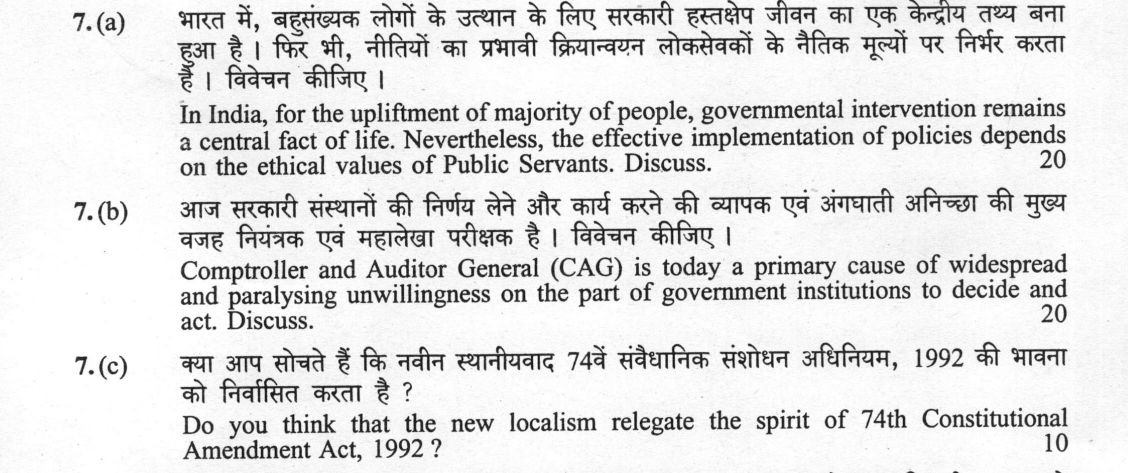
In India, for the upliftment of majority of people, governmental intervention remains a central fact of life. Nevertheless, the effective implementation of policies depends on the ethical values of Public Servants. Discuss. 20 marks
Comptroller and Auditor General (CAG) is today a primary cause of widespread and paralysing unwillingness on the part of government institutions to decide and act. Discuss. 20 marks
Do you think that the new localism relegate the spirit of 74th Constitutional Amendment Act, 1992 ? 10 marks
हिंदी में प्रश्न पढ़ें
भारत में, बहुसंख्यक लोगों के उत्थान के लिए सरकारी हस्तक्षेप जीवन का एक केंद्रीय तथ्य बना हुआ है। फिर भी, नीतियों का प्रभावी क्रियान्वयन लोकसेवकों के नैतिक मूल्यों पर निर्भर करता है। विवेचन कीजिए। 20
आज सरकारी संस्थानों की निर्णय लेने और कार्य करने की व्यापक एवं अंगघाती अनिच्छा की मुख्य वजह नियंत्रक एवं महालेखा परीक्षक है। विवेचन कीजिए। 20
क्या आप सोचते हैं कि नवीन स्थानीयवाद 74वें संवैधानिक संशोधन अधिनियम, 1992 की भावना को निर्वासित करता है ? 10 marks
Model answer
Written by UPSC Answer Check against this question's marking rubric, to the expected length. UPSC does not publish answers for Mains — this is one way to score well, not an official key.
(a) Ethical Values of Public Servants in Policy Implementation
In a developing welfare state like India, governmental intervention remains indispensable for the socio-economic upliftment of marginalized sections under the Directive Principles of State Policy. However, translating policy intent into transformative grassroots outcomes depends directly upon the ethical orientation of public servants. Foundational values such as integrity, empathy, objectivity, and commitment ensure that state resources and flagship welfare programs reach the intended beneficiaries without elite capture or leakage.
As the Second Administrative Reforms Commission (2nd ARC) emphasized in its report on 'Ethics in Governance', a deficit in ethical standards produces a persistent 'implementation gap'. Despite well-conceived schemes, administrative apathy, nepotism, and systemic corruption divert public funds, leading to policy failure. While external statutory mechanisms like the Right to Information (RTI) Act, 2005 enhance transparency and social accountability, they cannot substitute for an internalized ethos of public service. Effective implementation demands combining robust accountability architecture with continuous value-based training, fostering an administrative culture rooted in empathy and constitutional morality.
(b) CAG and Administrative Decision-Making
The Comptroller and Auditor General of India (CAG), under Article 148, has progressively broadened its oversight from traditional compliance and financial audit to comprehensive performance, proprietary, and environmental audits. Critics argue that aggressive ex-post facto scrutiny has induced a 'chilling effect' across the bureaucracy. This 'fear of the CAG' often disincentivizes civil servants from exercising discretion, leading to procedural rigidity, risk aversion, and institutional paralysis where non-action becomes the safest bureaucratic strategy.
Conversely, the CAG functions as an indispensable constitutional watchdog safeguarding public exchequer and parliamentary accountability. Landmark audits in the 2G spectrum and coal block allocation cases exposed severe irregularities and policy distortions, demonstrating the audit's vital role in checking crony capitalism and executive arbitrariness. As the Supreme Court has observed, a delicate balance must be maintained between averting 'policy paralysis' and preventing 'vigilance overreach'. Audit institutions must distinguish between bonafide commercial or administrative errors made in good faith and deliberate malfeasance, thereby protecting entrepreneurial decision-making while enforcing rigorous financial accountability.
(c) New Localism versus the Spirit of the 74th Constitutional Amendment Act
The paradigm of 'new localism'—marked by centralized, mission-mode urban interventions such as the Smart Cities Mission and AMRUT, evolving from the earlier JNNURM framework—presents a complex dynamic with the 74th Constitutional Amendment Act, 1992. The 74th CAA sought to establish Urban Local Bodies (ULBs) as self-governing, autonomous democratic units endowed with funds, functions, and functionaries. In contrast, new localism heavily relies on corporate-style Special Purpose Vehicles (SPVs) and parastatal agencies to execute projects efficiently.
This model frequently bypasses elected municipal councils, Ward Committees, and Metropolitan Planning Committees, concentrating managerial authority in technocrats and diluting local democratic representation. However, new localism also represents a pragmatic adaptation to overcome the acute capacity deficits, bureaucratic inertia, and execution bottlenecks paralyzing traditional ULBs.
To prevent the constitutional vision of urban self-governance from being compromised, SPVs must be institutionally anchored under the oversight of elected local councils. Reconciling managerial efficiency with democratic decentralization requires strengthening municipal administrative capacity and ensuring substantial, predictable fiscal devolution as recommended by the Central and State Finance Commissions.
What "Discuss" is asking you to do
Lay the issue out from more than one side — how it arose, what is claimed for it, what is held against it, and where it now stands. UPSC attaches discuss to broad topics with several live dimensions, so coverage of the dimensions earns more than the strength of your opinion.
Structure that answers it
Set the issue up → the case as it is made → the case against → the dimension both sides leave out → where the balance now lies
Where marks are lost
Listing facts with no thread between them, or arguing one side throughout and calling it a discussion.
How this answer will be evaluated
Approach
Framework: Public Administration Paper II (Ethics, Governance, Constitutionalism). (a) discuss: intro > 3-4 dimensions > example > balanced close | (b) discuss: intro > 3-4 dimensions > example > balanced close | (c) comment: context > arguments both sides > judgment > close Full marks: Precise, analytical, and well-structured with specific Indian examples and references to key administrative concepts.
Key points expected
- Define the scope of governmental intervention in India
- Identify specific ethical values (impartiality, integrity, empathy)
- Link ethical failure to policy implementation gaps
- Provide a concrete Indian administrative example
- Explain the constitutional role of CAG (Art 148)
- Analyze the 'fear of audit' as a cause of inaction
- Distinguish between 'paralysis' and 'accountability'
- Provide examples of CAG reports causing administrative delays
Evaluation rubric
Each sub-part is marked on its own, against the marks and word limit printed on the paper.
- (a) Analyze the link between state intervention and the ethical conduct of public servants in policy implementation. 20 marks
discuss— intro → 3-4 dimensions → example → balanced close
Must cover
- Define the scope of governmental intervention in India
- Identify specific ethical values (impartiality, integrity, empathy)
- Link ethical failure to policy implementation gaps
- Provide a concrete Indian administrative example
Loses marks
- Generic moralizing without administrative context
- Ignoring the 'implementation' aspect of the prompt
- GS-2 style policy critique without administrative focus
Earns more
- Reference to 2nd ARC Report on Ethics
- Mention of Lokpal and Lokayuktas Act, 2013
- Distinction between 'letter of law' and 'spirit of law'
Extra mark
- Reference to specific CAG audit reports on welfare schemes
- Mention of 'Probity in Governance' (2nd ARC)
- (b) Critically evaluate the claim that CAG's role causes administrative paralysis and unwillingness to act. 20 marks
discuss— intro → 3-4 dimensions → example → balanced close
Must cover
- Explain the constitutional role of CAG (Art 148)
- Analyze the 'fear of audit' as a cause of inaction
- Distinguish between 'paralysis' and 'accountability'
- Provide examples of CAG reports causing administrative delays
Loses marks
- Defending CAG without addressing the 'paralysis' claim
- Ignoring the 'unwillingness to decide' aspect
- Vague generalizations about 'red tape'
Earns more
- Reference to CAG's 'ex-post' vs 'ex-ante' audit powers
- Mention of 'Audit Reforms' or 'Performance Audit' concepts
- Discussion of 'Risk Aversion' in bureaucracy
Extra mark
- Reference to specific CAG reports (e.g., 2G, Coalgate)
- Mention of 'Audit Committee' recommendations
- (c) Assess whether the 'new localism' undermines the spirit of the 74th Constitutional Amendment Act, 1992. 10 marks
comment— context → arguments both sides → judgment → close
Must cover
- Define 'new localism' in the Indian context
- Explain the core spirit of the 74th CAA (decentralization)
- Analyze the tension between 'new localism' and 74th CAA
- Provide a balanced judgment on the impact
Loses marks
- Confusing 'new localism' with 'localism' generally
- Ignoring the 'spirit' of the 74th CAA
- Vague generalizations about 'local governance'
Earns more
- Reference to 'Gram Sabha' or 'Panchayati Raj' institutions
- Mention of 'Urban Local Bodies' (ULBs) and their role
- Discussion of 'Participatory Governance' vs 'Elite Capture'
Extra mark
- Reference to '73rd CAA' for rural context
- Mention of 'Smart Cities Mission' as a form of 'new localism'
Practice this exact question
Write your answer and it is marked point by point against the model answer above — what you covered, what you missed, what you got wrong.
Evaluate my answer →More from Public Administration 2022 Paper II
- Q4 (a) "The Indian judicial system has failed to deliver justice expeditiously". Examine the…
- Q5 Answer the following in about 150 words. 10×5=50 (a) Examine the lateral entry recruitmen…
- Q6 (a) The recommendations of National Finance Commissions are more norms based than the nee…
- Q7 (a) In India, for the upliftment of majority of people, governmental intervention remains…
- Q8 (a) The main objective of Panchayats (Extension to Scheduled Areas) Act, 1996 is to enabl…