Paper II — Q1
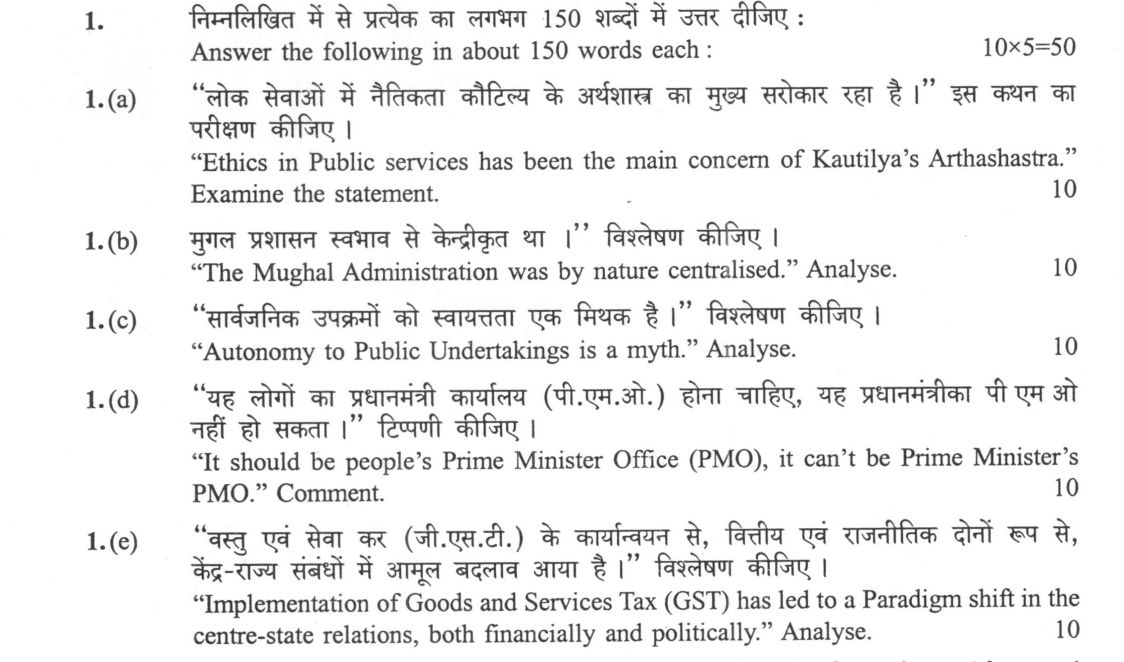
Answer the following in about 150 words each: (a) "Ethics in Public services has been the main concern of Kautilya's…
Answer the following in about 150 words each:
"Ethics in Public services has been the main concern of Kautilya's Arthashastra." Examine the statement. 10 marks
"The Mughal Administration was by nature centralised." Analyse. 10 marks
"Autonomy to Public Undertakings is a myth." Analyse. 10 marks
"It should be people's Prime Minister Office (PMO), it can't be Prime Minister's PMO." Comment. 10 marks
"Implementation of Goods and Services Tax (GST) has led to a Paradigm shift in the centre-state relations, both financially and politically." Analyse. 10 marks
हिंदी में प्रश्न पढ़ें
निम्नलिखित में से प्रत्येक का लगभग 150 शब्दों में उत्तर दीजिए :
"लोक सेवाओं में नैतिकता कौटिल्य के अर्थशास्त्र का मुख्य सरोकार रहा है।" इस कथन का परीक्षण कीजिए। (10 अंक)
मुगल प्रशासन स्वभाव से केंद्रीकृत था ।" विश्लेषण कीजिए। (10 अंक)
"सार्वजनिक उपक्रमों को स्वायत्तता एक मिथक है।" विश्लेषण कीजिए। (10 अंक)
"यह लोगों का प्रधानमंत्री कार्यालय (पी.एम.ओ.) होना चाहिए, यह प्रधानमंत्रीका पी एम ओ नहीं हो सकता ।" टिप्पणी कीजिए। (10 अंक)
"वस्तु एवं सेवा कर (जी.एस.टी.) के कार्यान्वयन से, वित्तीय एवं राजनीतिक दोनों रूप से, केंद्र-राज्य संबंधों में आमूल बदलाव आया है।" विश्लेषण कीजिए। (10 अंक)
Model answer
Written by UPSC Answer Check against this question's marking rubric, to the 150-word length. UPSC does not publish answers for Mains — this is one way to score well, not an official key.
(a) Ethics in Kautilya's Arthashastra
Kautilya’s Arthashastra embeds ethics deeply within statecraft, balancing normative ideals with rigorous administrative realism. At the apex, Rajdharma mandates that the ruler’s ultimate duty is public welfare ("Prajasukhe sukham rajnah"), establishing governance as a moral enterprise. Kautilya designed elaborate institutional ethics for public functionaries (Amatyas), mandating character testing through Upadhas (integrity trials) prior to appointment and codifying distinct service rules. To counter administrative corruption—famously noting that officials handling public funds naturally resemble fish drinking water undetected—he deployed strict accounting protocols, periodic audits, and an undercover surveillance network of spies to enforce civil service accountability.
However, Kautilya maintains a clear dichotomy between personal ethics and state survival. In matters of external statecraft and internal security, encapsulated in the Mandala theory and Koota Yuddha (covert warfare), pragmatic realism overrides conventional morality, justifying deception and expediency for the preservation of the state. Kautilyan ethics is therefore utilitarian and institutional: individual virtue in public officials is rigidly enforced to safeguard the treasury and public trust, while statecraft remains guided by sovereign pragmatism.
(b) Centralisation in Mughal Administration
The Mughal administrative apparatus operated fundamentally as a centralised bureaucratic structure backed by military authority. Centralisation was operationalised through the Mansabdari system, which integrated all civil and military officers into a single imperial hierarchy directly appointed, graded, and transferred by the Emperor. Financial centralisation was secured via the Jagirdari and Zabt revenue systems, wherein land revenue assessments and assignments flowed strictly under the direction of imperial ministers like the Diwan-i-Kul and Mir Bakshi.
Nevertheless, total centralisation was tempered by spatial realities and administrative deconcentration. The empire was systematically divided into Subahs (provinces), Sarkars (districts), and Parganas (sub-districts). At the provincial level, institutional checks were instituted through dual authority: the Subahdar (law and order) and the provincial Diwan (revenue) reported independently to the central court, preventing regional hegemony. Furthermore, at the grassroots, hereditary Zamindars and autonomous village councils (Panchayats) maintained decisive control over agrarian disputes and customary law. Akbar’s administrative syntheses institutionalised a dynamic equilibrium where strong central oversight accommodated local power structures to ensure operational sustainability across a vast subcontinent.
(c) Autonomy of Public Sector Undertakings (PSUs)
The assertion that PSU autonomy is a myth stems from pervasive structural and political controls. Public enterprises frequently face intrusive ministerial interference in day-to-day operations and strategic board appointments. They are subject to a triple layer of accountability: audit by the Comptroller and Auditor General (CAG) under Article 148, constant scrutiny by the Parliamentary Committee on Public Undertakings (COPU), and judicial review under Article 12. Additionally, pricing restrictions and mandated socio-economic obligations often constrain their commercial agility and market responsiveness.
Conversely, post-1991 economic reforms dismantled total departmental control through institutionalised decentralisation. The Memorandum of Understanding (MoU) system established a performance-based paradigm, shifting oversight from ex-ante process control to ex-post result evaluation. Furthermore, the categorisation into Maharatna, Navratna, and Miniratna boards delegated substantial financial and operational autonomy, allowing PSUs to sanction large capital expenditures, execute international joint ventures, and raise market debt without prior ministerial clearance. While full autonomy remains constrained by public accountability, PSUs have evolved from subordinate departmental arms into corporatised entities operating with significant commercial flexibility within an overarching framework of democratic accountability.
(d) Democratic PMO vs. Personalised PMO
The evolution of the Prime Minister’s Office (PMO) demonstrates an institutional tension between personalized, concentrated executive authority and citizen-centric democratic governance. Historically, particularly from the 1970s onwards under Prime Minister Indira Gandhi, the PMO expanded into an all-powerful apex secretariat, often centralising policy formulation, overshadowing line ministries, and subordinating the Cabinet Secretariat. When functioning as a "Prime Minister's PMO," it risks creating an insular, command-and-control bureaucracy that undermines cabinet collegiality and institutional checks.
In a constitutional democracy, the PMO must transition into a "People's PMO" by acting as an institutional conduit for transparency, public accountability, and responsive governance. Modern administrative mechanisms have sought to democratise this interface: the PMO-monitored PRAGATI platform fast-tracks developmental infrastructure projects affecting citizens, direct public grievance redressal through CPGRAMS holds line ministries accountable, and policy inputs are crowdsourced alongside strategic advisory bodies like NITI Aayog. Transforming the PMO into a People's PMO requires de-concentrating discretionary power while institutionalising open data, participatory policy-making, and seamless public interface, ensuring the apex executive remains directly responsive to citizen welfare.
(e) GST and Centre-State Relations
The implementation of the Goods and Services Tax (GST) through the 101st Constitutional Amendment Act marks a decisive structural realignment of Indian fiscal federalism. Financially, states surrendered substantial fiscal sovereignty by subsuming major sub-national revenue sources—such as sales tax, entry tax, and state VAT—into a unified, national tax architecture. While this eliminated interstate trade barriers and established a single market, it significantly curtailed states’ independent capacity to mobilise revenues during economic downturns, making them reliant on the pooled tax pool.
Politically and institutionally, the creation of the GST Council under Article 279A established a formal arena for pooled sovereignty. Its voting mechanism allocates one-third voting weight to the Centre and two-thirds collectively to the states, requiring a 75% majority for all decisions. This grants the Centre a de facto veto over any resolution, while compelling states to forge collective coalitions. The friction witnessed over the phasing out of the GST compensation cess highlighted emerging fault lines between cooperative and coercive federalism. GST has transformed Indian fiscal federalism from an era of autonomous legislative taxation to one of institutionalised collective bargaining and negotiated interdependence.
What "Analyse" is asking you to do
Break the subject into its working parts and show how they act on each other. The marks are in the interconnections — which factor drives which, and what the resulting structure explains — not in the inventory of factors.
Structure that answers it
Define the whole → separate it into its parts → show which part drives which → what that interaction produces → what the structure implies
Where marks are lost
A flat list of causes with no account of which drives which. An answer of neatly separated headings, each self-contained, scores as description.
How this answer will be evaluated
Approach
Framework: Public Administration Paper II (UPSC). (a) examine: intro > how/why with reasoning > evidence > conclusion | (b) analyse: intro > causes > effects > stakeholders/linkages > way forward | (c) analyse: intro > causes > effects > stakeholders/linkages > way forward | (d) comment: context > arguments both sides > judgment > close | (e) analyse: intro > causes > effects > stakeholders/linkages > way forward Full marks: Precise terminology, specific Indian examples, balanced analysis, clear structure.
Key points expected
- Define 'Dharma' and 'Niti' in Arthashastra context
- Link ethics to 'Rajdharma' (duty of ruler)
- Mention 'Matsyanyaya' (law of the fish)
- Connect to modern Indian administrative ethics
- Define 'Mansabdari' system and its central control
- Explain 'Zamindari' as revenue collection, not ownership
- Mention 'Diwani' and 'Faujdari' powers
- Note the role of the 'Mansabdar' as a servant
Evaluation rubric
Each sub-part is marked on its own, against the marks and word limit printed on the paper.
- (a) Assess the centrality of ethics in Kautilya's Arthashastra. 10 marks · 150 words
examine— intro → how/why with reasoning → evidence → conclusion
Must cover
- Define 'Dharma' and 'Niti' in Arthashastra context
- Link ethics to 'Rajdharma' (duty of ruler)
- Mention 'Matsyanyaya' (law of the fish)
- Connect to modern Indian administrative ethics
Loses marks
- Treating Arthashastra as purely political science
- Ignoring the 'Lok' (public) aspect of service
- Vague generalities without specific terms
Earns more
- Reference to 'Saptanga' theory
- Mention of 'Gyaan' (knowledge) as a pillar
- Comparison with modern 2nd ARC ethics
Extra mark
- Citing specific chapters (e.g., Book 2)
- Reference to 'Danda' as a tool of justice
- (b) Explain the structural centralization of Mughal administration. 10 marks · 150 words
analyse— intro → causes → effects → stakeholders/linkages → way forward
Must cover
- Define 'Mansabdari' system and its central control
- Explain 'Zamindari' as revenue collection, not ownership
- Mention 'Diwani' and 'Faujdari' powers
- Note the role of the 'Mansabdar' as a servant
Loses marks
- Confusing 'Zamindar' with feudal landlord
- Ignoring the 'Mansab' rank system
- Focusing only on military aspects
Earns more
- Reference to 'Iqta' system evolution
- Mention of 'Sipahsalar' (military commander)
- Comparison with British centralization
Extra mark
- Citing specific Mughal emperors (e.g., Akbar)
- Reference to 'Dihwani' department
- (c) Critique the reality of autonomy in Public Sector Undertakings (PSUs). 10 marks · 150 words
analyse— intro → causes → effects → stakeholders/linkages → way forward
Must cover
- Define 'Autonomy' in PSU context
- Identify 'Political Interference' in appointments
- Mention 'Financial Constraints' (subsidies/loans)
- Reference '2nd ARC' recommendations on PSUs
Loses marks
- Assuming all PSUs are equally autonomous
- Ignoring the 'Public Interest' mandate
- Vague complaints without structural analysis
Earns more
- Mention of 'Board of Directors' composition
- Reference to 'CVC' (Central Vigilance Commission) role
- Comparison with private sector flexibility
Extra mark
- Citing specific PSU examples (e.g., BHEL, SAIL)
- Reference to 'Disinvestment' policy
- (d) Evaluate the role of PMO in serving the public vs. the PM. 10 marks · 150 words
comment— context → arguments both sides → judgment → close
Must cover
- Define PMO's constitutional role (Article 74)
- Discuss 'Coordination' vs. 'Control' functions
- Mention 'Citizen-centric' initiatives (e.g., PM-KISAN)
- Address 'Political' vs. 'Administrative' balance
Loses marks
- Treating PMO as purely political
- Ignoring the 'Administrative' support function
- Vague praise without critical analysis
Earns more
- Reference to 'NITI Aayog' coordination
- Mention of 'Grievance Redressal' mechanisms
- Comparison with 'Cabinet Secretariat' role
Extra mark
- Citing specific PMO initiatives (e.g., Swachh Bharat)
- Reference to '2nd ARC' on PMO powers
- (e) Explain the financial and political shift in Centre-State relations due to GST. 10 marks · 150 words
analyse— intro → causes → effects → stakeholders/linkages → way forward
Must cover
- Define 'GST' as a 'Single Market'
- Explain 'IGST' (Inter-State) mechanism
- Mention 'GST Council' (Article 279A)
- Discuss 'Compensation' to states
Loses marks
- Ignoring the 'Political' dimension (GST Council)
- Focusing only on 'Financial' aspects
- Vague statements without specific mechanisms
Earns more
- Reference to '101st Constitutional Amendment'
- Mention of 'Dual GST' structure
- Comparison with pre-GST 'Cascading' taxes
Extra mark
- Citing specific GST rates (e.g., 5%, 18%)
- Reference to 'GSTN' (GST Network) technology
Practice this exact question
Write your answer and it is marked point by point against the model answer above — what you covered, what you missed, what you got wrong.
Evaluate my answer →More from Public Administration 2024 Paper II
- Q1 Answer the following in about 150 words each: (a) "Ethics in Public services has been the…
- Q2 (a) The National Data and Analysis Platform (NDAP) of NITI Aayog facilitates a robust eco…
- Q3 (a) "The role of State Finance Commission in distribution of finances between state and l…
- Q4 (a) Public sector undertakings have been the bedrock of welfareism in India for many deca…