Paper II — Q2
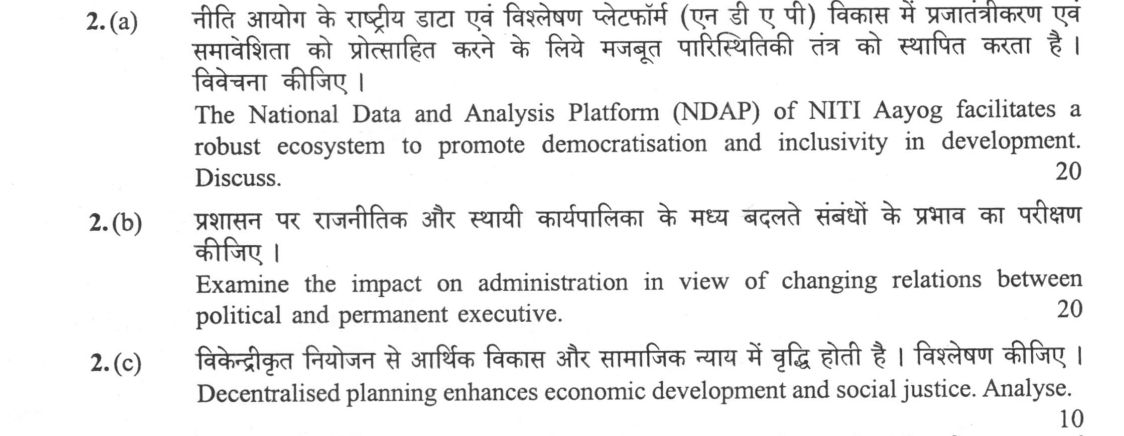
(a) The National Data and Analysis Platform (NDAP) of NITI Aayog facilitates a robust ecosystem to promote democratisation and…
The National Data and Analysis Platform (NDAP) of NITI Aayog facilitates a robust ecosystem to promote democratisation and inclusivity in development. Discuss. 20 marks
Examine the impact on administration in view of changing relations between political and permanent executive. 20 marks
Decentralised planning enhances economic development and social justice. Analyse. 10 marks
हिंदी में प्रश्न पढ़ें
नीति आयोग के राष्ट्रीय डाटा एवं विश्लेषण प्लेटफार्म (एन डी ए पी) विकास में प्रजातंत्रीकरण एवं समावेशिता को प्रोत्साहित करने के लिये मजबूत पारिस्थितिकी तंत्र को स्थापित करता है। विवेचना कीजिए। (20 अंक)
प्रशासन पर राजनीतिक और स्थायी कार्यपालिका के मध्य बदलते संबंधों के प्रभाव का परीक्षण कीजिए। (20 अंक)
विकेंद्रीकृत नियोजन से आर्थिक विकास और सामाजिक न्याय में वृद्धि होती है। विश्लेषण कीजिए। (10 अंक)
Model answer
Written by UPSC Answer Check against this question's marking rubric, to the expected length. UPSC does not publish answers for Mains — this is one way to score well, not an official key.
Contemporary Indian governance rests upon three intersecting pillars: evidence-based policy formulation, a balanced politico-administrative interface, and empowered grassroots institutions.
NDAP: Democratisation and Inclusivity in Development
NITI Aayog’s National Data and Analysis Platform (NDAP) provides a standardized, API-driven architecture that ensures interoperability across ministries and seamless integration with the Ministry of Statistics and Programme Implementation (MoSPI). By hosting clean, machine-readable, and real-time data, NDAP democratises public administration, breaking bureaucratic data silos and empowering civil society organisations, researchers, and citizens with open data access.
Inclusivity is advanced through highly disaggregated data across gender, marginalized social groups (SC/ST/OBC), and micro-geographies (districts and blocks). This enables evidence-based targeting of welfare schemes. However, its potential is constrained by the prevailing digital divide, gaps in grassroots data literacy, and variable data quality arising from unreliable primary source reporting.
Changing Political-Permanent Executive Relations and Administrative Impact
The traditional British-era convention of 'amoral' bureaucratic neutrality and institutional anonymity has evolved into a dynamic where an assertive political executive expects rapid alignment with electoral mandates, accentuated post-RTI and in the post-2014 era.
This evolution has expedited policy formulation and outcome tracking, but it has created institutional tensions between executive mandates and objective administrative counsel:
- Policy continuity and civil service morale suffer when administrative advice is bypassed or when civil servants face frequent premature transfers.
- Politicisation of postings and lateral entry reforms have generated debate over domain expertise versus the institutional ethos of the permanent civil service.
- Institutional safeguards, such as fixed tenures mandated by DoPT rules and Civil Services Boards following the T.S.R. Subramanian (2013) judgment, face systemic dilution.
When executive dominance prioritises short-term targets, it can compromise bureaucratic objectivity and data integrity, undermining evidence-based policy implementation.
Decentralised Planning: Economic Development and Social Justice
Constitutionalised under Articles 243G and 243W through the 73rd and 74th Amendments, decentralised planning operationalises local self-governance. Economic development is achieved through participatory resource allocation via Gram Panchayat Development Plans (GPDP) and demand-driven rural employment under MGNREGA. Social justice is structural, driven by statutory reservations for SCs, STs, and up to 50% representation for women in Panchayati Raj Institutions across several states.
However, decentralisation faces structural bottlenecks:
- Inadequate fiscal devolution, as highlighted by the 14th and 15th Finance Commissions, leaving local bodies reliant on tied grants.
- Capacity deficits and sharp inter-state disparities, evident when comparing Kerala’s participatory budgeting with Bihar’s resource constraints.
- Convergence initiatives, such as spatial planning through the SVAMITVA scheme and localization of Sustainable Development Goals (SDGs), are essential to revitalise local planning.
Way Forward
To achieve equitable development, governance must integrate NDAP’s granular data and SDG dashboards directly into local GPDP formulation. Simultaneously, insulating the permanent civil service through genuine security of tenure will safeguard data integrity and ensure professional, fearless administrative execution at all tiers of government.
What "Discuss" is asking you to do
Lay the issue out from more than one side — how it arose, what is claimed for it, what is held against it, and where it now stands. UPSC attaches discuss to broad topics with several live dimensions, so coverage of the dimensions earns more than the strength of your opinion.
Structure that answers it
Set the issue up → the case as it is made → the case against → the dimension both sides leave out → where the balance now lies
Where marks are lost
Listing facts with no thread between them, or arguing one side throughout and calling it a discussion.
How this answer will be evaluated
Approach
Framework: Public Administration Paper II (UPSC). (a) discuss: intro > 3-4 dimensions > example > balanced close | (b) examine: intro > how/why with reasoning > evidence > conclusion | (c) analyse: intro > causes > effects > stakeholders/linkages > way forward Full marks: Comprehensive analysis with specific Indian examples, clear structure, and critical evaluation.
Key points expected
- Define NDAP and its role in NITI Aayog
- Link data availability to democratic accountability
- Explain inclusivity via data-driven policy targeting
- Provide specific Indian administrative examples
- Define political and permanent executive roles
- Identify key changes in their relationship
- Examine impact on administrative neutrality
- Discuss impact on policy implementation
Evaluation rubric
Each sub-part is marked on its own, against the marks and word limit printed on the paper.
- (a) Analyze how NITI Aayog's NDAP promotes democratic and inclusive development. 20 marks
discuss— intro → 3-4 dimensions → example → balanced close
Must cover
- Define NDAP and its role in NITI Aayog
- Link data availability to democratic accountability
- Explain inclusivity via data-driven policy targeting
- Provide specific Indian administrative examples
Loses marks
- Generic discussion of data without NITI context
- Ignoring the 'democratisation' aspect
- No specific Indian institutional examples
Earns more
- Mention specific data sets or platforms
- Reference 2nd ARC recommendations on data
- Discuss data privacy and security concerns
- Compare with previous planning commission data
Extra mark
- Cite specific NITI Aayog reports
- Reference specific state-level data initiatives
- (b) Analyze the impact of changing political-permanent executive relations on administration. 20 marks
examine— intro → how/why with reasoning → evidence → conclusion
Must cover
- Define political and permanent executive roles
- Identify key changes in their relationship
- Examine impact on administrative neutrality
- Discuss impact on policy implementation
Loses marks
- Confusing administration with politics
- No specific Indian administrative examples
- Ignoring the 'changing relations' aspect
Earns more
- Reference 2nd ARC recommendations
- Discuss recent governance reforms
- Mention specific instances of political interference
- Analyze impact on bureaucratic morale
Extra mark
- Cite specific Supreme Court judgments
- Reference specific administrative reforms
- (c) Analyze how decentralised planning enhances economic development and social justice. 10 marks
analyse— intro → causes → effects → stakeholders/linkages → way forward
Must cover
- Define decentralised planning
- Explain link to economic development
- Explain link to social justice
- Provide specific Indian examples
Loses marks
- Generic discussion of decentralisation
- Ignoring the 'social justice' aspect
- No specific Indian examples
Earns more
- Reference 73rd and 74th Amendments
- Discuss Panchayati Raj institutions
- Mention specific state-level initiatives
- Analyze challenges in implementation
Extra mark
- Cite specific economic data
- Reference specific social justice outcomes
Practice this exact question
Write your answer and it is marked point by point against the model answer above — what you covered, what you missed, what you got wrong.
Evaluate my answer →More from Public Administration 2024 Paper II
- Q1 Answer the following in about 150 words each: (a) "Ethics in Public services has been the…
- Q2 (a) The National Data and Analysis Platform (NDAP) of NITI Aayog facilitates a robust eco…
- Q3 (a) "The role of State Finance Commission in distribution of finances between state and l…
- Q4 (a) Public sector undertakings have been the bedrock of welfareism in India for many deca…
- Q5 Answer the following in about 150 words each: (a) The constitutional stature provided to…