Paper II — Q7
(a) The separation of police investigation and prosecution has its own benefits and challenges. Analyse in context of recent…
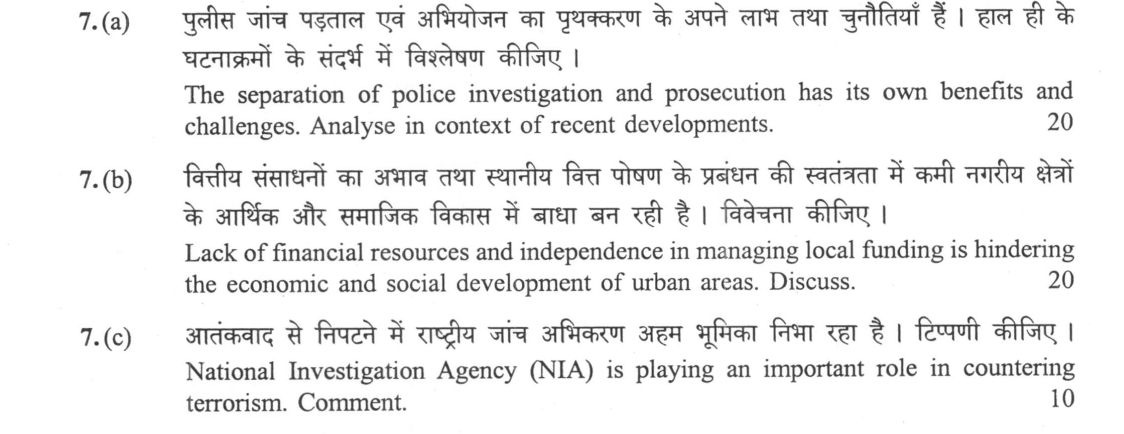
The separation of police investigation and prosecution has its own benefits and challenges. Analyse in context of recent developments. 20 marks
Lack of financial resources and independence in managing local funding is hindering the economic and social development of urban areas. Discuss. 20 marks
National Investigation Agency (NIA) is playing an important role in countering terrorism. Comment. 10 marks
हिंदी में प्रश्न पढ़ें
पुलिस जांच पड़ताल एवं अभियोजन का पृथक्करण के अपने लाभ तथा चुनौतियां हैं। हाल ही के घटनाक्रमों के संदर्भ में विश्लेषण कीजिए। (20 अंक)
वित्तीय संसाधनों का अभाव तथा स्थानीय वित्त पोषण के प्रबंधन की स्वतंत्रता में कमी नगरीय क्षेत्रों के आर्थिक और सामाजिक विकास में बाधा बन रही है। विवेचना कीजिए। (20 अंक)
आतंकवाद से निपटने में राष्ट्रीय जांच अभिकरण अहम भूमिका निभा रहा है। टिप्पणी कीजिए। (10 अंक)
Model answer
Written by UPSC Answer Check against this question's marking rubric, to the expected length. UPSC does not publish answers for Mains — this is one way to score well, not an official key.
(a) Separation of Police Investigation and Prosecution
The separation of prosecution from police investigation traces its constitutional roots to Article 50, which mandates separating the judiciary from the executive. Codified through Section 25A of the CrPC via the 2008 and 2009 amendments, this institutional bifurcation was designed to eliminate bias, ensure objective scrutiny of evidence, and professionalize trial management.
The primary benefit of this separation is the reduction of police bias and malpractices during charge-sheeting. A distinct Directorate of Prosecution, as successfully operationalised in the Delhi model, injects independent legal vetting, ensuring that only legally sustainable cases proceed to trial, thereby protecting civil liberties. However, the operational reality presents severe challenges. Complete institutional decoupling has generated coordination gaps, where investigating officers and prosecutors work in silos, leading to evidentiary lapses. Furthermore, the deficient quality, lack of specialized training, and poor service conditions of cadre prosecutors hamper trial outcomes.
Recent developments reflect ongoing efforts to resolve this tension. The Supreme Court in the Mohd. Hussain alias Julfikar Ali case underscored the critical need for independent legal assistance and robust prosecutorial oversight to ensure fair trials. The Bharatiya Nagarik Suraksha Sanhita (BNSS) 2023 reinforces this architecture by establishing a two-tier Directorate of Prosecution and Directorate of Investigation, institutionalising structured oversight. State-level experiences reveal sharp divergences: while Maharashtra has harmonized inter-agency protocols to maintain high conviction rates, Bihar continues to grapple with institutional inertia, severe prosecutorial vacancies, and procedural bottlenecks.
For the criminal justice system to function effectively, structural separation must be balanced with functional synergy through joint pre-trial consultations and unified digital workflows.
(b) Urban Financial Autonomy and Development Constraints
The 74th Constitutional Amendment Act envisioned Urban Local Bodies (ULBs) as institutions of self-government, devolving 18 functions under the Twelfth Schedule read with Article 243W. However, the failure to match these functional responsibilities with corresponding fiscal powers has created a chronic structural asymmetry, severely impeding urban economic and social development.
Indian ULBs suffer from crippling own-revenue limitations. Property tax collection remains sub-optimal due to outdated assessment methods, while user charges for basic utilities rarely cover operational costs. Intergovernmental fiscal transfers remain inadequate; although the 15th Finance Commission significantly enhanced urban grants by tying them to audited accounts and property tax performance, total municipal revenues hover around a meager 1% of GDP.
This fiscal squeeze is aggravated by structural bottlenecks. India’s municipal bond market remains deeply underdeveloped, restricting creditworthy municipalities from raising commercial debt for long-gestation infrastructure. Simultaneously, top-down schematic conditionalities under flagship programs such as JnNURM and the Smart Cities Mission impose rigid matching-grant burdens and project templates, distorting local expenditure priorities and bypassing local democratic accountability.
Consequently, cities are incapacitated from investing in critical social infrastructure like public healthcare, affordable housing, and climate resilience. Rectifying this requires revitalising State Finance Commissions, deepening municipal debt markets, and providing unconditional fiscal transfers to grant ULBs genuine developmental autonomy.
(c) National Investigation Agency (NIA) and Counter-Terrorism
Constituted under the NIA Act 2008 in the aftermath of the 26/11 Mumbai terror attacks, the National Investigation Agency has emerged as India’s premier federal counter-terrorism agency. The 2019/2020 legislative amendments significantly broadened its mandate, empowering the agency to investigate offences related to cyber-terrorism, human trafficking, counterfeit currency (FICN), and extra-territorial crimes against Indian interests.
Operationally, the NIA has established a formidable track record, demonstrating high investigative rigor in complex, cross-border cases such as the Pathankot airbase attack, the Uri terror strike, and terror-financing networks in Pulwama. Its specialized focus on dismantling illicit financial conduits and terror infrastructure has significantly disrupted sleeper networks.
However, the agency faces crucial institutional concerns. The NIA’s overarching authority to take over cases without state government consent creates friction within India's federal framework, occasionally undermining state police morale. Additionally, mounting pendency rates and delayed trials in designated Special Courts threaten the principle of speedy justice. To sustain its efficacy, kinetic counter-terrorism and legal prosecution must be complemented by soft-power strategies, including institutionalized de-radicalization, community engagement, and intelligence-sharing mechanisms across state security apparatuses.
What "Analyse" is asking you to do
Break the subject into its working parts and show how they act on each other. The marks are in the interconnections — which factor drives which, and what the resulting structure explains — not in the inventory of factors.
Structure that answers it
Define the whole → separate it into its parts → show which part drives which → what that interaction produces → what the structure implies
Where marks are lost
A flat list of causes with no account of which drives which. An answer of neatly separated headings, each self-contained, scores as description.
How this answer will be evaluated
Approach
Framework: Public Administration: Institutional Analysis & Governance. (a) analyse: intro > causes > effects > stakeholders/linkages > way forward | (b) discuss: intro > 3-4 dimensions > example > balanced close | (c) comment: definition/context > points in order > small example > short close Full marks: Precise institutional analysis, specific recent examples, clear link to theory.
Key points expected
- 2023 CBI/Police reforms
- Manoj Kumar Committee
- 15th Finance Commission
- NIA Act 2008
Evaluation rubric
Each sub-part is marked on its own, against the marks and word limit printed on the paper.
- (a) Evaluate the structural and functional implications of separating investigation from prosecution. 20 marks
analyse— intro → causes → effects → stakeholders/linkages → way forward
Must cover
- Benefits: Objective investigation, reduced police bias
- Challenges: Delayed trials, coordination gaps
- Recent development: 2023 CBI/Police reforms
- Role of Public Prosecutors (PPs)
Loses marks
- Generic 'police reform' without specific separation focus
- Ignoring the 'recent developments' aspect
Earns more
- Manoj Kumar Committee recommendations
- 2nd ARC recommendations on police reform
- Comparison with UK/US models
- Impact on conviction rates
Extra mark
- Specific state examples (e.g., Delhi, Karnataka)
- Reference to specific recent court judgments
- (b) Examine how financial constraints and lack of autonomy hinder urban development. 20 marks
discuss— intro → 3-4 dimensions → example → balanced close
Must cover
- Financial dependence on state/central grants
- Lack of independent revenue generation (property tax)
- Impact on basic services (water, sanitation)
- Role of 15th Finance Commission
Loses marks
- Ignoring the 'independence' aspect of funding
- Focusing only on rural development
Earns more
- 73rd/74th Constitutional Amendment Act
- Urban Local Bodies (ULBs) fiscal health
- Municipal bonds and PPP models
- Smart Cities Mission impact
Extra mark
- Specific data on ULB revenue expenditure
- Reference to specific state municipal acts
- (c) Assess the NIA's effectiveness and role in counter-terrorism. 10 marks
comment— definition/context → points in order → small example → short close
Must cover
- NIA Act 2008 mandate
- Centralized investigation capability
- Key cases (e.g., 2008 Mumbai attacks)
- Coordination with state police
Loses marks
- Confusing NIA with CBI or IB
- Ignoring the 'counter-terrorism' specific focus
Earns more
- NIA's role in cross-border terrorism
- Comparison with FBI/MI5
- Challenges: Jurisdictional issues
- Recent high-profile arrests
Extra mark
- Specific NIA success rate statistics
- Reference to specific NIA guidelines
Practice this exact question
Write your answer and it is marked point by point against the model answer above — what you covered, what you missed, what you got wrong.
Evaluate my answer →More from Public Administration 2024 Paper II
- Q4 (a) Public sector undertakings have been the bedrock of welfareism in India for many deca…
- Q5 Answer the following in about 150 words each: (a) The constitutional stature provided to…
- Q6 (a) "The success of administrative reforms in a country like India depends upon the polit…
- Q7 (a) The separation of police investigation and prosecution has its own benefits and chall…
- Q8 (a) Police-Public relations are poor in India. What measures are required to strengthen t…