Paper II — Q5
Answer the following in about 150 words each: (a) The constitutional stature provided to the Public Service Commissions accord…
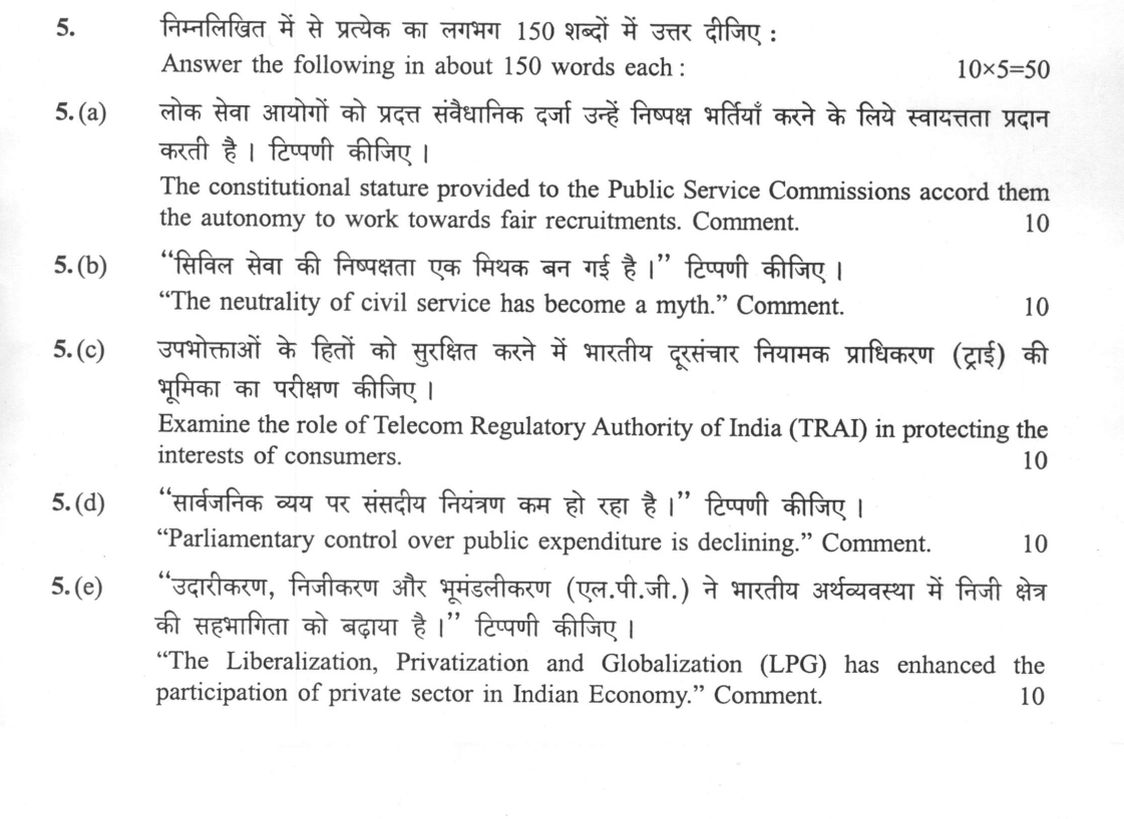
Answer the following in about 150 words each:
The constitutional stature provided to the Public Service Commissions accord them the autonomy to work towards fair recruitments. Comment. 10 marks
"The neutrality of civil service has become a myth." Comment. 10 marks
Examine the role of Telecom Regulatory Authority of India (TRAI) in protecting the interests of consumers. 10 marks
"Parliamentary control over public expenditure is declining." Comment. 10 marks
"The Liberalization, Privatization and Globalization (LPG) has enhanced the participation of private sector in Indian Economy." Comment. 10 marks
हिंदी में प्रश्न पढ़ें
निम्नलिखित में से प्रत्येक का लगभग 150 शब्दों में उत्तर दीजिए :
लोक सेवा आयोगों को प्रदत्त संवैधानिक दर्जा उन्हें निष्पक्ष भर्तियाँ करने के लिए स्वायत्तता प्रदान करती है। टिप्पणी कीजिए। (10 अंक)
"सिविल सेवा की निष्पक्षता एक मिथक बन गई है।" टिप्पणी कीजिए। (10 अंक)
उपभोक्ताओं के हितों को सुरक्षित करने में भारतीय दूरसंचार नियामक प्राधिकरण (ट्राई) की भूमिका का परीक्षण कीजिए। (10 अंक)
"सार्वजनिक व्यय पर संसदीय नियंत्रण कम हो रहा है।" टिप्पणी कीजिए। (10 अंक)
"उदारीकरण, निजीकरण और भूमंडलीकरण (एल.पी.जी.) ने भारतीय अर्थव्यवस्था में निजी क्षेत्र की सहभागिता को बढ़ाया है।" टिप्पणी कीजिए। (10 अंक)
Model answer
Written by UPSC Answer Check against this question's marking rubric, to the 150-word length. UPSC does not publish answers for Mains — this is one way to score well, not an official key.
(a) Constitutional stature of PSCs. Articles 315–323 give Public Service Commissions a distinct constitutional position, not merely administrative status. Article 320 makes their role advisory in recruitment and service conditions, while Articles 317 and 322 protect members’ tenure and charge salaries on the Consolidated Fund, insulating them from casual executive pressure. This stature supports fair recruitment by separating examination, merit assessment and advice from day-to-day political control. Yet autonomy is bounded: the government frames recruitment rules, regulations, reservations, cadre policy and service conditions, may refer matters to the Commission, and PSC reports under Article 323 do not bind the executive. The Commission’s annual reports, though not binding, create a public record that disciplines executive action. Hence, constitutional independence is real but functional, not absolute; it works best when rules are transparent, appointments are merit-based, and executive discretion is restrained.
(b) Neutrality of civil service. The claim that neutrality is a myth captures real anxieties: political transfers, file manipulation, selective implementation and the “committed bureaucracy” debate suggest that officers may serve political masters as much as the Constitution. Lateral entry, while bringing expertise, can intensify fears of sectoral or political capture if appointments are perceived as reward-based. Yet the myth is overstated. All-India Services, governed by conduct rules and service regulations, possess institutional resilience: cadre rotation, professional ethos and judicial review often check partisan pressure. In practice, neutrality is tested when officers implement welfare schemes, manage crises, or handle sensitive files where political expectations are strongest. Such tests require institutional memory and ethical courage. The issue is not that neutrality has vanished, but that it is a practice under strain. Stronger safeguards—transparent transfers, independent grievance mechanisms, and stricter accountability for political interference—are needed to make neutrality credible rather than merely doctrinal.
(c) TRAI and consumer interests. TRAI protects consumers through tariff regulation, quality-of-service (QoS) standards, grievance redressal under the Telecommunications Consumer Protection Regulations, and mobile number portability, giving users bargaining power and informed choice against dominant operators. The TRAI Act, 1997, and its amendments provide the statutory basis for these regulations, enabling TRAI to set service conditions, monitor performance and recommend policy. Mobile number portability is especially significant: it reduces switching costs and forces operators to compete on service rather than lock-in. Yet TRAI’s role is limited. Spectrum policy and auctions are ultimately decided by the government, and auction outcomes can shape prices, competition and rural coverage, particularly in underserved areas. Even where TRAI has overreached, as in the call-drop compensation regulation struck down for exceeding its statutory powers, courts have corrected it. Thus TRAI is a strong consumer regulator, but its effectiveness depends on implementation and on the state’s broader policy choices.
(d) Parliamentary control over expenditure. Parliamentary control rests on budget scrutiny, the Public Accounts Committee (PAC), the Estimates Committee and CAG reports. The claim of decline is partly justified: PAC effectiveness has fallen because recommendations are often not implemented, CAG reports face implementation gaps, and money-bill classification can narrow legislative debate by limiting Rajya Sabha’s role. The anti-defection law, by reducing defections, can also weaken opposition strength and make sustained scrutiny harder. Yet Parliament still controls the purse through the Appropriation Act, questions, debates and committee reports. Public expenditure, especially grants and subsidies, is often examined after the fact, reducing preventive oversight. This weakens the budget’s corrective function. Alternative mechanisms—RTI, social audit, audit-based accountability and judicial review—partly compensate for legislative weakness. The verdict is not that control has disappeared, but that it has become more procedural and less consequential. Strengthening PAC implementation, timely CAG follow-up and independent audit will be essential to restore substantive control.
(e) LPG and private sector participation. LPG has clearly enhanced private sector participation. Disinvestment policy reduced the state’s direct ownership in industry, while public-private partnership (PPP) models opened infrastructure, power, highways and railways to private capital. FDI liberalization, including automatic routes and higher sectoral caps, allowed private and foreign firms to enter telecom, insurance, banking, retail and manufacturing. This shift has increased competition and consumer choice, but also exposed vulnerabilities in supply chains and employment security. The strategic sectors debate shows the limit: the state retains control in defence, energy, space and other sensitive areas, even as private participation grows. Employment patterns also matter: private sector growth has shifted work from agriculture to services and informal activity, but formal job creation remains uneven. Atmanirbhar Bharat now seeks to balance private investment with domestic manufacturing, PLI schemes and import substitution. Thus LPG has expanded private participation, but not uniformly; the state remains a strategic regulator and investor.
What "Comment" is asking you to do
Take a position on the statement and support it. Comment usually attaches to a quoted line in the short slots, so the reasoning must be compressed — an opening view, a few load-bearing reasons, and the limit of the claim.
Structure that answers it
Unpack what the statement asserts → your stance → two or three supporting reasons → the qualification that limits it
Where marks are lost
Neutral summary; a comment without a stance has not answered. Equally costly is accepting the quoted line wholesale and never testing where it fails.
How this answer will be evaluated
Approach
Framework: Concept > Thinker > Indian institutional application > Reform. (a) comment: context > arguments both sides > judgment > close | (b) comment: context > arguments both sides > judgment > close | (c) examine: intro > how/why with reasoning > evidence > conclusion | (d) comment: context > arguments both sides > judgment > close | (e) comment: context > arguments both sides > judgment > close Full marks: All 'must' points present, specific Indian examples, 2nd ARC references, clear distinction between administration and politics
Key points expected
- Cite Article 320(3) or 317 for autonomy
- Mention 2nd ARC recommendations on recruitment
- Distinguish administrative neutrality from political pressure
- Provide a specific example of fair recruitment
- Define 'neutrality' in administrative context
- Provide evidence of political interference
- Mention 2nd ARC recommendations on neutrality
- Distinguish administration from politics
Evaluation rubric
Each sub-part is marked on its own, against the marks and word limit printed on the paper.
- (a) Context of UPSC/SPC autonomy > arguments for/against fair recruitment > judgment 10 marks · 150 words
comment— context → arguments both sides → judgment → close
Must cover
- Cite Article 320(3) or 317 for autonomy
- Mention 2nd ARC recommendations on recruitment
- Distinguish administrative neutrality from political pressure
- Provide a specific example of fair recruitment
Loses marks
- GS-2 style answer without administrative focus
- Theory with no Indian institutional anchor
Earns more
- Reference to specific UPSC selection process
- Mention of 'merit' vs 'representation' balance
Extra mark
- Cite a specific Supreme Court judgment on UPSC
- Reference to specific 2nd ARC report number
- (b) Context of civil service neutrality > arguments for/against the 'myth' claim > judgment 10 marks · 150 words
comment— context → arguments both sides → judgment → close
Must cover
- Define 'neutrality' in administrative context
- Provide evidence of political interference
- Mention 2nd ARC recommendations on neutrality
- Distinguish administration from politics
Loses marks
- GS-2 style answer without administrative focus
- Theory with no Indian institutional anchor
Earns more
- Reference to specific instances of bias
- Mention of 'political masters' concept
Extra mark
- Cite a specific 2nd ARC report on neutrality
- Reference to a specific Supreme Court case
- (c) Intro to TRAI > how/why it protects consumers > evidence > conclusion 10 marks · 150 words
examine— intro → how/why with reasoning → evidence → conclusion
Must cover
- Name TRAI's statutory role (Telecom Act 1997)
- Mention specific consumer protection measures (e.g., QoS, tariffs)
- Provide evidence of TRAI's impact on consumers
- Distinguish TRAI's role from DoT's role
Loses marks
- GS-2 style answer without administrative focus
- Theory with no Indian institutional anchor
Earns more
- Reference to specific TRAI regulations (e.g., TDR)
- Mention of consumer grievance redressal mechanisms
Extra mark
- Cite a specific TRAI order or regulation
- Reference to a specific consumer survey or data
- (d) Context of parliamentary control > arguments for/against declining control > judgment 10 marks · 150 words
comment— context → arguments both sides → judgment → close
Must cover
- Define 'parliamentary control' over expenditure
- Provide evidence of declining control (e.g., budget process)
- Mention 2nd ARC recommendations on financial accountability
- Distinguish legislative from executive control
Loses marks
- GS-2 style answer without administrative focus
- Theory with no Indian institutional anchor
Earns more
- Reference to specific parliamentary committees (e.g., PAC)
- Mention of 'no-confidence' motions or budget debates
Extra mark
- Cite a specific 2nd ARC report on financial accountability
- Reference to a specific Supreme Court case on budget
- (e) Context of LPG > arguments for/against enhanced private sector participation > judgment 10 marks · 150 words
comment— context → arguments both sides → judgment → close
Must cover
- Define 'LPG' and its impact on private sector
- Provide evidence of enhanced private sector participation
- Mention 2nd ARC recommendations on public-private partnership
- Distinguish public from private sector roles
Loses marks
- GS-2 style answer without administrative focus
- Theory with no Indian institutional anchor
Earns more
- Reference to specific sectors (e.g., telecom, aviation)
- Mention of 'FDI' or 'PPP' models
Extra mark
- Cite a specific 2nd ARC report on public-private partnership
- Reference to a specific Supreme Court case on FDI
Practice this exact question
Write your answer and it is marked point by point against the model answer above — what you covered, what you missed, what you got wrong.
Evaluate my answer →More from Public Administration 2024 Paper II
- Q2 (a) The National Data and Analysis Platform (NDAP) of NITI Aayog facilitates a robust eco…
- Q3 (a) "The role of State Finance Commission in distribution of finances between state and l…
- Q4 (a) Public sector undertakings have been the bedrock of welfareism in India for many deca…
- Q5 Answer the following in about 150 words each: (a) The constitutional stature provided to…
- Q6 (a) "The success of administrative reforms in a country like India depends upon the polit…
- Q7 (a) The separation of police investigation and prosecution has its own benefits and chall…
- Q8 (a) Police-Public relations are poor in India. What measures are required to strengthen t…